


West Bengal Jewellery - A Clear Guide to Bengali Gold
 Sujoy Dhar
12 min read
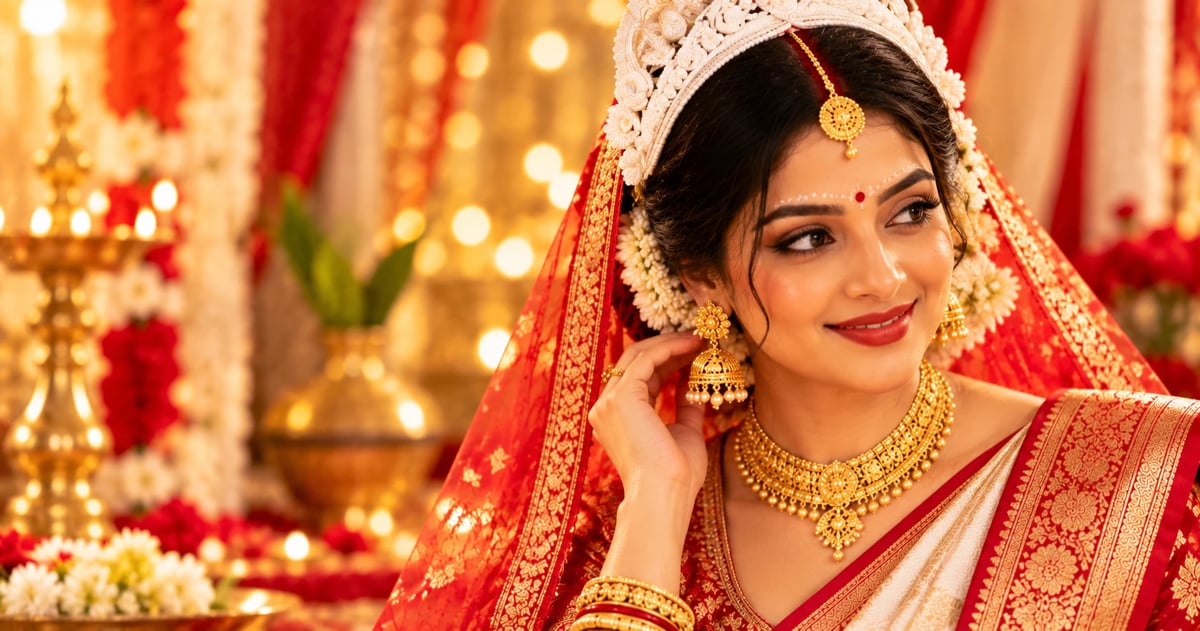
The West Bengal jewellery you'll see at a wedding or in a family box is usually 22K gold. Pieces are named for where they sit: tikli on the forehead, kaan on the ear, sitahar at the neck. The wrist has the most names: chur, bala, mantasha, ratan chur. Many married Hindu women add white shakha and red pola bangles.
Below, the pieces run head to wrist. You'll also see where sources disagree on names, who makes the pieces, and how to check them.
What counts as West Bengal jewellery today
Gold sits at the center of traditional Bengali jewellery. The swarnakar (Bengal's hereditary goldsmith community) work mostly in 22K, which is about 91.6 percent pure gold.
Two other crafts sit beside it. Conch bangles come from Sankhari carvers, and silver filigree comes from village workshops south of Kolkata.
Global InCH, an online crafts encyclopedia, says British rule changed how Bengal set its stones. Kundan setting (uncut stones pressed into gold foil) gave way to claw setting (cut stones held by prongs). Both are still made.
Mughal influence shows most clearly at the wrist. The same entry traces the mantasha and the ratan chur to Mughal designs.
Taste has also moved lighter. Global InCH notes that buyers now prefer lighter pieces with fewer stones. So a slim modern chur is a real Bengali chur, just with less gold in it.
Tribal silver and brass ornaments form a separate tradition, outside this guide.
The design glossary, from head to wrist
Think of this as a map of the body. These are the traditional Bengali gold jewellery names you'll hear most, with a note on when each piece comes out.
Head, forehead and nose pieces
Tikli. A forehead ornament that hangs from the hair parting on a pearl string or fine chain. Brides wear it on the wedding day. It works much like the gold maang tikka worn elsewhere in India.
Mukut. The white crown on a Bengali bride's head. It's usually shola pith (a light plant core), not gold, so it won't appear on a jeweller's bill.
Chiruni. A curved comb of tortoiseshell or horn with gold or silver inlay. Global InCH says brides were once given one. Today you'll find it in old boxes, not shops.
Nath or nakchhabi. A nose ring. Older bridal versions were large, but Global InCH says most are now a small stone or plain stud. See our gold noth designs.
Ear pieces: kaan, kaan bala and pasha
Kaan. A gold or silver piece that covers the whole ear, built from thin filigree plates. It comes out for weddings and other special occasions. See the full kaan design guide.
Kaan bala vs kaan pasha. People mix these up. Global InCH describes kaan bala as an elaborate ear piece with a wide, flat filigree face. A pasha reaches from the ear toward the temple, framing the side of the face. Our pasa earrings buying guide shows both pinned and earring styles.
Jhumko. A bell-shaped drop, often with seed pearls hanging from the rim. It suits Puja evenings and weddings alike. See jhumka designs for every occasion.
Makri and dool. A makri is a simple hoop with a diamond-cut surface. A dool is a small pendant earring. Both are everyday pieces, like belkuri earrings and the sui suto style.
Neck pieces: chik, sitahar and chains
Chik. A tight gold choker, sometimes over an inch wide, often set with rows of stones. Brides wear it, and many women wear it at Durga Puja. Compare gold choker designs.
Sitahar. A long layered necklace, in plain gold or gold with pearls. It's a common bridal choice. Start with gold pearl sitahar designs, then weigh pearl sitahar vs gold sitahar.
Hansuli. A crescent-shaped silver collar that fits close to the neck. Global InCH says Muslim women traditionally wore it, and many other women wear it now.
Longer options include long gold necklaces for brides and the dokia chain. A pola necklace borrows the red and gold of the wedding bangles.
Hand and wrist pieces: shakha, chur, bala and more
The wrist follows an order. Global InCH gives it for married women: conch bangle first, then iron, then thin gold bangles. A kankan or bala closes the row.
Shakha. The white conch bangle. Many families now have it bound in gold. See gold sankha design trends and sakha badhano designs.
Pola. The red bangle worn beside the shakha. The name comes from coral, but today's pola is lacquer, as our lal pola design guide explains.
Noa (loha). An iron bangle, usually on the left wrist and often bound in gold. The gold noa design guide covers styles.
Chur. A wide gold bracelet. Global InCH describes it as stone-set and hinged, but shop usage is looser.
Bala. A narrow gold cylinder with chased and filigree work. Classic versions end in a pair of makara heads (a mythical crocodile). It's often the piece a mother or mother-in-law hands down.
Kankan. A ridged wristlet that closes the row of bangles.
Bauti. A half-cut bangle filled with lac and coated in gold. It gives width without the weight of solid gold. Read the bauti design budget guide, or look at cover bangles.
Mantasha. A broad bridal wristlet, often with pearls. Our pearl mantasha bridal guide covers it in detail.
Ratan chur. A bridal hand ornament. Five finger rings chain to a centerpiece on the back of the hand, which joins a wristlet. See ratan chur designs.
Arm and waist pieces: baju and waist chains
Baju. An upper-arm band. Global InCH describes a thick, hollow gold or silver ring with chased decoration. Lighter filigree armlets tied with silk tassels are called tabiz or tagaa.
Some bridal sets also add a gold waist chain. It's optional in most families.
Chur, bala, mantasha: where sources disagree
The same word can mean different pieces depending on who's writing. Here's how published sources define five common terms.
Term | Global InCH (crafts encyclopedia) | Other published sources | What this means for you |
|---|---|---|---|
Chur | Wide, stone-set, hinged bracelet | My Gold Guide: broad bracelet, usually a pair. One jeweller's FAQ: solid daily bangles | Ask for width and whether it opens |
Bala | Narrow cylinder with filigree and makara heads | WeddingSutra: thick bangle with floral or animal motifs, often inherited | Expect either shape under this name |
Mantasha | Wristlet with pearls and stones, Mughal in origin | WeddingSutra: broad wristlet with a ring for one finger. One jeweller's FAQ: a bridal necklace | Treat it as a wristlet |
Ratan chur | Finger rings chained to a hand centerpiece and wristlet, Mughal in origin | WeddingSutra and My Gold Guide agree. One travel blog calls it a Marathi necklace set | Treat it as a hand piece |
Shakha and pola | Gives the wearing order but doesn't define pola | WeddingSutra: shakha is conch, pola is coral. Some pages call both coral | Shakha is conch. Pola is named after coral but made of lacquer now |
So what separates chur, bala and kankan? By Global InCH's definitions, a chur is wide and hinged. A bala is a slimmer cylinder, often with animal-head ends. A kankan is a ridged wristlet worn last in the row.
In practice, Kolkata sellers use these words loosely. You won't offend anyone by calling a bala a chur. Still, describe the piece by width, clasp and net weight, and you'll get the right tray.
The mantasha split is the one that can cost you. If a listing calls it a necklace, ask to see it on a wrist before you pay.
Who makes it, from West Bengal
West Bengal jewellery still comes from named neighborhoods. Global InCH lists the main making areas as Barasat Biswakarma Jewellery Shilpalaya , Bowbazar, Baghbazar, Bhawanipur, Kalighat and Gariahat.
Silver has its own map. The same source counts about 30 villages in South 24 Parganas with roughly 3,000 filigree and silver artisans.
The World Gold Council's 2022 study of India's jewellery market says Kolkata and Chennai are known for handmade pieces. It puts handmade work at about 55 percent of India's manufactured gold jewellery.
That study also cites a 2020 paper by NILERD (a government labor research institute). Many karigars (jewellery artisans) earned Rs 15,000 to 16,000 a month. Keep that in mind when a making charge looks high.
Conch work took a different route. Sahapedia's record of the Sankhari community traces the craft's old center to Dhaka. After 1947, Sankhari families came to Kolkata as refugees.
A colony at Habra failed in 1953. Then a second one at Barrackpore took hold in 1956, and its Ghoshpara Road still trades in conch. Sahapedia also notes that conch bangles combined with gold filigree sell for more. That's the gold-bound shakha many brides now choose.
Old gold, current rules: hallmarks for heirlooms
A current Indian hallmark has three marks, according to the BIS hallmarking FAQ for jewellers. They are the BIS logo, the purity in carat and fineness, and a six-digit HUID (unique ID for each piece). You can check any HUID with the Verify HUID feature in the BIS Care app.
The World Gold Council says BIS introduced hallmarking in 2000 and made it mandatory from 16 June 2021. So a bala bought in the 1980s almost certainly has no BIS mark. That says nothing about its purity, good or bad.
If you're keeping your grandmother's pieces
The BIS FAQ is written for jewellers who sell. Nothing in it asks you to hallmark jewellery you simply keep and wear.
You can still get purity tested. The same FAQ says consumers can verify purity at any BIS-recognized assaying and hallmarking center. Call first, because walk-in rules can differ. Hallmarking itself is usually arranged through a BIS-registered jeweller, who sends the piece to a center.
If you sell, exchange or remake a piece
In a mandatory district, jewellery sold must meet the grades in IS 1417, the Indian gold purity standard. For heirlooms that don't fit a grade, BIS allows hallmarking at the next lower grade.
Older hallmarks without a HUID must be redone before a jeweller resells the piece, BIS says.
Remaking is treated differently. BIS says job work on gold you supply is not a sale, because you still own the metal. If a jeweller melts old gold into a new piece for sale, it gets a new HUID.
Some items are exempt from mandatory hallmarking. These include items under 2 grams, and Kundan, Polki and Jadau work. Jewellers with turnover up to Rs 40 lakh a year are exempt too. So a chur made in kundan or polki work may carry no hallmark at all.
BIS has amended the mandatory order many times, most recently in August 2026 as we write. Check its current district list, and see hallmark gold vs BIS gold for more on the marks.
Buying a heritage piece today: weight, making charges, GST
For any Bengali heritage jewellery you buy, start with the bill. BIS says it must list each article, the net weight of precious metal, and its purity. Hallmarking charges must appear too. If a retest finds lower purity, BIS rules provide compensation of twice the shortfall's value plus testing charges.
The CBIC gems and jewellery GST FAQ says GST is 3 percent of the total transaction value. That applies whether or not making charges are shown separately. Many websites still describe a 3 plus 5 percent split, so check the current notification.
The 5 percent rate in that FAQ covers a registered job worker's charges to a jewellery maker. If you're remaking your own gold, ask how the labor will be taxed and get it in writing. This is general information, not tax advice.
Weight is the biggest variable in West Bengal jewellery. No reliable published figure exists for what a chur or bala "should" weigh. Ask for the net weight of each piece, then run it through our gold calculator for jewellery bills.
Lightweight Bengali gold jewellery designs are legitimate. A 2-gram pair of earrings or a slim necklace still follows the old forms. Try 2 gram gold earrings for daily use or small gold necklace designs.
Lightweight gold is not the same as plated metal, though. The World Gold Council cites its own 2017 study putting 10 to 15 percent of jewellery sold below stated purity. Check the hallmark every time, and read real gold vs plated sitahar for warning signs.
Worried about a heavy upsell? Separate what's ritual in your family from what's choice. Our bridal jewellery guide lists a Bengali set in ritual order, and the gold purity check covers the rest.
Bengali customs worth knowing before the wedding
Many rules you'll hear about West Bengal jewellery belong to one family, not to Bengal. Knowing that helps when you face the relatives.
Shakha and pola are often the first Bengali wedding jewellery a bride wears that day. They usually go on at dawn, during Dodhi Mangal (the wedding-morning curd-and-rice ritual). In many homes, married women place the bangles on the bride's wrists. Who gives them varies, so ask both families early. Our guide to pola bangles and Bengali custom covers the ritual step by step.
No fixed rule says how long a woman wears pola after marriage. Some wear the set daily for life. Others keep it for pujas and family occasions.
Gold on the feet is the custom outsiders most often miss. Global InCH says Bengal traditionally avoids gold foot ornaments because gold stands for the goddess Lakshmi. It adds that Bengali Muslims follow the same habit. Many families still keep anklets and toe rings in silver, though some now choose gold.
Durga Puja is when the family box comes out. On Bijoya Dashami (the last day of Puja), married women play Sindoor Khela, marking each other with vermilion. For Puja, a chik or sitahar with a pair of chur looks traditional. You don't need the full bridal load.