

Sui Suto vs Sui Dagha: Kolkata's Best-Loved Earrings

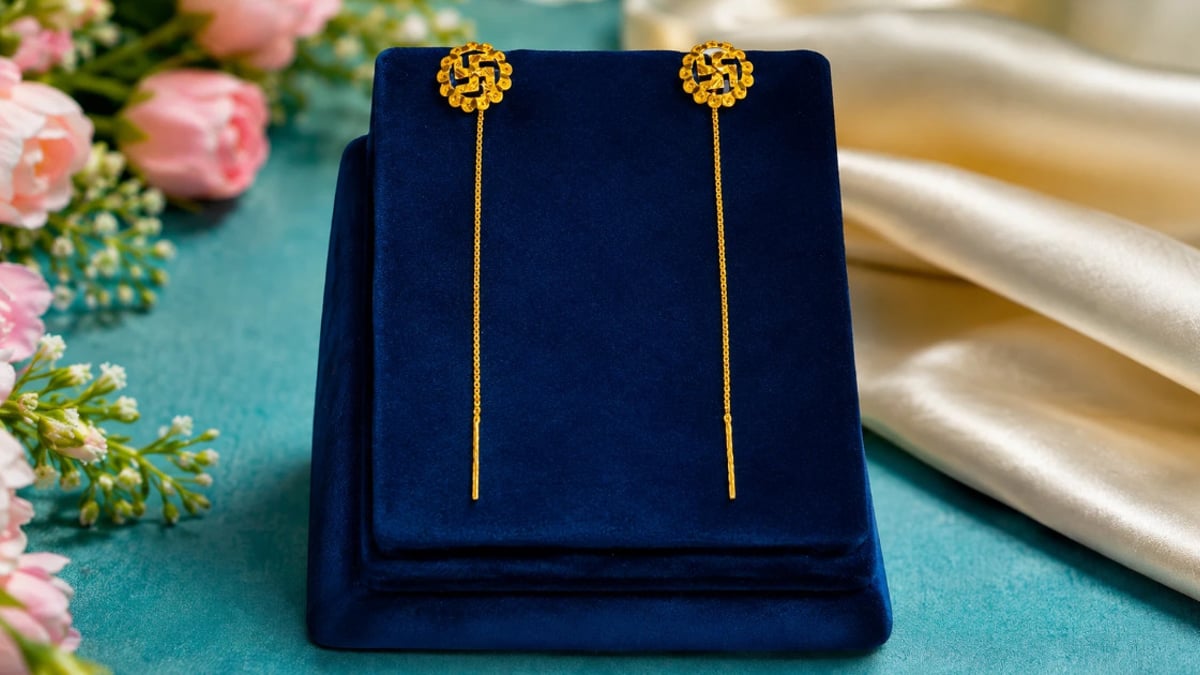
Sui suto and sui dagha are, in almost every Kolkata showroom, the same earring under two different names. One name is Bengali. The other is Hindi. Both describe a fine gold wire or chain that slips through the pierced ear the way thread follows a needle, with the ornament resting at the front and a tail hanging behind.
So the useful question isn't which name wins. It's which construction you're paying for — because that decides comfort, security, resale and price. This guide covers that, plus a hallmarking rule that quietly affects most lightweight gold earrings sold in India.
The short answer, in one paragraph
Sui suto is the Bengali name for the needle-and-thread earring that Hindi speakers call sui dhaga or sui dagha. Both refer to the same threader-style design: a fine gold wire passes through the pierced ear and hangs freely at the back. In Bengali-speaking Kolkata, sui suto is the name you'll hear at the counter.
Neither is "better." Ask about the mechanism instead of the label, and you'll get a far more useful answer from the salesperson.
Where the two names come from
Sui means needle in both Bengali and Hindi. The second word is where the languages split. Bengali says suto (সুতো) for thread; Hindi says dhaga. Same object, same metaphor, two vocabularies — which is why a Kolkata buyer and a Delhi buyer can describe an identical pair and think they're discussing different jewellery.
You'll also see sui suta, such suto and sui dagha written on product pages and Instagram posts. These are transliteration variants, not separate designs. If you're searching for such suto jewellery online and getting thin results, try the Hindi spelling too — the national e-commerce catalogues index almost everything under sui dhaga.
In English, the trade calls them threader or thread-through earrings.
Sui suto vs sui dagha, side by side
Sui suto | Sui dagha / sui dhaga | |
|---|---|---|
Language of the name | Bengali (suto = thread) | Hindi (dhaga = thread) |
Where you'll hear it | Kolkata, West Bengal, Bangladesh | North, West and Central India; national e-commerce |
Design it describes | Needle-and-thread earring | Needle-and-thread earring — the same family |
Typical local styling | Often shorter, worn close to the lobe for daily wear | Often longer drops marketed for occasion wear |
English trade term | Threader / thread-through earring | Threader / thread-through earring |
What genuinely varies | Length, gold weight, finish, whether the back is open or secured | Same |
That last row is the honest one. The overlap between the two terms is nearly total, and the variation that matters sits within each name, not between them.
Find the perfect Jhumkas for every occasion. Have you explored our latest collection yet?
The difference that actually changes your purchase
Two very different earrings get sold under both names. Knowing which one is in the tray protects you from a bad surprise on day three.
Thread-through: the true needle-and-thread
A single continuous wire or fine chain, no clasp, no butterfly back. You feed it through and it settles by gravity and friction.
It feels weightless and it moves beautifully. However, nothing physically locks it in place. A dupatta lifted over the head, a towel after a bath, a toddler's grabbing hand — any of these can pull one out, and a light gold threader is easy to lose and hard to spot on a dark floor. If you wear a saree pallu over your shoulder all day, factor this in.
Fixed-back drops sold under the same name
Here the "needle" is a small top that sits on the lobe, secured by a screw back or a hook, with a motif hanging below. Visually it echoes the threader. Structurally it's a different animal.
You give up some of the floating movement. In exchange you get a piece you can wear on a crowded metro without checking your ear every ten minutes. For most daily-wear buyers, that trade is worth making.
Ask the seller one question: does the wire pass through and hang loose, or does it lock? Everything else follows from the answer.
Why Bengal took to this design
Lightweight gold with fine wirework is not a modern shortcut in this region — it's old practice. The Victoria and Albert Museum holds a pair of mid-19th-century Bengali gold ear ornaments built from hollow sheet gold with applied twisted wire and granulation, collected before 1872. Hollow construction, fine wire, big visual effect, small metal weight. That's the same logic a sui suto uses today.
The craft base explains the rest. According to the World Gold Council's study of India's gold jewellery market structure, around 55% of gold jewellery manufactured in India is handmade by karigars, and Kolkata is identified there as a centre known specifically for handmade pieces rather than machine-made or cast work. Handwork favours designs where skill, not bulk, carries the value.
Then there's the practical layer. Bengali traditional jewellery is worn daily, not stored for weddings alone, and a design you can sleep in beats a design you have to plan around.
👀 Missed Diamond Earrings: Best Designs & Buying Tips?
Designs you'll see across Kolkata
The vocabulary is fairly consistent across showrooms, whether you're in Bowbazar, Bhowanipore or Gariahat:
Plain wire with a bead or ball drop — the everyday workhorse, the lightest option, and the one that survives a monsoon commute.
Jaali and filigree work — pierced or wire-lace panels that read as substantial while staying light. Bengal's filigree tradition shows up here strongly.
Meenakari and enamel touches — colour on the front motif, usually reserved for festive and bengali wedding jewellery.
Jhumka-tipped threaders — a miniature bell at the end of the thread. Heavier, and the extra weight sits at the bottom, so check how it hangs before buying.
Pearl and stone drops — softer against silk, and popular for Durga Puja through the wedding season.
Latest sui suto design releases tend to be iterations on these, not departures from them. If a "new" design costs meaningfully more, the difference is usually in the making, not the concept.
Silver versions exist too and are worth considering if you want to test a length or a look before committing gold to it.
The hallmarking gap nobody warns you about on lightweight gold
Here's the part the styling guides skip.
Under the Bureau of Indian Standards' mandatory hallmarking rules, the list of exemptions in the Quality Control Order includes "an article with weight less than two grams". Many lightweight gold earrings fall under that threshold. So a genuinely light sui suto pair can be sold to you, legally, with no BIS logo, no purity mark and no six-digit HUID code on it.
The same BIS FAQ notes the reason is practical — some designs are simply too small to mark cleanly — and that jewellers may still get sub-two-gram articles hallmarked voluntarily after testing. That word "may" is doing a lot of work. Voluntary means you have to ask.
What to do about it:
Weigh it in front of you. If the pair crosses two grams, mandatory hallmarking applies in covered districts and you should see the BIS triangle, the purity mark and the HUID.
If it's under two grams, ask whether the jeweller will hallmark it anyway. Many will. A jeweller who refuses and can't explain why is telling you something.
Check the invoice. BIS requires the bill for hallmarked articles to show the description, net weight of precious metal, purity in carat and fineness, and hallmarking charges separately. Insist on that breakdown regardless.
Verify the HUID on the BIS Care app at the counter, before payment, not after.
If the purity later tests below what was marked, BIS rules provide for compensation to the consumer at twice the difference plus testing charges. That remedy only exists if the piece was hallmarked in the first place — which is precisely why the two-gram question matters more on earrings than on a chain or a bangle.
What really drives the price
Four numbers make up what you pay, and only one of them is negotiable in practice.
The gold rate moves daily and is the same for everyone in the city. Net weight is what you're actually buying. Making charges are the jeweller's labour, quoted either as a percentage of gold value or as a flat rate per gram — and on intricate handwork like filigree, this is where lightweight pieces can surprise you. A two-gram earring with heavy karigar work can cost more than a three-gram plain one. Wastage covers metal lost in fabrication, usually expressed as a percentage.
GST applies to the metal and to the making charge, and the two attract different rates. Those rates have been revised in recent years, so confirm the current split on your invoice rather than assuming last year's figures.
One honest note: gold buying is a financial decision as much as a fashion one, and lightweight earrings generally carry higher making charges as a proportion of value than heavier pieces. If resale value is your priority rather than daily wear, that ratio works against you. Worth knowing before, not after.
Choosing yours: three real situations
If you want one pair for daily office wear, take the fixed-back drop in a plain or lightly jaali finish. Skip the long threader. You'll lose it, and you'll spend the day touching your ear.
If you're buying for Durga Puja or a wedding and the earrings will be worn for a handful of hours under supervision, the true thread-through is the more beautiful object. Longer drops read well against a silk saree, and the movement is the whole point. Pair with a lighter neckpiece so the ear does the work.
If this is a gift and you don't know her piercing history, go fixed-back. A stretched or healing piercing handles a secured light drop far better than a loose wire, and you avoid the awkwardness of a gift she can't safely wear.
For a woman who wears a saree every day, the deciding factor is usually the pallu, not the design. Watch how the fabric passes your ear before you commit.
Where to buy sui suto and sui dagha earrings in Kolkata
Kolkata gives you three routes, and each has a real cost.
Established local jewellers in the traditional clusters offer customisation and a relationship, which matters if you'll return to exchange or upgrade. National chains offer standardised purity and buyback terms with less design flexibility. Online gives you the widest catalogue and the weakest ability to check weight and finish before paying.
Whichever you choose, the checklist doesn't change: confirm net weight, ask about hallmarking on any piece under two grams, get making charges and wastage quoted separately, and take the invoice with the full breakdown.
You can browse our sui suto earring collection to compare weights and finishes, look at long earrings if you want more drop, or start with silver earrings to test a style before buying gold.
One caveat we'll state plainly: no organisation publishes sales-share data for earring styles by city. Any claim that sui suto is "the most popular earring in Kolkata" — including from us — is a trade impression, not a measured figure. Treat it accordingly.