

Top 10 Best Picks for Brides Gold Noth Designs

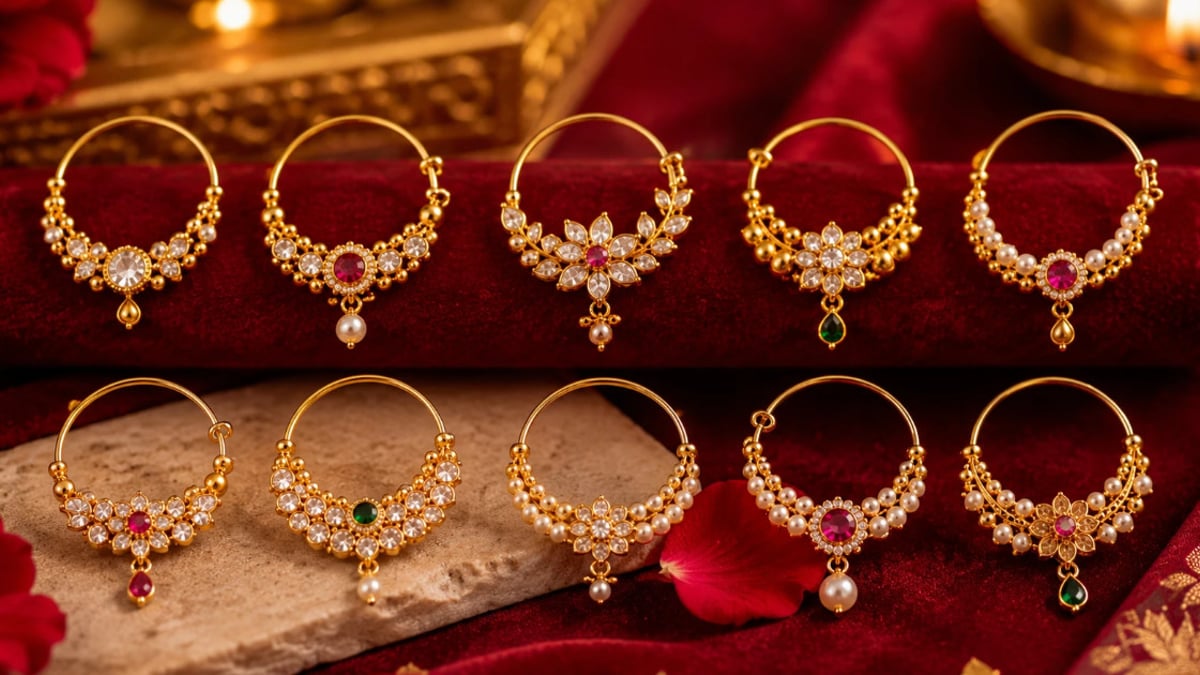
Choosing a gold noth is less about the design you love on screen and more about fit. Three things decide it: your face shape, your outfit's neckline, and how long you'll wear it. Get those right and almost any style works.
Below are ten gold nath designs worth comparing, plus the practical parts most bridal galleries skip. You'll get face-shape guidance, honest comfort trade-offs, and a look at what actually reads well in photographs.
Why Gold Naths Remain a Bridal Favourite
Yellow gold holds its warmth against red, maroon and rani pink. Silver and oxidised metal tend to go flat beside those shades.
Noth and nath are the same ornament, by the way. The spelling shifts by region, and so does the design.
There's history behind the piece too. Times of India has tracked how the nose ring became a cultural icon across Indian communities, well beyond bridal use.
Placement matters just as much. A gold noth sits exactly where cameras focus during the varmala and the pheras.
It also moves when you smile. No other piece of bridal jewellery does that, which means a design that looks static in a product shot can behave differently on the day.
One practical note before you shop: ask for the BIS hallmark. It certifies purity, and it's the only proof worth relying on.
10 Best Gold Noth Designs
Each entry below names who it suits and where it gets awkward. Keep the nath collection open alongside this if you want to see live pieces.
1. Traditional Maharashtrian Nath
The paisley curve is the giveaway. Small pearls run along a gold frame. The piece tilts across the cheek instead of hanging straight down.
Two named variants come up often: the Brahmani and the Peshwai.
Best worn with a nauvari saree and a crescent-shaped chandrakor bindi.
The catch is width. Pair it with a heavy maang tikka and the two fight over the same space.
2. Kundan Gold Nath
Kundan means stones set in gold foil. The effect reads white-on-gold, so a kundan nath design sits naturally beside a matching kundan jewellery set.
Pick this if your bridal set is gold-dominant rather than diamond-dominant.
Where it struggles: mixing kundan with a diamond necklace. Two different whites under one light, and the camera shows it.
3. Pearl Bridal Nath
Pearls soften everything near them. On a gold hoop, they cut the glare that solid metal throws under harsh lighting.
Morning muhurats and haldi functions suit a pearl gold nath best. Ivory, pastel and pista-green outfits do too.
One caution: perfume and hairspray dull pearls over time. Put the nath on last, after your makeup has set.
4. Oversized Bridal Hoop Nath
Scale is the entire point. A hoop reaching from nostril to jaw balances a heavily worked lehenga.
Most large gold nath designs come with a chain that hooks into the hair. That chain is doing real work. It shifts weight off your nostril and onto your hairline.
Honest trade-off: eating and talking get harder. Plenty of brides switch to something lighter before the reception.
5. Floral Gold Nath
Flower motifs keep visual weight low without going plain. Petals in gold, sometimes with a small pearl at the centre.
Mehendi and sangeet looks take these well. So do lighter Banarasi sarees.
Beside heavy zardozi work, though, a floral nath can vanish. Save it for functions where the outfit is quieter.
6. Punjabi Shikarpuri Nath
Punjabi bridal nath designs in gold run large and dense. Gold wire carries rows of pearls and coloured stones, with a chain running back to the hair.
Wear it with a bold red or fuchsia lehenga and a heavy choker.
Be realistic about the load. Ask for the gram weight, then wear the piece for ten minutes before you buy.
7. Polki Nath
Polki uses uncut, unpolished natural diamonds. It carries more depth than kundan, and it catches light from odd angles.
Expect polki jewellery to cost more than a kundan piece of the same size. Ask for a grading report and check exactly what you're paying for.
8. Minimal Gold Hoop Nath
A plain gold ring, or one with a single stone. That's the whole design.
Simple gold nath designs work harder than they look. Register weddings, court marriages and receptions all suit them.
First-time wearers should start here. If your piercing is new, check with your piercer before moving to anything heavier.
The limit is scale. Against a fully worked bridal lehenga, a small hoop can look accidental rather than chosen.
9. Meenakari Nath
Meenakari is coloured enamel fired onto gold. Rajasthani and Marwari bridal looks lean on it heavily.
Greens, reds and blues let you pull a shade straight from your lehenga.
Most meenakari work sits on the reverse of the piece. So it shows in profile shots and whenever you turn your head.
Chips are the real risk. Enamel is glass, and a knock against a hard surface can crack it.
10. Contemporary Designer Nath
Modern bridal nath designs in gold break the circle. Think asymmetric drops, geometric frames and chains you can detach.
Convertible pieces are the genuinely useful part. One designer gold nath becomes a nose pin for the reception, which saves buying twice.
Making charges climb with design complexity. Ask for metal cost and making charge as separate figures before you commit.
Did you check our Diamond Nose Ring ?
How to Choose the Right Nath
Style names matter less than four checks: region, face, outfit and hours worn. Run them in that order and the shortlist shrinks fast.
Regional style | Typical look | Signature detail | Pairs with |
|---|---|---|---|
Maharashtrian | Wide paisley curve | Pearls on a tilted gold frame | Nauvari saree, chandrakor bindi |
Punjabi (Shikarpuri) | Very large hoop | Dense pearls and stones, hair chain | Heavy lehenga, choker |
Bengali | Large but fine hoop | Slim gold wire, light beadwork, often a chain | Red Benarasi, shakha-pola |
Rajasthani / Marwari | Medium hoop | Meenakari enamel, kundan settings | Bandhani or gota-patti outfits |
Modern | Small to medium | Detachable chain, convertible fitting | Reception gowns, pastel lehengas |
Face Shape Guide
Round faces do better with length than width. A teardrop or elongated hoop breaks the curve, while a wide circular hoop simply repeats it.
Got an oval face? Almost anything sits well. That's the easy case.
For a long or narrow face, width helps. A broader Maharashtrian curve balances the vertical line.
Curved shapes soften a strong square jaw. Sharp geometric frames tend to sharpen it further.
Heart-shaped faces suit designs that carry their weight low. Bulk near the bottom balances a narrow chin.
Nostril placement counts too. A higher piercing lets a large hoop hang clear of your lip line.
Do not Forget Gold Maang Tikka for you !
Outfit Matching Guide
Start with the neckline, not the nath. A deep V or plunging blouse already pulls the eye downward, so keep the noth modest.
Closed necklines and chokers leave the face free. That's where a large hoop earns its place.
Stone choice follows your necklace set. Kundan with kundan, polki with polki, pearls with ivory and pastels.
Mixing polki and kundan rarely works in photographs. The two whites read differently under the same light.
Sarees sit differently from lehengas. With a nauvari or a Benarasi, a tilted Maharashtrian shape looks more at home than a symmetric hoop.
Above all, match your maang tikka's scale rather than its motif. Two heavy pieces at once crowd the forehead and nose.
Comfort Considerations
Weight is measured in grams, and it's the first number to ask for. Lightweight gold nath designs often use hollow construction to look large without the load.
A hair chain changes everything. It moves most of the weight from your nostril to your hairline.
Pheras run long, and the nath is usually the first thing a bride wants off. Plan a lighter second piece for the reception.
Try a practical test before the day. Wear it for twenty minutes at home. Eat something. Take a phone call.
No piercing? Clip-on and press-on styles are common now, and they photograph much the same. Both formats sit in the nose pin and noth collection.
What Photographs Well, and What Vanishes
Polished yellow gold picks up light and holds its shape in close-ups. Antique and matte finishes read flatter under video lighting.
Fine filigree is the usual casualty. In wide group shots, delicate detail blurs into a smudge of gold.
Pearls photograph soft and forgiving. Polki shows depth, and kundan lands somewhere between the two.
A hair chain gives the camera a line to follow across your cheek. Profile shots gain a lot from it.
Scale is the real decision, though. A small nath disappears in a full-length frame, however lovely it looks up close.
For a sense of scale against a heavy lehenga, Vogue's real-wedding coverage is a useful reference point.
Latest Bridal Nath Trends
Trend claims age quickly, so treat this as direction rather than gospel.
Big-but-light is the clearest shift. Hollow gold construction delivers statement scale at a fraction of the weight.
Detachable chains come next. Brides wear the full set-up through the pheras, then take the chain off for the reception.
Convertible fittings are growing too. One piece serves as a noth for the wedding and a nathni-style stud afterwards.
Pearl-forward designs keep pace with the pastel and ivory lehenga styling that dominates daytime functions.
Clip-on options have moved from workaround to mainstream. Non-pierced brides now get the same designs as everyone else — a direct answer to the old assumption that a nath needs a piercing.
Latest nose ring trends for brides lean the same way: lighter builds, more flexibility, fewer single-use pieces. Times of India publishes a regular round-up of current bridal nath designs worth checking before you buy.
Start Here If You're Still Deciding
Two questions settle most of it. How long will you wear it, and what is your necklace already doing?
Long ceremony plus a heavy choker? Go large, but insist on a hair chain.
Short function, light jewellery, first time wearing one? A minimal hoop is the safer buy.
See both formats side by side in the nath collection. Then compare them against nose pins and diamond nose pins before deciding.
Still unsure about size on your own face? Ask to try two contrasting pieces in store, and photograph both on your phone. The camera settles arguments that the mirror can't.
Everything else for the wedding tray sits in the full jewellery collection.