

Diamond Nose Ring: Designs, Prices & Expert Guide

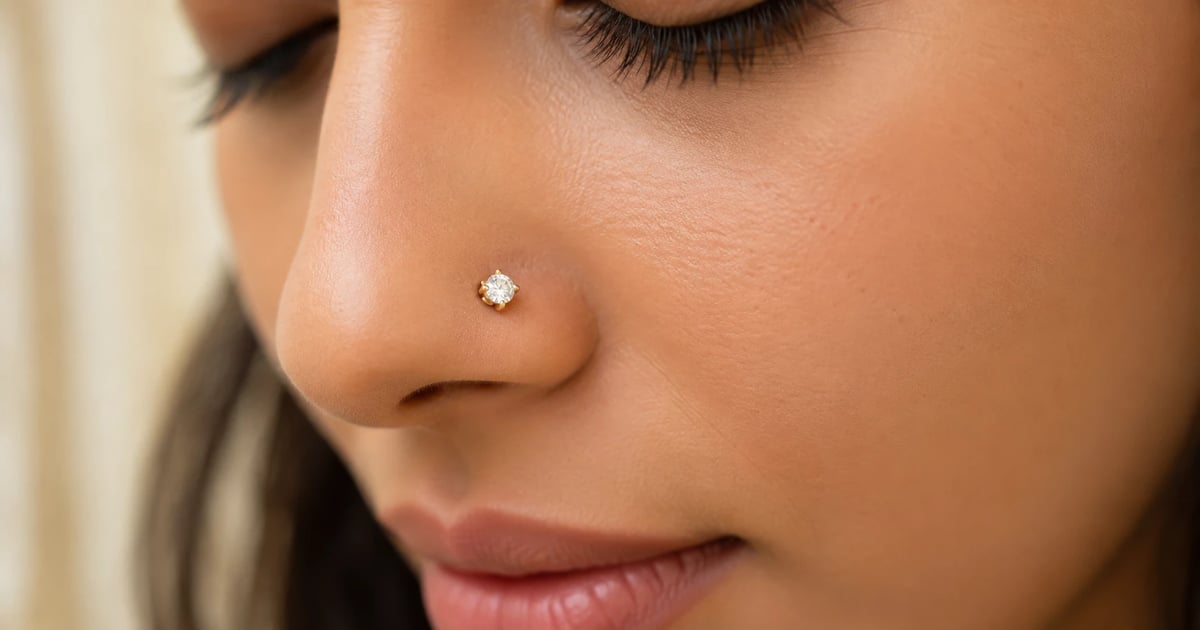
Most diamond nose ring shopping goes wrong at the counter, not online. You compare designs for a week, then pay without checking two numbers. Those two numbers decide most of what you spend.
In India, a certified diamond nose pin usually costs ₹8,000 to ₹25,000. Bridal naths and larger stones often cross ₹50,000. Carat weight, gold purity and net gold weight move that figure far more than the design does.
This guide covers the styles, the real price drivers, face-shape fit, and the certification checks worth making. It also covers something almost no product page mentions. Most diamond nose pins are legally exempt from BIS hallmarking, because they weigh under two grams.
What Counts as a Diamond Nose Ring in India
Four words get used for four different things. Sellers mix them up, and buyers receive the wrong shape.
Nose Pin, Nose Stud, Hoop and Nath Compared
A nose pin and a nose stud mean the same thing in most Indian shops. One stone sits flat against the nostril on a short post.
A nose ring is a circle that passes through the piercing. A nose wire is the thin, light version of that circle.
The nath is the large bridal ring. It often carries a pendant drop and a chain hooked over the ear.
So use the exact word when you enquire. Ask for a solitaire diamond nose pin if a stud is what you want.
Screw, L-Shape, Press and Flat-Back Fittings
The fitting decides comfort far more than the design does. Yet almost nobody asks about it.
Fitting | How secure | Best for |
|---|---|---|
Screw (corkscrew post) | High | Long-term daily wear |
L-shape | Medium | Quick changes, occasional wear |
Press-fit / push pin | Low | Short wear, photos, events |
Flat-back labret with disc | Highest | Sleeping in it comfortably |
Most healed nostril piercings take an 18G or 20G post. Ask for the gauge and the post length before you order online. A post that is too short will press; too long, and it wobbles.
Diamond Nose Ring Designs Worth Considering
Design changes the look. It also changes how much cleaning and repair follows.
Solitaire Studs for Everyday Wear
One round brilliant diamond, held by four prongs or a bezel. This is the default first purchase.
A solitaire diamond nose pin suits every face and every workplace. It also has the fewest crevices to trap grime.
Bezel-Set Designs for Sensitive or New Piercings
A bezel wraps a thin metal rim around the whole stone. Nothing sticks out.
Prongs catch on dupattas, towels and tissues, and a caught prong bends. Bezels also make a stone read slightly wider, because the rim adds visual width.
Floral and Pressure-Set Cluster Designs
Several tiny diamonds, called melee, arranged as a flower or a pavé surface. Total carat weight stays low while visible sparkle goes up.
The trade-off is real. More stones means more settings, more crevices, and more chances for one stone to work loose.
Diamond Hoops and Nose Wires
A slim gold circle set with small diamonds along the front curve. Lighter than a nath, dressier than a stud.
Hoops suit festive wear and pull focus sideways across the face. Still, they snag more than any stud, so they are a poor daily choice.
Bridal Diamond Nath Designs
The bridal nath is built for one day, not for Monday morning. Diamond naths carry a hoop, a decorative drop, and usually a supporting chain.
Weight is the thing to check. A heavy nath drags on the piercing across a long wedding day. Ask for the total gram weight before you commit. For more silhouettes, see this breakdown of ten bridal gold noth designs by face shape and outfit.
Diamond Nose Ring Price Ranges in India
Here is what the Indian market looks like right now. These bands come from publicly listed prices at Indian jewellers and B2B marketplaces, checked in August 2026.
What you are buying | Typical stone | Indicative price band |
|---|---|---|
Entry solitaire nose pin, 14K gold | 0.03–0.05 ct | ₹5,000 – ₹10,000 |
Everyday solitaire, 18K gold | 0.05–0.10 ct | ₹8,000 – ₹16,000 |
Larger solitaire stud | 0.10–0.20 ct | ₹15,000 – ₹30,000 |
Floral or cluster nose pin | melee, 0.05–0.15 ct total | ₹9,000 – ₹22,000 |
Diamond hoop or nose wire | small stones | ₹12,000 – ₹30,000 |
Bridal diamond nath | 0.30 ct total and above | ₹25,000 – ₹1,00,000+ |
Treat these as bands, not quotes. Gold rates move daily, and two shops can price the same stone differently.
Yes, a real diamond nose ring under ₹10,000 is very achievable. You get there with a smaller stone, 14K gold, or a lab-grown diamond. What you should not accept at that price is a cubic zirconia sold as a diamond.
What Actually Drives the Price on Your Bill
Four things move a diamond nose ring's price. Design complexity is rarely the biggest one.
Nose Ring Diamond Sizes: Carat to Millimetre
Carat is weight, not width. One carat equals 0.2 grams. For a nose pin, the width is what people actually see.
Carat weight | Approximate diameter |
|---|---|
0.03 ct | about 2.0 mm |
0.05 ct | about 2.4 mm |
0.07 ct | about 2.7 mm |
0.10 ct | about 3.0 mm |
0.15 ct | about 3.4 mm |
0.25 ct | about 4.1 mm |
These figures assume a well-cut round brilliant. A deeply cut stone hides weight underneath and faces up smaller.
So ask for the millimetre measurement, not just the carat. It is the honest way to picture the stone on your nostril.
Gold Purity: 14K vs 18K vs 22K
Purity changes both price and durability. Higher is not automatically better here.
14K gold, marked 585, is the hardest of the three. It grips a small stone well and resists bending at the post.
18K gold, marked 750, is the usual choice for diamond settings in India. It balances colour, strength and value. You will find it in yellow gold, white gold and rose gold. Colour comes from the alloy, not the purity.
22K gold, marked 916, is too soft for fine prongs. It is excellent for a plain gold nose pin and a poor idea for a prong-set diamond. Before you pay, run the five-minute gold purity check on the piece in your hand.
Setting Style and Making Charges
Prong settings use less metal and show more stone. Bezels use more metal and cost slightly more to make.
Pavé and cluster work costs the most in labour, because each melee stone is set by hand. Making charges appear as a separate line on a proper bill. As of August 2026, GST is charged at 3% on the jewellery value. A further 5% applies to the making charges. Confirm both line items before you pay.
Net Weight vs Gross Weight on the Invoice
This is where money quietly leaks. Gross weight includes the diamond. Net weight is the gold alone.
You should be charged the gold rate on the net gold weight only. Not on the stone. For a hallmarked article, BIS requires the bill to list net weight of precious metal, purity and hallmarking charges.
If your invoice shows only one combined weight, ask for it to be split. A jeweller who will not split it is telling you something.
Choosing a Diamond Size That Suits Your Face
Treat this as proportion guidance, not a rule. Your nostril curve and piercing placement matter more than your face shape does.
Round and Fuller Faces
A very large round stud echoes the curve of a rounder face. A smaller, brighter stone reads cleaner.
Around 2.4 mm to 3.0 mm usually sits well. A bezel gives definition without adding bulk.
Long or Narrow Faces
A long or narrow face gives you room to go slightly wider. Try a 3.0 mm to 3.4 mm stone, or a small floral cluster, for extra width.
Square and Heart-Shaped Faces
Round and floral shapes soften a strong jaw. On a heart-shaped face with a narrow chin, keep the stone small and central so it does not compete.
Face-shape logic applies across all jewellery. The same thinking runs through this pasa earrings face-shape and fit guide. Above all, try the size before you decide. A 0.5 mm difference is visible on a face and invisible in a photo.
Certification: What to Check and What to Doubt
A diamond report is an independent laboratory's opinion on a stone. It is not a guarantee of value or resale price.
Reading an IGI or GIA Report
IGI and GIA are the two names you will see most often on Indian diamond jewellery. Both grade using the 4Cs: cut, colour, clarity and carat weight.
Do not accept a printed report at face value. Type the report number into the lab's own database instead, using IGI's report verification page or GIA's report check tool. The details on screen must match the paper and the piece.
Certification Red Flags to Walk Away From
Five things should slow you down:
A "certificate" issued by the seller's own in-house valuer.
Any lab name you cannot find or verify online.
No report number that can be looked up anywhere.
One parcel certificate for total carat weight, shown as if each stone was graded.
Laser inscription on the girdle that does not match the report number.
One point deserves fairness. Stones under roughly 0.18 ct are often not individually certified, and that is normal trade practice. The problem is a seller who lets you assume otherwise.
Why Most Nose Pins Carry No BIS Hallmark
Hallmarking covers the gold, never the diamond. That surprises most buyers.
It goes further. BIS exempts any article weighing less than two grams from mandatory hallmarking. A diamond nose pin almost always falls under that. So the absence of a hallmark on a nose pin is not automatically a red flag.
You still have an option. A jeweller can voluntarily send a sub-two-gram article for testing and hallmarking, and many will if you ask. If they do, the piece gets a BIS mark, a purity number and a six-digit HUID. You can then check that HUID yourself in the BIS Care app. Our guide to what a BIS hallmark does and does not cover explains the marks in full.
Lab-Grown vs Natural Diamond Nose Rings
Both are real diamonds. They share the same crystal structure, hardness and optical behaviour. Origin and price are the differences.
For a nose pin specifically, lab-grown makes a strong case. The stone is small, sparkle is what you notice, and the saving buys you a wider stone.
One 2026 detail matters, and most guides have not caught up. GIA announced in June 2025 that it would stop using natural-diamond colour and clarity nomenclature for lab-grown stones. Since 1 October 2025, GIA describes lab-grown diamonds as either "premium" or "standard" instead.
So if a 2026 lab-grown stone arrives with a GIA report reading "D VVS1", check the issue date. It may be an older report, or it may not be GIA at all.
Natural diamond | Lab-grown diamond | |
|---|---|---|
Cost for the same width | Higher | Lower |
Current GIA reporting | Full 4Cs grades | "Premium" or "standard" |
Resale market in India | Established, still discounted | Thin and unpredictable |
Best for | Heirloom intent | Maximum visible size per rupee |
Buy neither one as an investment. Ask your jeweller for the buy-back policy in writing, whichever you choose.
Daily Wear Comfort and Sensitive Skin
Can you wear a diamond nose ring every day? Yes, and most buyers do. Three choices decide whether it stays comfortable.
Pick a bezel or a low-profile prong setting. Nothing should project far enough to catch.
Keep the total weight light. A nose pin under about half a gram of gold sits without dragging.
Then there is the metal itself. White gold is gold alloyed with nickel or palladium, then plated with rhodium for brightness. Nickel is a well-documented contact allergen for some people.
If your skin reacts to costume jewellery, say so before ordering. Ask for a palladium-alloyed white gold, a higher-karat yellow gold, or platinum. No jeweller can promise you a reaction-free metal, and persistent irritation is a question for a dermatologist, not a shop.
One boundary is worth stating plainly. Do not put a new piece into a piercing that has not fully healed. Take that timing from your piercer.
Long-Term Costs Most Buyers Never Budget For
Most buying guides stop at the purchase price. Ownership costs continue.
Rhodium re-plating. White gold's bright finish is a plated layer, and plating wears. Re-plating is a routine, chargeable service, so ask what it costs at your jeweller before you choose white gold.
Prong tightening. A loose prong is how small stones disappear. Have the setting checked when you have the piece cleaned.
Replacement fittings. Screw posts and flat-back discs get lost. Ask whether your jeweller stocks spares for that design.
Buy-back reality. Indian jewellers commonly buy back gold near the prevailing rate and diamonds at a discount. Get the terms in writing at purchase, not years later.
How to Clean a Diamond Nose Ring at Home
Skin oil, sunscreen and face cream dull a small stone faster than anything else. A five-minute clean restores it.
Mix warm water with a few drops of ordinary dish soap.
Soak the piece for ten to fifteen minutes.
Brush gently with a soft toothbrush kept only for jewellery.
Clean behind the stone, where oil and grime collect most.
Rinse over a closed drain, because a nose pin is small enough to lose.
Dry with a lint-free cloth before wearing it again.
Two cautions. Skip bleach, toothpaste and abrasive powders, since these can damage the metal. Be careful with home ultrasonic machines too, because a deep clean can loosen a stone that was already slightly loose.
The Natural Diamond Council also recommends a professional clean and setting check every six to twelve months.
Your Diamond Nose Ring Buying Checklist
Take this to the counter, or work through it before you click buy.
Confirm the exact style: nose pin, hoop or nath.
Ask for the stone's millimetre diameter, not only its carat weight.
Confirm the gold purity, 14K or 18K, and see the mark.
Ask for the fitting type and the post gauge.
Get gross weight and net gold weight separately.
Check that making charges and GST appear as separate lines.
Ask whether the stone is natural or lab-grown, in writing.
Verify any report number on the laboratory's own website.
Ask about re-plating, prong checks and spare fittings.
Get the return, exchange and buy-back policy on paper.
To see the styles beside this checklist, browse the diamond nose pin collection. You can also compare them against plain gold nosepin designs.
The Short Version Before You Buy
Pick the fitting first, the stone width second, and the design last. Comfort is what makes you wear it daily.
Ask for the net gold weight in writing, and verify any report number yourself. Those two habits protect you more than any brand name will.
A 0.05 to 0.10 carat solitaire in 18K gold, bezel-set, remains the safest first diamond nose ring for most buyers. It survives daily wear, suits every face, and rarely disappoints later.