

Gold Purity Check: The 5-Minute Buyer Checklist 2026

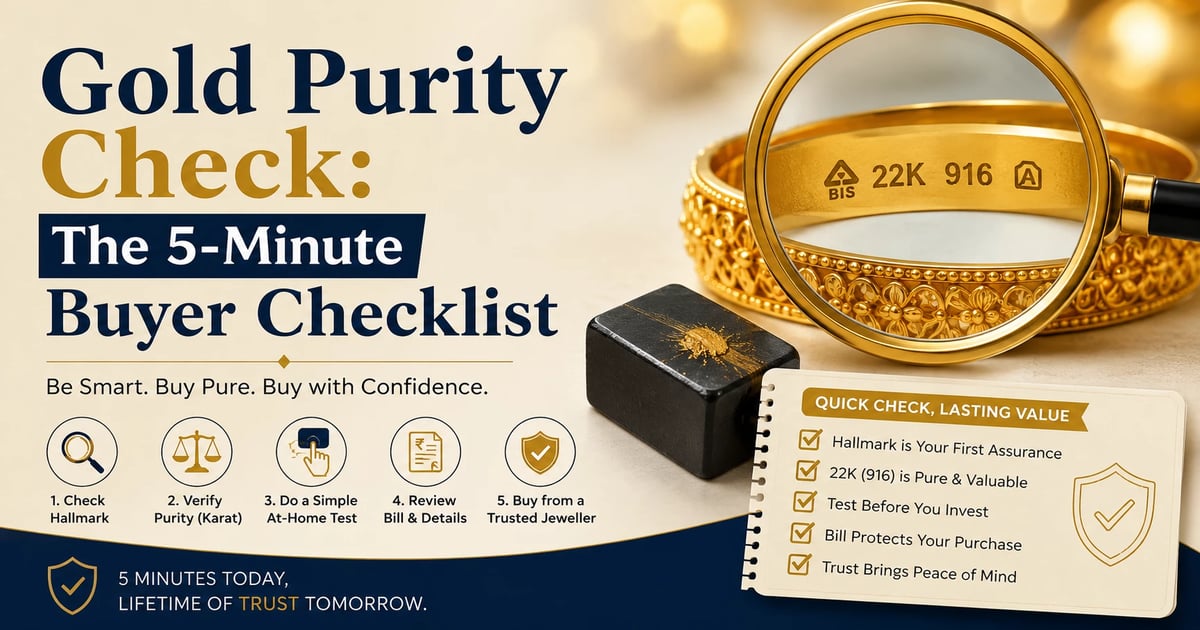
Most buyers only think about gold purity after a jeweller has already rung up the bill. That's the wrong order. Checking gold purity takes five minutes, and it should happen before you pay, not after.
This guide walks you through what to look for, in what order, right at the counter. It also covers a gap most guides skip: what you're owed if the purity turns out lower than promised.
What Gold Purity Really Means
Gold purity is the proportion of actual gold in a piece of jewellery. It's measured in karats or as a fineness number. Pure gold is 24K, written as 999 fineness. So everything below that is gold mixed with other metals for strength.
A 22K piece is 91.6% gold, which is why jewellers stamp it 916. An 18K piece is 75% gold, stamped 750. The rest is silver, copper, or zinc, added so the metal can hold its shape in a ring or bangle.
In fact, this isn't a technicality. It's the number that decides what your jewellery is actually worth.
Why Gold Purity Affects What You Pay
Two rings can look identical and still differ in value by thousands of rupees. The gap comes entirely from purity. A 22K ring contains more gold than an 18K ring of the same weight, so it costs more per gram.
Jewellers price gold by the gram at the day's rate, multiplied by purity. If a seller quotes you a flat "gold rate" without stating the karat, ask directly. A vague quote is often where the first overcharge hides.
Purity also decides resale value. Buyers, other jewellers, and even banks accepting gold as collateral all price it against the marked purity, not the appearance.
Gold Purity Marks You'll See on Jewellery
BIS hallmarking uses a small set of standard purity marks. Each one tells you the karat and the fineness in one glance. Learning these four takes less time than reading a price tag.
24K (999)
In fact, 24K gold is 99.9% pure, the highest grade sold in India. It's too soft for rings or bangles, so you'll mostly see it in coins and bars, rarely in everyday jewellery.
22K (916)
22K gold, marked 916, is the standard for traditional Indian jewellery. It holds detailed craftsmanship reasonably well and still carries strong resale value. So most wedding sets and gold coins for gifting use this grade.
18K (750)
18K gold, marked 750, mixes in more alloy for extra strength. It suits diamond and gemstone settings, where the stone needs a firmer grip. Daily-wear rings often use this purity because it resists dents better than 22K.
14K (585)
14K gold, marked 585, is the most durable of the common grades and the least gold-heavy. It works well for rings worn every day. The trade-off is a paler yellow tone and lower resale value per gram.
The 5-Minute Gold Purity Checklist Before You Pay
Run through this list while you're still standing at the counter, before you agree to pay. Most competing guides explain hallmark symbols in detail but stop short of a step-by-step routine you can actually follow mid-purchase.
Locate the BIS logo. It's a small triangular mark stamped on the piece, confirming the article passed through a BIS-recognised centre.
Check the purity mark. Look for 916, 750, or 585 stamped beside the logo, matching what the jeweller told you.
Verify the HUID on the BIS Care App. Enter the six-digit code and confirm it matches the article you're holding.
Match the HUID and purity against the invoice. The numbers on the metal and the numbers on paper must agree exactly.
Ask for magnification if the hallmark isn't visible. A genuine jeweller keeps a loupe on the counter for this.
Know your compensation rights. If the tested purity comes in lower than marked, you're entitled to redress. The next sections explain how.
So screenshot this list before you go shopping. It fits on one phone screen and takes less time than trying on a second ring.
How to Verify HUID on the BIS Care App
Every hallmarked piece sold since 2021 carries a six-character alphanumeric HUID, laser-engraved next to the BIS logo and purity mark. This single code is what lets you confirm gold hallmark verification instantly, without lab equipment.
Here's the process:
Download the BIS CARE app from the Play Store or App Store.
Open the "Verify HUID" section.
Type in the six-digit code from the jewellery.
Compare the purity, article type, and hallmarking centre shown against what the jeweller claims.
A match confirms the piece is genuinely registered. A mismatch, or no result at all, is a reason to walk away.BIS built this "Verify HUID" feature specifically so buyers could confirm an article's purity before completing a purchase.
Can Fake Gold Carry a Hallmark?
Yes — but not a genuine one. Counterfeiters sometimes stamp a fake BIS logo and purity mark onto gold-plated or low-purity metal, hoping buyers won't check further. This is exactly why the hallmark alone isn't enough anymore.
Still, the HUID closes that gap. A stamped triangle can be forged with a die. A HUID code is different — it has to resolve correctly in the BIS CARE app. It must match the exact article type and purity claimed, which is far harder to fake. If a "hallmarked" piece has no HUID, or the app shows nothing, treat that as a red flag.
Should You Buy Gold Without a Hallmark?
Generally, no. Mandatory hallmarking now covers gold jewellery and artefacts across the country, expanded in phases by BIS since 2021. A jeweller selling unhallmarked new gold in a covered district is operating outside that requirement.
There are narrow exceptions.Jewellery weighing less than two grams is exempt from mandatory hallmarking.So are export pieces and specialty Kundan, Polki, or Jadau work If you're buying one of these, ask the jeweller to explain the exemption in writing on the invoice.
So for everyday purchases — rings, chains, bangles, wedding sets — insist on a hallmark with a valid HUID. It's the one piece of paperwork that protects you if the purity is ever disputed later.
What Your Jewellery Invoice Should List
Most buying guides mention "keep your invoice" and stop there. What the invoice should actually contain matters just as much as keeping it.
A complete jewellery invoice needs:
The exact purity (916, 750, and so on), matching the hallmark on the piece
The HUID number, matching the code on the article
Gross weight and net weight, separated if stones are set
The making charges, shown separately from the metal rate
The jeweller's BIS registration number
GST charged, shown as a line item, not folded into the total
If any of these are missing, ask for a corrected invoice before you pay. An invoice without a HUID or purity figure gives you nothing to fall back on later.
Common Mistakes Gold Buyers Make
Still, even careful buyers slip up in predictable ways. Here's where it usually goes wrong.
Trusting the shine, not the stamp. Colour and polish tell you nothing about actual purity. Two pieces with identical shine can differ by several karats.
Skipping the HUID check because the queue is long. This is the single most avoidable mistake, since the app check takes under a minute.
Assuming a big showroom means no need to verify. Reputation helps, but it isn't a substitute for checking the number yourself.
Not reading the invoice before signing. Once you've paid, disputing a mismatched purity figure gets harder.
Buying gold purely as an investment without understanding making charges. If resale value matters to you, ask how making charges affect what you'd get back. That conversation belongs before the sale, not after.

What to Do If Purity Details Don't Match
If the HUID doesn't match, the purity mark looks altered, or the app returns nothing, stop the transaction. Ask the jeweller to explain the discrepancy in writing before you proceed.
If you've already bought the piece and suspect the purity is wrong, get it independently tested.A BIS-recognised Assaying and Hallmarking Centre will test the jewellery, on a chargeable basis, and issue an assay report.
Say that report shows the purity is genuinely lower than what was marked. BIS has a specific remedy for exactly this. Consumers are entitled to compensation equal to twice the value of the purity shortfall, plus the testing charges.Very few competing guides mention this right at all.
So keep the assay report and your original invoice together. You'll need both to raise the claim with the jeweller. If that fails, consumer forums like the National Consumer Helpline can take it further.
Comparing designs before you decide on purity and weight? See how hallmark checks apply to a real piece in the Dokia chain design and hallmark guide. Check today's gold rate in Kolkata before you go. Or use the Biswakarma gold calculator to work out fair cost at a given purity and weight.