

Gold Sankha Design Trends 2026 : 7 Styles to Know

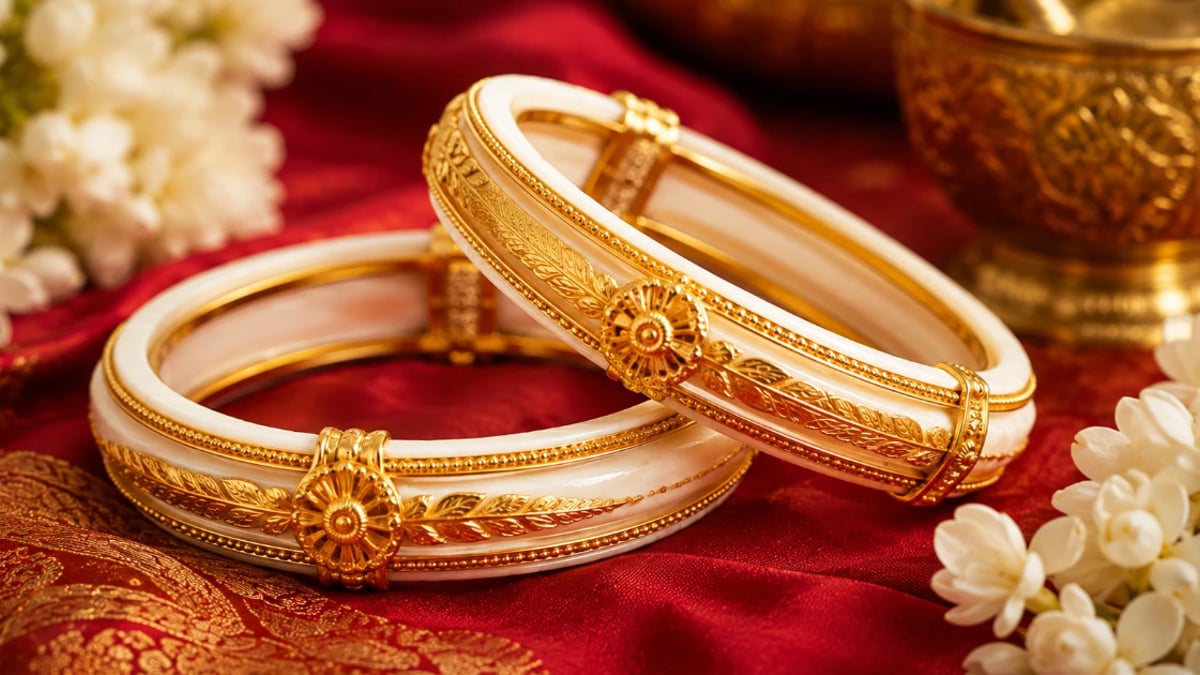
A pillar explainer on how Bengali gold sankha design is evolving for 2026 — seven current styles, a traditional-vs-modern comparison, price drivers, hallmark checks and daily-wear reality. It targets Bengali brides-to-be, married women upgrading, and family members buying wedding gifts, all of whom are researching before they walk into a showroom. It deserves to exist because every page currently ranking for this query is a product grid: nobody explains the solid vs hollow vs gold-bound distinction that decides the bill, and nobody tells you a genuine pair carries two different hallmarks.
Gold sankha design has shifted more in the past three years than in the previous twenty. Prices pushed it. Bengali brides pushed it harder. You now see slimmer profiles, hollow builds and motifs scaled down to fit a narrower band. Yet the silhouette hasn't moved. A sankha still reads as a sankha across a room, and that's the whole point.
What's changing in gold sankha design right now
Gold sankha design in 2026 favors lighter, slimmer bangles with shallower carving. Hollow and tubular construction cuts weight without shrinking the silhouette. Floral, lotus and antique nakshi motifs lead the patterned end, while plain polished bands lead the daily-wear end. The traditional conch-shaped profile itself has not changed.
Economics drives this, not only aesthetics. The World Gold Council's India gold demand report for Q2 2026 records a nearly 60% year-on-year rise in gold prices. That rise, the report says, accelerated the shift toward lighter-weight and lower-carat jewelry.
You'll feel this in the showroom. Bangles that were once solid now often come hollow. Same width. Same outer curve. Far less metal inside.
Lower-carat options have spread too. BIS, India's national standards body, permits hallmarking at 14K, 18K, 20K, 22K, 23K and 24K. Bengali buyers still lean heavily toward 22K, though, because of its warmer yellow.
What a gold sankha is, and how it differs from a conch shakha
Two very different objects share this name. One is a conch-shell bangle, white and hand-cut, worn on both wrists. The other is a gold bangle shaped to copy that conch profile. Gold sankha design refers to the second.
There's also a hybrid, and it confuses a lot of first-time buyers. Jewelers bind a real conch shakha with gold caps and a thin gold rim. Bengalis call this bandhano or mukh work.
That distinction matters more than any motif. A solid gold sankha can carry many times the metal of a gold-bound conch pair. So two pieces that look alike on a wrist can differ enormously in price. Ask which format you're being shown before you ask anything else.
Our sakha collection is grouped this way, so you can compare formats side by side rather than by photo alone.
Why sankha pola still matters at a Bengali wedding
Married Hindu Bengali women traditionally wear four things together. Shakha is the white conch bangle. Beside it sits pola, the red one. Add noa, an iron band, plus sindoor in the parting.
The gold version arrived later, as an upgrade rather than a replacement. You wear it alongside the conch pair, or in place of it once the first year passes. Customs differ by family and district, so nobody should tell you there's one correct way.
Practical reasons matter too. Conch cracks. Gold doesn't. For women who cook, commute and handle a laptop all day, that alone settles it.
7 gold sankha design trends shaping 2026
The latest gold sankha design work splits into seven clear directions. Some are genuinely new. Others are old ideas rebuilt lighter.
1. Hollow and tubular lightweight builds
This is the biggest change on the shop floor. Karigars form a thin gold sheet around a core, then remove the core. What's left looks solid but weighs a fraction as much.
A lightweight gold sankha lets you keep the wide, ceremonial look without the wide, ceremonial bill. The trade-off is real, though. Thin walls dent under a hard knock, and there's a limit to how often they can be re-rounded.
2. Floral and lotus carving
Floral motifs have replaced dense all-over patterning as the default bridal choice. Instead of covering the band, karigars now place three or four blooms with plain gold between them.
Lotus reads as the most traditional. Jasmine and creeper vines look softer and photograph well up close. Because the negative space does half the work, a lighter band still looks worked rather than bare.
3. Plain polished bands
Nothing carved. Just the conch curve, a mirror polish and a clean edge.
Minimalist gold sankha design ideas sell hardest to women in their late twenties and thirties who wear the piece daily. A plain band slides under a shirt cuff. It also stacks cleanly beside a watch, which a deeply carved bangle never does. Browse path shaka for this flat, uncarved profile.
4. Antique nakshi and temple-inspired finishes
Antique gold sankha design patterns use an oxidized, slightly darkened finish that dulls the shine on purpose. Nakshi means hand-chased relief work, raised rather than engraved.
Temple-inspired motifs borrow from Bengali terracotta panels and old deity frames. The look suits red Benarasi silk especially well. On the other hand, matte finishes need re-polishing every few years to look intentional rather than neglected.
5. Geometric edges and faceting
Here the conch profile stays but the surface gets cut into flat planes. Some pieces carry a single milled groove running the full circumference. Others use stepped shoulders where the band meets the closure.
Geometric gold sankha design styles appeal to buyers who find floral work fussy. They also hide small scratches better than a mirror polish does.
6. Gold-bound conch and mukh caps
Rather than replacing the conch, this format dresses it. A gold cap covers each end, and a narrow gold band runs around the middle or edge.
Trending gold sankha pola designs increasingly pair this with a matching gold rim on the red pola. The result costs far less than a solid pair. Still, the conch underneath can crack, and a cracked shell means a repair, not a polish.
7. Custom bridal sets built on one motif
Custom gold sankha design inspiration now usually starts with a single motif carried across the whole set. Pick a lotus, then repeat it on the sankha, the pola binding and the clasp of your sitahaar.
This is where handmade gold sankha design earns its cost. A karigar can scale a motif to your wrist width. A cast production piece cannot do that. Expect four to eight weeks for genuinely custom work. Ask for a sketch before any gold is cut.
Designer gold sankha bangles sit between stock pieces and full custom work. You pick from a house pattern book, then adjust width and finish.
Bengali gold sankha design also varies by workshop and district. Carving depth, motif spacing and finish all shift between karigar traditions. So ask where a piece was made. That often explains its style better than any trend does.
Traditional vs modern gold sankha design, compared
Traditional | Modern | |
|---|---|---|
Profile | Wide and domed | Slim to medium, flatter curve |
Build | Usually solid | Often hollow or tubular |
Carving | Deep and dense across the full band | Shallow motifs with plain gold between |
Finish | High polish, yellow-forward | Matte, brushed or antique alongside polish |
Purity | Almost always 22K | 22K for bridal, 18K where sections run thin |
Closure | Solid slip-on | Screw or hinged clasp on many pieces |
Worn for | Weddings, pujas, big occasions | Weddings, plus office and daily wear |
Reworking | Re-polishes and re-carves easily | Thin walls limit how often it can be reworked |
That last row rarely appears in showroom conversations. It should. A solid bangle can be melted, redesigned and remade several times across a lifetime. A hollow one has far less room for that.
How much gold a sankha uses, and what drives the price
Weight depends almost entirely on format. Gold-bound conch pairs use the least. A hollow gold pair sits in the middle. At the top end sits a solid 22K pair.
Width and wall thickness then decide the rest. Add roughly two millimeters of width and the metal cost climbs noticeably, because you're adding across the whole circumference.
Your final bill has four parts. Metal weight multiplied by the day's rate, plus making charges, plus any wastage percentage, plus applicable GST. Ask for each line separately. A jeweler who won't itemize making charges is telling you something.
Rates move constantly. For scale, look at the April–June 2026 quarter. The World Gold Council put the average domestic spot gold price at ₹1,50,733 per 10 grams. Check today's rate before you commit, because that number is already stale.
Gold prices can fall as well as rise. Buy a sankha because you want to wear it, not as a bet on the metal.
How to choose a gold sankha you'll still wear in ten years
1. Decide daily or ceremonial first. Everything else follows from this. Daily wear pushes you toward narrower bands, shallow carving and a secure clasp.
2. Match width to your wrist, not to a photo. A 20mm band that looks graceful on a wide wrist swallows a narrow one. Try the actual width before ordering.
3. Pick purity by section thickness. A 22K gold sankha design suits bridal pieces where the band is substantial. Where walls run thin, 18K holds its shape better because the alloy is harder.
4. Check the closure honestly. Screw clasps hold well but loosen over years. Hinged clasps open faster but have more parts to fail. Slip-on solids have nothing to break, though you need the sizing exactly right.
5. Verify the hallmark on both bangles. BIS requires each article in a pair to carry its own six-digit HUID. So a genuine pair gives you two different codes, never one repeated. Check both in the free BIS Care app.
6. Ask to see the mark under magnification. Every BIS-registered jeweler must keep a 10x magnifier and show you the hallmark on request. That rule sits in the BIS hallmarking FAQ, along with the current three-mark format.
Already own a piece and want certainty? Any BIS-recognized assaying centre will fire-assay it for ₹200.
Wearing gold sankha every day without wrecking it
Lightweight gold sankha bangles are durable enough for daily wear, with limits worth knowing. A hollow band survives normal life fine. What it doesn't survive is a direct hit against a door frame or a gym bar.
Deep carving traps soap, oil and turmeric. So if you cook daily, shallow patterns or plain bands stay looking new far longer. Warm water and a soft brush handle routine cleaning at home.
Take them off for the gym, for swimming and for heavy kitchen work. Chlorine and repeated impact do more damage than years of ordinary wear. For anyone who removes bangles often, a screw clasp beats a slip-on you have to force.
Slim profiles suit this best. Our soru shaka range covers the narrow end, while soru design shaka adds carving without adding much bulk.
Styling gold sankha with the rest of your bridal set
Balance is the whole trick. Bridal gold sankha design carries more width and deeper carving than daily pieces. So if your sankha is heavily carved, keep the pola binding plain. Let one of them lead.
For a red Benarasi, warm 22K sits better than any pale alloy. Pair a medium-width carved sankha with a sitahaar and matching chik at the throat. Then keep the forearm clear, or add a single mantasha rather than a stack.
Modern gold sankha design works differently at a reception. A plain polished pair with a slim ratanchur reads cleaner under bright light. It also stops the wrist competing with heavy earrings.
For daily wear, one gold sankha on each wrist is plenty. Skip the pola if you're heading to the office. Many women keep a carved bridal pair for pujas and a slim pair for everything else.
Patterned options across widths sit in our design shaka range, and the full jewellery catalogue covers matching pieces.
Where to start
Pick the format before the pattern. Solid, hollow or gold-bound changes your budget more than any motif ever will. After that, decide honestly how often you'll wear it. A bridal-weight carved pair sitting in a locker gives you nothing. Worn daily, a plain band gives you plenty.
Then check both hallmarks, get the making charges in writing, and take your time.