


Sakha Badhano Design: Styles, Weight and Bill Checks in 2026

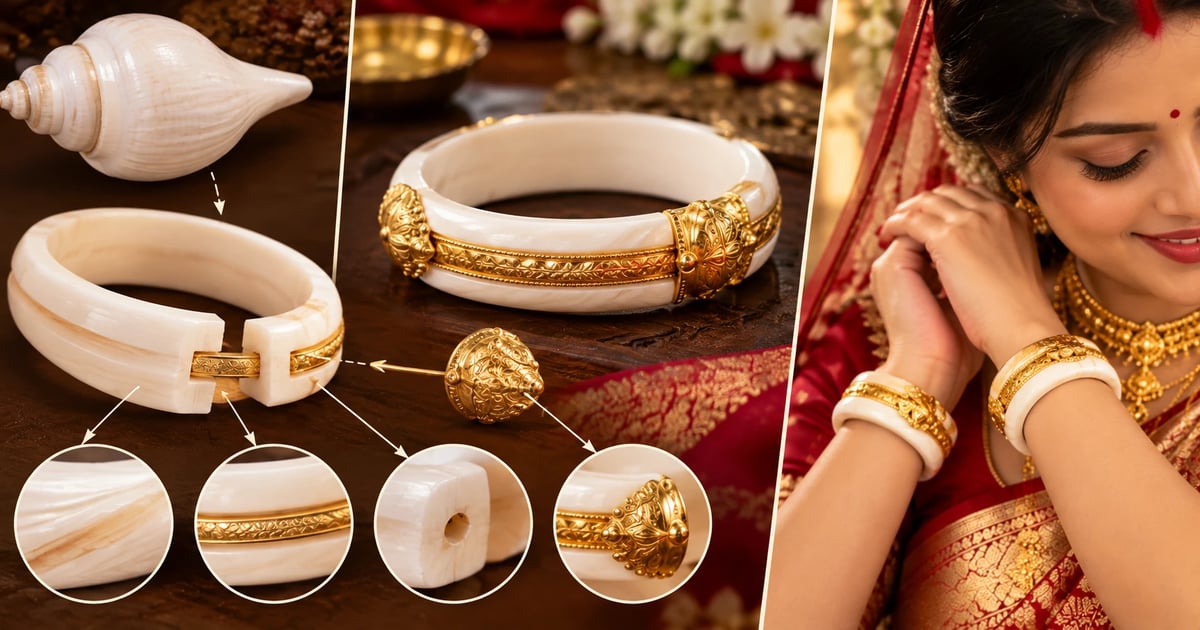
You have a date, a phone full of sakha badhano design photos and one word nobody explains. Badhano means bound, yet shops use it for two different products. One is a conch bangle bound in gold. The other is a solid gold bangle shaped like a conch. Only the gold in the first kind is billed as metal. So learn two numbers, net gold weight and purity, and you can check any bill.
Badhano means bound: two products under one name
A sakha badhano design is a conch bangle bound with gold. It comes in named profiles: Path, Soru, Soru Design and Design. Only its gold is weighed as metal, so the bill rests on net gold weight and purity. Solid gold bangles shaped like a conch also sell under this name.
Sakha, also spelt shakha or sankha, is the white conch-shell bangle. Badhano (বাঁধানো) is Bengali for bound. Shops also spell it bandhano or badhono. This guide keeps badhano.
In the first kind, the conch is the body. Gold then sits on it as a band, wire or cap. Jewellers call the cap mukh work. In the second kind, every gram is gold. Listings call it a sonar sakha badhano, meaning a gold sakha badhano design.
So ask which kind you are looking at before you ask the price. Our gold sankha design guide compares the solid, hollow and bound builds.
Explore Our Premium Bala Collections Available in 10 gm to 20 gm+ Designs.
The four sakha badhano design profiles
Our catalogue sorts the Bengali sakha badhano design range into four profiles. A profile is the shape of the bangle and how much work sits on it. So each has a name you can say at the counter.
Path sakha: flat and steady
Path means flat. The outer face is smooth and level, so a slim gold band shows cleanly. Flat bangles also sit steady beside others. Our listing for stock code (SKU) 151/10 describes a smooth flat profile with the gold band seated deep. It also carries a daily wear tag. See the Path Shaka range.
Soru sakha: slim and light
Soru means thin. The band is narrow and rounded, so it slips under a cuff. Slim profiles suit daily wear best. Weight still varies by piece, though, so ask for the gross figure. See the Soru Shaka range.
Soru Design sakha: slim with cut patterns
Soru Design keeps the slim band and adds carving. So you get detail without much extra width. That suits a day that starts at work and ends at a family function. See the Soru Design Shaka range.
Design sakha: patterned and wider
Design is the patterned end of the range. Widths vary, and the gold work covers more of the surface. Bridal pieces also tend to carry more width and deeper carving. Browse the Design Shaka range.
Sankhari carvings: lotus bud, jasmine and paddy sheaf
Sankharis are the conch-cutter families who cut and engrave the shell. Sahapedia records that the shell is Turbinella pyrum, a sea snail from the Gulf of Mannar. Barrackpore, near Kolkata, has also been a conch trade hub since 1956.
Banglapedia's entry on the shankha records about 25 engraving types on conch bangles. Lotus bud, lily petal, wildflower buds, sheaf of paddy and jasmine are among the common ones. The entry also lists design names such as banshrekhi (bamboo-lined), karnishdar (arched) and phultaranga (waving flower).
Those names come from Dhaka's workshops. Workshops in West Bengal may use others, so ask for the name your jeweller uses. Global InCH adds that conch bangles carry notched edges or diamond shapes along the centre.
The gold can carry work too. Nakshi is hand-chased raised carving in gold. So ask which motif is engraved in the shell and which is cut into the gold.
How the gold is bound to the conch
Three methods appear in the written record. First, Banglapedia's conch crafts entry describes a special drill that makes holes in bangles. Gold wire can then be threaded through them.
Second, Asia InCH describes thin gold bands set into cut grooves, usually in a diagonal pattern. It says this decoration was made for wealthy clients.
Third comes filigree, fine gold wire work. Sahapedia reports that Sankhari artisans now combine conch bangles with gold filigree in a bid to survive. Those pieces fetch a higher price.
Our Path Shaka listings describe a slim gold band seated deep. So ask your jeweller which method holds the gold on the piece you are shown. The method does not tell you how much gold is there. Only net weight does.
Wrist order with pola and noa
Global InCH's record of West Bengal jewellery gives the usual order for a married Bengali woman. The conch bangle goes on first. Then comes the noa, or loha, the iron bangle. Thinner bangles follow, and a kankan (ridged wristlet) or bala (narrow metal cylinder) ends the line.
That record does not place the pola, the red lacquer bangle. So families differ here, and you should ask the elders who will dress the bride. A sakha pola badhano set pairs a bound sakha with a red pola.
For looks, let one bangle lead. A carved Design sakha suits a plain pola. A Path or Soru sakha can take a worked pola. But that is styling advice, not custom.
Our lal pola design guide covers pola profiles. Our pola bangles guide covers the pre-wedding Dodhi Mangal ritual. For the iron bangle in gold, see the gold noa design guide.
Read a listing: net weight, gross weight, purity
A good listing shows three numbers. Net weight is the gold alone. Gross weight is the whole piece, conch included. Purity is 22K, stamped 916 on the hallmark, meaning 22 parts gold in 24.
Two of these set the price: net weight and purity. Gross weight tells you how heavy the bangle feels. So the gap between net and gross is mostly conch.
One worked sum at ₹14,820 a gram
Take SKU 151/10, a Path Shaka. Its page lists 22K, net weight 3.46 g and gross weight 56.67 g. The listed price on 21 September 2026 was ₹60,896. The piece showed as out of stock that day, so treat it as a method.
Our Kolkata rate board showed 22K at ₹14,820 per gram on 20 September 2026. Metal on the net weight comes to 3.46 g × ₹14,820 = ₹51,277. But priced on gross weight, the same piece would need ₹8,39,849 of gold.
That gap is the conch. Of the 56.67 g on the tag, 53.21 g is not gold. Then open the listing's Price Breakup tab to see how the remaining ₹9,619 above the metal value splits.
Sakha badhano design with weight and price
Gold content depends on the build. In a light weight sakha badhano design, net gold is low, though the bangle need not be small. A conch-and-gold build can hold under 5 g, and SKU 151/10 holds 3.46 g. But a solid gold bangle under 5 g would be very slim.
The table shows metal value only, at 22K and ₹14,820 per gram (Kolkata, 20 September 2026). Making charges, hallmark charge and tax come on top. It is not a quote.
Net gold weight | Metal value at ₹14,820 per gram |
|---|---|
2 g | ₹29,640 |
3.46 g | ₹51,277 |
5 g | ₹74,100 |
8 g | ₹1,18,560 |
10 g | ₹1,48,200 |
Rates move daily. So check the Kolkata gold rate page before you compare. Use our gold calculator guide for the making and tax lines, and ask for GST itemised.
The World Gold Council's India report for Q2 2026 puts domestic gold prices 59% higher year on year. It also says buyers are moving to lighter, lower-carat pieces.
A lighter sakha badhano is not a lesser one. It is the same conch with less gold on it. One trade-off is worth knowing, though. Making charges usually do not come back when you exchange a piece.
Hallmark and bill checks before you pay
BIS is India's national standards body. Its hallmarking FAQ says a bill for hallmarked gold must list four things. Those are a description of each article, the net weight of precious metal, the purity, and the hallmarking charge.
A hallmark includes a six-digit HUID, a unique ID for that article. BIS says each article in a pair carries its own hallmark. So for a solid gold pair, expect two HUIDs.
A conch-and-gold pair is different. We could not confirm how BIS counts a gold band on a shell. So ask the jeweller, in writing, which part carries the mark and whether it has a HUID.
BIS also exempts articles under 2 g from its mandatory order. That order applies only to notified districts. Neither point settles how your piece is treated, so ask if your district is covered.
Ask to see any hallmark under a 10x magnifier. BIS says registered jewellers must keep one. You can also have a hallmarked piece tested at a BIS-recognised centre for ₹200. For the wider purity checklist, read our hallmark gold vs BIS gold guide.
Size and care for gold-bound conch
A conch bangle has no clasp, so size matters. Measure the inner width in millimetres of a bangle that already slips over your hand. Give that figure first, because size labels vary between shops.
Sahapedia quotes a conch trader who says buyers now ask for bigger sizes. They want bangles that come off easily for special occasions. So if you plan to remove yours, say so when you order.
For care, our listing note says to avoid sweat and moisture. It also says to apply perfume first and store the piece apart from other jewellery. Then wipe it with a soft cloth. The listing offers free lifetime cleaning and polishing at our showroom. Also take the bangles off before swimming or heavy kitchen work.
Daily, office or bridal: which profile fits
For a simple sakha badhano design you can wear every day, start with Path or Soru. So the slim band clears a cuff and a keyboard.
For a traditional sakha badhano design for a Bengali bride, look at Design. Then ask the family. Customs differ, and asking is fine.
Profile | Suits | Ask to see |
|---|---|---|
Path | Daily and office wear | Gross weight and band width |
Soru | Daily and office wear | Net gold weight |
Soru Design | Office days and family functions | Which motifs are cut in gold |
Design | Bridal sets and festivals | Net weight and the hallmark note |
Bengali bridal bangles work as a set. So choose the sakha first, then match the pola and noa to it.
Your next step: two questions for the jeweller
Ask two things at any counter. What is the net gold weight? What is the purity? Then ask for both in writing before you pay. To compare profiles with photos and weights, browse our sakha collection.