

Gold Calculator for Indian Jewellery Bills 2026
 Sujoy Dhar
9 min read
Sujoy Dhar
9 min read
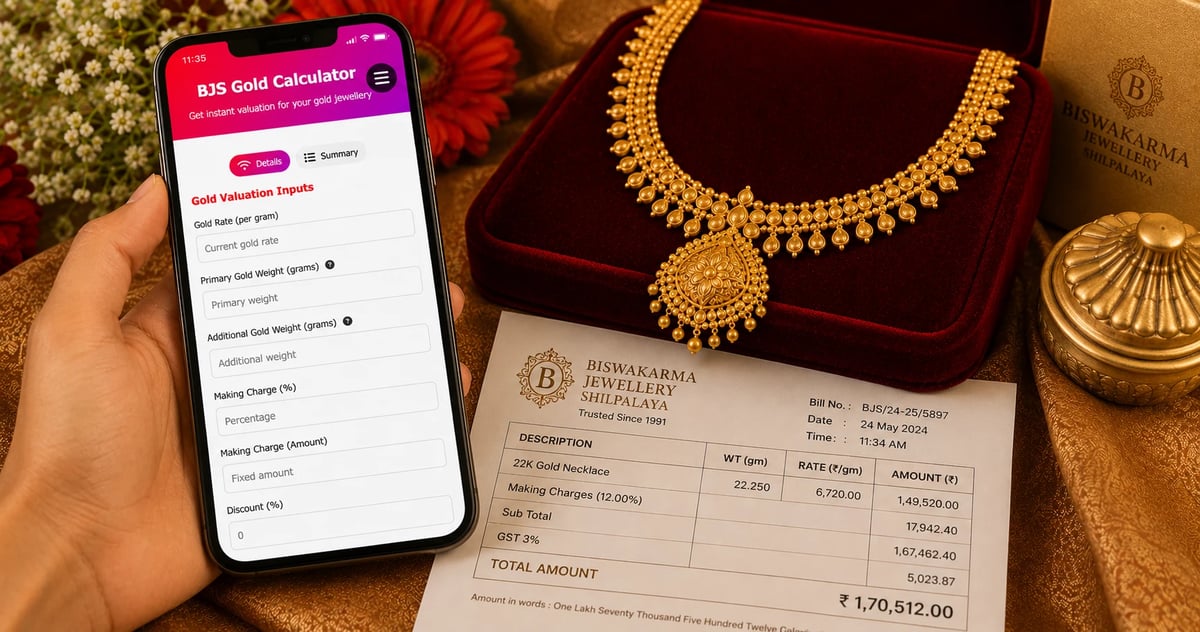
Your bill is higher than weight times rate, and you want to know why. Here is the formula a gold calculator uses: (weight x rate per gram) + making charges + GST.
Take 10 grams of 22K at ₹15,245 per gram, the board rate published on 28 August 2026. That is ₹1,52,450 of gold. Add 12% making, ₹18,294. Then 3% GST on the total. You pay ₹1,75,866. So every rupee above the metal has a name, and you can check each one.
The gold value formula, in one line
Gold value = weight in grams x rate per gram for that purity. Everything else is a charge sitting on top.
Write it out as your shop would bill it:
(weight x rate) + making + wastage + hallmark + fitting - discount, then 3% GST.
That is the whole thing. A gold calculator just does the arithmetic faster than you can on a phone.
But the order matters more than most people expect. Discount comes off before tax, not after. More on that below.
The three inputs: rate, weight and purity
Get these three right and the rest is addition.
Which rate your shop is actually using
Rates move daily, sometimes twice a day. The India Bullion and Jewellers Association publishes a benchmark. Shops then price off it with their own margin.
First, ask which purity the quoted rate is for. A rate quoted for 24K is not the rate for your 22K chain.
Also check the update time on any rate board before you compare two shops. Our own Kolkata gold rate board showed 22K at ₹15,245 per gram on 28 August 2026. The 18K rate was ₹12,350. Both carry a timestamp.
What 916 means, and the 22K to 24K gap
916 is the fineness stamp for 22K gold. It means 91.6% pure gold by weight.
So if a shop quotes you a 24K rate, multiply by 0.916 for the 22K equivalent. At a 24K rate of ₹15,824 per gram, 22K works out near ₹14,495.
BIS permits six caratages for hallmarking under IS 1417:2016. They are 14K (585), 18K (750), 20K (833), 22K (916), 23K (958) and 24K (995). If your bill says 22K, the stamp should say 916.
Whether stones and thread are on the scale
This one costs people real money. Ask for net gold weight, not gross weight.
Stones, beads, thread and lac filling are not gold. Still, they sit on the same scale. A stone-set piece billed at gross weight charges you gold rate for glass.
So ask the counter to show you both numbers. A shop that can only give you one is worth a second question.
The four charges that sit on top of gold
Four lines turn a metal price into a bill. Each one behaves differently.
Making charges: the biggest line after gold
Making charge is the labour to turn metal into an ornament. It is quoted as a percentage of gold value, or as a flat rupee amount per gram.
There is no published national standard for it. In fact, the calculator pages ranking for this term quote 8-25%, 8-15% and 3-25%. None of them cites a source. So treat any range you read as a guess.
What matters is the number on your bill. On a 14 gram piece at ₹15,245, every 1% of making charge is ₹2,134. Moving from 12% to 8% saves ₹8,537 on the same necklace.
That is why you should ask for making as a figure in rupees, not just a percentage. Then compare that figure between shops.
Wastage: sometimes a second making charge
Wastage covers metal lost while the piece is made. It is legitimate in principle. Handwork does lose gold.
But here is the part nobody sources. GST law has notified no prescribed wastage limits, as the gems and jewellery sector's GST FAQ states plainly. So any wastage percentage you are quoted is that shop's own policy.
Plenty of shops fold wastage into the making charge instead of billing it separately. Both are normal. Being charged both, at full rates, is worth questioning out loud.
Hallmark charges: what BIS actually charges
This is the one line with a published number. According to the BIS hallmarking FAQ, hallmarking costs ₹45 per gold article. The minimum per consignment is ₹200.
Two details from the same page are useful at a counter. First, hallmarking charges do not depend on the weight of the piece. Second, they do not include making or wastage charges.
Which means a hallmark line that scales with your gold weight is not a hallmarking fee. Ask what it is.
Fitting, card and miscellaneous lines
Fitting or card charge covers a clasp, a screw, a display card. Miscellaneous covers whatever else the shop adds.
These are small, usually a few hundred rupees. Even so, they belong on the bill as their own lines, with names.
GST on gold: 3% or 5%, and why bills differ
Here is the direct answer. On a normal retail purchase of finished gold jewellery, you pay 3% GST on the whole value, including making charges.
The reason is Section 8 of the CGST Act. Selling an ornament is a composite supply: gold and labour naturally bundled, with gold as the principal supply. As a result, the rate for the principal supply applies to the entire transaction.
The 5% figure is real. But it is the rate for job work. That applies when labour is charged as its own supply, not when you buy a finished piece off the shelf.
So why do two friends get differently structured bills? Because invoicing practice varies. The gems and jewellery sector GST FAQ covers this directly. Where gold and labour carry separate consideration, gold is taxed at 3% and labour at 5%.
That split costs you more. On the necklace below, the split invoice produces ₹7,308 of GST against ₹6,822 on the composite route. A difference of ₹487 on one bill.
So ask your jeweller how they invoice, and why. Tax treatment turns on the facts of the sale. Check anything unusual with a tax professional, not with us.
Where the discount sits, before or after GST
Discount comes off first. GST is then charged on the reduced amount.
The condition is that the discount must be recorded on the invoice. Per the same sector GST FAQ, a discount given at the time of sale is excluded from the taxable value. But it has to appear on the bill.
An unrecorded discount is not excluded. So a verbal "I'll give you 5% off" that never becomes a line is worth less than it sounds.
Next, check the sequence on your bill. Gold, making, discount, then tax.
A worked example on a real jewellery bill
Here is a bill with every line an Indian jewellery invoice actually carries. A 22K necklace with a matching piece, at our published board rate.
Line | Amount |
|---|---|
Primary gold weight | 12.500 g |
Additional gold weight | 1.500 g |
Gold rate (22K, 28 Aug 2026) | ₹15,245/g |
Gold value (14.000 g) | ₹2,13,430 |
Making charge @ 12% | ₹25,612 |
Subtotal | ₹2,39,042 |
Discount @ 5% | - ₹11,952 |
After discount | ₹2,27,090 |
Fitting / card charge | ₹250 |
Hallmark charge | ₹45 |
GST @ 3% | ₹6,822 |
Total after discount | ₹2,34,206 |
Before the discount, the same necklace totals ₹2,46,517. So the discount is worth ₹12,311 once the tax effect follows it down.
That works out to ₹16,729 per gram, all in. Against a metal rate of ₹15,245, you are paying about 9.7% over gold. That covers labour, fittings, hallmarking and tax.
Now run these same lines yourself in the BJS gold calculator. It takes primary weight, additional weight, making charge and discount. Plus fitting, hallmark and miscellaneous. Then it shows totals before and after discount. There is also a plain-language walkthrough of the gold value calculator if you want the tour first.
One honest caveat. No calculator output is anyone's final bill. Shops differ on rate, rounding and policy. So use the number as a check, not as a quote.
Check any gold bill in sixty seconds
Do this at the counter, before you pay.
Read the net gold weight. Not gross. Ask if stones or thread are included.
Multiply weight by the purity rate. That is your metal cost.
Subtract it from the pre-tax subtotal. What is left is making, wastage and fittings combined.
Divide that gap by the metal cost. Now you have the real making percentage, whatever the bill calls it.
Check the discount sits above the tax line.
Check the hallmark line is per article, not per gram.
Say step four gives a number far above what you were quoted. Then something is being charged twice, under two names.
Above all, a shop that will not itemise is telling you something. That is an opinion, not a rule. Even so, it has served buyers well.
Selling or exchanging old gold
You will not get the board rate. That is the honest starting point.
Buyers deduct for purity, for melting loss and for their own margin. Old unhallmarked pieces get tested, and the tested purity decides the payout, not the stamp.
Still, you can settle the purity question independently. BIS lets any member of the public have jewellery assayed at a recognised Assaying and Hallmarking Centre. The charge is ₹200, by the fire assay method under IS 1418.
On an exchange, GST is charged on the open market value of the new piece. The sector GST FAQ is explicit here. Your old gold reduces what you hand over, but it does not reduce the tax base.
We publish no fixed buyback percentage. Be wary of anyone who quotes one before weighing and testing your gold.
Why two shops in one city quote different rates
Same city, same day, two different numbers on the board. Several things move it.
Shops price off a benchmark and add their own margin. Update timing differs too, so a 10 am board and a 4 pm board are not comparable.
Import duty feeds through as well. India raised the duty on gold and silver to 15% from 6% on 13 May 2026, as CNBC reported. The new structure is a 10% basic customs duty plus a 5% cess. So any page still quoting 6% is describing a market that ended in May.
Compare like with like. Same purity, same timestamp, and making charges in rupees.
Run the numbers before you pay
The arithmetic is genuinely simple. Weight, rate, making, the small lines, discount, then tax.
Once you have done it once, you will do it in thirty seconds at any counter. Keep a gold calculator open on your phone if it helps. Plus you will ask better questions, which is most of the benefit.
For the background on purity marks, our guide to checking gold purity before buying covers what to look at. And hallmark gold versus BIS gold clears up the labels people mix up. Once you are ready to compare real pieces, the gold jewellery listings carry weights. Put those straight into the calculator.