

Pola Bangles: Meaning, History and Bengali Custom

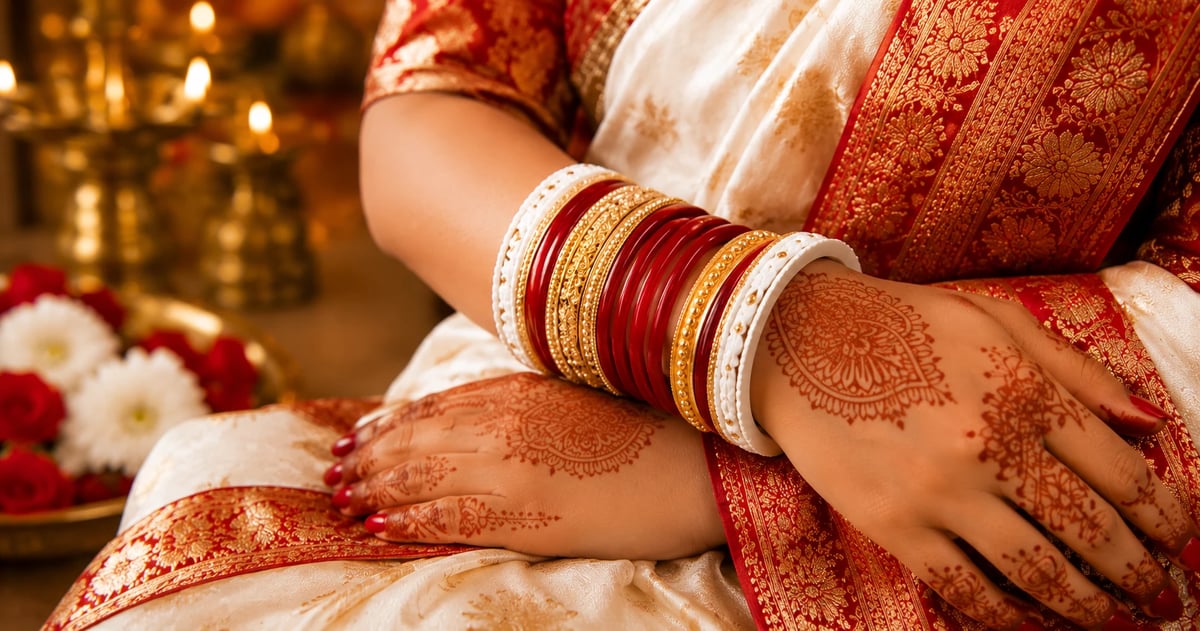
Ask five Bengali families what pola bangles mean and you may get five slightly different answers. The shared core is simple. Pola are the red bangles a Bengali Hindu bride receives at her wedding, worn beside the white conch shakha. Everything after that varies by household — how long, how often, who else may wear them. Below you'll find where the tradition came from, how the bangles are given, and which rules are real.
What pola bangles mean in Bengali households
A pola marks marriage. Above all, that is its job, and it outranks decoration.
Bengali Hindu custom, though, does not lean on the mangalsutra that much of India uses. Shakha, pola and sindoor carry that signal instead.
So a woman wearing them is telling you something specific. She is married, and she follows Bengali Hindu marriage custom.
One caution belongs here, stated plainly. Pola bangles are a cultural marker. They are not a guarantee of anything, and claims about luck or protection belong to belief rather than fact.
How pola got its name and its colour
Pola takes its name from coral. The material, that is, rather than the shape.
That coral was never local to Bengal. Corallium rubrum, the red coral prized in jewellery, is almost endemic to the Mediterranean Sea. A history of the Mediterranean red coral trade records where it travelled. Europeans shipped it to India, Persia and China across the seventeenth and eighteenth centuries.
Bengal sat on the other side of that same commerce. Banglapedia records that Bengal shell products were exported on a large scale in exactly those two centuries.
Coral came in. Shell went out. The red half and the white half of the pair have opposite trade histories.
Today's pola is lacquer rather than coral. Our lal pola design guide explains what changed and why the law is involved.
The artisan lineage behind shakha and pola
The white half of the pair has a documented family tree. The red half mostly does not.
From Tamil Nadu to Dhaka, then Kolkata
Zoologist James Hornell dated conch craft in Tamil Nadu to the first century CE. He also concluded that South Indian artisans had settled in Dhaka by the fourteenth century. Sahapedia's record of the Sankhari community carries both findings.
Dhaka's Shankhari Bazaar became the centre of the craft in undivided Bengal. Then 1947 moved the border, and Sankhari families crossed into West Bengal as refugees.
A rehabilitation colony at Habra failed in 1953. A second attempt at Barrackpore worked in 1956. Ghoshpara Road there remains a conch trade hub.
Why the craft is shrinking now
Raw conch comes from Turbinella pyrum, a sea snail found in the Gulf of Mannar. Rameswaram, Tuticorin and Tirunelveli supply most of it.
Supply has tightened badly, though. Artisans quoted in that Sahapedia record blame ocean pollution, the 2004 tsunami, and cheap machine-made competition.
This matters for what ends up on your wrist. A hand-carved shakha and a moulded copy photograph almost identically. They come from completely different economies.
Dodhi Mangal: how the bangles are actually given
Dawn on the wedding day. That is when it happens, first of all, at the bride's home, before anything else begins.
Dodhi Mangal is the daybreak meal ritual. The bride eats curd and rice, then fasts until the wedding rites finish.
Next, seven married women place the bangles on her wrists. Many families read the seven as seven goddesses. The bangles are often soaked in turmeric water first.
Who hands them over differs, too. In some households the mother gives them. Elsewhere the in-laws or senior relatives do.
Some families run the bangle ceremony as a separate step called Sankha Porano. Others fold it straight into Dodhi Mangal.
Shakha, pola, loha and sindoor as one signal
Four markers, not one. That is the part most explanations skip entirely.
Shakha comes off a conch shell, cut and rubbed smooth by hand. Pola starts as a material and is formed into a ring.
Loha, also called noa, is iron. It sits on the left wrist and often gets bound in gold. Our gold noa design guide covers that binding.
Sindoor completes the set. Some women also touch a little vermilion to the shakha as they apply it.
Here is the whole set at a glance.
Marker | What it is | Where it is worn |
|---|---|---|
Shakha | White bangle carved from conch shell | Both wrists |
Pola | Red bangle, lacquer today, named after coral | Both wrists |
Loha (noa) | Iron bangle, frequently bound in gold | Usually the left wrist |
Sindoor | Vermilion powder | The parting of the hair |
Treating the four as interchangeable is the usual error. Each entered the tradition separately, and each still carries a slightly different weight.
How long Bengali women wear pola after marriage
No fixed term exists. Anyone quoting you one is describing their own family, not a rule.
Mandatory is also the wrong word. No religious rule compels a Bengali woman to keep pola on after her wedding. Social expectation does the work instead, and it varies sharply between households.
Older custom expected lifelong wear. The Sahapedia record notes that a bride wore sankha through her married life, setting it aside on her husband's death. Pola generally followed the same pattern.
That expectation has loosened a great deal. Plenty of women now wear pola daily through the first year, then keep the set for pujas and family occasions.
Some remove them for work and put them back at home. Others never take them off at all.
Practice around divorce and separation, on the other hand, stays unsettled. Families differ, and no single custom governs it.
Unmarried women and pola: what custom allows
Wearing the full set is what signals marriage. That is why an unmarried woman generally does not put on shakha and pola together.
Red bangles by themselves, however, are a different matter. Red runs through Bengali dress for married and unmarried women alike.
The line sits at the pairing and the ritual, not at the colour. A red lacquer bangle worn as fashion is not a bride's pola.
Buying carries no restriction either, as it happens. Daughters buy for mothers, sons for wives, families assemble a trousseau months ahead.
Households still differ on this. Some are relaxed, others are strict, so ask your elders rather than a shop assistant. A pola ring suits anyone who wants the red-and-gold look without the ritual pairing.
Pola bangles at Durga Puja and other festivals
Durga Puja is when Bengal wears the most pola. Married women bring out the full set for pandal mornings and family visits.
Sindoor Khela on Bijoya Dashami is the peak of it. Women mark each other with vermilion after the goddess is bid farewell. Red on red, wrists and foreheads together.
Poila Boishakh brings the set out again. So do Jamai Shashthi, Lakshmi Puja and weddings in the family.
Outside Bengal, the calendar does more work than daily habit. Diaspora households often keep pola bangles for exactly these dates.
Distance changes the practicalities too. Sizing by post is difficult, and lacquer travels badly in hold luggage. So families abroad frequently buy two pairs on a visit home, keeping one spare.
That shift deserves naming. For many families, pola has moved from everyday wear to occasion wear.
What "authentic" really means for pola bangles
Authenticity here rests on provenance and workmanship, not mystique.
Start with the honest part, though. Natural coral pola is not what shops sell today, and any claim otherwise deserves scepticism.
That leaves three things you can actually judge. The quality of the lacquer body. The cleanliness of the join where gold meets it. Whether the shakha beside it was carved or moulded.
Provenance counts as well. The Development Commissioner (Handicrafts) records conch carving as a Shankhakar craft centred on Bishnupur and Bankura. A machine-pressed set carries none of that lineage.
For the counter checks — weights, hallmarks, the exact questions to ask — our lal pola design guide has the full list.
Myths about pola bangles that still circulate
Three claims keep going around, and all three are out of date.
First, that pola is natural red coral. It is not, and has not been for a long time.
Second, that every Bengali woman wears the set for life. Many do. Many do not, and both are normal now.
Third, that only married women may buy them. No such restriction operates at a shop counter.
A fourth is worth adding. Pola bangles promise a marriage nothing at all. Treat that as belief, and be wary of any seller who presents it as a guarantee.
Where the tradition stands now
Pola bangles carry two things at once. They still mark a marriage. They also sit on top of a craft under genuine strain.
Sankhari workshops are shrinking. Meanwhile, younger artisans keep leaving the trade. That is the part symbolism articles never reach.
One pair will not fix that. Even so, asking where a set was made helps, and paying properly for hand carving helps more.
As for the rules, most of them belong to your family rather than to Bengal. Ask at home first, then shop. Our pola collection is a reasonable place to start looking.