

Best Cover Bangle Collection Under Your Budget

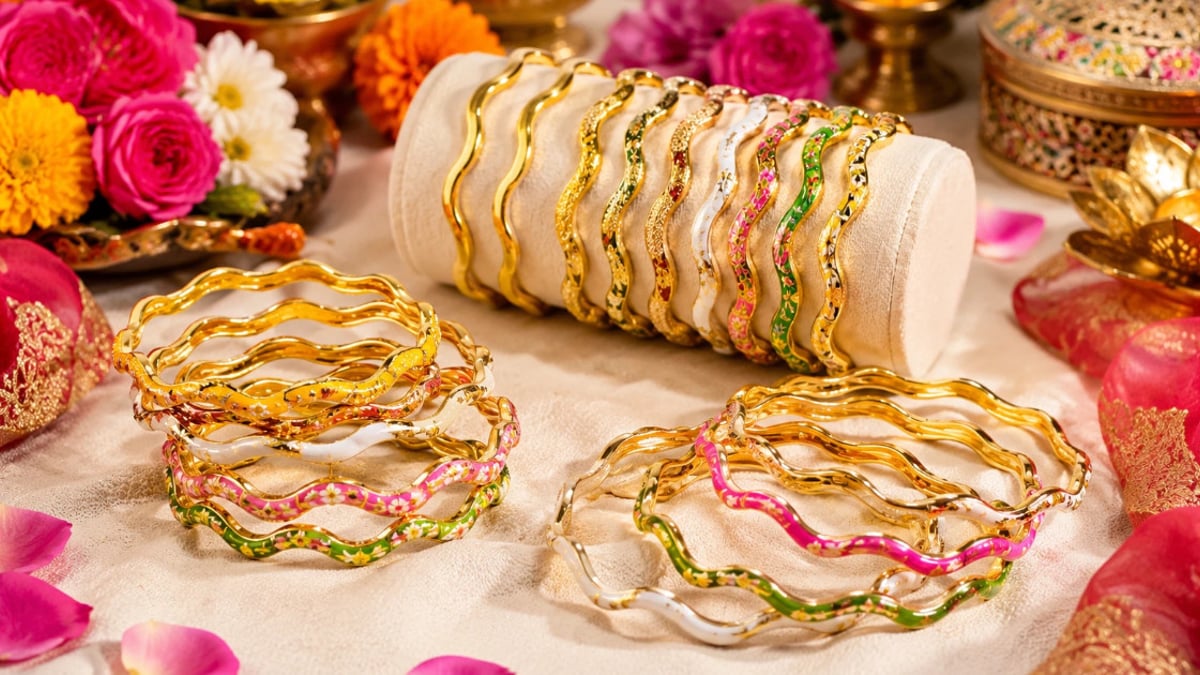
Gold rates keep climbing. Wrists still need bangles. A cover bangle closes that gap. It's real 22K gold, shaped as a hollow shell and filled to hold its form. You get the width of a heavy bangle. Your bill, though, follows the gold inside it — not the size you see.
That one fact decides nearly everything else about buying well. So this guide starts there, then works through weight, sizing, styling and care.
What a cover bangle actually is
Bengali goldsmiths have built bangles this way for generations. A craftsman rolls 22K sheet into a hollow tube, shapes it, then packs the inside with lac. Lac is a natural resin, hardened from insect secretions. It sets firm and stops the thin gold walls from collapsing.
The trade calls this construction "cover" — the gold covers a core it doesn't fill. You'll see the same idea in a socket bauti or a lac-filled bala.
Here's what that means at the counter. Two bangles can sit side by side at identical width. One is solid 22K, so every gram on the scale is gold. The other is a cover bangle, where much of that weight is filler. They look close. They do not cost the same.
Take a live example. The 57/197 Dual Tone Leaf Cover Bangle lists 12.32 g gross and 3.56 g net. That 8.76 g difference is filler, not gold. You pay for the 3.56 g.
One myth is worth killing right here. A cover bangle is not imitation jewellery. It isn't gold-plated brass either. The surface you see is 22K gold, the same alloy as a solid bangle. Only the construction differs.
Why cover bangles suit Indian buyers right now
India remains the world's second-largest jewellery market, behind China alone. The World Gold Council's Q1 2026 India report puts the country at 22% of global jewellery demand. Yet the same report shows volumes under real pressure from record prices.
That's the squeeze every buyer in Barasat and Kolkata feels. Weddings don't get smaller. Pujas don't get fewer. Budgets, though, stop stretching.
Cover construction is one honest answer. Instead of a thinner solid bangle, you buy the same visual width in less gold. For a saree, width matters more than mass. A 4 g cover bangle reads bolder on the wrist than a 4 g solid churi.
There's a trade-off, and you should hear it plainly. A cover bangle carries less gold per piece. So if resale weight matters most to you, a solid churi holds more metal at the same wrist size. Buy cover for how it wears, not for what it weighs.
How to check a cover bangle before you pay
Four checks, in this order. Each takes under a minute in the shop.
Read the net weight, not the gross weight
Gross weight is everything on the scale. Net weight is the gold alone. For a cover bangle, that difference is the entire story.
This isn't a favour you have to request. The Bureau of Indian Standards is clear on this. Its hallmarking rules for jewellers require four things on the invoice. Those are the article description and the net weight of precious metal. Then purity in carat and fineness, plus the hallmarking charges.
So ask for it in writing. If a shop quotes only a gross figure, slow down. A piece billed at gross weight means you're paying gold rate for lac.
Check the hallmark, then verify the HUID
Three marks belong on hallmarked gold. Those are the BIS logo, the purity in carat and fineness, and a six-digit HUID. HUID stands for Hallmark Unique Identification. Every individual piece gets its own code.
Type that code into the BIS Care app before you leave the shop. The record should match the piece in your hand.
One catch matters for slim bangles. Articles weighing under two grams are exempt from mandatory hallmarking. Some delicate cover bangles fall below that line. A jeweller can still get them hallmarked voluntarily, so ask whether yours is marked.
Press the joint, the screw and the hinge
Hollow gold is thinner than solid gold. That's where a cover bangle fails first — never on the surface.
Run your thumb along the seam where the tube closes. It should feel smooth, with no ridge or gap. Next, open and shut the screw or clasp several times. Any grinding means the threads are already worn.
Then squeeze the bangle gently across its widest point. A well-made piece won't flex. If it gives under light pressure, the walls are too thin for daily wear.
Look at the finish in daylight
Shop lighting flatters everything. Step towards the door and look again.
22K gold sits warm and slightly deep in colour. Watch for patchiness around engraved areas, since polishing tends to skip there. On dual-tone pieces, check that the white and yellow zones have clean borders. A blurred edge points to rushed rhodium work.
Rhodium is the bright white plating used on dual-tone finishes. In fact it's the one part of a gold bangle that genuinely wears thin over years. Most jewellers re-plate it cheaply, so ask what that costs before you commit.
The collection by gold weight
Forget rupee tiers for a moment. Gold rates move daily, so a price band goes stale within weeks. Net gold weight doesn't. Pick your band first, then let the day's rate settle the bill.
Net gold weight | Best for | How it wears |
|---|---|---|
Under 4 g | Daily wear, office, first purchase | Slim to medium width, light enough to forget |
4–8 g | Pujas, family functions, gifting | Wide face, visible motif work, comfortable all day |
Above 8 g | Weddings, receptions, bridal stacks | Broad statement width, deep detailing, worn for hours |
Under 4 g — daily wear and first buys
Most first purchases land here. One under 4 g stays comfortable through a full workday. Plus it won't catch on a dupatta or a laptop bag.
The 57/197 Dual Tone Leaf Cover Bangle sits in this band at 3.56 g net. Its enamel leaf motif gives the face something to look at without adding bulk.
Buy here if you want one bangle you rarely take off. Skip this band if you need a piece that carries a whole festive look alone.
4–8 g — festivals and family functions
Motif work needs metal to sit on. Once you cross roughly 4 g net, a goldsmith has room for deeper chasing and a wider face.
This band suits Durga Puja, annaprashan, and weddings where you're a guest rather than the bride. Wear two on one wrist, or one on each.
It's also the sensible gifting band. Wide enough to feel like an occasion. Light enough that the person actually wears it.
Above 8 g — weddings and bridal stacks
Bridal wrists carry more than one piece. That's exactly why weight per bangle matters more here than anywhere else.
A broad cover bangle above 8 g net gives bridal presence without bridal load. Stack it with sankha, pola and loha, and your wrist still moves freely late into the evening.
Be honest with yourself on one point, though. Say you want an heirloom to hand down, and gold content is the reason. A solid churi then carries more metal at the same wrist size. Cover construction buys you scale, not mass.
Browse the cover bangle collection page, or sort the cover bangle range by price to work upwards from your floor.
Cover bangle vs solid churi vs socket bauti
These three sit side by side in most Bengali shops. They are not interchangeable.
Cover bangle | Solid churi | Socket bauti | |
|---|---|---|---|
Build | Hollow 22K shell, filled core | Solid 22K throughout | Half-cut, filled, gold-covered |
Width for its gold weight | Widest | Narrowest | Wide |
Gold per piece | Lowest | Highest | Low |
Daily wear | Good, if walls are thick | Very good | Good |
Dent risk | Highest | Lowest | Moderate |
Best for | Festive width on a budget | Holding gold weight | Everyday Bengali staple |
Choose solid when the gold itself is the point. Cover Bangle wins when the look matters more. And bauti gives you that traditional half-cut shape, no screw needed.
Compare all three in the bangles and bracelets category. Or go straight to solid churi, socket bauti and fitting churi.
Getting your bangle size right
Sizing is the most common reason bangles come back. It's also the easiest thing to fix at home. Take five minutes and a measuring tape.
Fold your thumb inwards towards your little finger, as though slipping a bangle on.
Measure around the widest part of that folded hand.
Note the reading in centimetres. Measure twice and take the larger figure.
Match it against the seller's own chart. Conventions differ between shops — Biswakarma lists cover bangles under size numbers like 23, 24, 25 and 26.
Add a little room if your hands swell in heat, or measure in the evening instead.
Two extra notes save real trouble later. A cover bangle can't be resized as freely as a solid one. Cutting into a hollow tube weakens the wall. And BIS rules permit alterations only up to 2 grams or half the weight, whichever is lower, before re-hallmarking.
That's why guessing a size costs more on a cover bangle than on almost anything else in the shop.
Styling with sarees and ethnic wear
Width is your main lever. A wide cover bangle wants a plain sleeve or a bare wrist beside it. Against a heavily worked blouse, the two compete and both lose.
For a Bengali garad or a red-and-white silk, stay with plain yellow and strong motif work. Leaf, lotus and paisley chasing reads traditional without shouting.
Dual-tone earns its place with contemporary drapes. Those white sections pick up silver zari and cool-toned georgettes beautifully. Against a warm Kanjeevaram, on the other hand, dual-tone tends to look busy.
Stone-studded faces stay popular for festive jewellery, and they photograph well. Still, they snag on chiffon and fine net. So think about your fabric before your motif.
One stacking rule genuinely works: odd numbers, mixed widths, one hero piece. Two slim bangles plus one wide piece beats three wide ones.
Care that keeps it looking new
A cover bangle fails from dents and grime, not from tarnish. 22K gold doesn't rust. What dulls it is everything your skin and your day leave behind.
Conservators at the Canadian Conservation Institute wear gloves for gilded metal. The reason: skin salts and oils mark those surfaces. You obviously won't wear gloves with a saree. But the same principle points to the fix: wipe the bangle down every time you take it off.
Four habits do most of the work:
Apply perfume, hairspray and moisturiser first. Put the bangle on last.
Take bangles off before kitchen work, gym sessions and sleep.
Store each piece in its own soft pouch, never jumbled in one box.
Clean with a dry, soft cloth. Skip toothpaste, and skip ultrasonic machines.
That last point matters far more here than for solid gold. Ultrasonic cleaning vibrates a piece hard. On a filled bangle, that can loosen the core inside.
Lifespan comes down to two things: wall thickness and how you handle it. A well-made piece worn sensibly lasts many years. A thin one treated roughly can dent within months. Biswakarma also offers complimentary lifetime cleaning and polishing at its showroom, worth using once a year.