

Best Gold Noa Design With Price Guide 2026

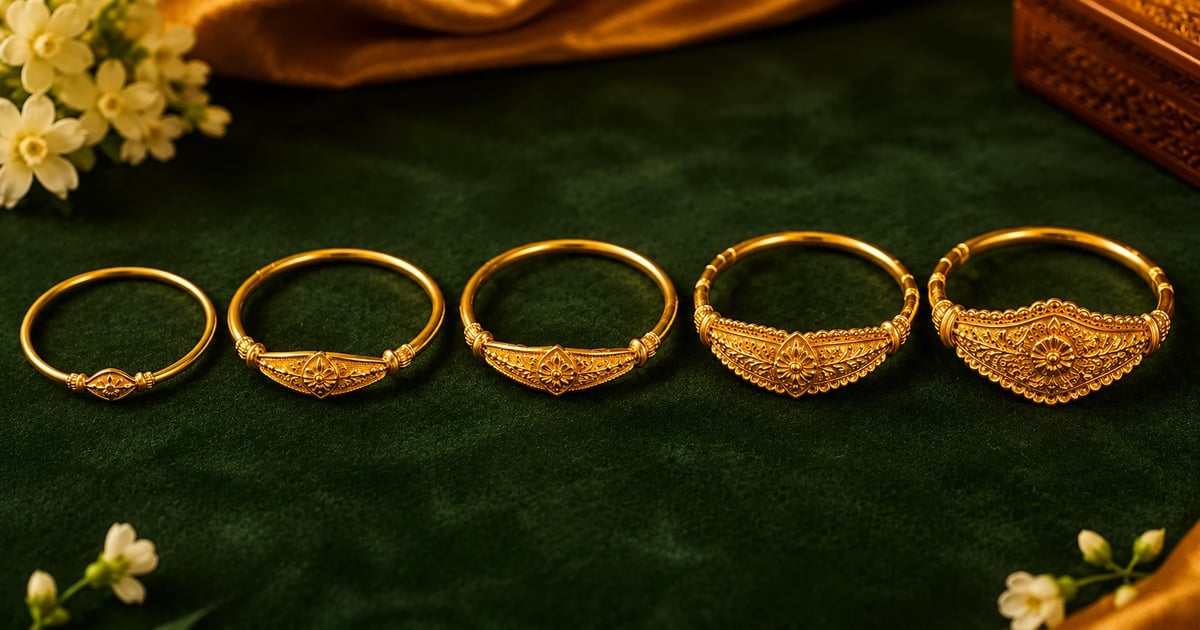
Gold noa design splits into two very different things, and the gap decides your bill. One is a solid 22K gold bangle. The other is an iron noa bound in gold, with far less metal inside. Ask which one you're looking at before you ask about pattern or price.
The noa itself is the iron bangle a Bengali mother-in-law gives her daughter-in-law. It sits on the left wrist, beside shakha and pola. Gold turns it into something you wear every day. That's where the choices, and the costs, begin.
What you are actually buying under the gold
Two products share the name noa on a shop counter. One question separates them.
A solid gold noa is 22K throughout. So nothing else sits inside it. Stocked weights in Kolkata typically run from about 3 grams to 12 grams. So metal weight drives almost the whole price.
A gold-bound noa is different. Bengalis call it loha bandhano, or noa badhano. An iron ring sits underneath, wrapped or capped in gold. Full cover wraps the whole band. Half cover, meanwhile, dresses only the outer face. Far less gold goes in, so the bill drops sharply.
That one choice moves your price more than any motif ever will.
Solid gold noa | Gold-bound noa (loha bandhano) | |
|---|---|---|
Core | None, 22K throughout | Iron |
Gold used | The full weight | A shell or caps only |
Typical cost | Higher | Much lower |
Hallmark | Usually carries one | Depends on the gold weight |
Rust risk | None | Possible at the join |
Melt value | The full weight | Only the gold, not the iron |
That last row rarely comes up in showroom conversation. It should. A solid noa can be melted and remade later. A bound one, however, gives you back only its thin shell.
5 gold noa design types worth knowing
Bengali shops sort noa by profile, not by motif. Five names cover most of what you'll be shown, and our gold noa collection is grouped the same way.
Path noa: flat and steady
Path means flat. The band shows a level outer face, so engraving reads clearly across it. Flat profiles also stack neatly beside a shakha without rolling. Browse path noa for this shape.
Soru noa: slim and rounded
Soru means thin. Here you get a narrow, rounded band that slips under a shirt cuff. For women in desk jobs, this is usually the daily-wear default. The soru noa range covers the narrow end.
Muk noa: a worked front face
Muk means face. The front section widens and carries the detail, while the rest of the band stays plain. You get bridal presence without paying for weight all the way round. See muk noa for that build.
Half round noa: domed outside, flat inside
Half round describes the wire profile itself. The outer face curves; the inner face sits flat against your wrist. So flat insides press less on the wrist bone. Our half round noa pieces use this section.
Diamond noa: small stones, everyday scale
Small diamonds set into the gold band. Here sparkle is the point, rather than stone size. Stones add cost that gold weight alone won't explain, so ask for the stone value as its own line. The diamond noa range sits in this group.
Older regional names still circulate too — baki, bani, pater, aarai pach. Besides, districts and workshops sort them differently. So ask to see the profile rather than trusting the label.
How much a gold noa costs at today's rate
A 22K gold noa costs metal weight times the day's rate, plus making charges, plus GST. Biswakarma listed 22K at ₹14,620 per gram in Kolkata on 12 August 2026. At that rate, a 5 gram noa lands near ₹86,800 with 15% making. Rates move daily, so check before booking.
Prices have climbed hard, which is why lighter builds now dominate. The World Gold Council's India gold demand report for Q2 2026 records domestic prices 59% higher year on year. That rise, the report says, accelerated the shift toward lighter-weight and lower-carat jewellery.
The four parts of your bill
Metal. Net gold weight multiplied by the day's 22K rate.
Making charges. The karigar's labour, usually quoted as a percentage.
Stone value. Only where diamonds are set.
GST. Charged at 3% on the gold value and 5% on making charges.
Ask for all four written as separate lines. A jeweller who won't split them is telling you something useful.
Gold noa price by weight, at ₹14,620 a gram
Net gold weight | Indicative all-in price |
|---|---|
2 g | ₹34,700 |
3 g | ₹52,100 |
4 g | ₹69,400 |
5 g | ₹86,800 |
6 g | ₹1,04,200 |
8 g | ₹1,38,900 |
10 g | ₹1,73,600 |
12 g | ₹2,08,300 |
These figures assume 15% making charges, then add 3% GST on gold and 5% on making. Drop making to 10% and the per-gram cost falls to roughly ₹16,600. Push it to 20% and it rises to about ₹18,100. Nothing in this table is a quote — check today's gold rate in Kolkata and recalculate.
For a bound noa, run the same maths on the gold weight only. The iron underneath costs very little, but you still pay labour on the binding work.
Why light noa often cost more per gram
Lightweight gold noa design carries a cost most buyers never see. Two forces push up the per-gram figure on a small piece.
First, some charges don't scale with weight. BIS bills hallmarking per article, not per gram. The BIS hallmarking FAQ puts it at ₹45 per gold article, with a ₹200 minimum per consignment.
Second, thin work often carries a higher making percentage than a chunky band. That figure varies by workshop, so get it before you fall for the piece.
The hallmark gap on light noa nobody mentions
Mandatory BIS hallmarking does not cover every gold article. The BIS jewellers FAQ lists an exemption for any article weighing less than two grams. A light gold-bound noa can sit under that line.
So a perfectly genuine piece may reach you without a hallmark. That isn't automatically a warning sign. Still, it removes your independent proof of purity. BIS confirms jewellers may hallmark such pieces voluntarily, after the usual testing.
Where a hallmark is present, look for three marks. You should see the BIS logo, the purity in carat and fineness, and a six-digit HUID number. BIS has required that format since 1 July 2021. Verify the HUID free in the BIS Care app.
Ask to see it under magnification too. Every registered jeweller must keep a 10x magnifying glass for exactly this, BIS says. One more gap worth knowing: jewellers with annual turnover up to ₹40 lakh fall outside the mandatory order entirely.
Your bill protects you more than the stamp
On a bound noa, the invoice does the heavy lifting. BIS requires four things on it:
a description of each article
the net weight of precious metal
purity in carat and fineness
hallmarking charges
Net gold weight is the number you're paying for. Gross weight includes iron you can never sell back. Those two figures can differ enormously on a bound piece, so read the line carefully.
There's a remedy if the purity turns out wrong. Under BIS rules, compensation is twice the difference calculated on the shortage for the weight sold, plus your testing charges. Any BIS-recognised assaying centre will fire-assay a piece for ₹200.
Which noa suits your wrist and your week
Sound gold noa design choices start with your routine, not with a photograph.
Daily wear, hands in water. Go slim and rounded. A soru or half round profile takes knocks without snagging on sleeves.
Bridal and festive. A muk noa gives presence at the front without full-band weight.
Tight budget, real gold. A bound noa buys the look for a fraction of the metal.
Buying as an heirloom. Solid gold is the only format that melts down cleanly later.
One honest caution about our own bound pieces. If your plan is to remake the gold in twenty years, a bound noa is the wrong buy. Its value sits in a thin shell. Solid 22K is the format that survives that plan, even though it costs far more today.
Sizing matters more than most buyers expect. A noa that spins loosely will wear thin at one point. Too tight, and you'll stop wearing it by the second summer.
Caring for an iron-cored noa without rust
Iron rusts. Gold doesn't. On a bound noa, the join between them is the weak point.
Dry the bangle properly after washing your hands. Water sitting at the gold edge is what starts the trouble. Take it off for swimming and long kitchen sessions, because chlorine and steam both find the seam.
Turmeric and oil collect under carved edges over time. Warm water and a soft brush clear them at home. Avoid harsh polish on a bound piece, since repeated polishing thins the gold layer.
Noticed a rust line at the edge? Take it in early and ask for a repair quote before assuming the whole piece needs replacing.
Where to start
Settle the build before the pattern. In gold noa design, solid versus bound changes your budget more than any motif will.
Then decide honestly how often it goes on your wrist. A heavy bridal piece sitting in a locker gives you nothing, while a slim band worn daily earns its cost.
After that, three checks. Get the net gold weight in writing. Making percentage next — ask for it before you commit. Then check the hallmark, if the piece carries one. Our gold sankha design guide covers the matching conch bangle, and the pola ring guide completes the set.