

Bauti Design Bangles: Best Picks For Every Budget

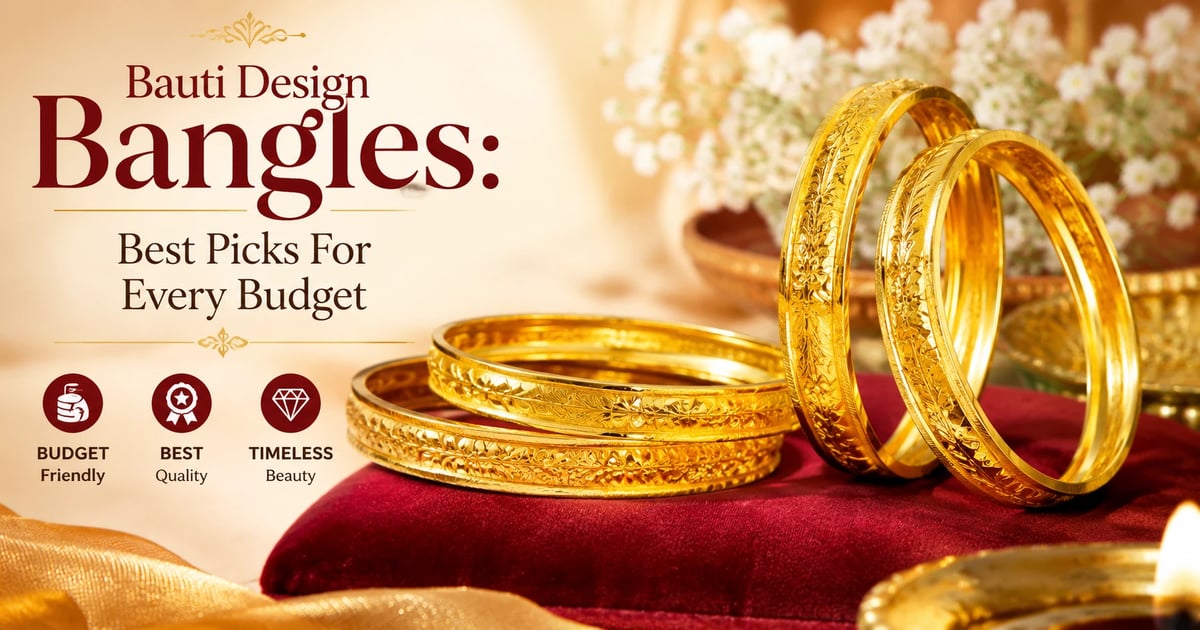
Most solid gold bauti design bangles now start above ₹45,000. That one number changes how you should shop for this Bengali classic. Gold-plated versions, meanwhile, sit under ₹2,000 online.
Between those two poles sits a wide, confusing middle. Nobody explains it well.
So this guide does the maths out loud. You'll get the real cost formula, three honest budget bands, and the checks that stop you overpaying. Plus the trade-offs, including where our own advice won't suit you.
A budget-first buying guide to Bengali bauti bangles that leads with the number shoppers actually need: what one costs today, and why. It's written for women, brides-to-be and festive gift buyers who want an authentic bauti design without overpaying or getting a thinly plated piece sold as gold. It deserves to exist because the entire ranking set for this query is product photos and wholesale listings — nobody has yet explained the pricing mechanics, the plated-versus-solid trade-off, or the hallmark checks that protect the buyer.
A bauti is a broad, hand-carved Bengali bangle, often hollow or lac-filled so it looks substantial while using little gold. At the 22K rate of ₹13,997 per gram recorded by IBJA on 11 August 2026, a 4-gram bauti costs roughly ₹66,500 including making charges and GST. Gold-plated versions sell under ₹2,000.
What A Bauti Design Bangle Actually Is
A bauti is a broad Bengali bangle, usually open-ended or half-cut. Carved work runs along its face. Goldsmiths call that surface detail naksha — hand-engraved patterning.
Motifs stay recognisably regional. Floral vines, paisley, bead borders and temple-inspired arches turn up again and again.
Here's the part that matters for your wallet. Many bauti bangles are hollow, or filled with lac — a natural resin that holds the shape. So a bauti can look wide and substantial while carrying only three or four grams of gold.
That single construction choice is why a bauti reads as heavy jewellery at a lighter price. Descriptions vary by shop, though. Some sellers use "bauti" for solid engraved bangles too, so always ask what's inside.
Why Bauti Bangles Still Matter In Bengal
Bengali jewellery has a specific grammar, and the bauti sits inside it. Married women pair it with shakha pola — the white conch and red coral bangles worn after a Bengali wedding.
It also travels well across occasions. A bauti works at Durga Puja, at a wedding reception, and on an ordinary Tuesday.
Then there's the gifting habit. Bauti bangles pass down through families, which is why so many women already own one before they ever shop for one.
Demand backs this up. The World Gold Council's India market updates note that while 22K stays the preferred choice, buyers are increasingly picking 18K and 14K as prices climb. Price sensitivity is reshaping traditional jewellery, not killing it.
What A Bauti Bangle Costs In 2026
There's no fixed price, and any site quoting one is guessing. Your final bill is built from four moving parts.
Understand those four and you can price any bauti design in about a minute.
Four Things That Move The Price
Gold rate on the day. This is the biggest lever by far. The India Bullion and Jewellers Association, whose benchmark the RBI references for gold loan valuation, listed 22K (916) gold at ₹13,997 per gram on 11 August 2026. You can check IBJA's daily gold rate table before you walk into any shop.
Net gold weight. Not the bangle's total weight. Lac filling, stones and enamel don't count as gold, so ask for the net figure in writing.
Making charges. This is the goldsmith's labour. Deep hand-carving costs more than a plain polished band, and pairs cost more than singles.
Tax. GST runs at 3% on the gold value and 5% on making charges. IBJA's own rate table states plainly that published rates exclude that 3% and exclude making charges.
A Worked Price Example You Can Copy
Take a 4-gram 22K bauti at the rate above.
Metal: 4 × ₹13,997 = ₹55,988
Making charges, if your jeweller quotes 15%: ₹8,398
GST on metal at 3%: ₹1,680
GST on making at 5%: ₹420
Total: roughly ₹66,500
Swap in today's rate and your jeweller's actual making percentage. The structure never changes.
Notice what this reveals. Even four grams — a genuinely light bauti — lands near ₹66,500. Any listing promising solid gold well below that deserves a hard second look.
Best Bauti Designs By Budget Band
The bands below reflect August 2026 gold rates. They will shift as the rate shifts, so treat them as shapes rather than fixed walls.
Under ₹10,000: Plated, Brass And Silver
Be clear-eyed here. ₹10,000 buys roughly 0.7 grams of 22K gold. No wearable solid gold bauti exists at that weight.
What you can buy instead is genuinely useful. Gold-plated bauti bangles over a brass base are widely listed from a few hundred rupees to around ₹2,000. Silver bautis with gold polish sit slightly higher and generally wear better.
Both are honest choices for festival dressing, gifting to a young relative, or trying a shape before committing. Neither is an heirloom.
One warning worth repeating. A plated brass bangle cannot legally carry a BIS gold hallmark, so any "hallmarked" claim on a ₹900 bauti is a red flag.
₹10,000 To ₹50,000: Your First Gold Bauti
This is where real gold starts, and it starts thin.
At the lower end you're looking at 14K or 18K rather than 22K. At ₹8,939 per gram for 14K on 11 August 2026, roughly ₹40,000 covers about 4.5 grams of metal before making charges. That's enough for a slim, single, lightly carved bauti.
Hollow and lac-filled construction earns its keep in this band. A lightweight bauti bangle built this way gives you visible width without the gold weight.
Trade-off, stated plainly: thinner walls dent more easily than solid ones. If you're rough on jewellery, spend up rather than sideways.
Above ₹50,000: Pairs And Bridal Bauti
Now the shape opens up. Singles with real presence, deeper carving, and matched pairs all live here.
On our own site, socket bauti singles have listed from around ₹46,000, with engraved pairs running past ₹1,00,000. Those figures move with the daily rate, so check the live listing rather than this paragraph.
For a bridal bauti bangle, budget for a pair and for heavier gauge metal. Wedding pieces get photographed, handled and worn for hours, and lightweight builds show it.
Solid Gold vs Gold-Plated Bauti Bangles
Neither option is wrong. They solve different problems.
Solid gold holds exchange value. Bring a hallmarked 22K bauti back to a jeweller years later and it still carries the metal's worth, minus deductions. Plated jewellery has no such floor — the gold layer is measured in microns, not grams.
Plating thickness is the number that decides lifespan. Trade practice treats anything under roughly 0.5 micron as flash plating, which can fade within months of daily wear. Heavier plating lasts considerably longer, but almost no online listing states the figure.
So ask. If a seller can't tell you the micron thickness and the base metal, assume the thinnest answer.
Where plated wins outright: you want three different bauti design looks for Puja week rather than one gold piece. That's a reasonable call, and no jeweller should talk you out of it.
How To Check A Bauti Before You Pay
Hallmarking is your best protection, and the rules are precise.
Since HUID was introduced on 1 July 2021, a gold hallmark consists of exactly three marks: the BIS logo, the purity in caratage and fineness, and a six-digit alphanumeric HUID. That's per the Bureau of Indian Standards hallmarking FAQ, which also confirms four things worth knowing at the counter.
Pairs need two HUIDs. Each article in a pair, and every detachable part, must carry its own hallmark with a different HUID. One HUID on a "pair" is a problem.
You can verify it yourself. The BIS Care app has a Verify HUID feature. Check before you pay, not after.
The shop must show you. A registered jeweller is required to keep a magnifying glass of at least 10× so you can see the mark.
Only six purities qualify. IS 1417:2016 permits 14K, 18K, 20K, 22K, 23K and 24K. Nothing else can be hallmarked as gold.
Take the invoice, and make sure it itemises net gold weight, rate, making charges and GST separately. A vague bill helps nobody later.
Bauti vs Bala vs Chur: A Quick Comparison
These three get muddled constantly, including by sellers.
Bauti | Bala | Chur | |
|---|---|---|---|
Shape | Broad, often open-ended or half-cut | Thick rounded bangle | Solid cylindrical bangle |
Surface | Hand-carved naksha across the face | Floral or animal motifs | Usually plainer, heavier form |
Build | Frequently hollow or lac-filled | Solid or lac-filled | Typically solid |
Gold weight | Low to moderate for its visual size | Moderate to high | High |
Usual role | Festive and daily wear | Everyday staple, often inherited | Marital and ceremonial |
Relative cost | Lowest of the three for the look | Middle | Highest |
The short version: a bauti gives you the most visual width per gram. A bala gives you solidity. A chur gives you ceremonial weight.
Daily Wear vs Bridal Bauti: Picking Right
Yes, you can wear a bauti every day. Millions of women in Bengal do. But daily wear and bridal wear pull in opposite directions.
For daily wear, pick a smoother profile with shallower carving. Deep openwork catches on sleeves, dupattas and handbag straps, and it collects grime that's fiddly to clean. Rounded inner edges matter more than you'd expect at a desk or a kitchen counter.
For a wedding, go the other way. Choose deeper relief, wider faces and a matched pair. Bridal jewellery is seen at close range and in photographs, so detail earns its cost.
If you're buying one bauti to do both jobs, buy for daily wear. A comfortable piece worn 300 days a year beats a showpiece worn twice.
Styling A Bauti For Durga Puja And Weddings
Durga Puja shopping in 2026 runs against a mid-October calendar. Mahalaya falls on 10 October, with the main days in the third week and Ashtami on 19 October.
If you want a bauti design made to order, ask the workshop for its cut-off date when you place the order. Custom carving takes time, and Puja compresses everyone's schedule.
For the styling itself, a few pairings that hold up:
With a lal paar saree: one bauti per wrist, shakha pola on the other side. Let the carving breathe.
For a reception: a matched pair stacked with a slim chur, keeping earrings restrained.
For daily ethnic wear: a single lightweight bauti with a plain bala reads modern without losing the tradition.
For gifting: a cover bangle alongside the bauti gives the recipient two ways to wear it.
Modern bauti designs increasingly use cleaner geometric cuts instead of dense floral work. They photograph well and suit western outfits, while still reading as Bengali.
Where To Buy Bauti Bangles Online
Online buying is fine for bauti bangles, provided you insist on four things.
A stated net gold weight. Total weight including lac tells you nothing about value.
Visible hallmark details. Purity, and confirmation that each piece in a pair carries its own HUID.
A transparent price breakdown. Metal, making charges and GST, listed separately.
A clear returns and exchange policy. Sizing is the most common problem with rigid bangles, so check this before ordering.
Browse our socket bauti collection for carved gold designs in singles and pairs. If you're comparing regional styles more broadly, our gold sankha design guide and cover bangle collection guide cover neighbouring categories.
For a lighter everyday alternative, look at fitting churi or a kabza bracelet. On a tighter budget, a silver ladies bangle delivers the shape without the gold rate.
The honest summary is that bauti bangles have not become unaffordable — they've become a weight decision. Decide how many grams of gold you're buying, then choose the design that makes those grams look their best. That order of operations saves more money than any discount.