

Lal Pola Design Guide: 6 Types and Expert Buying Tips

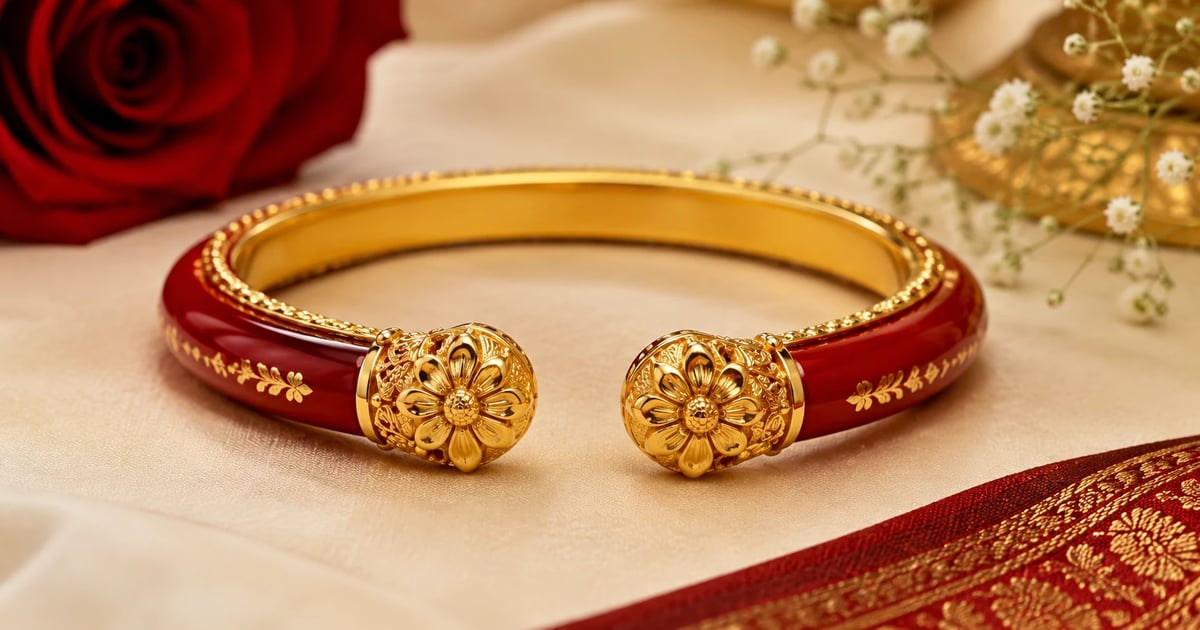
Two red bangles on the counter look nearly identical. One costs three times the other. The difference is gold weight, and a lal pola design is priced on that alone.
Most guides stop at symbolism. That leaves you knowing what pola means without knowing what you are holding. So this guide does the other half. You will get the six design types by name. Plus the gold work that separates them. And the one number on the bill that sets your price.
What a lal pola design is and who wears it
A pola is the red bangle worn by married Bengali women, usually in a pair. It sits beside the white shakha, carved from conch shell. Many women add a noa, the iron bangle, on the left wrist.
The body is no longer coral. Today it is lacquer, shaped and polished to a deep red. Gold follows, at the ends or across the surface.
Brides first receive them during the wedding. For newly married women, daily wear follows. Plenty keep them on for decades, replacing a pair when the lacquer dulls.
Why red: the meaning behind pola bangles
Red carries marriage in Bengali custom. It runs through the lal-par saree, the sindoor, and the alta on the feet. Pola belongs to that same colour language.
The white of shakha and the red of pola are read as a pair. Purity and vitality, held together on one wrist.
Families vary in what they emphasise. Some treat the pair as strictly ritual. Others treat it as identity worn in public. Both readings are common, and neither is wrong.
A note on claims you will see elsewhere. Pola is a cultural marker, not a guarantee of anything. Treat promises of luck, protection or prosperity as belief, not fact.
Shakha vs pola: how the two bangles differ
They are named together and confused constantly. But they are different objects from different materials.
Shakha is white and carved from conch shell. Artisans in Bishnupur and Bankura cut rings from the shell, then rub them smooth against stone. The Banglapedia entry on shankha records about 25 engraving motifs on conch bangles. Lotus bud, lily petal and sheaf of paddy among them.
Pola, on the other hand, is red and made from lacquer. It is moulded rather than carved, so its surface takes gold work more easily.
That single difference explains a lot. Shakha designs come from carving. Pola designs come from what gets added on top. For the white side of the pair, our gold sankha design guide covers the carving styles in detail.
Six lal pola design types worth knowing
Shops name these types in Bengali, and the names describe shape, not decoration. Learn the six and you can ask for exactly what you want.
Soru Pola: the slim daily-wear profile
Soru means slim. This is the narrow, rounded profile that sits close to the wrist.
It snags least under sleeves. As a result it is the usual pick for women who never take their pola off. Gold appears as a fine lining rather than a broad face. Browse the soru pola range to see how narrow these run.
Path Pola: the flat, broad-faced band
Path pola has a flat outer face instead of a rounded one. Plus, that flat surface photographs well and carries engraving cleanly.
It reads more formal than soru without becoming heavy. See the path pola designs for the profile difference.
Choura Chur Pola: the wide ceremonial form
Choura means broad. This is the widest of the six, closer to a chur than a bangle.
Brides choose it for the wedding day and for Durga Puja. Still, it is a lot to wear at a desk. Most women own one pair of choura chur pola and something slimmer for daily use.
Mukh Pola: gold caps at both ends
Mukh means mouth. The gold sits at the two open ends of the bangle, capping them.
Above all, this is the most recognisable gold pola design. The red body stays visible along its length. So the piece still reads as pola, not as a gold bangle. Worked ends range from plain domes to floral mesh. The mukh pola collection shows both extremes.
Design Pola: carved and patterned gold
Here the gold carries pattern across its surface. Nakshi work, meenakari colour and vine motifs all appear.
Detail costs labour, which lands in the making charge rather than the metal rate. Compare pieces in the design pola category before deciding how much pattern you actually want.
Pasting Pola: gold layered over lacquer
Pasting pola carries gold as a layer worked over the red body rather than only at the ends. The finish stays smooth and the gold covers more surface.
So ask the jeweller to show you the join where gold meets lacquer. That join is where wear shows first. The pasting pola range gives you a baseline for what clean work looks like.
Coral then, lacquer now: what changed and why
Historically, pola was made from red coral traded into Bengal by sea. That is where the name and the colour came from.
Coral stopped being an option, and not because of fashion. India lists corals under Schedule I of the Wild Life (Protection) Act, 1972. As Mongabay India reported in May 2026, that listing bans collection, trade and possession of coral. Live and dead alike. Penalties run to three to seven years' imprisonment.
So a shop offering you genuine coral pola today is offering something it should not be selling. Lacquer is the legal, standard material — not a downgrade.
That also settles a myth worth retiring. Lacquer pola is not fake pola. It is what pola is made of now.
Pola badhano: how gold work changes the look
Badhano means bound. Pola badhano is the gold added around a red bangle. It is the biggest lever on both appearance and price. In fact, gold work is what separates one lal pola design from the next.
Keep the gold at the ends alone and the piece stays quiet and red-dominant. Spread it across the face and the bangle starts reading like gold with red showing through.
Neither is more correct. But they photograph very differently, so decide which you want before you look at price.
One honest trade-off. More gold surface means more to scratch and more to re-polish. If you want low maintenance, keep the gold at the ends.
Net weight vs gross weight: the pola price trap
This is the number that matters, and almost no guide mentions it.
A gold-finished pola is mostly lacquer by weight. The gold is a small fraction of what you are holding. Gross weight is the whole bangle. Net weight is the gold alone.
The gap is large. Take SKU 13/329, a 22K soru pola pair in our own catalogue. It lists net weight 1.33 g against gross weight 13.01 g. The gold is roughly a tenth of the object.
You pay the gold rate on 1.33 g. Not on 13.01 g.
So ask for both figures before you discuss price. A quote built on gross weight for a lacquer-bodied pola is charging you gold rate for lacquer. That single question protects you more than any design knowledge in this guide.
Your bill should also split tax. GST on gold jewellery runs at 3% on metal value. Making charges attract 5%. Those are two separate lines. Rates change, so confirm the current split at the counter.
Hallmarking on pola: why HUID often does not apply
Here is the edge case that confuses buyers. Many gold pola carry no BIS hallmark, and that is often entirely legal.
The Bureau of Indian Standards exempts gold articles up to 2 grams from mandatory hallmarking. Marking pieces that small is difficult. Our example above carried 1.33 g of gold. It falls under that exemption.
So a missing HUID on a pola is not proof of fraud. Even so, do not let it pass unrecorded.
Ask instead for purity, net gold weight and gross weight on the invoice. A shop confident in its work will write it down. One that refuses has told you something useful.
Choosing a lal pola design by age and occasion
Match the width to the life, not to the trend.
A bride wants presence on camera, so choura chur or a worked mukh pola earns its place for the ceremony. Newly married women wearing pola every day are better served by soru or path, which survive sleeves and handbags.
Women in their forties and fifties often settle on one slim pair worn permanently. A broader set then comes out for Durga Puja and family weddings.
Buying for someone else? Go slimmer than you think. An over-wide pola gets left in the box, and that is the most common regret in this category.
Buying mistakes first-time pola shoppers make
Five errors account for most of the disappointment.
Sizing by guesswork tops the list. Pola does not resize like a gold bangle, so a wrong size becomes a shelf ornament.
Paying on gross weight comes next, which the section above covers. Third, buying maximum gold coverage for a wedding, then finding it too heavy for the daily wear that follows.
Fourth, ignoring the join between gold and lacquer, where poor work lifts within a year. Fifth, assuming a missing hallmark means a fake, and walking away from a legitimate piece.
Styling lal pola with shakha, noa and gold
Order on the wrist matters. The Global InCH record of West Bengal jewellery documents the usual order. Conch bangle first, then the iron bangle, then other bangles further along the arm.
Also keep the metal tone consistent. A yellow-gold mukh pola beside a rose-gold bala reads as a mismatch in photographs.
Leave the wrist some space. Pola, shakha and noa already occupy three positions, so one additional bangle is usually plenty. Our gold noa design guide covers how the iron bangle is bound in gold and where its weight sits.
Want the same red-and-gold pairing in something smaller? A pola ring suits outfits that a full bangle set would overwhelm.
Caring for a lal pola so it lasts
Lacquer dislikes two things: heat and moisture. Both dull the red and can lift the gold at the join.
First, keep sweat and water off it where you can. Apply perfume and hairspray before the pola goes on, never after. Store each pair separately, since gold surfaces scratch against other bangles.
For cleaning, a soft dry cloth is all you need. Also skip the household cleaners and the ultrasonic machine, which damage lacquer.
Expect to re-polish rather than replace. Many jewellers, ours included, clean and polish free for the life of the piece. Ask before you assume a dull pola is finished.
What to take to the shop counter
You need four things and no more. The type name you want. Your wrist size, measured properly. Net and gross weight of anything quoted. Purity written on the invoice.
Get those four and the rest is taste. Ask for the type by name. Check the join where gold meets lacquer. Refuse any quote built on gross weight.
The pola you keep wearing is the one that fits your day, not the one that photographed best.