

Ratan Chur Designs 2026 : 7 Trends Worth Knowing

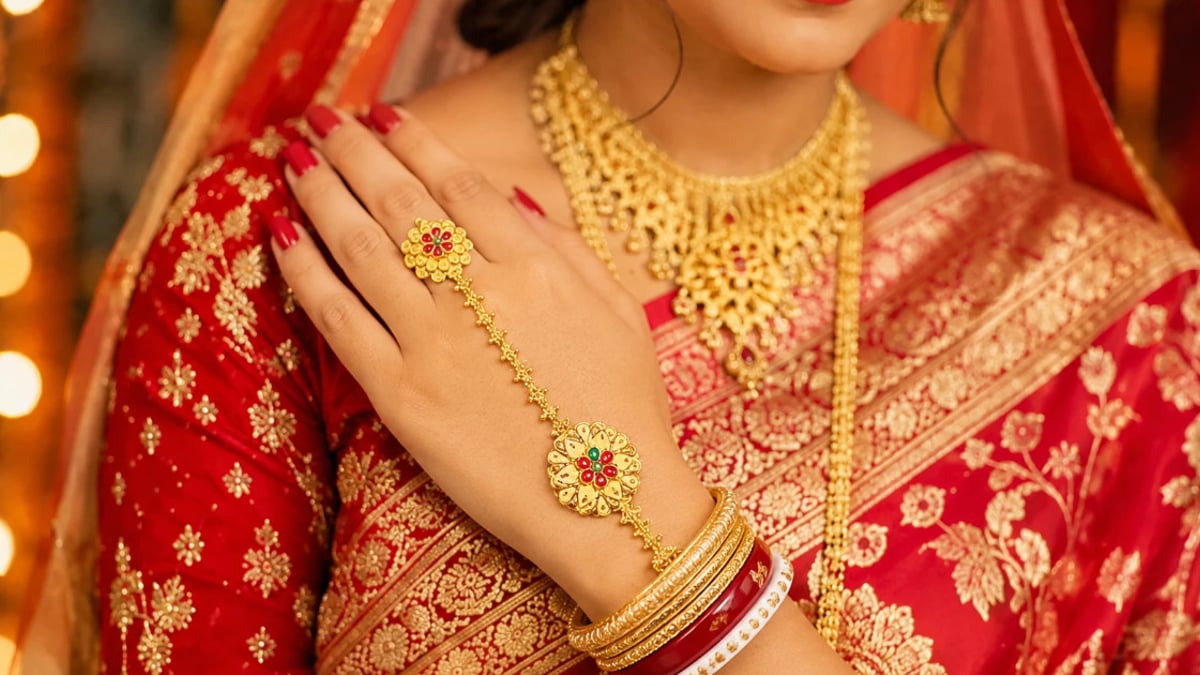
Shopping for a ratan chur right now can feel repetitive. Most showrooms open the drawer on the same broad, heavy panja. The 2026 direction is different, and it works in your favour.
Ratan chur designs trending are lighter and less rigid than the classic all-gold panja. Expect slim chains, pearl drops, floral motifs, meenakari colour, minimal single-chain styles and gemstone centrepieces. Handcrafted heritage patterns are back too. Detachable centrepieces now let you wear one piece well beyond the wedding day.
This guide covers all seven. Plus you get the mechanics most product pages skip. Fit, hallmarking, saree pairing and re-wear decide whether you love the piece in five years.
What A Ratan Chur Is And How It's Worn
Picture the back of your hand. A bracelet or cuff sits at the wrist. From there, fine chains fan outward to one or more finger rings. Where the chains meet, a decorated centrepiece rests over your knuckles.
That whole arrangement is the ratan chur, also spelled ratanchur. The five-ring version has its own name: panchangla. Single-ring and three-ring builds are just as common now.
Bengali families usually call the plain wrist piece a chur or bala. A ratan chur adds the chains and rings on top of that idea.
This is hand harness jewellery, and it is far older than Bengal. The Metropolitan Museum of Art holds an 18th-century gold hathphul from northern India, set with rubies and emeralds. Its catalogue entry traces this rings-and-chains form back to the eighth or seventh century BC. So the Bengali ratan chur is one regional branch of a very old idea.
Why Bengali Brides Still Choose A Ratan Chur
Weddings in Bengal dress the hands deliberately. Shakha and pola go on the wrists first. Then a chur or bala adds weight and shine. The ratan chur finishes the look by covering the bare back of the hand.
That surface matters more than most brides expect. During sindoor daan and mala badal, photographers shoot your hands from directly above. A bare hand reads flat in those frames. Gold across the knuckles catches the light instead.
There is a family layer too. Many Bengali households pass a ratan chur down, alongside the sitahar and the mantasha. So the piece often arrives with a name and a story attached.
Seven Ratan Chur Trends Shaping 2026
Design direction has shifted from bulk to structure. Each trend below comes with its honest trade-off. Not every one will suit your hand, and some will fight your saree.
Lightweight Gold Ratan Chur
Lightness is the biggest change of all. It is also not a passing fashion. The World Gold Council's Q2 2026 India report puts India's gold jewellery demand at 75 tonnes. That figure is 15% lower year on year, with domestic prices up almost 60%. Buyers responded by moving towards lighter, lower-carat and studded pieces.
For a lightweight ratan chur, the weight comes out of three places. Thinner link chains, a flatter centrepiece and a narrower wrist band. Ask how the weight was reduced before you commit. Hollow sections wear beautifully, but they dent more easily than solid gold.
One cost mechanic is worth knowing here. Making charges pay for labour, not for metal. So on a very light piece, that labour becomes a bigger share of your bill. Lighter does not automatically mean proportionally cheaper.
Pearl-Accented Ratan Chur Designs
Pearls have moved from the edge of the design to its centre. Some builds string small pearl drops along each chain. Others set a pearl cluster into the knuckle piece. Against a red Banarasi, that white break stops the gold from turning into one solid block.
Pearls are not replacing all-gold work, though. Plain gold still rules the heirloom end of the market. What changed is the middle of the range. Pearl detailing now appears on serious bridal gold, not only on fashion pieces.
Care is the honest trade-off. Pearls are softer than gold, so they need different handling. Perfume, hairspray and alta can dull the surface over years. Put the piece on last, once your make-up is finished. Nobody can promise a pearl will look untouched two decades later.
Mean while You should not miss our Pearl Mantasha Collection Guide for Bridal
Floral And Vine Motif Designs
Floral work itself is not new. The scale of it has changed. Older pieces used dense, symmetrical flower panels across the knuckles. The 2026 versions trail instead — a vine running along one chain, small buds near the rings.
Negative space now does half the work. This suits narrow hands especially well, because a trailing motif follows the hand's natural line. Heavy blocks can make a small hand look shorter than it is.
Meenakari Colour Work On Gold
Meenakari means coloured enamel fused onto gold. Reds, greens and deep blues sit inside carved outlines. On a ratan chur design, jewellers usually keep the enamel on the centrepiece alone. Chains stay plain, so the colour has somewhere to land.
Enamel chips if it takes a hard knock. So skip it if your rituals involve a lot of hand movement. Reverse-side meenakari solves part of that problem. There the colour faces your skin and stays protected all evening.
Minimalist Single-Chain Styles
One chain, one ring, one small centrepiece. That is the entire design. Minimal pieces appeal most to brides who plan to wear them again, not just once.
Scale is the honest limitation. A thin chain can vanish in a wide group photograph. It also competes badly with a heavily worked chur on the same wrist. So pair minimal with minimal, or leave that wrist bare.
Gemstone-Studded Centrepieces
Colour is returning through stones as well as enamel. Rubies and emeralds remain the traditional pairing for Bengali gold. What has changed is the setting height. Small stones now sit flush rather than raised, and flush stones snag far less on a zari border.
Polki, which is uncut natural diamond, appears at the premium end. Under warm mandap lighting, it photographs softer than faceted stones. Ask about setting depth and closed backs before you decide.
Handcrafted Heritage Patterns
Here is the counter-trend, and it is a real one. Some brides now want the old hand-finished work back. Filigree means fine twisted gold wire. Granulation adds tiny gold beads, one at a time. Both take a karigar — a bench goldsmith — days rather than hours.
Machine-made pieces repeat perfectly, every single time. Handcrafted gold jewellery carries small variations, and that is precisely the appeal. Ask to see the work under the shop's magnifier before you judge the finish.
Traditional Versus Modern Ratan Chur Compared
Both styles still sell well, and neither one is outdated. The real difference lies in how the piece is built.
What to compare | Traditional ratan chur | Modern 2026 ratan chur |
|---|---|---|
Centrepiece | Broad and domed, covers most of the knuckles | Flatter and smaller, often floral or pearl-set |
Chains and rings | Several thick chains, five rings common | One to three finer chains, fewer rings |
Feel on the hand | Firm and structured, sits high | Softer, follows the hand as it moves |
Finish | High-polish or antique matte gold | Mixed: matte gold, pearl, enamel, stones |
Pairs best with | Heavy Banarasi and a full traditional set | Lighter silks, lehengas, smaller sets |
Re-wear | Wedding and big pujas only | Often detachable for regular use |
Choose traditional if the piece is going into your family's collection. Choose modern if you want it out of the locker more than twice a year.
How Much Gold Goes Into A Ratan Chur
Weight varies far more than most listings admit. A slim single-chain design and a five-ring panchangla are not remotely comparable. So ask for two numbers, never one.
Gross weight includes stones, pearls and any lac filling. Net gold weight is what you actually pay for as metal. A pearl-heavy piece can look substantial while holding less gold.
Purity is a separate question from weight. Indian Standard IS 1417:2016 allows hallmarking at 14K, 18K, 20K, 22K, 23K and 24K. Most bridal work in Bengal is 22K gold, marked 916.
Now for the detail almost no product page mentions. The hallmarking FAQ published by the Bureau of Indian Standards is clear on multi-part jewellery. Each article in a pair carries its own hallmark, and so does every detachable part. Each of those marks has a different six-digit HUID, the unique code laser-marked on every hallmarked piece.
Check this yourself before paying. Registered jewellers must keep a 10x magnifying glass on the counter for exactly this purpose. You can then verify each HUID in the BIS Care app.
How To Choose A Ratan Chur You'll Actually Wear
Work through these in order, and most fit problems disappear.
Fix the hand first. Decide which hand carries the piece, then measure that ring finger properly.
Allow for swelling. Fingers swell in mandap heat and under fresh mehendi.
Ask for an adjustable ring. An open-back or screw ring absorbs a half-size change without a goldsmith.
Check chain length while seated. Curl your fingers, then flatten them. The chain should not go taut.
Test it against your fabric. Bring the actual saree or lehenga sleeve to the counter.
Confirm the making time. Handcrafted work always takes longer than ready stock.
If you are ordering three weeks before the wedding, the squeeze lands here. Custom work needs time, and ring size is usually the first casualty. A ready design with an adjustable ring is the safer call that late. Browse our ratan chur designs to see which builds are held in stock.
Styling A Ratan Chur With Sarees And Lehengas
Fabric decides the design far more than trend does.
Red Banarasi with heavy zari: go broader and flatter, and insist on flush-set stones so nothing catches the weave.
Katan or Kanjivaram silk: a smooth link chain reads cleanly against that tight, glossy surface.
Jamdani or soft tussar: stay minimal. One chain and one ring is plenty against fine cotton.
Lehenga with a fitted sleeve: shorten the wrist band, otherwise it rides up under the cuff all evening.
Half-sleeve or sleeveless blouse: leave the forearm clear, or balance it with a mantasha higher up.
Balance across both hands as well. A loaded ratan chur on one hand wants a quieter wrist opposite. Shakha, pola and a heavy chur stacked on the same arm will crowd the frame. Slim wristlets are the easier partner on the second hand.
Wearing Your Ratan Chur After The Wedding
Most brides wear it twice, then stop. Choices made at the counter decide whether that happens to you.
Detachable centrepieces come off and hang as a pendant. Some wrist bands unclip and work alone as a slim bracelet. A single-chain design can go straight to a Durga Puja evening or a Poila Boishakh lunch.
So ask one question before you pay. Which parts of this come apart, and what does each one become? If the answer is none, you are buying a once-a-year piece. That is a perfectly fair choice — just make it knowingly.
Storage matters more than people expect. Keep it flat in a soft pouch with the chains uncrossed. Tangled chains stretch links and weaken solder joints over time.
Where To See These Ratan Chur Designs In Person
Photographs flatten gold. Depth, chasing and enamel colour all shift under real light. So the last step belongs at a counter, on your own hand.
Take your saree, take your ring size, and take your time. Compare a broad traditional build against a slim modern one. The difference in weight and drape becomes obvious within a minute.
Our ratan chur designs are the place to start. From there, the wider gold jewellery collection shows how a complete Bengali wedding jewellery set comes together.