

Pearl Mantasha: The Complete Bengali Bridal Guide

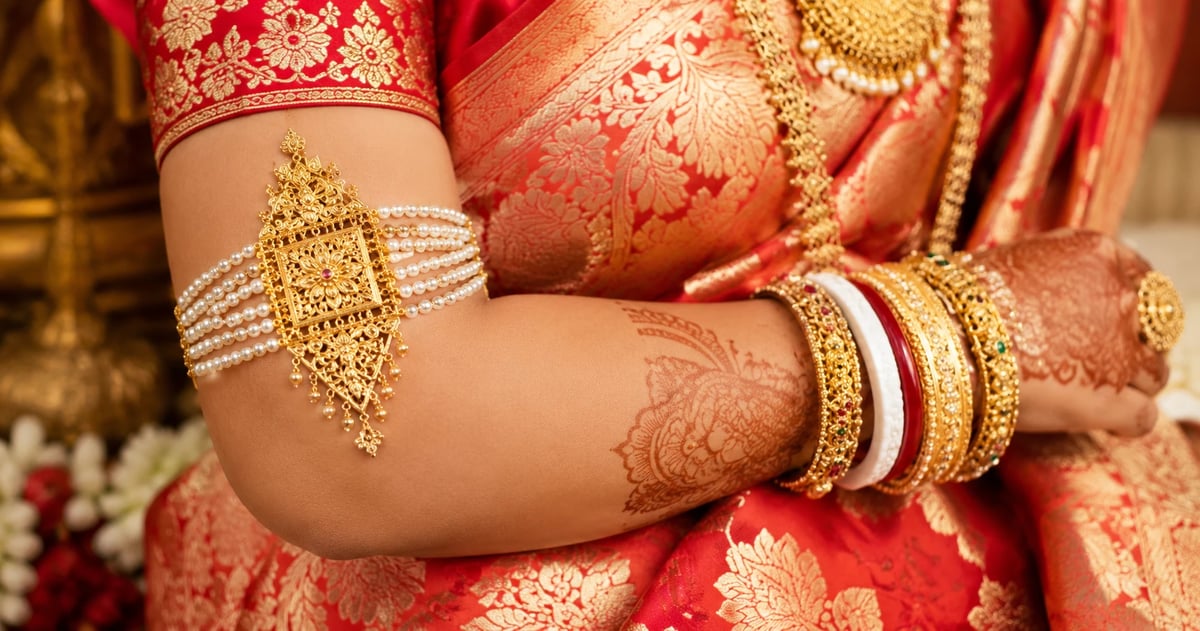
You've seen the pearl mantasha on a cousin, in a photo, behind a shop window. But nobody explained what it is. Here's the short version. A pearl mantasha is a broad Bengali wristlet set with strands of pearls in gold. The mantasha design came from the Mughals, not from modern bridal fashion.
Most pages selling one skip that part. They show designs and a price, then stop. This guide covers the rest. Where the piece came from. How to tell a good one from a filler. And what you'll do with it after the wedding.
What a pearl mantasha actually is
The shape gives it away. A mantasha is broad, and it sits on the forearm rather than snug at the wrist. The pearl version threads strands of pearls into or alongside that gold framework.
WeddingSutra's guide to jewellery for the Bengali bride describes it as a broad wristlet with golden lacework. It also carries a fine chain to a finger ring. And that chain does real work. It anchors the piece at two points, so the mantasha lies flat and doesn't rotate.
Width is the second difference. A bala is narrow and closed. A mantasha covers several centimetres of forearm. So it photographs as a fuller ornament, even when the metal is light.
Shops list the same piece under several names. Pearl mantasha bracelet, pearl mantasha bangle and mantasha wristband all point to this ornament.
Where the mantasha design came from
Trace the design back far enough and you land in a Mughal workshop. The Asia InCH heritage encyclopedia, run by the Craft Revival Trust, records the mantasha as a Bengali wristlet. It describes strands of pearls and precious stones in a gold setting. That entry states plainly that the origin of the design was Mughal.
So the mantasha entered Bengali jewellery the same way the ratanchur did. Both arrived through Mughal court taste. Local swarnakars, the goldsmith community of Bengal, then reworked them.
The same source notes something useful for you. Some varieties of mantasha carry no jewels at all. Just worked gold or silver. Pearls are traditional here, but they were never compulsory.
Kolkata's goldsmithing quarters still cluster where they always did. Bowbazar, Baghbazar, Bhawanipur, Kalighat and Gariahat remain the trade's centres of gravity.
Why pearls and mantasha go together
Pearls weren't bolted onto the mantasha by a marketing team. They sit in the heritage description of the ornament itself.
There's a practical reason too. A broad gold band across the forearm can look flat under wedding lighting. Pearl strands break that surface up. They also catch light from a different angle than polished gold does.
Colour helps as well. Bengali brides usually wear red, most often a lal paad Benarasi. Against red silk, white pearls read cleanly. Gold on gold tends to blur in photographs.
Then there's weight. Pearls fill visual space without adding much mass. That matters when the mantasha is the widest thing on your arm.
Four pearl mantasha styles worth comparing
Four builds cover almost everything you'll be shown. The differences aren't cosmetic. They change what you pay, what you can wear it with, and how long it survives.
Traditional bridal mantasha in solid gold
Wide gold framework, worked in naksha or filigree, with pearl strands along the edges or across the face. This is the heirloom version. It's the heaviest of the four, and the one that gets handed down.
Choose it if the mantasha is going into the family, not just onto the wedding photos.
Lightweight pearl mantasha for weddings
Same visual width, far less metal. Makers get there with hollow or shell construction, wider pearl coverage, and open lacework instead of solid panels.
A lightweight pearl mantasha suits a bride in a heavy Benarasi with a full neck stack. Your forearm is already carrying shakha, pola and often a bala. Adding a dense solid-gold piece on top gets uncomfortable by the fourth hour.
Asia InCH also records the wider shift. Lighter ornaments with minimal stones and fine craftsmanship are what buyers now seek.
Gold-plated and micro-plated pearl mantasha
Here the base is brass, copper or silver, with a gold layer applied on top. The trade separates these by coating thickness, measured in microns.
A very thin flash or wash coating gives colour and little else. Micron plating lays down a measurably thicker layer and lasts longer under friction. Neither is solid gold. Neither should be sold to you as such.
Plated pieces make sense for a reception look or a sangeet. They also work as a second mantasha in a colour you'd never buy in gold.
Designer and meenakari pearl mantasha
Meenakari is enamel work, a Persian technique Indian craftsmen adopted centuries ago. On a mantasha it shows up as coloured enamel panels between pearl rows.
Designer versions also play with pearl colour, using grey, peach or baroque pearls instead of round whites. Baroque simply means irregularly shaped.
A handcrafted pearl mantasha in this style photographs beautifully. It also dates faster than a plain naksha piece. Think about that before committing serious gold to one.
Mantasha vs bala, bauti and ratanchur
Bengali brides rarely wear one thing on the wrist. Knowing what the mantasha competes with stops you buying two ornaments that do the same job.
Ornament | What it is | Where it sits | Pearls typical? | Life after the wedding |
|---|---|---|---|---|
Mantasha | Broad wristlet, often with a chain to a finger ring | Forearm, above shakha-pola | Yes — part of the traditional description | Pujas, festivals, family weddings |
Bala | Thick closed gold bangle, usually inherited | Wrist | Rarely | Frequent, sometimes daily |
Bauti | Half-cut bangle filled with lac, coated in gold | Wrist | Rarely | Regular wear across Bengal |
Ratanchur | Wristlet plus chains to five finger rings | Back of the hand | Sometimes | Occasional |
One convention is worth knowing before you shop. WeddingSutra notes that if a Bengali bride wears a mantasha, the ratanchoor is usually left out. Both ornaments claim the hand. Wearing them together reads as crowded rather than rich.
Our guide to ratan chur designs for 2026 breaks down what that piece does differently.
How to spot a well-made pearl mantasha
Lustre first. The Gemological Institute of America calls lustre possibly the most important of its seven pearl value factors. GIA describes excellent lustre as reflections that appear bright and sharp. Poor lustre, on the same scale, means reflections that are dim and diffused.
Now tilt the piece under the shop light. You should see a small sharp highlight on each pearl. A soft glow with no defined edge means weaker lustre.
Next, look for chalkiness. GIA says a dull, chalky look means the nacre is thin. Nacre is the layered coating that makes a pearl a pearl. Also, a visible nucleus under the surface points the same way. Thin nacre hurts both shine and durability.
Third, check matching across the strand. GIA treats matching as a value factor of its own for multi-pearl jewellery. Run your eye down the row. Sizes and tones should step evenly, not jump.
Now ask out loud: are these natural, cultured or imitation pearls? Cultured pearls are real pearls farmed with human help. They're what most genuine pearl jewellery uses today. Imitation pearls are glass or plastic with a coating. On the cheapest marketplace listings, assume imitation unless the seller says otherwise in writing.
Finally, work the hardware. Open and close the clasp five or six times. Press gently where the pearl strand meets the gold. Loose settings and a gritty hinge are the two failures that surface first.
If the piece isn't solid gold, ask for the plating figure in microns. Don't accept "gold-plated" on its own as a description.
What makes one mantasha cost more
Two things move the number more than anything else. How much gold is actually in the piece. And what kind of pearls sit on it.
After that, the drivers stack up like this.
Construction. Hollow and shell builds use less metal than solid panels of the same width.
Pearl grade. Round, well-matched, high-lustre pearls cost more than uneven ones. GIA notes round is the hardest shape to culture, and therefore the rarest.
Handwork. A handcrafted naksha or filigree face takes days. Cast or machine-finished pieces don't.
Meenakari. Enamel adds a separate specialist's labour to the same piece.
Plating spec. On non-gold pieces, a thicker micron layer costs more and lasts longer.
Gold rates move daily. So any figure you read online is stale by the time you reach a counter. Ask your jeweller for a current written quote against the exact piece and its weight. That's the only number that means anything.
Styling a pearl mantasha with your bridal saree
Red Benarasi is the default, and pearls were made for it. White pearls against a red and gold weave give your wrist a defined edge. Gold-only ornaments tend to melt into a zari border.
Baluchari and Swarnachari sarees are busier, with figurative woven panels. Against those, keep the mantasha simpler. Fewer pearl rows, less enamel, so the wrist doesn't compete with the drape.
Garad and off-white silks are the easy case. Almost any pearl mantasha works here. A design with coloured meenakari earns its place better than it does on red.
Now the arm itself. Shakha and pola sit closest to the hand and don't move. The shakha is conch shell. The pola is red coral. Your mantasha goes above them, with the finger chain running over the back of the hand.
Leave a gap. Stacking the mantasha flush against the pola makes the forearm read as one solid band. Our guide to gold sankha design trends covers how that base layer is changing.
If your neckline is already crowded, thin the wrist rather than the neck. One bala plus the mantasha usually beats a bala, a chur and a mantasha together. Our comparison of pearl sitahar and gold sitahar covers how the neck piece should relate to your arm.
Proportion matters as well. Slim forearms carry a narrower mantasha better. On a fuller arm, a very narrow piece reads as a mismatched band. A broader one balances it.
Wearing your mantasha after the wedding
This is where most brides get stuck, and where most product pages go quiet. A mantasha is a formal ornament. So you won't wear it to work.
But it isn't a single-use object either. Durga Puja, Lakshmi Puja and the Ashtami morning are exactly what it was made for. Family weddings, annaprashan ceremonies and Poila Boishakh all work.
Three habits separate a piece that comes out yearly from one that stays in the locker.
Buy for the second occasion, not only the first. A slightly quieter design gets worn more often than a maximal one.
Wear it without the finger chain. Many mantasha designs detach at the ring. That turns a bridal ornament into a wide cuff.
Pair it down. With a plain Dhakai jamdani and no other wrist jewellery, a pearl mantasha stops looking bridal and starts looking deliberate.
For genuine everyday wear, a bauti or a bala is the more sensible buy. Our budget guide to bauti design bangles lays out that side of the wardrobe.
Caring for pearls so the shine lasts
Pearl sits at 2.5 on the Mohs hardness scale, according to GIA. Very soft, and easily scratched or abraded. That single fact should shape everything you do with the piece.
GIA's pearl care guidance is direct about chemicals. Pearls can be damaged by many chemicals and all acids. The GIA list includes hair spray, perfume, cosmetics and even perspiration. So the mantasha goes on after your makeup and attar, never before.
For a Bengali wedding, add sindoor and alta to that list. Both are pigment suspensions. Both sit exactly where your hand ornaments do.
GIA says pearls should never go into an ultrasonic or steam cleaner. Warm soapy water is safe for occasional thorough cleaning. For routine care, wipe the pearls with a very soft, clean cloth after each wearing.
Two more from the same source. High heat can burn cultured pearls or cause discoloration, splitting or cracking. So keep the piece out of a hot car boot. Direct sun on a summer afternoon does the same damage.
Also, store it in a soft cloth pouch of its own, not the family locker's shared tray. Kolkata's monsoon humidity is hard on plated bases. A silica sachet in the box is cheap insurance.
Pearl mantasha questions brides still ask
Is a pearl mantasha suitable for daily wear?
No, and anyone telling you otherwise is selling. Pearl's hardness of 2.5 on the Mohs scale means daily friction dulls it. A broad forearm piece also catches on sleeves and bag straps. Wear it for occasions instead. For everyday use, buy a bala or a bauti, and keep the mantasha for days that deserve it.
Are pearl mantashas made with real pearls?
Some are, many aren't. Genuine pieces use cultured pearls, which are real pearls grown with human intervention. Cheaper market pieces frequently use imitation pearls made of glass or coated plastic. Neither is dishonest if it's disclosed. Ask the seller to state the pearl type on your bill. Treat a refusal as your answer.
What's the difference between gold-plated and gold pearl mantasha?
A gold mantasha is gold throughout, and its value tracks its weight. A gold-plated mantasha is brass, copper or silver with a gold surface layer. It's priced for the design rather than the metal. Plating wears at friction points and can be redone. Solid gold can be melted and remade.
Where can I buy a pearl mantasha online?
Buy from a jeweller who publishes weight, metal and pearl type on the product page. A physical showroom you could actually visit is the second filter. Browse our pearl mantasha collection or the wider gold and pearl mantasha range. The cheapest marketplace listings are almost always plated bases with imitation pearls.
Can I wear a pearl mantasha on both hands?
Traditionally it's worn on one. The mantasha carries a finger chain and needs room. Bengali brides usually balance it with a bala or chur on the other arm. Matched pairs exist, but they crowd the look and double the cost for little gain.
Does a pearl mantasha suit a mehendi or reception look?
For mehendi, skip it. The piece covers exactly the forearm your artist wants. For a reception, a gold mantasha works well with a gown or a lighter saree. A plated piece in a lighter colourway does the same job.
What to settle before you buy
Three decisions do most of the work. Solid gold or plated, which comes down to heirloom versus outfit. Wide or narrow, which follows your forearm and your saree. And pearl type, which you should get in writing.
Then take the piece to natural light before you pay. Tilt it. If the highlights are sharp and the strand steps evenly, you're looking at a mantasha worth keeping.