

One Gram Gold Ring Price & 9 Best Designs 2026
 Sujoy Dhar
10 min read
Sujoy Dhar
10 min read
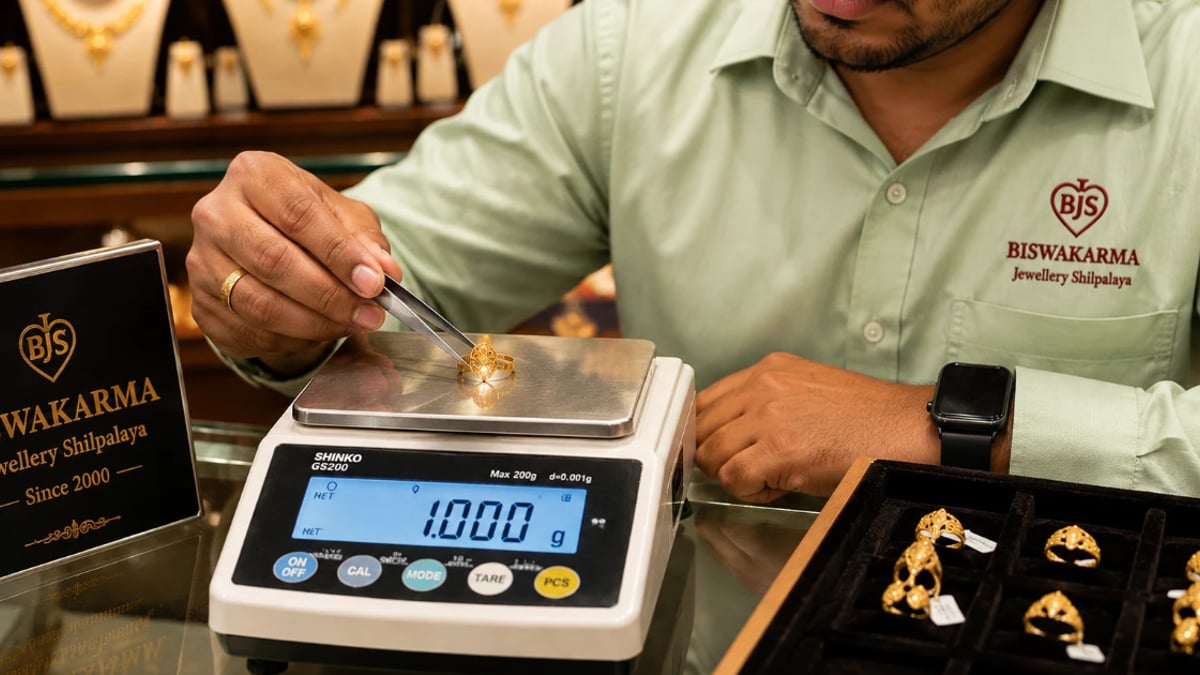
A one gram gold ring in 22K costs about ₹17,400 in Kolkata right now. That is ₹15,045 of gold, plus making charges, a ₹45 hallmark charge and 3% GST. The gold figure comes from our own Kolkata gold rate board, timestamped 30 August 2026.
Most pages ranking for this price were built on a rate that has since moved. And almost none of them mention the one rule that matters most on a ring this light.
That rule is the reason this guide exists.
What a one gram gold ring costs today
Start with the metal. Everything else is a charge sitting on top of it.
The price table, line by line
Our Kolkata board showed 22K at ₹15,045 per gram at 11:04 am on 30 August 2026. Here is a 1.000 g plain band worked from that number.
Line | Amount |
|---|---|
Net gold weight | 1.000 g |
22K (916) board rate, 30 Aug 2026, 11:04 am | ₹15,045/g |
Gold value | ₹15,045 |
Making charge, worked at 12% | ₹1,805 |
Hallmark charge (BIS, per article) | ₹45 |
Subtotal | ₹16,895 |
GST @ 3% | ₹507 |
Total | ₹17,402 |
So the all-in cost lands near ₹17,400. That is roughly 16% above the raw metal value.
One honest caveat. The making charge above is worked at 12%, the same figure our gold calculator guide uses in its example. Your shop may quote differently. Ask for it in rupees, not as a percentage.
You can check our Gini Ring Collection for Ladies for Occassional Wear
Why most price pages you find are stale
Gold moved hard through 2025 and 2026. The World Gold Council's India demand report for Q2 2026 recorded a nearly 60% year-on-year rise in prices. That kept constraining affordability, it said, and pushed buyers towards lighter-weight, lower-carat jewellery.
That shift is why you are searching this phrase at all.
It also means something simpler. Any 1 gram gold ring price built on a ₹8,000 rate describes a market that ended. Check the timestamp on any rate board before you trust the total under it.
Real gold or plated? Two products, one phrase
Here is the confusion nobody clears up. "One gram gold" means two completely different things in the Indian market.
One meaning is literal. A 22k 1 gram gold ring weighs one gram on the scale and carries a 916 stamp. The other meaning is a trade label for brass or copper jewellery with a thin gold coating. Search the phrase on any marketplace and both appear in the same list.
The ranking pages disagree with each other too. Some say one gram gold has only a plated exterior and little resale value. Others insist it uses genuine gold throughout. Both are describing real products. They are just describing different ones.
The three-step test that settles it
You do not need to take anyone's word for it. Run these three checks instead.
Put it on the scale. A real 1 gm gold ring weighs about one gram, and it looks it. Thin band, nothing more. Gold is far denser than brass. So a chunky, wide ring sold as "one gram gold" is plated, not solid.
Look for 916 under a magnifier. That stamp means 22 carat, or 91.6% fine gold. A plated piece will not carry it legitimately.
Check the price against the rate. At ₹15,045 per gram, a real 1 gram ring cannot cost ₹800. If it does, it is plated. That is arithmetic, not opinion.
Plated rings are not a scam by themselves. Plenty of people buy them knowingly for fashion. The problem is buying one while believing it is bullion-grade metal.
Why the hallmark rule changes below 2 grams
This is the part almost nobody publishes, and it is the most useful fact on this page.
A gold article weighing less than two grams is exempt from mandatory hallmarking in India. It sits at item (b) on the BIS list of hallmarking exemptions under the Quality Control Order. So your 1 gram ring is legally allowed to leave the shop without a hallmark.
BIS explains why. Marking some designs weighing up to 2 grams is physically difficult. But the same BIS guidance adds something important. Jewellers may still get these pieces hallmarked by an Assaying and Hallmarking Centre. The centre tests under IS 1418 first.
Read that again. On the single most affordable real-gold item in India, your main protection is optional.
What ₹45 buys you on a light ring
Now the number that makes this concrete.
The BIS hallmarking charges FAQ puts hallmarking at ₹45 per gold article. The same page states plainly that hallmarking charges do not vary with the weight of the article. There is a ₹200 minimum per consignment, but that is spread across a batch.
So the cost of doing the right thing on a ₹17,400 ring is ₹45. Under three-tenths of one percent.
That reframes the whole conversation at the counter. "It is too light to hallmark" is true as a rule. It is not true as a reason. Ask whether the shop will hallmark it anyway, and watch how the answer lands.
Since 1 July 2021 a hallmark carries three marks. Those are the BIS logo, purity in carat and fineness, and a six-digit HUID. You can verify that HUID yourself in the BIS Care app before you pay.
Nine ring designs that work at one gram
One gram is genuinely thin. A design that ignores that will look mean on the finger. So a light weight gold ring design has to earn its look from shape, not mass.
These nine hold up.
Plain tapered band. Wider at the top, narrowing at the back. It puts the metal where you see it.
Half-round comfort band. Rounded outside, flat inside. Sits well for daily wear and hides thinness.
Twisted rope band. Two thin wires wound together. The twist reads as volume without needing extra grams.
Beaded edge band. Tiny raised dots along both rims. An old Bengali workshop trick for making light metal look considered.
Single-initial signet. A small flat top with one engraved letter. Popular as a 1 gram gold ring for men and for teenagers — our gold ring designs for boys covers this shape by age.
Open adjustable shank. The ends do not meet, so the size adjusts. Best pick for a 1 gram gold ring for girl of eight or ten, because it avoids resizing loss later.
Tiny floral top. One small motif on a plain shank. This is the classic simple design for female buyers.
Two-tone thin band. A rhodium stripe against yellow gold. Contrast does the work that width normally does.
Cut-work open band. Pierced pattern through the band face. It looks wider than it weighs.
A one gram gold ring for ladies usually comes down to two of these — the thin band or the small motif top. Both carry well at this weight.
What does not work: wide bands, stone settings, and anything with a hollow dome. Each needs more metal to hold its shape, or it dents within a year. That is a craft limit, not a sales pitch.
Want something with more presence? Our umbrella ring designs and price guide works four real examples from 1.85 g upward.
Making charges on a light ring, and the trap
Here is the mechanism nobody explains. The karigar's labour does not shrink when the ring does.
Soldering a joint, filing a shank, polishing a band. Each takes roughly the same bench time at 1 gram as at 5. So a percentage making charge, applied to a very small gold value, pays the workshop very little. Shops respond in one of two ways. They quote a higher percentage on light pieces, or they set a flat minimum per ring.
Neither is dishonest. But the two produce different bills, and nobody warns you.
Flat charge versus percentage, worked out
Say a shop sets a flat ₹1,800 making charge per ring, regardless of weight.
On a 1 gram ring, the bill comes to ₹17,397 all-in. That is ₹17,397 per gram. On a 2 gram ring, the same flat charge spreads across twice the metal. The total becomes ₹32,893, or ₹16,447 per gram.
That is ₹950 per gram cheaper, from nothing but arithmetic. The gold rate never changed.
We publish no national making-charge range, because there isn't one. Pages that quote 8–25% are guessing. Ask your shop for the rupee figure and compare that instead. Our gold calculator guide for Indian jewellery bills shows the workaround. You can back out the real percentage from any bill in about a minute.
Who should buy 1 gram, and who should buy 2
A 1 gram ring is a fair purchase for some buyers and a poor one for others. Here is the honest split.
Buy at 1 gram if it is a first gold piece for a teenager. Or a small gift for a birthday or annaprashan. Or your one real-gold item on a tight budget. A lightweight ring you actually wear beats a heavier one you cannot afford.
Buy at 2 grams if you want it hallmarked without asking twice. Or you want a design with real surface detail. Or you plan to wear it daily for years. Thin bands do wear through.
Do not buy either for a baby. A ring small enough for an infant finger comes off and goes in the mouth. A bangle or a chain is the safer gift at that age. That is a safety point, not a sales one.
The 1 gram versus 2 gram comparison
1.000 g ring | 2.000 g ring | |
|---|---|---|
Gold value at ₹15,045/g | ₹15,045 | ₹30,090 |
Making charge @ 12% | ₹1,805 | ₹3,611 |
Hallmark charge | ₹45 | ₹45 |
GST @ 3% | ₹507 | ₹1,012 |
Total | ₹17,402 | ₹34,758 |
All-in cost per gram | ₹17,402 | ₹17,379 |
Mandatory hallmarking | Exempt | Applies |
Notice the second-to-last row. At the same percentage making charge, the per-gram cost barely differs. The gap only opens up when the shop uses a flat minimum, as shown above.
The 2 gram ring does cross the hallmarking threshold, though. Exactly 2.000 g is not below two grams, so the exemption stops applying. The same weight-versus-price logic runs at heavier weights too — our 8 gram gold necklace price guide works it on a bigger piece.
Six checks to run at the counter
Do these before you pay. They take under five minutes.
Weigh it in front of you. Ask for the net gold weight, not gross. Anything that is not gold should be off the scale.
Ask for 916 under the magnifier. A registered jeweller keeps a 10x glass for exactly this.
Ask whether it is hallmarked, and if not, why not. Under two grams the honest answer is the exemption. Then ask if they will hallmark it.
Check the HUID in the BIS Care app. Six digits, alphanumeric, verified on your own phone in seconds.
Read the invoice lines. BIS requires the bill to show the description, net weight, purity in carat and fineness, and hallmarking charges separately.
Ask for making in rupees. A percentage on a 1 gram gold ring hides how small the base is.
If you want the longer version of this, our gold purity check before buying walks through each mark in detail. And hallmark gold versus BIS gold clears up the two labels people mix up.
Where can I see one gram gold ring designs with price?
Weights and rates are what you need, not photographs alone. Our ring guides on the blog carry real weights, and the ring collection lists current pieces. Put any weight and the current rate into the BJS gold calculator. That gives you a figure to check against a bill.
What to do before you pay
Three numbers decide this purchase. The board rate with its timestamp, the making charge in rupees, and whether the piece carries a HUID.
Get those three and the rest is addition.
And if a shop tells you a 1 gram ring cannot be hallmarked, they are half right. It does not have to be. It still can be, for ₹45.