

Gini Ring Meaning, Designs & Complete Buying Guide

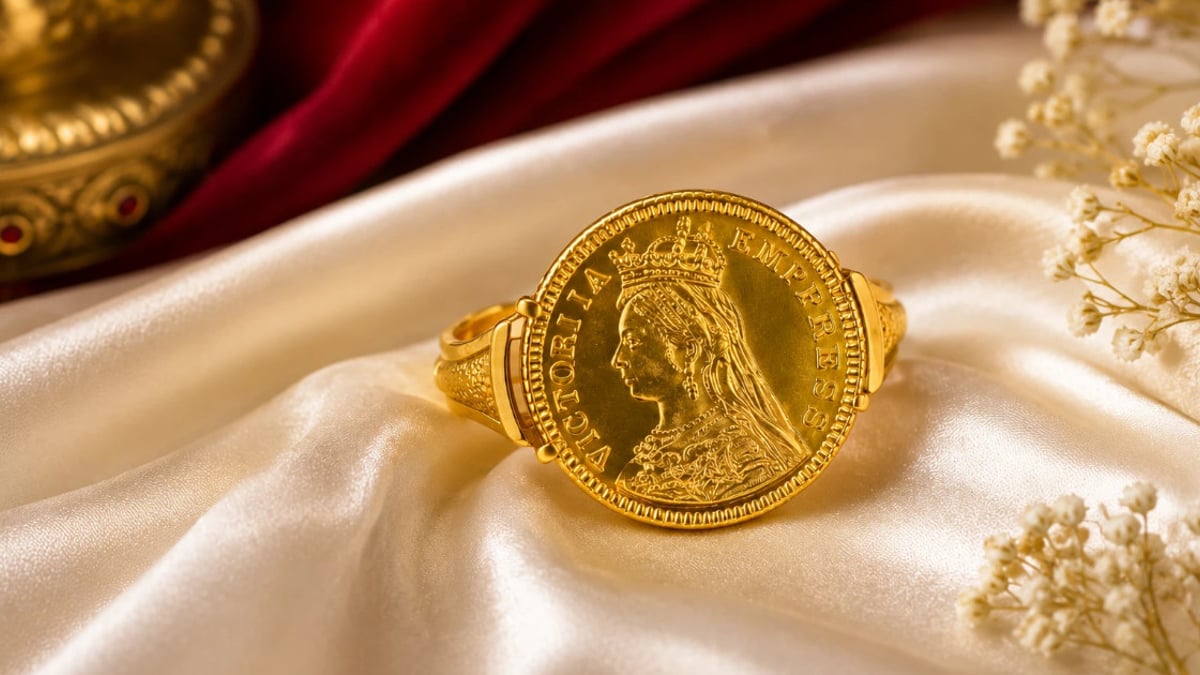
Someone hands you a gold ring with a coin face and calls it a ginni. Nobody explains what a gini ring actually is, or whether that coin is real.
A gini ring is a traditional Indian gold ring built around a coin-shaped face. The name comes from gini or ginni, the everyday Indian word for a gold coin. Most are not made from legal tender. Instead, the jeweller crafts a coin motif and sets it into the ring.
That answer takes ten seconds. The useful part takes longer. Below you get the origin of the name and the history behind the design. Plus the checks that separate a good gini ring from an expensive mistake.
Why it is called a gini ring
The word traces back to the guinea, a British gold coin. According to the Royal Mint's history of the guinea, it was first struck in 1663 under Charles II. It took its name from the Guinea Coast in West Africa, the source of much of its gold.
The guinea was struck in 22 carat gold. That is the same purity Indian families still buy today. It stayed in circulation until 1814, then the gold sovereign replaced it after the Coinage Act of 1816.
The coin left, but the word stayed. In Hindi, Bengali and Gujarati, gini or ginni came to mean a gold coin of any kind. So a gini ring is simply a coin ring, named in the language people actually spoke.
How coin jewellery took root in Bengal
Gold coins were savings before they were ornaments. British sovereigns circulated widely across colonial India. The Royal Mint cites an 1866 Gazette of India entry, recording that bankers and merchants sought them as reserve wealth.
Then the war changed the supply route. Gold bound for London from South Africa was diverted, so the Royal Mint opened a branch inside the Bombay mint. Between August 1918 and April 1919 it struck 1,294,372 sovereigns, each marked with a small "I" for India.
That was the only year sovereigns were minted here. Even so, the coins already sat in family lockers across the country. Calcutta was the capital of British India until 1911, and Bengali households held gold the same way others did.
Turning a saved coin into something wearable was practical, not decorative. A coin in a locker earns nothing socially. A coin on a finger travels to every wedding.
One honest correction, though. The gini ring is not exclusively Bengali. South India has its own coin tradition in the kasu malai. Coin motif jewellery appears across Gujarat and Rajasthan too. Bengal adopted the form warmly rather than invented it.
What the coin motif stands for
A coin means stored value. That is the whole symbolism, and it needs no decoration.
In practice the motif carries a few layers. Wearing gold you could otherwise sell signals security. Handing a gini ring to a daughter passes on both the metal and the habit of saving in it. Many designs feature Lakshmi, associated with prosperity, which reinforces the same idea.
Be careful with claims beyond that. Gini rings are not lucky charms, and no jeweller can promise you protection or good fortune. The meaning is cultural and personal, not magical.
Why gini rings are selling again
Small gold pieces are having a moment, and price is the reason. The World Gold Council's Q1 2026 India Focus put Indian gold demand at 151 tonnes. That is up 10% year on year, with value at a Q1 record.
The same report noted rising traction in plain gold jewellery and a sharp increase in coin sales. When gold is expensive, buyers move to lighter, simpler pieces. A gini ring fits that shift precisely.
Design has moved too. Thinner shanks, flatter coin faces and cleaner rims read as contemporary rather than dated. The motif is old; the proportions are not.
Gini ring vs coin ring vs signet ring
These three get mixed up constantly, especially online. The differences are real and they affect price.
Gini ring | Coin ring | Signet ring | |
|---|---|---|---|
The face | Coin-style disc made by the jeweller | Often an actual coin, set or reshaped | Flat seal, initials or crest |
Where the name comes from | Gini or ginni, meaning gold coin | Plain English description | Wax-sealing signets of Europe |
Typical metal in India | 22K gold | 22K gold, or a foreign coin | 18K or 22K gold |
What is on it | Deity, floral border or plain rim | Whatever the original coin showed | An engraved monogram |
Who buys it | Festive and everyday wearers | Collectors and gift buyers | People wanting a personal mark |
The practical takeaway is simple. If a seller says "real coin", ask which coin, and ask to see it. A genuine sovereign carries its own weight and markings, and the price should reflect that.
Gini ring designs you will actually see
Walk into any shop and the range narrows to four families. Ask for a gini finger ring by name and you will be understood.
Plain coin-face gini rings
A smooth disc with a raised rim and light engraving. This is the lightest option and the easiest to clean. Because there are fewer crevices, dust does not collect, which matters more than most buyers expect.
Antique-finish gini rings
Here the jeweller darkens the recesses so the raised detail stands out. The look is deliberately aged. Antique finish is a surface treatment, not a purity grade, so it should never change the karat you are quoted.
Stone-set and diamond gini rings
Small stones ring the coin face or sit in the shank. Diamond versions are often built in 18K gold rather than 22K, since harder metal holds prongs better. Ask which karat you are paying for, because the rate differs.
Gini rings for men
Yes, men wear them, and they always have. A men's gold gini ring uses a wider coin face, a heavier shank and a plainer finish. You will find both in the ring collection at Biswakarma Jewellery Shilpalaya.
Don't Miss our Popular one gram Gold Ring Collections
How much gold a gini ring really uses
Start with a benchmark. A full British sovereign weighs about 7.98 grams in 22 carat gold. A ring built to that diameter therefore starts near 8 grams, before the shank is added.
Most gini rings are smaller than that. Everyday pieces use a reduced coin face, and the shank is kept slim to control weight. Lighter rings cost less and sit more comfortably for long hours.
Never accept a weight range. Ask for the exact figure in grams, written on the bill. Weight drives most of your price, so an approximate number costs you real money.
Our umbrella ring designs and price guide works through four real 22K weights and what each one cost. The same arithmetic applies to a gini ring.
Checking purity: hallmark, HUID and your rights
This is the section most gini ring pages skip entirely. It is also the one that protects your money.
The three marks on a hallmarked gini ring
Since 1 July 2021, hallmarked gold in India carries three marks, not four. The Bureau of Indian Standards names three. They are the BIS Standard Mark, purity in carats and fineness, and a six-digit HUID code.
Purity is written as a pair. A 22 carat gini ring shows 22K916, meaning 91.6% gold. An 18 carat piece shows 18K750. BIS standard IS 1417:2016 originally covered 14, 18 and 22 carat. An amendment later added 20, 23 and 24 carat.
HUID stands for Hallmark Unique Identification. It is a six-character code unique to that one ring. Download the free BIS Care app, open Verify HUID, and enter the code before you pay. The app returns the jeweller's registration number, the purity and the testing centre.
If nothing comes up, stop. A stamp with no database record is not a hallmark.
What to do if the purity is short
You have a specific legal remedy, and hardly anyone knows it. Under Rule 49 of the BIS Rules, 2018, BIS sets the amount. Compensation for a purity shortfall is two times the difference, plus testing charges.
You can also test independently. Any BIS-recognised Assaying and Hallmarking Centre will test a consumer's article for a fee. It then issues an assay report, which helps later when you sell or pledge the piece.
Keep the bill for as long as you keep the ring. BIS confirms a hallmark stays valid for the lifetime of the jewellery.
What a gini ring costs, line by line
There is no single gini ring price in India, because gold moves daily. What stays constant is the structure of the bill. Ask to see each line separately.
Metal value — weight in grams multiplied by that day's rate for the karat you chose
Making charges — either a fixed rupee amount per gram or a percentage of metal value
Stone charges — listed separately for diamond or stone-set gini rings
Hallmarking — BIS sets this at ₹45 per gold article, with a minimum of ₹200 per consignment
GST — 3% on the gold value and 5% on making charges
Making charges are where two shops diverge most. A heavily engraved antique gini ring takes more bench hours than a plain disc, so it costs more to make. That is fair. What is not fair is a percentage-based charge you were never shown.
Where a gini ring is the wrong choice
Straight talk, because a one-sided recommendation helps nobody.
22 carat gold is soft. On a gini ring, the raised coin detail is the highest point. So it takes the most contact, and years of daily wear will flatten the finest engraving.
Consider a different karat or design if you type all day or work with your hands. The same goes if you want one ring you never remove. An 18K version holds detail better, and a recessed coin face survives longer than a raised one.
Antique finish needs the same warning. The darkened recesses can lighten over years of wear and cleaning. Most jewellers can restore it, but ask first whether yours will.
How to style a gini ring
Keep it as the only worked piece on that hand. A coin face already has detail, so pairing it with another carved ring makes both look busy.
Stack it with one plain gold band on the same finger. Or wear it alone, on the index or middle finger. With a saree or a salwar suit, a single gini ring finishes the hand without competing with bangles.
For daily office wear, pick a smaller coin face in a plain finish. If you want a matching set, our ladies' ring collection shows how coin motifs sit alongside other traditional forms. The pola ring guide covers another Bengali favourite that pairs well.
Six checks before you buy a gini ring
Work through these at the counter, in this order.
Get the weight in grams. Written down, not spoken, and before any price is quoted.
Confirm the karat. Check the piece shows all three hallmark marks, including the six-digit HUID.
Verify the HUID in the BIS Care app. Do it while you are still in the shop.
Ask how making charges are calculated. Per gram or percentage, and what the figure is.
Inspect the coin face under light. Detail should be crisp, edges even, and the rim free of pitting.
Take an itemised bill. Weight, purity, HUID, making charges, hallmarking and GST, all listed separately.
If a seller resists any of these six, that is your answer. A registered jeweller has no reason to withhold a weight or a HUID.
Your next step on a gini ring
You now know more than the ring's own sellers usually explain. The name comes from a coin. The design comes from a savings habit. Quality comes down to three marks and one app.
Go in with two things fixed in your mind: the weight you want and the karat you want. Everything else on the bill follows from those. Ask for the HUID, check it before you pay, and walk out with an itemised invoice.
Do that, and a gini ring stops being a mystery on someone else's hand.