

Umbrella Ring Designs & Price Guide: 4 Real Examples

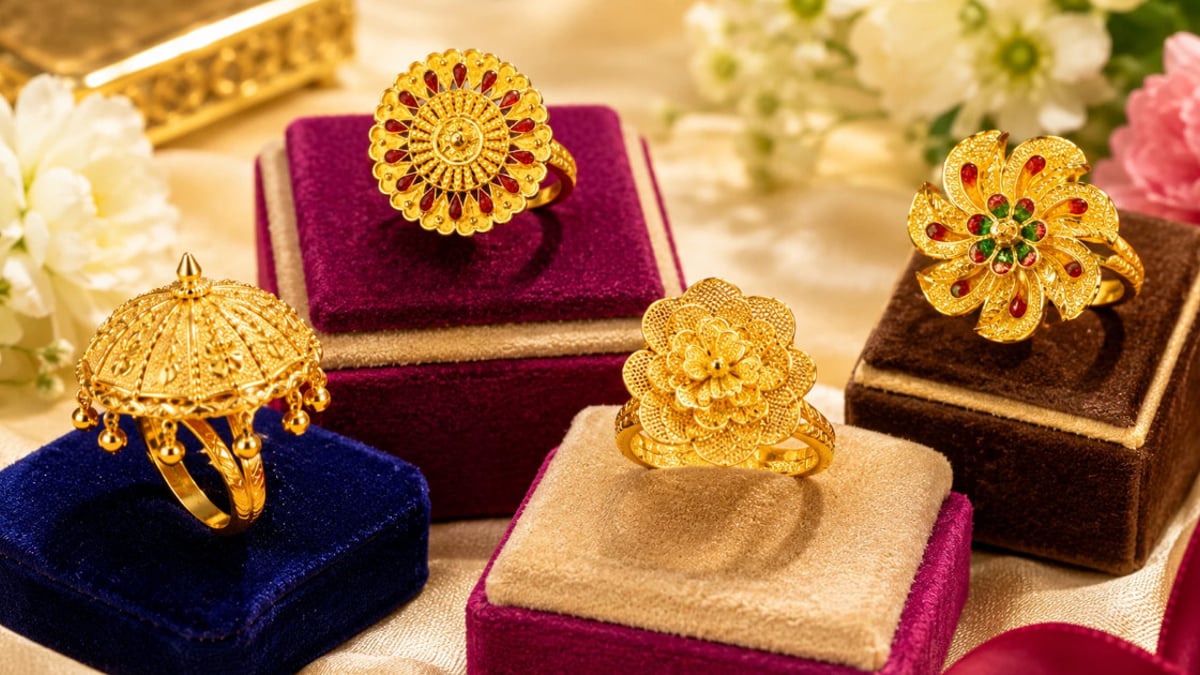
This is a buying guide for anyone comparing gold umbrella rings before purchase, built around four real 22K pieces with their exact net weights and listed prices.
It answers the question every ranking page ignores — why near-identical rings differ in price — by breaking cost into gold weight, purity, making charges, GST and the hallmarking fee, and by showing readers how to run that sum themselves. It deserves to exist because the current top ten is entirely product listings and Pinterest boards, with the only substantive "design with price and weight" content locked inside YouTube videos.
Two umbrella ring designs can sit in the same tray and differ by more than ₹66,000. Same shop, same 22K gold, same shelf.
The gap is almost never about the design. It's about weight.
That one fact clears up most of the confusion buyers run into. So this guide takes the price apart properly. You'll see four real 22K umbrella rings, their exact net weights, and what each costs. After that, you can work out any quote yourself — before anyone hands you one.
What an umbrella ring is, and why the name
An umbrella ring is a gold ring with a wide, domed top that sits above the finger. The raised canopy resembles an open umbrella. Most Indian umbrella rings use 22K gold with floral or filigree work. Price follows weight: light designs start near 2 grams, statement pieces cross 5 grams.
The name is purely descriptive. So look at one from the side and you'll see why. The shank rises, then flares outward into a canopy, the way ribs open on an umbrella.
There's no formal industry definition, though. In fact, no standards body classifies ring silhouettes at all. Different shops draw the line in different places. So treat the label as a shape description, not a technical grade.
One structural point matters more than the name. Because a dome covers a lot of finger using very little metal, you get scale cheaply. That's the whole appeal.
Umbrella ring vs floral ring: the real difference
Shoppers mix these two up constantly. But the distinction is simple once you hear it.
An umbrella ring is defined by its shape — the raised, domed profile. A floral ring, on the other hand, takes its name from its motif — petals, buds, vines.
So the two overlap all the time. Plenty of umbrella rings carry floral work across the canopy. Still, a flat flower ring that hugs the finger isn't an umbrella ring at all.
Here's the practical test. Turn the ring sideways. If the top lifts clear of the finger in a dome, it's an umbrella ring. The pattern on it doesn't matter.
Why this matters at the counter: shape drives comfort and catching, while motif drives only appearance. As a result, people buy for the pattern and later regret the profile.
Don't Miss our Popular one gram Gold Ring Collections
Why umbrella rings suit Indian occasion wear
Occasion jewellery has to read from across a room. A domed silhouette does that efficiently, because it presents a broad surface at an angle.
That efficiency is the real reason the style persists. In short, you get visual presence without paying for a solid block of gold.
The canopy also gives artisans room to work. Pierced borders, hand-engraved nakshi patterning and filigree — fine twisted-wire detailing — all need surface area. So a dome supplies exactly what they need.
In Bengali and wider East Indian jewellery, that handcrafted surface work is much of the point. Naturally, the umbrella form has become a home for it. You'll see the same instinct across the wider ring collection, including traditional shapes like the caterpillar ring.
A fair caution, though. Nobody can trace the umbrella ring to a single documented origin. Anyone quoting a precise historical date for it is guessing.
Latest umbrella ring designs to consider
Four families cover almost everything currently on offer. Each one suits a different budget and a different wearer.
Lightweight umbrella rings under 2 grams
Most first-time buyers should start here. Under 2 grams, a dome still reads as a full statement ring. Yet the metal cost stays contained.
Two live examples make the point. The Bloom Umbrella Ring (2/687) weighs 1.85 g of 22K gold. Meanwhile the Floral Glow Umbrella Ring (2/689) weighs 1.86 g.
What weight should you target? For a lightweight umbrella ring, roughly 1.5 g to 2.5 g is the practical band. Below about 1.5 g, though, the canopy gets thin enough to bend under everyday knocks.
Floral umbrella ring designs
Floral motifs dominate this category. They also age well, because they aren't tied to a trend cycle.
The two designs above show the range within one weight class. Bloom uses layered petals over a spiral motif. Floral Glow, by contrast, uses a single sunflower-style top.
Same purity, near-identical weight, completely different mood. So choose on which one you'd still like in ten years.
Nakshi and filigree umbrella rings
Nakshi means hand-worked surface patterning. Filigree means fine gold wire twisted into openwork.
Both are labour, not metal. That distinction matters for your bill, and we'll come back to it shortly.
The Starloom Bloom Umbrella L Ring (2/747) shows the technique at 5.32 g. It carries star-cut spokes, pierced petal borders and a mesh-textured centre bed. Open side cuts also keep it from feeling heavy.
Bridal and heavier statement umbrella rings
Above roughly 5 grams, an umbrella ring becomes bridal-scale. As a result, it holds its own beside chunky bangles and a heavy necklace.
The Umbrella Gold Ring (2/684) sits here at 5.73 g in 22K. A floral centre and filigree edging carry the design.
Are these good for bridal jewellery? Yes, with one honest caveat. Bridal sets get worn a handful of times, so a tall dome that catches on fabric matters far less. But for a piece you'll wear weekly, drop a weight class.
Umbrella ring price guide with real weights
Every jeweller in India builds the number the same way:
(net gold weight × rate for that purity) + making charges + GST + hallmarking fee = final price
Nothing else enters the calculation. So learn those four inputs and no quote can catch you out.
Here are four real 22K umbrella rings, sorted by weight:
Design (SKU) | Purity | Net weight | Listed price |
|---|---|---|---|
Bloom Umbrella Ring (2/687) | 22K | 1.85 g | ₹32,626 Apprx |
Floral Glow Umbrella Ring (2/689) | 22K | 1.86 g | ₹32,802 Apprx |
Starloom Bloom Umbrella L Ring (2/747) | 22K | 5.32 g | ₹93,026 Apprx |
Umbrella Gold Ring (2/684) | 22K | 5.73 g | ₹98,739 Apprx |
Listed prices captured on 11 August 2026. Gold moves daily, so read this as a snapshot, not a rate card.
Why weight decides most of the price
Look at the middle two rows again. Bloom is 1.85 g; Floral Glow is 1.86 g. That's a difference of one-hundredth of a gram.
The price difference, in turn, is ₹176.
Now take the extremes. The 5.73 g design weighs about 3.1 times the 1.85 g design. Accordingly, it costs about 3.0 times as much.
That's the pattern, and it holds across the whole table. Weight moves price. Design, on its own, barely does.
So the first question isn't which design you like. It's what weight you're buying. Settle that first. Your budget is then roughly fixed, before you look at a single photo.
How gold purity changes the per-gram rate
22K means 916 parts gold in every 1,000. That's the standard for wearable gold jewellery across India.
Purity sets your per-gram rate, and the spread is wide. Take 11 August 2026. On that date, the India Bullion and Jewellers Association published indicative retail rates of ₹14,883 per gram for 22K. The 18K rate was ₹12,352. IBJA notes those figures exclude 3% GST and making charges.
Which purity is best for an umbrella ring? 22K, in almost every case.
The reasoning is structural. Because 24K is too soft to hold a raised dome, it deforms. 18K is harder and cheaper per gram. Even so, it reads paler than most Indian buyers want.
Only six caratages can legally be hallmarked in India. Under IS 1417:2016, the Bureau of Indian Standards permits 14K, 18K, 20K, 22K, 23K and 24K fineness grades. So anything sold outside that list should stop you cold.
How making charges are worked out
Making charges pay for labour — the karigar's hours, not the metal.
Shops calculate them one of two ways. Some apply a percentage of the metal value. Others charge a flat rate per gram.
First, ask which method applies. Then ask for the rupee amount, not just the method. A percentage sounds small and a flat rate sounds fair. Only the final figure tells you anything.
This is the one place where design genuinely moves your bill. Because hand-pierced filigree and dense nakshi work take far more hours, labour costs diverge sharply. Two rings of identical weight can therefore carry very different charges.
Here's the trade-off nobody mentions. On a lightweight ring, making charges form a larger slice of what you pay. There's simply less metal to absorb them. So lightweight is easier on the wallet overall — but less of your money sits in gold.
One more question is worth asking. Are making charges returned if you exchange the piece later? Usually they aren't. Get the answer in writing.
What GST and hallmarking add to the bill
Two fixed additions round out the price.
GST applies to gold jewellery at 3%. That's why IBJA publishes its rates exclusive of it. Expect it as a separate line item.
The hallmarking fee is smaller and stranger. BIS sets it at ₹45 per piece for gold jewellery. Crucially, that figure doesn't change with weight. So the same ₹45 applies to a 1.85 g ring and a 5.73 g one.
Working the sum yourself
Try it on the Bloom Umbrella Ring. It holds 1.85 g of 22K gold. At the 22K rate quoted above, the metal alone comes to roughly ₹27,534.
The listed price, meanwhile, is ₹32,626. Everything above the metal value is labour, tax and that ₹45 fee.
Two caveats before you use this. IBJA's rate is indicative, so your local Kolkata rate may differ slightly. Shops also update rates through the day.
Still, the method holds. Ask any jeweller to itemise the gap between metal value and final price. One who won't is telling you something.
How to choose an umbrella ring that suits you
Weight sets your budget. These three checks, however, decide whether you'll actually wear the thing.
Matching the dome size to your finger
Take your finger's proportions seriously here, because a dome exaggerates them.
On slim, long fingers, a wide canopy balances the hand nicely. On shorter or broader fingers, however, an oversized dome shortens the finger visually. A narrower, taller profile flatters more.
Check the span against your knuckle too. If the canopy is wider than your knuckle, it will rotate and sit crooked.
Picking a weight for daily wear
Is an umbrella ring suitable for daily wear? Under about 2.5 grams, yes, comfortably.
Above that, though, be realistic. A tall 22K dome snags on sleeves, dupattas and handbag linings. Since gold at 916 fineness is soft, repeated knocks round off crisp filigree edges.
So if you want one ring for everything, go lighter and lower. Save the 5-gram-plus pieces for weddings and pujas.
Which finger to wear it on
The index and ring fingers work best. Both give the canopy room to sit without fouling its neighbours.
Avoid the middle finger with a wide dome. It's your longest, so the canopy tends to press against the fingers on either side.
Left or right is personal preference. Just note that most people knock their dominant hand more.
How to check purity before you pay
You don't have to take anyone's word for purity. Since 1 July 2021, hallmarked gold in India carries three marks.
Look for three things. First, the BIS logo. Next, the purity grade — 22K916 on a 22-carat piece. Last, a six-digit alphanumeric HUID code.
Then verify it. BIS runs a free mobile app, BIS Care, with a "Verify HUID" feature. Enter the code before you pay. Check that the details match the ring in your hand.
Know your protection as well. Say hallmarked jewellery later tests below its marked purity. Then BIS entitles the buyer to compensation of twice the shortfall, plus testing charges. Any consumer can also get a piece assayed at a BIS-recognised centre.
Finally, keep the invoice. It should state net weight, purity and making charges separately. A single lump-sum bill gives you nothing to check later.
Caring for a gold umbrella ring at home
Domed rings need slightly different habits from flat bands, because the canopy takes the impact.
Take it off before kneading dough, gardening, gym sessions and swimming. Chlorine and sustained pressure are the two things that undo fine work fastest.
Apply perfume and hairspray first, then put the ring on. Store it separately, since 22K scratches against harder metals.
For cleaning, use warm water with a drop of mild soap. Then work a very soft brush into the filigree gaps. Pat dry afterwards. But skip toothpaste and baking soda entirely — both abrade soft gold.
A closing note on price. Every rupee figure here was accurate on 11 August 2026. All of them will drift as gold moves. What won't drift is the method: weight × rate, plus labour, plus 3% GST, plus ₹45.
Carry that sum into any showroom and you're negotiating from the same information as the counter. Two places to go next. The ring guides on our blog cover individual designs. Meanwhile, the umbrella ring collection shows current weights against current rates.