

Gold Earrings for Women: Top Designs by Weight
 Sujoy Dhar
12 min read
Sujoy Dhar
12 min read
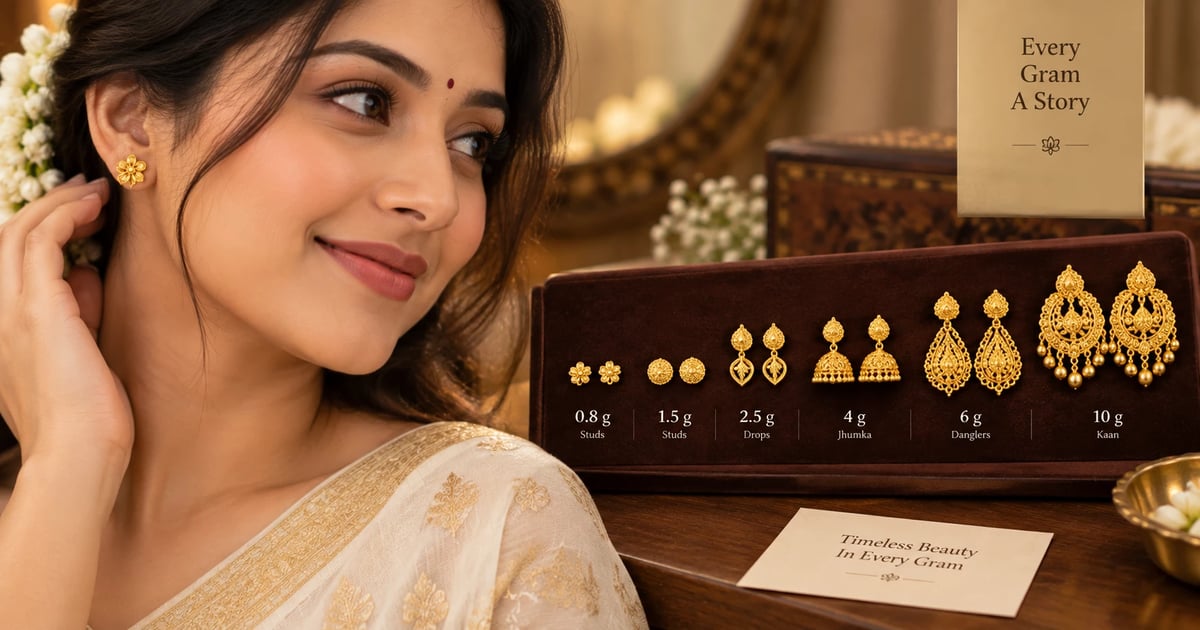
The best gold earrings for women in daily wear are plain 22K studs, small huggies and light balis. Keep the pair between 0.8 and 3 grams. That weight sits flat, clears a helmet strap and rarely stretches a piercing. Jhumkas and chandbalis start near 4 grams. Those are occasion pieces, not everyday ones.
Almost every earring page online shows a photo and a price. Very few show the gram weight. That is backwards. Gold sells by weight, and the rate moves daily. A design at 6 grams and the same design at 2.5 grams are two different purchases.
So this guide sorts designs by gram band instead. Under each band you get the styles that hold up, the metal cost, and who the shape suits.
One number for context. The World Gold Council put Indian jewellery demand at 75 tonnes in Q2 2026, down 15% year on year. Buyers moved to lighter, lower-carat pieces. Lighter is not a compromise this year. It is what most counters are actually selling.
How to pick gold earrings by weight, not by photo
Ask for the gross weight before you ask the price. Every hallmarked piece has one, and every jeweller can print it.
Weight decides three things at once. Metal cost comes straight off it. So does how the pair feels after six hours. At exchange time, weight is what gets valued.
A photo hides all three. Two jhumkas can look identical on screen. One is hollow at 3.1 grams. The other is solid at 7.4 grams, so it costs more than twice as much.
Hollow work is not cheating. It is how a big design gets made wearable. Still, know which one you are holding. A dented hollow jhumka is hard to repair.
Ask a second question too: is that weight net or gross? Gross includes stones, beads and any lac filling inside. You pay gold rate only on the gold.
Top gold earrings for women, sorted by gram band
IBJA is the India Bullion and Jewellers Association. Its published rate is India's benchmark, used by banks and lenders. Metal costs below use the IBJA 916 closing rate for 3 September 2026: ₹14,101 per gram. That excludes making charges and GST, and it moves every working day.
Under 1 gram: plain studs and tiny tops
This is where a first pair belongs, and where a daughter's newly pierced ears belong too.
A plain 22K stud pair usually lands between 0.6 and 1.2 grams. At 0.8 grams the metal alone works out near ₹11,280.
What works here: a flat round top, a small square, a single ball, a tiny flower. Anything with a smooth back that does not catch on a pillow.
What does not work: nothing with a dangling element. There is not enough metal to build a hinge that survives daily wear.
1 to 2 grams: huggies and small balis
A bali is a hoop. A huggie is a small hoop that sits close to the lobe, usually 8mm to 12mm across.
Metal at this band runs roughly ₹14,100 to ₹28,200 a pair. That is where most genuine daily wear gold earrings sit right now.
Huggies win on comfort because the weight sits against the ear instead of hanging below it. They also survive a dupatta better than an open hoop.
One design worth steering away from for daily wear: the big thin bali. 30mm or wider, in hollow 22K tube. It looks great and it costs less than you expect for its size. It also snags hair, flattens if you sleep in it, and dents from a single knock against a door frame. Buy it for going out. Do not buy it as your everyday pair.
2 to 4 grams: sui dhaga, small jhumkas and belkuri
The sweet spot for office wear. Enough metal for a real design, light enough to forget about by lunch.
Metal here is roughly ₹28,200 to ₹56,400 a pair. A 2 gram pair works out to about ₹28,200 in metal before making charges and GST.
Sui dhaga, the needle and thread style, threads through the lobe and hangs as a short chain. It is featherlight for its length, and it is one of the few long designs that does not pull. Bengali counters call it sui suto, and the naming genuinely differs by shop. There is a full breakdown in the guide to sui suto and sui dagha earrings in Kolkata.
Small jhumkas start being possible around 3 grams. Below that the dome is too shallow to hold its shape. For picking a jhumka by occasion rather than by photo, see the jhumka design guide for every occasion.
Belkuri is the Bengali jasmine-bud drop, usually hung from a safety-pin style hook. Light, quiet, and very Kolkata. The belkuri earrings design and price guide covers real weights and why many pairs skip hallmarking.
4 to 8 grams: chandbali, drops and party jhumkas
Now you are buying an occasion piece. Metal runs about ₹56,400 to ₹1,12,800 a pair.
A chandbali is the crescent moon shape, wide and flat. A jhumka is the bell or dome. People mix the two names constantly. The difference is the silhouette: a chandbali spreads sideways across the jaw, a jhumka drops straight down.
At 5 grams a pair, expect real presence and real weight on the lobe. That is roughly ₹70,500 in metal, or about ₹81,300 once you add 12% making and 3% GST.
Above 5 grams, ask for a supporting chain that loops over the top of the ear. It moves most of the load off the piercing. Good jewellers offer this without being asked. Ask anyway.
8 grams and above: full kaan and bridal sets
Full kaan covers the ear from lobe to helix, usually with a panel and a drop. Bridal chandbalis and heavy jhumkas live here too. Metal alone crosses ₹1,12,800 at this band.
Nobody wears 10 grams on a lobe unsupported. Kaan designs spread weight along the ear rim, which is exactly why the style exists. The full kaan earrings guide on weight, price and hallmarks goes into the construction.
If you are gifting at this level, a pasa is worth comparing. The pasa earrings buying guide covers face-shape fit and price drivers.
What a pair of gold earrings actually costs
Four things go on the bill: metal, making, GST, and sometimes wastage. Here is a full worked example.
A 2.4 gram pair of 22K balis, priced on 3 September 2026:
Line | Basis | Amount |
|---|---|---|
Metal | 2.4 g × ₹14,101 (IBJA 916, 3 Sep 2026) | ₹33,842 |
Making charge | 12% of metal value | ₹4,061 |
Subtotal | ₹37,903 | |
GST | 3% on the total | ₹1,137 |
Total | ₹39,041 |
Change the rate and every line moves. That is why a price without a date and a rate tells you nothing.
Making charges are the part you can actually discuss. They are not regulated and not fixed by law. They are quoted either as a percentage of metal value or as a flat rupee amount per gram.
Handwork costs more than machine work, and it should. A cast plain stud takes minutes. A filigree kaan panel takes a karigar days. So a 6% making charge on one and 20% on the other can both be fair.
What is not fair is a percentage nobody will show you. Ask for the basis, the number and the total in rupees. Then compare across two shops on the same day, at the same weight.
Wastage charge is separate. It covers metal lost while working the piece, and some sellers fold it into making instead. Either way, it should appear as a line you can read.
You can run any bill through the gold calculator for Indian jewellery bills before you pay. Today's board rate sits on the Kolkata gold rate page.
One honest note on exchange. Most jewellers value returned gold on metal weight and purity, not on what you paid in making charges. Ask for the exchange terms in writing before you buy, and check whether hallmarked pieces from other shops are accepted. The BJS FAQ page is the place to start that conversation.
GST on gold earrings: 3% total, not 3% plus 5%
A lot of jewellery blogs tell you gold is taxed at 3% and making charges at 5%. For a normal retail purchase, that is wrong.
The CBIC sectoral FAQ for gems and jewellery answers this directly. Question 7 puts the exact case. A jeweller sells a gold chain to a customer. Charge 3% on the total, or 3% on gold plus 5% on making? The published answer is blunt. GST is payable at 3% of the total transaction value, whether the making charge is shown separately or not. That wording sits in the CBIC sectoral FAQ on gems and jewellery.
The reasoning is composite supply. The gold is the principal supply, and the making is incidental to it. So one rate applies to the whole invoice.
Where does 5% come from? Job work. A jeweller sends metal out to a karigar and gets a finished piece back. That registered karigar charges 5% on the job charges. That is a business-to-business transaction, and it never appears on your retail bill.
So if a bill shows 5% on your making charges, ask about it. Tax rules do change. Confirm the current rate with your jeweller or a tax professional before treating this as settled.
Which earring shape suits your face
Shape matching is about contrast, not rules. A few pairings still hold up.
Round face. Go vertical. Sui dhaga, straight drops and narrow chandbalis add length. Big round balis over 25mm tend to widen the frame.
Long or oval face. Studs, short wide jhumkas and hoops sit well. Long thin drops can stretch the face further.
Square or angular jaw. Curved shapes soften the line. Round huggies, dome jhumkas and circular tops work.
Heart shape. A design wider at the bottom than the top balances a narrow chin. Chandbali does this naturally.
Hair matters more than most guides admit. Wear it down daily and a smooth-edged design beats an ornate one, because filigree catches strands.
Earlobe comfort: weight limits and back types
This is the question customers ask at the counter and almost no website answers.
How much weight a lobe can carry
There is no medical standard here, and any site quoting an exact gram limit is guessing. What jewellers see is a pattern, and it is worth knowing.
Under 3 grams a pair, most people wear gold all day without noticing it. Between 3 and 6 grams, comfort depends on the piercing. A hole placed low in the lobe, or one already stretched, will feel it by evening.
Above 6 grams, a supporting chain or an over-the-ear hook does most of the work. Without one, the weight hangs on a few millimetres of skin. Most gold earrings for women sold for daily wear never reach that band.
Watch for signs of strain. A hole that reads as a slot rather than a circle is one. Another is the front of the earring tipping forward. Soreness lasting past the evening counts too. If any of that is happening, drop a band and give the lobe a rest. Persistent pain or a tearing lobe is a doctor's job, not a jeweller's.
Screw back or push back: which is safer
Push back is the friction butterfly. It goes on fast and it comes off fast, including on a bus.
Screw back threads onto the post. Two patterns are common: the Madras screw and the Bombay screw. They differ in thread direction and post length. A screw back rarely falls out. That is why almost every daily-wear stud in Bengal uses one.
The trade-off is real. Screw threads wear down over years and start spinning without gripping. If yours turns freely and never tightens, get the post replaced before you lose the pair.
Omega backs and French wires are the third route, mostly on drops. Both hold well. Both add their own weight.
For a first pair, or for a child, buy screw back. For a piece you take on and off daily, push back is quicker and the risk is yours to judge.
Are gold earrings safe for sensitive ears?
Mostly yes, and the reason is the alloy.
22K gold is 91.6% pure, marked 916. Only 8.4% is other metal. 18K is 75% pure, marked 750, so a quarter of it is alloy. If nickel is what your ears react to, higher purity generally means less of whatever is irritating you.
But purity is not a guarantee. Alloy recipes are not printed on the bill, and a jeweller may not know the exact mix. If you have a diagnosed metal allergy, ask what the alloy contains and speak to your doctor. Do not treat a hallmark as an allergy test.
One practical fix: for reactive ears, plain polished surfaces collect less sweat and residue than deep filigree. Clean the posts weekly with a soft cloth.
Six checks to run before you pay
Find the three hallmarks. Since 1 July 2021, a gold hallmark is three marks. The BIS logo, the purity in carat and fineness, and a six-digit alphanumeric HUID. Anyone still describing four marks is quoting an old rule. The BIS hallmarking FAQ sets this out.
Check both earrings, not one. BIS requires each article in a pair, and every detachable part, to carry a hallmark with a different HUID. One marked earring and one blank one is a problem.
Verify the HUID yourself. Open the BIS Care app and use Verify HUID. It takes about a minute, and you can do it standing at the counter.
Ask for the magnifier. BIS requires a registered jeweller to keep a magnifying glass of at least 10x. If nobody offers it, ask.
Get the weight split on the bill. Gross weight, net gold weight, stone weight, purity, making charge and GST, each on its own line. A single lumped figure is not a bill you can check later.
Read the exchange policy before paying, not after. Terms vary by shop, and the difference shows up years later.
Two related reads: gold purity check before buying and hallmark gold vs BIS gold.
Browse what is in stock in the BJS earrings collection. Or filter by budget: under ₹10,000, and ₹10,000 to ₹20,000.
Want the styles side by side before deciding? Start with the BJS earrings blog archive and the diamond earrings buying guide.