

Full Kaan Earrings Guide: Weight, Price & Hallmarks

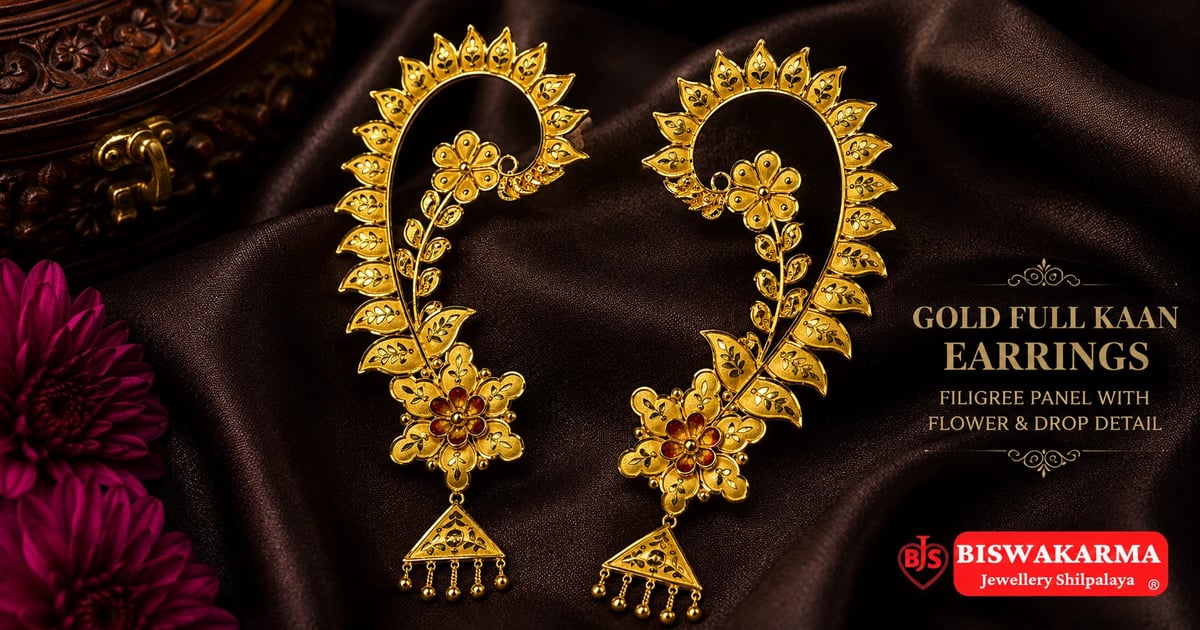
A full kaan earring is a Bengali ear ornament that covers most of the outer ear. It is built from thin gold plates, usually decorated with filigree, and often set with stones. A post passes through the pierced lobe, while a chain or hook carries the remaining weight.
Most guides to kaan earrings hand you photographs and stop there. Pictures won't tell you whether your ear can carry the piece through a six-hour wedding. A full kaan is a shaped gold panel that follows the curve of your outer ear. It sits on a post through your lobe, and usually on a chain that shares the load. So the useful questions here are structural, and they get answered before we reach motifs.
The short answer on full kaan earrings
A full kaan earring is a Bengali ear ornament that covers most of the outer ear. It is built from thin gold plates, usually decorated with filigree, and often set with stones. A post passes through the pierced lobe, while a chain or hook carries the remaining weight.
That description comes from the craft record, not from marketing copy. The Craft Revival Trust's encyclopedia of West Bengal jewellery defines it plainly. A kaan covers the whole ear in thin plates of gold or silver, worked with filigree.
"Full kaan" itself is a shop phrase rather than a technical grade. It signals coverage. The panel reaches from the lobe upward along the outer rim, while a half kaan stops shorter.
You will also see it spelled full kan earring, kaner dul or kaan er dul. These are transliteration habits, not separate products. Search both spellings and your results roughly double.
Elevate your look with our elegant Jhumkas collection—crafted for every celebration and special moment.
How a full kaan carries its weight
Nearly every regret with this design traces back to one question. Where does the gold actually rest?
Once you have that answer at the counter, the rest of the decision gets easier.
The post through your lobe
A single post or screw back goes through the piercing. On its own, it holds a fraction of the total weight.
That limit is not new. The V&A holds a pair of Indian ear ornaments from around 1850, standing 16.5 cm tall. The museum notes that their considerable weight was only partly supported by the gold bar through the lobes.
So if a seller says the post alone will hold a large kaan, ask to wear it. Ten minutes tells you everything.
The hollow panel that makes size affordable
Good karigars build the ear panel from thin sheet gold, shaped and joined over a form. Inside, it is largely hollow.
This is why a kaan can look enormous and still weigh less than a solid bangle. Filigree and jaali work push the effect further. Both create surface area without adding metal.
Press gently along the panel edge. A well-made piece feels rigid, while a thin one flexes and dents in the box.
The kaan chain, or sahara
The chain that runs from the earring up over your ear is doing structural work. In Bengal it is often called a matil or kaan chain; in Hindi, a sahara.
It hooks into the hair with a pin, or loops over the top of the ear. Either way, it transfers load off the piercing.
The same V&A pair used pearl and ruby strands fastened into the hair for exactly this purpose. The idea is roughly two centuries old.
Ask whether the chain is included, and whether it is gold or gold-plated. Sold separately, it is often a real cost.
Full kaan designs you'll meet in Kolkata
Bengali ear ornaments follow a fairly settled vocabulary. Knowing the words stops you paying for one design while describing another.
Design | What you're looking at | Suits |
|---|---|---|
Filigree (tarkashi) kaan | Fine twisted wire lacework across the panel | Brides wanting scale at lower weight |
Jhumka kaan | Full panel with a bell-shaped drop below | Wedding and reception photographs |
Kaan bala | Wider flat surface, heavy filigree, less coverage | Everyday festive wear |
Kaan pasha | Large ornate stud filling the lobe area | Round faces, saree functions |
Meenakari kaan | Coloured enamel worked into the gold | Puja and family functions |
Kundan or polki kaan | Uncut stones set into gold foil beds | Bridal sets with matching pieces |
Silver or plated kaan | Same silhouette, different metal | Testing a look before buying gold |
Filigree deserves the extra note. The same craft encyclopedia counts roughly 3,000 artisans across about 30 villages in South 24 Parganas. They work in filigree and silver. That skill base is why Kolkata kaan work looks the way it does.
One historical shift still shows up in the tray. Under British influence, Bengali setting moved from kundan beds for uncut stones toward open claw settings for faceted ones. Both techniques are still practised, so you will see them side by side.
👀 Missed Diamond Earrings: Best Designs & Buying Tips?
How much gold a full kaan actually needs
Weight is the number that decides comfort, price and resale. It is also the number most product pages leave out.
Ask for net weight in grams, per piece, before anything else. Gross weight includes stones and lac filling. Net weight, on the other hand, is the gold you are buying.
Two pieces of identical size can differ sharply in weight. Sheet thickness, hollow versus solid sections, and the amount of wirework all move the figure.
Here is the part that surprises people. A lighter kaan sometimes costs more than a heavier one. Filigree takes hours of hand labour, and that labour is priced separately from metal.
The World Gold Council's research on India's gold jewellery market structure puts around 55% of it as handmade. Kolkata, in fact, sits among the dominant manufacturing centres. Handwork carries the value here, so making charges matter more than in cast pieces.
The hallmarking gap on multi-part earrings
This is the section styling guides skip, and it applies squarely to bridal kaan sets.
Where hallmarking is mandatory, an article carries three marks. The BIS logo. The purity in carat and fineness. A six-digit HUID code. Coverage has widened in phases, reaching 380 districts from 2 March 2026, and further districts since. Check the current mandatory hallmarking order for your district.
Two exemptions in the Quality Control Order matter for a full kaan.
Detachable parts under two grams
BIS exempts any article weighing less than two grams from mandatory hallmarking. Its guidance for jewellers addresses detachable parts under two grams in the same answer.
A full kaan set is often several parts. Panel, jhumka drop, screw back, kaan chain. The small components can fall under that threshold.
So the panel may carry a HUID while the chain carries nothing. That is legal, and it is worth knowing before you assume the whole set is marked.
Jewellers may still hallmark sub-two-gram articles voluntarily after testing. You have to ask, because "may" is not "must".
Kundan, polki and jadau sit outside the rule
The BIS exemption list names Kundan, Polki and Jadaau as special categories excluded from mandatory hallmarking. Plenty of bridal kaan designs use exactly these techniques.
That does not make them fake. Still, your purity assurance now has to come from somewhere else. A written declaration, a detailed invoice, and a jeweller who stands behind both.
For any hallmarked article, BIS requires four things on the bill. Description, net weight of precious metal, purity in carat and fineness, and hallmarking charges. Insist on that breakdown even where hallmarking was not required.
If purity later tests below what was marked, BIS rules provide compensation at twice the difference plus testing charges. That remedy depends on the piece having been hallmarked first.
What really drives the price of a kaan
Four components make up your bill, and only one of them is genuinely negotiable.
Gold rate — set daily, identical across the city
Net weight — grams of gold in the piece
Making charges — the karigar's labour, quoted per gram or as a percentage
Wastage — metal lost during fabrication, usually a percentage
Stones sit outside all four. Kundan, polki and coloured stones get valued separately, and that valuation is far less standardised than gold.
Tax is added on top. Gold value attracts 3% GST, while making charges attract 5%. Confirm the split on your invoice rather than assuming, since these figures do get revised.
Making charges are where full kaan earrings vary most between shops. So ask for the rupee figure per gram rather than a percentage. Then the comparison becomes obvious.
Choosing a kaan for your face and occasion
Coverage is the variable. A full kaan draws the eye upward and outward across the whole ear. That changes how your face reads in photographs.
If you're buying for your own wedding
Go for coverage and matching, but wear the pair for fifteen minutes in the shop first. Sit down, turn your head, tilt it forward.
Ask for the kaan chain in the same gold, not a plated substitute. On a wedding day you will be in it for eight hours or more.
Pair a heavy kaan with a lighter neckpiece. Two statement pieces competing at the same height flattens both.
If it's for Durga Puja or family functions
A kaan bala or a mid-weight filigree kaan does more work than a full bridal panel. You can wear it repeatedly across the season without your ears complaining.
Meenakari suits this slot well. Colour reads beautifully against a red-bordered saree and photographs cleanly in daylight.
If you're gifting and don't know her ear
Buy lighter than you think, and prefer a design with a support chain. A stretched or previously torn piercing handles a shared load far better than a post alone.
Also watch for visible elongation of her lobes, or a history of earrings hurting. In that case, ask a doctor or a professional piercer before buying heavy gold.
Caring for a heavy pair between weddings
Store each earring flat, in its own soft pouch. Hanging a full kaan by its post stresses the joint where the panel meets the fitting.
Keep it away from perfume, hairspray and sindoor. Enamel and foil-set stones react badly to all three.
Clean gently with a soft dry cloth. For filigree, a soft brush lifts dust from the wirework without bending it.
Get the solder joints checked after every few wears. Catching a loose joint early costs a repair charge; catching it late can cost a stone.
Where to buy full kaan earrings in Kolkata
The city's traditional jewellery clusters sit in Bowbazar, Baghbazar, Bhawanipur, Kalighat and Gariahat. Each has its own workshop network behind the counter.
Three routes are open to you. Established local jewellers offer customisation and a relationship you can return to. National chains offer standardised terms with less design flexibility. Online gives the widest catalogue and the weakest ability to check weight and finish.
Whichever you pick, the checklist stays the same. Net weight per piece, hallmark status of every component, making charges quoted per gram, and the buyback terms in writing.
You can browse our full kaan earring collection to compare panel styles and weights. Want drop without full coverage? Look at long earrings instead. Or start with silver earrings and test the silhouette first.
Our everyday gold earrings cover the lighter end. The wider earrings range sits inside our full catalogue.
Still comparing Bengali earring styles? Our guide to sui suto and sui dagha covers the lightweight end of the same tradition. There is more in our earring guides.
One honest caveat. Nobody publishes verified sales data for kaan designs by city. Any claim about the "most popular" kaan style, including ours, is trade impression rather than measured fact.
What to check before you pay
Take five things away from this guide, and you will buy well.
Ask for net weight per piece. Check which components carry a HUID and which do not. Get making charges quoted in rupees per gram. Wear the pair in the shop for ten minutes before deciding. Get the buyback terms written on the invoice.
A full kaan is one of the few ornaments where comfort and craftsmanship are the same conversation. A piece built to sit properly on your ear is almost always a piece built properly overall.