

Belkuri Earrings: Complete Design & Price Guide

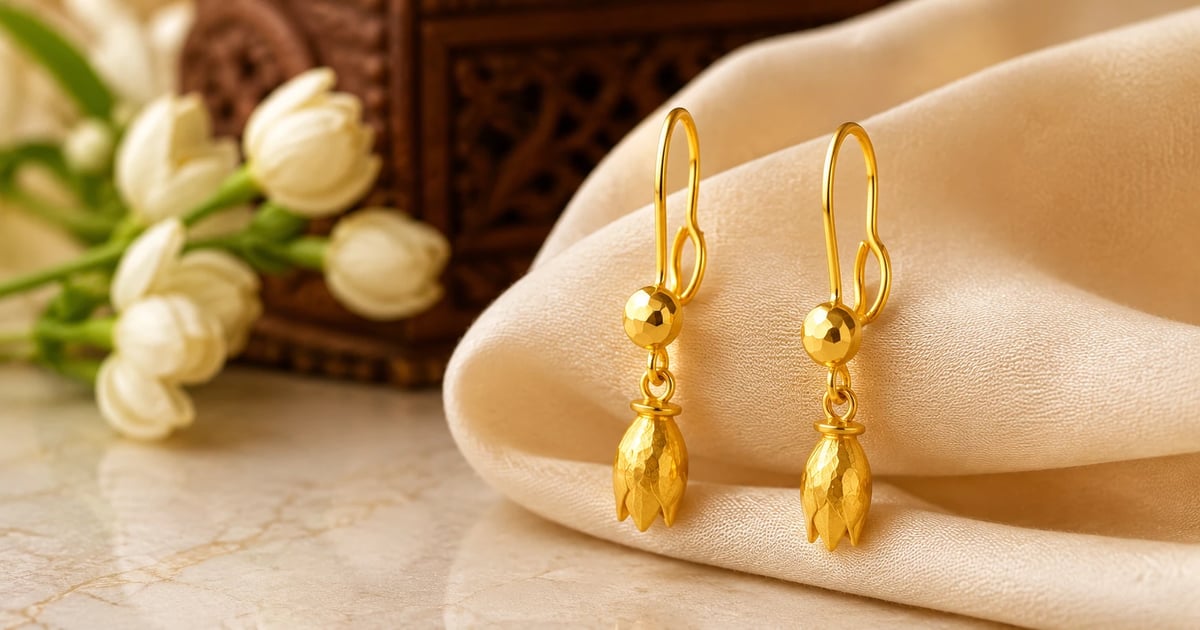
You want one pair of gold earrings that works on a Monday morning and at a Sunday puja. Belkuri earrings were built for exactly that job. They're the small jasmine-bud drops that hang from a thin gold hook, worn across Bengal for generations.
Most pairs weigh under two grams. That single number shapes almost everything else. It sets the price and decides how your ear feels by evening. On top of that, it triggers a hallmarking rule few shops explain.
So this guide covers the shapes, the real weights and the cost maths. Plus the checks worth making before you pay.
What belkuri earrings are and what the name means
The name is a description, not a brand. In Bengali, bel is the jasmine flower and kuri is a bud. Put them together and you get the shape. A small closed bud, sitting at the end of a fine gold wire.
That wire is the second half of the design. It curves back on itself and locks, much like a safety pin. Because of that, many shops file belkuri under safetypin earrings rather than under drops or danglers.
One honest caveat. No museum catalogue or standards body has documented the belkuri, so its exact origin isn't recorded anywhere you can check. What follows describes how the design is made and sold today.
Where belkuri sits in Bengali jewellery history
Bengali gold splits roughly into two families. One is bridal — heavy sets, worn a handful of times, kept in the locker. The other is everyday gold, worn from morning to night and rarely taken off.
Belkuri belongs firmly to the second family. So do shakha-pola, the thin sui-suto wires, and small kaan pieces. These are the ornaments a woman wears while cooking, teaching, commuting and sleeping.
That's why the design survived. A heavy ornament gets locked away when gold prices climb. A one-gram bud on a wire keeps getting worn.
The closest alternative sits in the same weight band. Our guide to sui suto versus sui dagha earrings compares both.
Find the perfect Jhumkas for every occasion. Have you explored our latest collection yet?
Design features that define the belkuri shape
Take a belkuri apart in your head and you'll find three parts. First, the bud — a rounded bead or a small dome. Next, a collar or frame that sits just below it. Last, the long wire hook that passes through the lobe.
Handmade wirework does most of the work here. The wire is drawn thin, bent by hand, then soldered at the joins. Nothing is cast in a single block.
That construction is why the weight stays low. There's no screw fitting, no back plate, and often no solid metal inside the bud at all.
Here's a real example from our own catalogue. The 16/761 Golden Drop Belkuri Earring is 22K gold with a net weight of 0.72 grams. It pairs a smooth round bead with a sharp V-cut frame underneath and a long slim hook.
Four belkuri styles you will actually find
Belkuri isn't one design. Four broad families cover almost everything sold in Kolkata shops today, and they differ more in feel than in price.
Plain gold belkuri for everyday wear
A polished bud, no stones, no cut-work. This is the simplest belkuri design and usually the cheapest to make, because the artisan spends less time on it.
Plain gold also cleans up fastest. No grooves means soap and sweat have nowhere to collect. That matters if you wear one pair for months.
Dome belkuri for a fuller look
The dome version swaps the small bead for a wider, shallower cap. On the ear it reads as bigger jewellery, even though the metal barely increases.
Most domes are hollow. As a result, you get visual size without the weight. Press a hollow dome hard, though, and it dents.
Safetypin belkuri and its easy hook
Here the hook is the feature. The wire runs long, curves back and tucks into a catch, so nothing can slip off in a crowded bus.
This suits anyone who keeps losing tiny earring backs. Our safetypin earring collection shows how the closure sits once it's fastened.
💎 You might have missed Diamond Earrings: Best Designs & Buying Tips.
Modern lightweight and hollow variations
Newer belkuri designs use machine-drawn wire and hollow beads to push weight down further. Matte, sandblasted and textured finishes have also arrived alongside the traditional high polish.
The trade-off is real, though. Thinner walls dent more easily, and a very fine hook bends out of shape faster than a heavier one.
How to choose the right belkuri pair
Four things decide whether you'll still wear the pair in three years. How it sits on your face. How it feels after ten hours. What it's made of, and what you paid.
Face shape and drop length
Treat this as a rough guide rather than a rule. A rounder face usually suits a belkuri with a slight vertical drop, since the length adds a little height.
Longer or oval faces tend to look better with a compact bud sitting close to the lobe. Heart-shaped faces often carry a wider bud well, because the width balances a narrower jaw.
Above all, check it in a mirror at arm's length, not at close range.
Comfort over a full working day
Weight per ear is what you feel, not the total for the pair. Under one gram each, most people forget they're wearing anything.
Hook thickness matters just as much. A very fine wire can feel sharp against a healed piercing, while a slightly thicker gauge spreads the pressure.
One practical test before you buy: turn your head quickly. A bud that swings hard will also catch on a dupatta or a helmet strap.
Gold purity and why 22K stays standard
22K gold is 91.6% pure, marked as 916. The Bureau of Indian Standards allows six caratages for hallmarking. That list runs 14K, 18K, 20K, 22K, 23K and 24K under IS 1417:2016.
For belkuri, 22K remains the default in Bengal. Exchange and resale here are built around 916 gold, so a 22K pair is easier to trade in later.
Still, 22K is soft. If you're hard on jewellery and never remove your earrings, an 18K hook will hold its shape better. You'll simply have a harder time exchanging it in a traditional Bengali shop.
Budget and what really moves the price
Three numbers make up the bill: metal, making charge, and tax. Metal is the only one you can calculate yourself.
Take that 0.72 gram listing above. It was priced at ₹14,095 when we checked on 13 August 2026. At that day's Kolkata 22K rate of ₹14,620 a gram, the gold in it is worth roughly ₹10,530.
The gap covers making charge, wastage and GST. Notice what that means for light pieces. A fixed making charge lands harder on a one-gram earring than on a ten-gram bangle, in percentage terms.
Rates move daily, so check today's gold rate in Kolkata before you compare quotes from two shops.
Belkuri earrings vs gold studs, compared
Both are small daily-wear gold earrings, and buyers usually shortlist them together. They behave quite differently on the ear.
Belkuri drop | Gold stud | |
|---|---|---|
How it fastens | Long hook, curves back and locks | Post with a separate back |
Typical weight each | Roughly 0.5 g to 1.5 g | Roughly 0.5 g to 2 g |
Movement | Swings slightly with the head | Sits still |
Risk of losing a part | Low, nothing detaches | Higher, backs slip off |
Sleeping in them | Usually fine, hook stays put | Post can press into the ear |
Repair if damaged | Hook can often be reset | Post replacement is common |
Best suited to | Daily wear with some movement | A completely flat, still look |
Choose a stud if you want zero movement and a flush look under a helmet. Pick belkuri if you'd rather never hunt for a lost back again.
Hallmarking gaps on earrings under 2 grams
This is where most belkuri buyers get caught out, so read this part slowly.
Mandatory hallmarking in India does not apply to every gold article. BIS exempts any article weighing less than two grams from the requirement, because marking such small designs is difficult.
Almost every belkuri earring falls under that line. So an unmarked belkuri isn't automatically a red flag — it's often just an exempt article, sold legally.
That said, a jeweller can still choose to hallmark light pieces voluntarily after testing. Ask whether yours were.
If your pair does carry a hallmark, check both earrings. BIS requires each article in a pair to carry its own hallmark. Every detachable part needs one too, with a different HUID number. One marked earring and one blank one is not compliant.
Since 1 July 2021, a valid hallmark carries three marks. The BIS logo, the purity in caratage and fineness, and a six-digit HUID. The shop must keep a 10x magnifying glass so you can see it.
Mandatory hallmarking itself keeps widening. Prasar Bharati's news service reports that the sixth phase took effect on 2 March 2026. It now covers 380 districts, with over 60 crore items hallmarked since 2021.
Two things to do regardless of weight. Get the purity written on your invoice, not just spoken. And if you ever doubt a piece, a BIS-recognised assaying centre will test it by fire assay for ₹200.
Styling belkuri for office, puja and weddings
Start with the office. A plain gold belkuri reads as neutral against a cotton saree, a kurta or a formal shirt. It also won't tangle in a lanyard.
For a puja or a family lunch, size up slightly. A dome belkuri with a thin chain or a sitahar builds a fuller look without adding a heavy set.
Weddings need honesty. Belkuri won't carry a bridal look on its own, and it isn't meant to. It works far better for the boubhat or the reception morning. Or as the pair you change into once the heavy kaan comes off. For that heavier end, see our full kaan earrings guide.
Modern outfits are easier than people expect. The bud shape is small and unfussy, so it sits comfortably with jeans, a linen shirt or a kurta set.
Caring for belkuri earrings at home
Wash them in warm water with a drop of mild soap. Use a soft brush around the collar, rinse well, then dry them fully before storing.
Order matters with cosmetics. Perfume, hairspray and hair oil go on first, and the earrings go on afterwards.
Store each pair in its own soft pouch. Loose gold rubbing against loose gold in a shared box is how fine scratches start.
Never straighten a bent hook yourself. Repeated bending work-hardens 22K wire until it snaps. A snapped hook costs far more to fix than a reset one.
If you wear the same pair daily, have the hook and solder joints checked once a year. Also take them off before a swimming pool, since chlorine is unkind to gold alloys over time.
Why lightweight gold earrings keep gaining ground
Buying habits have shifted, and the numbers show it. The World Gold Council put Indian jewellery demand at 75 tonnes in the April–June quarter of 2026. That's down 15% year on year. Prices climbed nearly 60%, and buyers moved towards lighter-weight, lower-carat pieces.
Belkuri sits naturally in that shift. It was always a light design, so it needed no reinvention to suit a high-rate market.
For buyers, this has one practical effect. Shops now stock more sub-gram options than they did five years ago. That gives you real choice inside a small budget. You can see the current spread across our gold earrings collection.
Where to go from here
Belkuri earrings earn their place through use, not display. They're light enough to forget and sturdy enough to keep. In gold terms they're also cheap enough to buy without a wedding as the excuse.
Before you pay, do four things. Weigh the pair in front of you. Ask whether it's hallmarked, and check both earrings if it is. Get the purity on the invoice. Then compare the metal value against today's rate.