

Jhumkas for Every Occasion: Expert Design Guide 2026

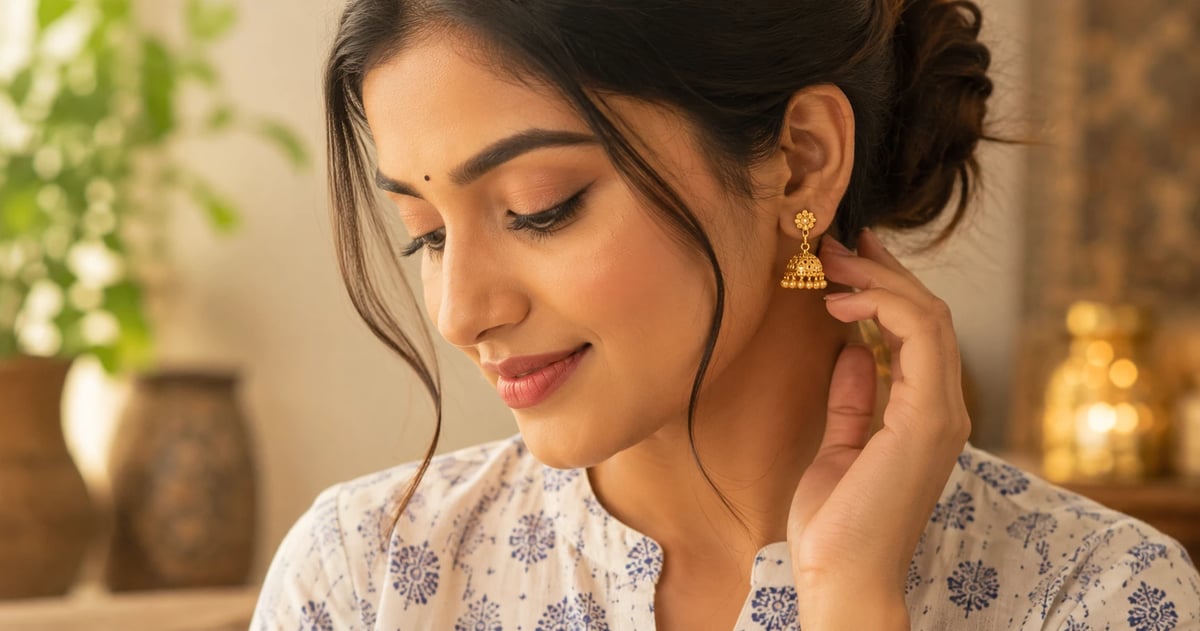
Buying jhumkas in 2026 means solving two problems at once. Which design fits the occasion. And how many grams your budget, and your earlobes, can actually carry.
So here is the short version. For office and daily wear, aim for a pair under about 4 grams. For puja and family functions, 4 to 8 grams does the work. Bridal pairs run far heavier, and that is where comfort planning begins.
Everything below is arranged that way. Occasion first, then weight. Because at 2026 gold rates, weight is the price.
Jhumka or jhumki: what actually separates them
A jhumka is the bell. That domed, hollow cup swings from your lobe and catches light as you move.
A jhumki is the same form, built smaller. Most shops use the word for anything roughly 2 cm or under.
Nobody has standardised that cut-off, though. So treat "jhumki" as a size signal, not a separate product. Ask for drop length in centimetres and net weight in grams. Then the label stops mattering.
One distinction is worth carrying to the counter. Chandbali starts from a crescent, while a jhumka starts from a dome. Hybrids join both, and those get sold under either name.
Why 2026's jhumkas got lighter, not smaller
Every trend piece calls lightweight jhumkas a 2026 style story. The primary data says otherwise. It is a price response.
The World Gold Council's India gold demand report for Q1 2026 puts jewellery volumes at 66 tonnes. That is down 19% year on year, and the second-lowest first quarter since 2000. Spending, meanwhile, rose 47% to a record.
Read those numbers together. Indian households bought fewer grams and paid more for them.
The same research names the direction of travel. Higher prices pushed mass-market buyers towards lighter, lower-carat and studded pieces. By Q2 2026, the Council's follow-up India report showed jewellery demand recovering quarter on quarter. Year on year, it was still down 15%.
That matters to you in one practical way. A 4-gram jhumka is not a compromise this year. It is where the whole market moved.
✨ Check out Diamond Earrings: Best Designs & Buying Tips.
Latest jhumka designs by occasion
First, occasion decides drop length, closure, and how much detail earns its cost. Design names come after that.
Daily wear and office jhumkas
Small dome, short drop, screw back. That is the whole brief.
So look for a plain or lightly beaded dome around 1.5 cm across. Jaali cutwork, which is pierced lacework, adds visual size without adding metal.
Skip fringe entirely here. Loose beads catch on dupattas and collars, and a snagged jhumka is how lobes tear.
Puja and festive jhumkas
Here is where meenakari earns its keep. Enamel colour reads beautifully against a red-bordered saree and photographs cleanly in daylight.
A fuller dome with a beaded rim suits Durga Puja and family functions. These are the traditional jhumka earrings most Bengali households already own. You will wear it repeatedly across a season, so comfort beats scale.
Already own a heavier Bengali set? Our full kaan earrings guide explains how those panels carry weight differently.
Engagement and sangeet jhumkas
Here the chandbali-jhumka hybrid does real work. The crescent widens the top, the bell drops below, and the pair reads larger than its weight.
Layered domes suit a sangeet lehenga, since they move when you do. Still, check the length against your neckline first.
Reception jhumkas
Reception, on the other hand, is the slot for stone-set domes and two-tier drops. Kundan and polki both suit it, and both photograph well under warm light.
One trade-off nobody flags. Kundan, polki and jadau sit outside mandatory hallmarking, so purity assurance shifts to your invoice.
Wedding-day bridal jhumkas
Temple work belongs above all here. Deep repoussé domes, deity motifs, kemp stones, often with a matching maang tikka.
Ask for a sahara, the support chain that hooks into your hair. On a wedding day you are in that pair for eight hours.
Pair heavy jhumkas with a lighter neckpiece. Two statement heights competing in one photograph flattens both. Our gold choker guide treats them as a single decision.
Buying jhumkas as a gift
Buy lighter than instinct says. A gifted pair that hurts gets worn twice, then lives in a locker.
So prefer a screw back and a short drop when you do not know her ear.
Pick by gram weight, not just by look
This is the table to photograph and take to the counter.
Occasion | Gram band to ask for (pair, 22K) | What that weight usually buys | Watch for |
|---|---|---|---|
Office and daily wear | Under 4 g | Small dome, plain or beaded, screw back | Sheet so thin it dents |
Puja and festive | 4–8 g | Fuller dome, meenakari or beaded rim | Fringe that snags on a pallu |
Engagement and sangeet | 8–14 g | Layered dome or chandbali hybrid | Drop length against your neckline |
Reception | 12–20 g | Two-tier drop, stone setting, longer fall | Six hours of wear, not two |
Wedding day | 20 g and above | Temple or kundan work, usually with sahara | No sahara offered |
Treat these as bands to request, not fixed specifications. Weight shifts with sheet thickness, dome depth and wirework.
Above all, ask for net weight per piece. Gross weight includes stones and any lac filling inside the dome. Net weight is the gold you pay for.
Ready to compare real weights? Our earrings collection lists net weight on every piece.
How heavy is too heavy for your earlobes
Let's be precise about what the evidence does and does not say.
No clinical study names a gram threshold. What the literature names is the mechanism. A 2020 cohort study in the Journal of Cutaneous and Aesthetic Surgery describes traumatic elongation of the earlobe cleft. It follows long-standing use of heavy jewellery, or a tug on the earring.
Notice that second half. The snag matters as much as the weight.
Take a 6-gram pair with loose fringe that catches daily. It carries more risk than a 12-gram pair worn twice yearly on a sahara.
So here is the jeweller's working rule, offered as trade judgement rather than medical advice. Above roughly 10 to 12 grams a pair, stop letting the post carry the load alone. Ask for a support chain. Then wear the pair for ten minutes in the shop before deciding.
That same study notes something reassuring. Repair of a split lobe is a routine outpatient procedure in India. Still better avoided.
If your lobes already show elongation, or earrings have hurt before, talk to a doctor or professional piercer first.
What to check before you pay for jhumkas
Four checks, and the third is specific to earrings sold in pairs.
Hallmark, HUID and the pair proble
Since 1 July 2021 a hallmark carries three marks, not four. The Bureau of Indian Standards hallmarking FAQ lists them. BIS logo. Purity in carat and fineness. A six-digit alphanumeric HUID.
For 22K, that fineness reads 916. You can verify any HUID yourself in the BIS Care app, which returns the jeweller's registration number.
Now the part almost no guide mentions. BIS requires each article in a pair, and every detachable part, to carry its own distinct HUID.
So two jhumkas means two HUIDs. A detachable drop or removable sahara can mean a third and fourth.
Check both earrings, not one. The jeweller must keep a magnifying glass of at least 10X to show you the marks.
Two limits are worth knowing. Articles under two grams fall outside mandatory hallmarking, which catches plenty of genuinely light jhumkis. Kundan, polki and jadau are excluded as special categories too.
Neither exemption makes a piece fake. It does move your assurance to a detailed invoice and a jeweller you can return to. Our guide on checking gold purity before buying covers the rest.
Making charges and why a jhumka costs more than a chain
A jhumka of the same weight as a plain chain costs more. The reason is labour.
So count the parts. Top stud, connector, dome, rim, fringe, closure. Each one is formed, joined and finished by hand before assembly.
Ask for making charges in rupees per gram, not as a percentage. Percentages hide the number until the bill arrives.
Hallmarking itself is a separate, small line. BIS sets gold hallmarking at ₹45 per article, with a ₹200 minimum per consignment. Those charges exclude making and wastage entirely.
Note the phrase "per article". A pair of jhumkas is two articles, so it is charged twice, whatever the weight.
Hollow dome or solid: which one dents
Hollow construction is how a jhumka looks generous at a wearable weight. Marketing treats that as pure benefit. It is a trade-off.
Next, press gently along the rim of the dome. A well-built piece feels rigid, while a thin one gives under your thumb.
Ask what gauge sheet was used, and whether the dome is lac-filled. Lac adds rigidity and gross weight, but it is not gold.
A dented hollow dome can usually be reworked. Even so, prevention costs nothing at the counter.
Screw back or push back
Screw backs stay put. Above about 5 grams a pair, insist on them.
Push backs are faster to wear and also easier to lose. They suit small daily jhumkis and little else.
Finally, ask whether the closure is 22K or a harder alloy. Soft posts bend, and a bent post loses you the earring.
Styling jhumkas by neckline and face shape
In fact, two rules cover most of it.
Round faces gain from length, so a longer drop or tiered dome adds definition. Angular faces take the opposite approach, since a rounded bell softens a strong jawline.
Necklines matter more than most guides admit. A high boat neck leaves the ear as your only ornament. That is where a fuller jhumka earns its place. Deep necklines already carry a necklace, so keep the earring shorter.
Wearing your hair down? Then fringe and beadwork disappear entirely. Tie it back, and the same pair reads twice as detailed.
Jhumkas for a Bengali wedding look
A Benarasi saree is a loud fabric. Zari brocade already competes for attention, so the earring must hold its own quietly.
Deep-dome jhumkas in plain or lightly worked 22K beat stone-heavy pairs here. Gold against zari reads clean, while coloured stones fight the weave.
Bengali bridal convention builds upward from the lobe, not only downward. Jhumka-pasha combinations pair an ornate lobe stud with a bell beneath. They sit naturally with a mukut and a heavy sitahar.
Our pasa earrings guide covers that stud half in detail. For the lighter everyday end, see belkuri earrings.
One practical note for the wedding day itself. Sindoor, alta and hair oil all reach the ears during rituals. Enamel and foil-set stones react badly to each, so plain gold survives better.
Where jhumkas actually came from
The Chola-origin line appears on nearly every page selling jhumkas, almost never with a source. Here is what the record supports.
South Indian temple jewellery is a documented craft with government recognition. Temple Jewellery of Nagercoil holds a registered Geographical Indication. The GI Registry of India shows it filed in 2006 and certified in 2007, under Tamil Nadu handicrafts.
That is the verifiable anchor. The bell form appears in South Indian temple sculpture, and Mughal-era workshops later elaborated it. Kundan setting and meenakari enamel both arrived that way.
Dating the design to a specific century, though, repeats a claim the registry does not settle. So treat "ninth-century Chola" as tradition rather than documented fact.
What a ₹20,000 or ₹30,000 budget buys
No honest page quotes a fixed rupee price for a gold design. The rate moves daily.
Use the arithmetic instead. Divide your budget by today's per-gram rate, plus the making charge per gram, plus GST. That gives the gram band you can shop in.
Check the live gold rate in Kolkata first. Then work backwards to the table above.
One caution about 2026. Domestic gold prices rose 81% year on year in Q1, per the World Gold Council. So a budget that bought a festive pair earlier now buys a daily-wear one.
That is not a reason to postpone. Rather, it is a reason to buy the lighter piece properly.
Will you get fair value when you exchange later
Buyers ask each other this constantly, but rarely ask the shop.
Exchange is now mainstream, not a fallback. The World Gold Council reported exchange volumes rising 10% to 20% in Q2 2026. At some jewellers, exchange reached up to 70% of sales.
Here is what carries value and what does not. Gold content does. Making charges and wastage do not come back.
So a heavily worked jhumka loses proportionally more than a plain pair of equal weight. Worth knowing before you pay for detail you rarely wear.
Still, two things protect you. A hallmark stays valid for the lifetime of the piece. A detailed invoice proves net weight and purity years later.
Get exchange terms written on the invoice at purchase. Not promised across the counter.
What to take to the counter
Five questions, and you will buy well.
Ask for net weight per piece, in grams. Ask for making charges in rupees per gram. Check that both earrings carry their own HUID. Press the dome rim to test the sheet. Get exchange terms written on the invoice.
Comfort and construction turn out to be the same conversation. A jhumka built to sit properly on your ear is almost always built properly throughout.
Browse the full earrings range or the wider jewellery catalogue. Would you rather ask first? Talk to us in Barasat — we have been trading here since 2000.