

Gold Choker Designs for Weddings & Parties: Expert Picks
 Sujoy Dhar
10 min read
Sujoy Dhar
10 min read
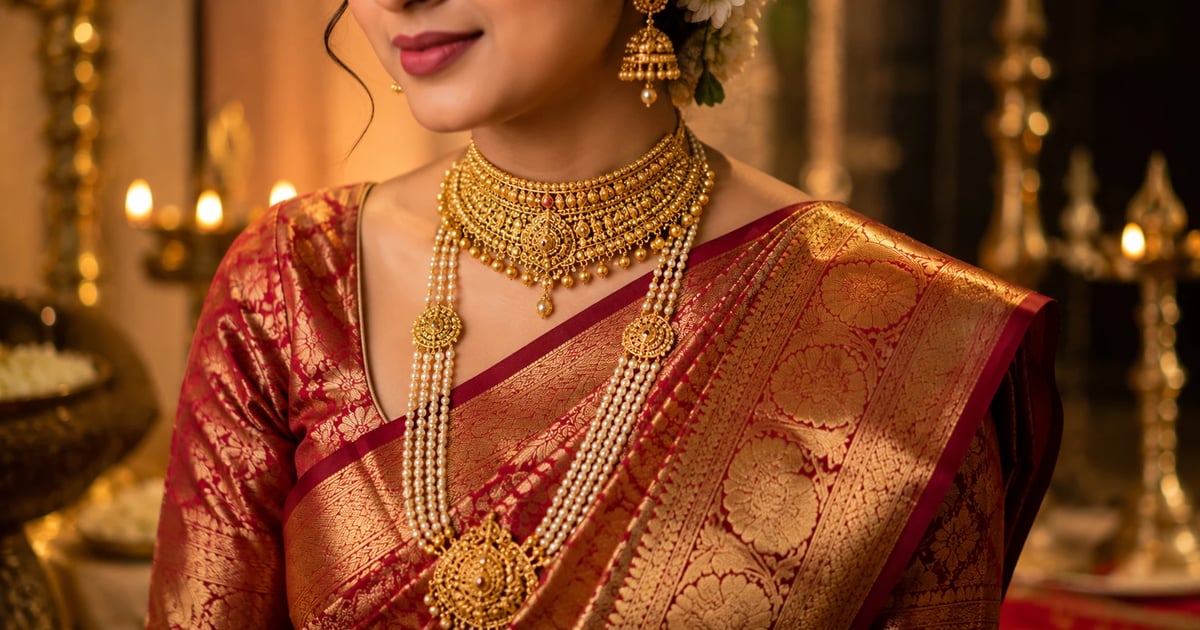
Choosing a gold choker gets hard fast. Here's the rule that solves most of it. Temple and antique designs suit the wedding ceremony. Kundan and polki suit sangeet and reception nights. Lightweight plain gold works for engagements, mehendi and parties.
Most design galleries skip that part. They show you dozens of photos and leave you to guess which one belongs at which function.
So this guide does the matching for you. You'll get design-by-function picks, neckline pairings, face-shape guidance, and the weight and hallmark checks worth doing before you pay.
Why a gold choker works beyond the wedding day
The old idea that a choker is bridal-only jewellery doesn't hold up any more. A choker sits high on the neck. That single fact makes it the most reusable heavy piece in a wedding trousseau.
Think about where it goes afterwards. Anniversary dinners. Pujo. A cousin's reception. A slim choker even works over a plain silk kurta.
Compare that with a full-length haar. A haar needs an occasion big enough to carry it, so it stays in the locker most years.
That's also why the reusability question should shape your budget. A design you'll wear four times a year justifies more than one you'll wear once.
Which gold choker suits each wedding function
Indian weddings aren't one event. They're five or six, each with different lighting, different clothes and different amounts of sitting still.
Function | Choker style that works | Why it works |
|---|---|---|
Roka / engagement | Slim plain gold, or a single-line kundan | Close-up photography; comfortable through long sittings |
Mehendi / haldi | Lightweight, minimal stones | Survives colour, floor seating and constant movement |
Wedding ceremony | Temple, antique or a broad kundan choker | Holds its own against heavy silk and layered jewellery |
Reception | Polki, gemstone or clean geometric gold | Reads well under indoor and stage lighting |
Sangeet / cocktail | Slim, flexible, with a secure clasp | Stays put while you're dancing |
Engagement and roka: keep it light
Cameras get close at a roka. So detail matters more than scale here.
A slim gold choker with fine granulation or a single kundan line photographs beautifully at that distance. Plus you'll be seated and talking for hours, so a light piece saves your neck.
Mehendi and haldi: colour over gold weight
Turmeric and henna are unforgiving. Deep stone settings trap paste, and cleaning them later is fiddly.
So pick something with few stones and open backs. Above all, pick something you can wipe down.
Wedding ceremony: the heirloom choker
This is where a heavy choker earns its place. Benarasi and Kanjeevaram silks are visually loud, and a delicate choker simply disappears against them.
Temple and antique designs work best because the matte finish doesn't fight with zari. A broad kundan choker does the same job with more sparkle.
Reception: modern and photograph-friendly
Reception lighting is usually indoor, warm and often harsh. As a result, highly polished gold can blow out in photos under that light.
Polki, gemstone settings and matte-finish geometric chokers hold detail better. That's why so many brides switch pieces between the ceremony and the reception rather than repeating one.
Sangeet and cocktail parties: movement matters
Dancing changes the requirement completely. A rigid wide choker rides up when you raise your arms.
Look for a flexible, segmented build and a clasp you can check by feel. Screw clasps and safety hooks beat a single spring ring here.
Latest gold choker designs brides are choosing
Six families cover most of what you'll be shown at a counter. Knowing the difference saves an hour of browsing.
Temple gold chokers
Temple jewellery borrows motifs from South Indian temple sculpture — Lakshmi figures, coin borders, nagas. The craft has real heritage behind it. Temple jewellery from Nagercoil in Tamil Nadu holds a Government of India Geographical Indication.
For a South Indian wedding, this is the default choice. Temple chokers pair naturally with a Kanjeevaram and a long kasu maala below.
They suit older brides and younger ones equally, which is rarer than it sounds.
Antique gold chokers
Antique here means a finish, not an age. Jewellers oxidise the surface to a dull, slightly darkened gold that mimics old family pieces.
The practical advantage is camouflage. In fact, an antique finish hides fingerprints and small scratches far better than high polish.
The trade-off is versatility. Antique-finish jewellery reads traditional, so it can look out of place with a contemporary gown.
Kundan gold chokers
Kundan work sets uncut stones into pure gold foil. So the setting technique is what you're paying for, not just the stones.
Kundan chokers cover more surface than almost any other style. If you want the neck fully dressed without a second necklace, start here.
Do check the reverse. Good kundan work carries meenakari detailing on the back. That enamel tells you a lot about the workshop.
Polki gold chokers
Polki uses uncut diamonds with their natural surface intact. Under directional light it glows rather than sparkles.
That soft glow is exactly why polki suits receptions and evening functions. But under daylight it can look understated.
Polki costs more per gram of visual impact than kundan. Ask for the stone weight separately from the gold weight before you compare quotes.
Gemstone and meenakari gold chokers
Emerald, ruby and pearl drops remain firmly in demand. In fact, the market backs that up. The World Gold Council's India Focus report for Q1 2026 found wedding buying led Indian jewellery demand that quarter. Record prices, it reported, nudged mainstream buyers towards lighter, lower-carat and studded pieces. So stone-set chokers are moving with the market, not against it.
Meenakari detailing adds colour through enamel instead of stones. It's lighter and usually cheaper than gemstone embellishments.
Plain and kolshi gold chokers
Plain gold is having a genuine moment. No stones, just form — twisted wire, beaten sheet, or the pot-shaped kolshi motif familiar across Bengal.
These are the easiest chokers to re-wear. A gold kolshi choker or a solid gold choker goes to a party as readily as to a wedding.
They also age well, since there's no setting to loosen.
Lightweight or statement: the honest trade-off
Lightweight chokers are absolutely suitable for bridal wear. The claim that only heavy chokers work for weddings is outdated, and the market has already moved on.
Still, the trade-offs are real in both directions.
Lightweight choker | Statement choker | |
|---|---|---|
Best for | Engagement, mehendi, parties, later re-wear | Wedding ceremony, heirloom intent |
Comfort over 6+ hours | High | Depends on width, lining and clasp |
Gold content on exchange | Lower | Higher |
Times worn per year | Often 3–6 | Often 1 |
The risk | Can look thin beside heavy Benarasi silk | Can sit unworn in a locker for years |
Here's the practical route most families take. Buy one heavier choker for the ceremony, then a light one for everything else.
If that stretches the budget, reverse the priority. A well-made light choker you wear often beats a heavy one you resent.
How heavy a bridal gold choker should be
There's no standard gram figure, and any article quoting one is guessing. Instead, weight depends almost entirely on construction.
Two chokers of identical size can differ hugely. A hollow or kolshi-style build uses far less gold than a solid one at the same width.
So judge comfort instead of chasing a number. Four checks do the job.
Wear it for ten full minutes. Not thirty seconds in front of a mirror. Discomfort shows up around minute six.
Raise both arms overhead. A choker that rides up and stays up will do that all evening.
Check the width against your neck length. A broad choker on a short neck restricts head movement more than the weight alone suggests.
Ask for the exact weight in writing on the bill. Stone weight and gold weight should be listed separately.
One more thing worth knowing. A wide choker spreads its load across the collarbone. So a 40 g wide piece can feel lighter than a 30 g narrow one. Width is comfort, not just cost.
Choosing a gold choker for your face shape
Face shape guidance is genuinely useful, and it's the section competitors either skip or reduce to one line. The principle is simple: a choker frames the jaw, so it either echoes your face shape or offsets it.
Face shape | What tends to suit | The reasoning |
|---|---|---|
Round | A V-shaped or pointed centre drop | Adds a vertical line and lengthens the frame |
Oval | Almost anything, including wide collars | Balanced proportions carry most silhouettes |
Heart | Softer, rounded lower edge | Adds visual width low down, near a narrow chin |
Square | Curved or scalloped borders | Curves offset a strong jawline |
Long / oblong | Broad, wide-set designs | Horizontal mass shortens a long face |
If you have a round face, the pointed pendant drop matters more than the choker's width. That single detail does most of the work.
Your earrings pull in the same direction, so choose them together. The same logic runs through our face-shape and fit guide for pasa earrings.
Pairing a gold choker with a saree or lehenga
Neckline decides this, not the outfit category. Get the neckline right and the rest follows.
Saree necklines that suit a choker
A high-neck or boat-neck blouse leaves almost no skin above the collarbone. A choker sits directly on fabric there, which flattens it.
Deep round and sweetheart necklines are the natural fit. The choker sits on skin, and the gap below it stays open for a second necklace.
For saree styling, one more detail helps: the pallu. If it's heavily worked and sits over one shoulder, keep the choker narrow on that side of your look.
Lehenga necklines that suit a choker
Lehenga blouses run bolder. Off-shoulder and deep-V cuts leave a wide field, which is where broad kundan and temple chokers look their best.
With a high-neck or collared blouse, skip the choker. A long haar over the fabric works better than a choker fighting it.
Layering a choker with a long necklace
Yes, you can layer — and for a bridal look you usually should. The rule is contrast, not repetition.
Keep a clear gap of a few fingers between the two pieces. Pair a heavy choker with a slimmer long chain, never two heavy pieces stacked.
Pearls do this job well, which is why a gold and pearl sitahar sits so comfortably under a gold choker. A dokia chain or a pearl choker gives you the same layered effect with less total weight.
Hallmark and weight checks before you pay
A choker is one of the larger gold purchases a family makes, so the paperwork deserves five minutes.
According to the Bureau of Indian Standards, a gold hallmark carries three marks. Those are the BIS logo, the purity in carat and fineness, and a six-digit HUID.
Here's the part that matters for a choker set, and almost nobody mentions it. BIS requires each article in a pair and every detachable part to carry its own hallmark with a different HUID. So a choker with detachable side pieces and its matching earrings should each be marked separately. Check every component, not just the main piece.
Coverage keeps widening too. Mandatory hallmarking reached 380 districts in its sixth phase from March 2026. It now applies to 14, 18, 20, 22, 23 and 24 carat gold.
Two more things to confirm on the bill. Gold weight and stone weight listed separately, and making charges stated as a figure you can check.
Our guide to what a BIS hallmark does and doesn't cover goes deeper. The five-minute purity check walks through verifying a HUID on your phone.
Where to start your search
Start with the function you're buying for, not the design you liked on a screen. That one reversal removes most of the regret.
Then narrow by neckline, check the piece against your face shape, and wear it for ten minutes before deciding.
You can browse our full gold choker collection online. Or come see them at our Barasat showroom, where you can try the weight first.