

Gold Locket Design for Female: Complete 2026 Guide
 Sujoy Dhar
6 min read
Sujoy Dhar
6 min read
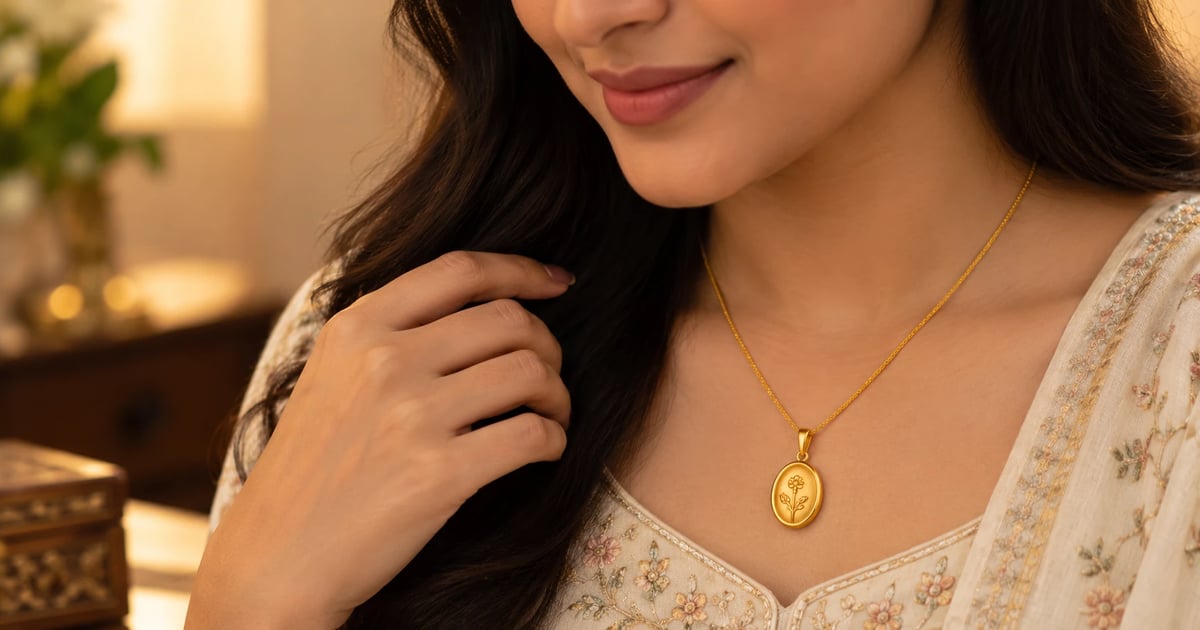
Shopping for a gold locket design for female buyers usually means facing two problems at once: is this piece pure and priced fairly, and will it still look right five years from now. This guide answers both. It gives real weight-to-price numbers, a hallmark check you can run yourself, and picks sorted by daily wear or gifting.
A locket, strictly, has a hinge and a compartment. Two hinged halves close over a tiny photo, a lock of hair, or a keepsake. That design goes back centuries in Western jewellery. In Indian retail, though, that's not what "gold locket design for female" usually means. It's almost always a solid pendant, often shaped like Surya, Ganesha, or Swastik, that doesn't open at all. Nobody tells you this upfront, so you end up guessing at checkout.
Locket or Pendant? What You're Actually Buying
A true locket opens. A pendant is simpler. It's any ornament that hangs from a chain, valued for its look or meaning, not for what it holds.
Indian jewellers use "locket" as the everyday word for both. Browse our locket and pendant collection and most pieces won't open, and that's fine. The Surya, Ganesha, and Swastik designs are meant to be worn as symbols, not storage.
What matters before you buy is asking directly: does this piece open? If you want a keepsake compartment, say so at the counter. If you just want a religious or decorative pendant, most of the "gold locket" range on the market already fits.
Gold Locket Design Types Worth Comparing
Three design families cover almost everything sold as a "gold locket design for female" today.
Antique and Temple-Style Lockets. Antique and temple-style lockets copy old temple carving. Think raised borders, dense motifs, and sometimes a deliberately dull, oxidised finish instead of high polish. That handwork usually means more labour. Expect a higher making charge than a plain casting piece of the same weight.
Casting Lockets for Everyday Simplicity. Casting lockets come from a mould, so the design repeats across pieces at a lower making charge. Most simple alphabet, initial, or name-engraved lockets fall in this category, which makes them a practical pick for daily wear.
Religious Motif Lockets: Surya, Ganesha, Swastik. Surya, Ganesha, and Swastik lockets dominate "gold locket" searches for a reason. They're worn daily as protection symbols, not occasional jewellery. If the sun-motif design interests you, our Surya locket guide breaks down what each element means.
How Much Gold You Need, and What It Costs
Most daily-wear gold lockets in Kolkata run 1 to 5 grams. Honestly, the 2 to 3 gram range is where most everyday sales happen. Heavier, more detailed antique pieces can go past 8 grams.
As of early September 2026, 22K gold in Kolkata trades near ₹14,700 a gram, per our live gold rate page. A simple 2 gram casting locket costs roughly ₹29,400 in metal alone, before making charges and GST. Rates move daily, so check the live board before you commit to a price.
Weight | Approx. metal cost (22K, ~₹14,700/g) | Typical use |
|---|---|---|
1 gram | ~₹14,700 | Thin daily wear, alphabet or initial |
2–3 grams | ~₹29,400–₹44,100 | Most common daily-wear range |
5 grams | ~₹73,500 | Slightly larger religious motif |
8+ grams | ₹1,17,600+ | Antique or temple-style, occasion wear |
A budget under ₹20,000 typically buys well under 1.3 grams of 22K gold. Making charges and 3% GST eat into that further. Making charges vary widely by jeweller and design, so run the exact math on our gold calculator before you shop.
Did you check our Caterpillar Ring Designs ? If Not be sure to check it out !
22K or 18K: Which Suits Daily Wear
22K gold (916 fineness, or 91.6% pure) is the default for Indian gold jewellery, including most lockets. It's softer, so intricate antique work shows up beautifully, but it also scratches and bends more easily with daily wear.
18K gold (750 fineness, 75% pure) mixes in more alloy, which makes it harder and more scratch-resistant. It suits a locket you'll wear every day and rarely take off. It also costs less per gram, simply because it holds less gold.
Neither is "better" outright. If resale value and the traditional gold look matter most, choose 22K. If daily durability matters more than resale, 18K is the honest recommendation. It's the wrong fit, though, if you're buying purely as an investment piece.
How to Check the Hallmark on Your Gold Locket
Hallmarking has been mandatory for gold jewellery sold in India since June 2021, per the Bureau of Indian Standards (BIS). A genuine hallmark carries three marks. Look for the BIS logo, the purity in caratage and fineness (like 22K916), and a six-digit HUID. That's the Hallmark Unique Identification number, unique to that exact piece.
Ask the jeweller for a 10x magnifying glass. Check that all three marks are stamped on the locket itself, not just printed on the tag. Then open the BIS Care app, tap "Verify HUID," and enter the six-digit code. A match confirms the piece is registered against that exact purity.
Always ask for a proper invoice listing the HUID, caratage, and weight. Without it, a hallmark dispute later has nothing to point back to. A hallmarked piece with its invoice is also easier to exchange or resell later. The jeweller can verify purity without re-testing from scratch.
Best Gold Locket Designs for Daily Wear
For daily wear, lighter wins. A 1 to 3 gram casting locket works best: simple alphabet, small Ganesha, or plain oval shape. It survives a work commute and a kitchen sink without catching on clothes or hair.
Yes, you can wear a gold locket every day, including in water. Soap and chlorine dull the shine over time, though, and can loosen stone settings if any are set. Take it off before a swim or a heavy workout, and you'll get years out of a simple piece.
Match the chain to the locket's weight. A heavy antique piece needs a sturdy chain, not a fine rope chain that will stretch under the load. Our gold choker guide covers chain and clasp choices for heavier pieces, if you're building toward a fuller look.
Best Gold Locket Designs for Wedding or Anniversary Gifts
For a wedding or anniversary gift, weight and finish matter more than for daily wear. A 4 to 8 gram antique or temple-style locket, or a Radha-Krishna motif, works well here. It reads as a considered gift, not an everyday piece.
If the gift pairs with a mangalsutra or a bridal set, keep the metal tone and finish consistent. Our mangalsutra guide is worth checking before you commit to a matching set.
Name or date engraving on the back turns a standard casting design into something personal. It usually adds only a small charge over the base making cost.
Choosing a Locket Design for Your Face Shape
A round face looks best with a longer chain and an elongated or oval locket. That combination draws the eye downward, per Jewelers Mutual's necklace-length guidance. Avoid short, wide lockets sitting high on the neck; they widen an already round face.
A long or oblong face benefits from the opposite. Try a shorter chain, around 16 to 18 inches, with a rounder or wider locket. That breaks up the length instead of adding to it.
For a square jawline, choose a longer chain with a softly curved locket. Oval or teardrop shapes work better than sharp edges here. A heart-shaped face is wide at the forehead and narrow at the chin. A choker-length chain balances that narrower jaw.
Once you've settled on weight, purity, and design, the fastest next step is browsing live options. Check our locket and pendant collection at today's gold rate.