

Surya Locket Meaning & Designs: A Buyer's Guide in 2026

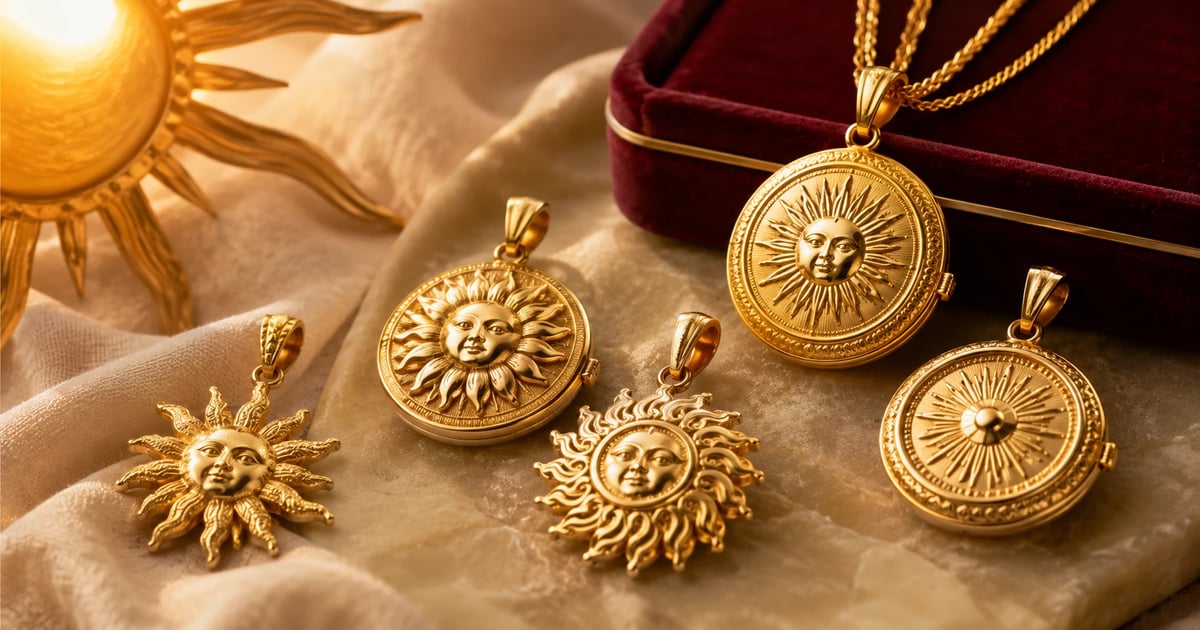
Search for a Surya locket and you get astrology promises or mythology lectures. Neither tells you what the pendant on the counter actually means. So, plainly: a Surya locket is a pendant carrying the sun god's imagery.
That imagery is specific. An open lotus. Flame-like rays. Seven horses. A single spoked wheel. Each shape came out of temple sculpture, and each one changes how the finished pendant wears.
This guide connects the two halves. First the meaning, then what that meaning does to real jewellery.
What a Surya Locket Actually Is
Surya is the Hindu sun god, also called Aditya or Surya Dev. A Surya locket puts him, or his solar signs, on a pendant you wear.
Two families of pendant share the name. The first shows Surya as a figure or a face, ringed by rays. The second drops the figure and keeps only the symbols.
In practice, both count as a sun god pendant. Neither is more correct than the other. Regional habit decides much of this, and so does the wearer's taste.
Sizes vary widely across a gold lockets and pendants range. Small ones read as everyday jewellery. Larger ones read as devotional pieces, and they sit heavier on the chest.
One thing is worth settling early. A Surya locket is jewellery with religious meaning attached. It is not a prescription, and no honest jeweller will promise you an outcome from it.
Surya Locket Meaning and Symbolism Explained
Surya's Place in Hindu Tradition
Surya appears in the Rigveda, among the oldest Vedic texts. Tradition counts him as one of the twelve Adityas, born of the goddess Aditi.
Unlike most deities, Surya is visible every day. That single fact shaped how he was worshipped. You can face what you are honouring at dawn, with no image needed.
Temples followed. Konark in Odisha and Modhera in Gujarat remain the best-known Surya sites in India.
Surya Namaskar, the yoga sun salutation, keeps the same idea alive in another form. So Surya Bhagwan sits inside daily practice, not only inside scripture.
Explore our other locket collections for women
Light, Energy and the Dispelling of Darkness
One theme repeats across Surya iconography: light pushing back dark. Museum catalogues describe female archers flanking the solar deity, shooting arrows to drive the night away.
The United Nations catalogue entry for the Surya sculpture gifted by India in 1982 puts the idea plainly. Surya is the dispeller of darkness, and he stands for willpower, name, fame and authority.
That is why a Surya locket reads as an energy symbol rather than a protective charm. It marks a quality you want to keep hold of. But it does not claim to fix anything.
Leadership, Confidence and Daily Discipline
Buyers often reach for a Surya pendant at a threshold. A new job. Starting college. Moving cities for the first time.
The sun works as a symbol there precisely because it is ordinary and relentless. It turns up. Nothing dramatic about it.
Wear the meaning that way and the pendant stays honest. Treat it as a shortcut to success and you will be let down. That is the seller's fault, not yours.
Four Symbols You'll See on Surya Lockets
Lotus Motif and Why It Frames the Face
Surya is usually shown holding a fully opened lotus in each raised hand. That choice is literal, not decorative. The United Nations' catalogue of its Surya sculpture spells it out. Lotus flowers matter in Surya iconography because they open once morning rays reach them.
So jewellers borrow the logic. Petals radiate from a centre, so a lotus gives a natural round frame for a face or a disc.
There is a practical bonus too. Petal tips are broad and rounded. So a lotus border snags far less on wool than a spiked ray border.
Want a Surya pendant design for daily wear under clothing? Start with lotus-framed pieces.
Sun Rays That Shape the Pendant Outline
The Philadelphia Museum of Art describes its twelfth-century Surya relief with flaming rays behind the god's head. In fact, even his eyebrows are made of flames.
That fire is what pendant rays copy. In metal, rays do two jobs at once. They read as light, and they set the pendant's outline.
Now the trade-off. Long, sharp, separated rays look brilliant and throw light beautifully. They also bend, and they hook on knitwear.
Shorter rays, or rays joined by a thin outer ring, survive daily wear far better. Ask to see both in hand, since photographs flatten the difference.
Seven Horses and the Chariot in Miniature
Surya crosses the sky in a chariot pulled by seven horses. The V&A's early tenth-century Surya sculpture from Patna shows those horses below the god. There the chariot shrinks to a single spoked wheel.
Jewellery inherits a problem that sculpture solved with space. After all, seven horses need width to stay readable.
At small pendant sizes, horses blur into texture. That is why they turn up mostly on wider men's pieces. Otherwise they get cut down to three or four suggested forms.
If the horses matter to you, go larger. Otherwise accept a stylised version rather than a literal count.
Solar Disc, the Wheel That Marks Time
Builders raised Konark's temple as Surya's chariot in stone. UNESCO's World Heritage listing for the Sun Temple at Konârak describes twelve pairs of wheels. Seven horses draw them, evoking movement across the heavens.
Those wheels are why a plain disc still carries weight. A circle here is not lazy design. It is the chariot wheel, and it stands for time turning.
For a jeweller the disc is also the friendliest shape available. It stays flat, symmetrical and light, and it sits flush against skin.
That combination explains why minimalist and unisex Surya symbol jewellery almost always starts from a disc.
Popular Surya Locket Designs Worth Knowing
Traditional Gold Surya Lockets
The classic form is a raised sun face inside a ring of rays, worked in yellow gold. Repoussé — metal shaped from behind — gives the face its depth.
Higher-karat gold is softer, so fine detail rounds off over years of wear. Slightly lower karat holds crisp edges for longer.
Traditional pieces run larger and heavier. They photograph beautifully at pujas and weddings. For a desk job through a Kolkata summer, though, they can feel like a lot.
Compare classic gold locket designs to see how face-and-ray proportions shift with size.
Silver Surya Pendants for Everyday Wear
Silver suits Surya better than most buyers expect. Oxidised silver darkens the recesses, so rays and petals stand out sharply against the background.
Entry cost is lower, which makes a Surya silver locket the sensible first deity pendant. It also works as a gift when you are unsure of someone's taste.
Silver does tarnish. A soft cloth and a dry box handle that. Anyone unwilling to do the upkeep should stay with gold.
Our silver locket options sit well on a leather cord as well as on a chain.
Diamond Surya Lockets and Light Play
A diamond Surya pendant makes a pointed argument. Stones set at ray tips throw light outward, which is exactly what the motif is about.
Even so, small stones in thin ray settings need checking. Prongs on narrow ray arms are the usual failure point on any sunburst design.
Halo settings around a central disc hold up better, and they keep the sun-god reading intact.
See how stone placement changes the effect across our diamond locket designs.
Minimalist Sun Discs for Daily Use
Minimal pieces strip Surya back to a flat disc with engraved rays, or a plain circle with a fine border.
Weight stays low, so the pendant does not swing or flip through the day. Nothing catches on a collar.
Sceptical that it still counts as devotional? It does. The disc is the chariot wheel, and that motif predates the minimalist trend now using it by centuries.
For under-shirt wear, or for someone who never removes their chain, this is usually the right call.
How to Choose a Surya Locket You'll Wear
Metal is the last call, not the first. Gold gives detail and permanence, silver gives contrast at lower cost, diamonds give light play. Match the metal to how often the piece will be worn.
Then work through these six steps in order.
Decide where it will live. Under a shirt daily, or over clothes on occasions? Under-shirt means flat, light and rounded.
Pick the motif that means something to you. Lotus for growth, rays for energy, horses for drive, disc for constancy.
Run a finger around the edge. Anything that catches your skin will catch fabric within a week.
Turn it over. A hollow back is lighter, while a solid back sits flatter and lasts longer.
Test the bail — the loop your chain passes through. It should move freely without letting the pendant spin face-backwards.
Match the chain before you pay. Bring the chain you already own to the counter.
Surya Locket Designs for Men
Men's Surya pendants run larger and lean on the chariot scene or a bold ray burst.
Wider designs need a heavier chain to hang straight. A thin chain under a broad pendant tilts forward, and it wears through at the bail.
Matte or brushed finishes suit these pieces well. They hide the fine scratches a shirt collar puts on high polish within months.
Surya Locket Designs for Women
Women's Surya pendants lean lighter and rounder. Lotus frames, fine ray borders and diamond haloes dominate here.
Chain length matters more than pendant size. A short chain sets the pendant high on the collarbone, where a wide sunburst can crowd a neckline.
Many buyers pair a small disc with a chain they already wear. Take that chain along, because bail width decides whether it will even pass through.
Matching the Chain to Your Pendant
A pendant usually fails on the chain, not on the pendant. Three things decide that.
First, the bail must clear the chain link comfortably. Force it and you damage both.
Second, weight. A light chain under a heavy sun disc stretches at the shoulders and eventually parts there.
Third, style. Rope and box chains suit textured sunbursts, while flat curb chains suit plain discs. Our guide to gold chains under 10 gms for men covers weight and comfort in more detail.
Surya Locket vs Surya Yantra Locket
These two get confused constantly, and the difference is real.
A Surya locket shows the deity or his solar motifs. A Surya Yantra locket shows a yantra — a geometric diagram used in worship. Most yantra pendants carry the diagram on one face and Surya's image on the other.
Surya locket | Surya Yantra locket | |
|---|---|---|
What's on it | Deity figure, face or solar motifs | Geometric grid of lines and numbers |
Usual metal | Gold, silver, diamond-set | Copper or silver |
Sold by | Jewellers | Astrology and puja retailers |
Comes with | A chain and a jewellery finish | Wearing instructions, often a thread |
Bought as | Jewellery that carries meaning | A prescribed remedy |
So the choice is straightforward. Want jewellery? Buy the locket.
A yantra recommended by someone you trust is a separate decision entirely. Claims about planetary results sit outside what any jeweller can verify, and we will not make them.
Choosing With Confidence, Not Guesswork
A Surya locket earns its place through meaning you actually recognise. The lotus opens to the sun. Rays stand for flame. Seven horses pull the chariot, and the wheel turns the year.
Pick the symbol that speaks to you, then check the edge, the back and the bail before paying. That order keeps you from buying a piece that looks right in a photograph and annoys you by week two.