

Dokia Chain Design Guide: Styles, Weight & Hallmarks

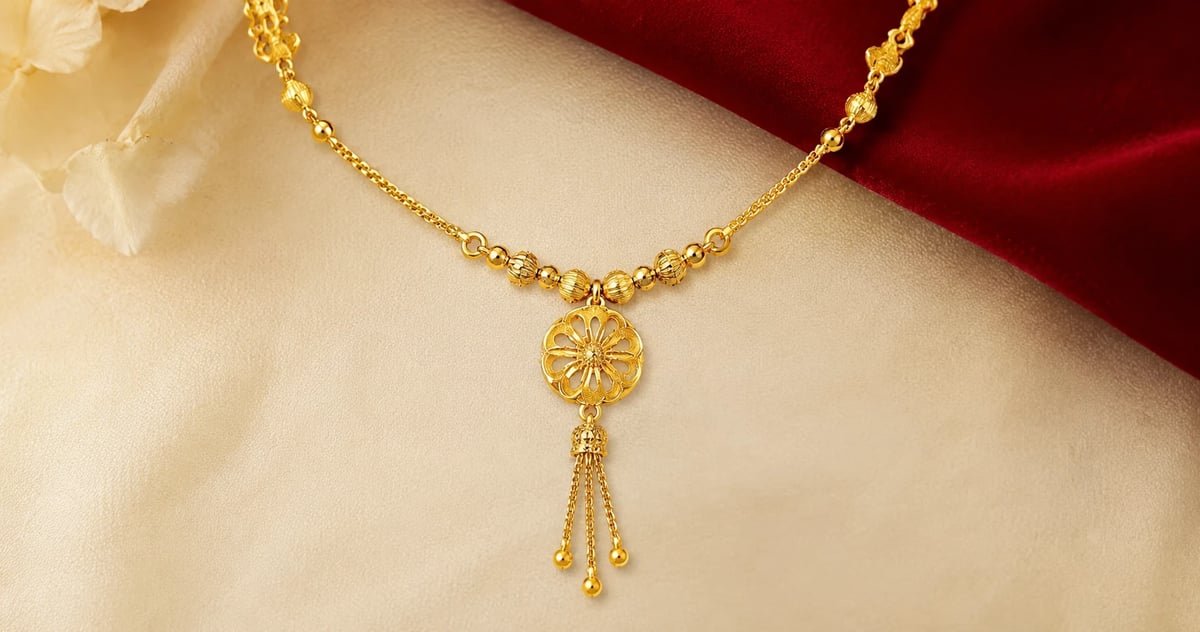
You have probably seen the photos already. Rows of small gold balls, a drop at the centre, tassels swinging below. Yet almost every dokia chain page online gives you a price, a weight, and nothing else.
Nobody explains what makes the design a dokia. Bead size, cut, finish, the centre drop — each one changes the piece completely. And the pendant may need its own hallmark, which hardly anyone mentions.
So this guide covers the design vocabulary jewellers actually use. Plus honest weight guidance, occasion advice, and the counter check that protects your money.
What a Dokia chain actually is
A dokia chain is a traditional Indian gold chain built from round gold beads linked in a row. Nearly all are 22K. Most designs add a centre drop with tassels or small bells. Bead size, cut and finish decide how heavy and how bright the chain looks.
You will see the name spelled two ways in shops. Dokia and dokiya both refer to the same bead-link construction.
Trade names describe the parts plainly. Our own 4/611 Gola Latkan Maniya Dokia Chain spells it out. Gola means ball. Latkan is the hanging drop, and maniya means beads.
One honest note before you read further. Documented history on this design is thin. Nearly every available source is a retailer or manufacturer catalogue, not a museum or academic record. So treat any confident origin story you read elsewhere with caution.
Design details that define a Dokia chain
Three things separate one dokia from another. Get these right and the rest follows.
Bead size and spacing set the whole look
Small beads packed tightly read as fine and fluid. The chain drapes and moves like fabric.
Larger beads with visible gaps read bolder. You see more gold per inch, so the piece carries further across a room.
Here is the part catalogues rarely state. Beads can be hollow or solid. Two chains of identical size can differ sharply in weight because of this, so always ask which you are buying.
Cuts and finishes that change the shine
Diamond cuts and laser cuts are tiny facets sliced into each bead. They flash under light and make a lighter chain look busier.
Choose a frost finish and you trade sparkle for a soft glow. It also hides fine scratches better than high polish.
Meenakari adds coloured enamel work on gold. Those beads pick up the colour of a saree instead of competing with it.
Then there is plain fine polish, the quiet option. Our 4/611 uses it, so its movement shows more than its sparkle.
Latkan drops, ghungroo bells and tassel ends
The latkan is the drop that hangs at the centre front. It is usually the heaviest single element on the chain.
Below or beside it sit ghungroo, small bells that jingle as you move. Tassels do the same job silently.
Movement is the whole point of these endings. The 4/611 carries triple tassel hangings below a dome-cut centre drop, so the base shifts as you walk.
Traditional Dokia chain styles still made today
Plain round beads in a single row remain the base design. Nothing hangs, nothing distracts, and the chain suits almost any neckline.
Next comes the version alternating beads with short gold pipes. The pipes stretch the pattern, so you cover more length for less gold.
Ghungroo-ended chains finish with a row of small bells across the drop. Bengali, Gujarati and Marathi trade catalogues all list versions of this.
For colour in an otherwise yellow piece, look at meenakari beads. Above all, they read as festive rather than everyday.
Many traditional dokia chains are still sold as sets with matching jhumka or screw-back earrings.
Modern Dokia chain designs selling now
Two-layer versions run a second bead row below the first. The look is fuller without a solid necklace weight.
Hollow beads have changed what a lightweight dokia chain can be. Makers get bead size without bead mass, though the trade-off is a thinner wall.
Look for mixed finishes too. A frosted bead beside a polished one gives depth without extra gold.
Detachable centre drops are the genuinely useful update. Remove the latkan and one chain works for office and for a wedding. Just read the hallmarking section below before you buy one.
Finally, shorter lengths are selling well, because they sit correctly with kurtis and western necklines.
Dokia chain vs a plain gold chain
The construction difference drives everything else.
Dokia chain | Plain link chain | |
|---|---|---|
Build | Round beads strung in a row | Interlocking solid links |
Visual weight | Looks fuller at the same gram weight | Looks slimmer, sits flatter |
Making charges | Higher, because bead work is hand-intensive | Lower, often machine-made |
Daily wear | Beads dent, tassels snag | Handles knocks far better |
Repair | Beads usually replaced, not reshaped | Links can often be re-soldered |
Pendant load | Bead links are not built to carry weight | Solid links take a heavy pendant |
Best use | Festive, bridal, occasion wear | Everyday, under clothing |
In short, you choose a dokia for presence and a link chain for endurance.
Choosing weight and length for a Dokia chain
Skip the old advice that heavier always means better. On a bead chain it is simply untrue.
What each weight band looks like worn
A dokia chain spends weight on air as well as gold. Bead diameter, hollow walls and gaps all change how much metal you get per centimetre.
As a real reference point, our 4/611 weighs 9.57 g net in 22K. That buys a full bead row, a dome-cut centre drop and triple tassels.
Go lighter than that and the hangings usually disappear first. You keep the bead row and lose the movement.
Heavier builds add bead diameter or a second row. Even so, a heavier chain can look smaller than a lighter one with wider beads. Judge the piece on your neck, not on the invoice.
Chain lengths and where a Dokia falls
Shorter chains sit at the base of the throat. Mid lengths fall just below the collarbone, which suits most blouse necklines.
Longer chains drop over the blouse and read as a necklace instead. That changes the whole outfit decision.
One quirk worth knowing. Beads add visual bulk, so a dokia looks shorter than a plain chain of the same measurement. Our guide to chain weight and length walks through the measuring method in more detail.
Daily wear: where a Dokia chain struggles
Time for the part most sellers skip. A 22K dokia chain is not an ideal everyday piece, and pretending otherwise costs you money.
Gold at 22K is soft. Hollow beads dent against a desk edge or a car seatbelt.
Rub a laser-cut bead daily and the facets flatten. The flash you paid for fades first at the back of the neck.
Tassels and ghungroo tangle in dupattas and hair. Trade catalogues themselves flag these chains as delicate, which tells you something.
Watch the clasp too, because S-hook fittings are common here. They open more easily than a spring ring under a jerk.
So if you want gold every single day, buy a plain link chain instead. Keep the dokia for occasions. Our lightweight chain guide covers that everyday category honestly.
Wedding and festive Dokia chain choices
Layering is where a dokia earns its place. Worn above a heavier necklace, the bead row fills the gap at the throat neatly.
Check the length against your blouse neckline before the fitting, not after. A drop that lands on embroidery disappears completely.
Meenakari beads work best when they echo one colour already in the saree. Two competing colours flatten both.
Matching earring sets save you a second search, and many dokia designs are made as sets for this reason.
One practical warning for ceremonies. Hangings catch on dupattas during pheras and aarti, so a shorter drop is the safer bridal pick. If you are still comparing bridal neckwear, our pearl versus gold sitahar comparison covers the heavier end of that decision.
Gifting a Dokia chain without guessing her taste
Sizing forgives you here, which is the real gifting advantage. A chain has no ring size and no bangle diameter to get wrong.
Mid-length chains with moderate bead size suit the widest range of wardrobes. Very long or very bold pieces need a known preference.
A detachable centre drop hedges your bet neatly. She wears the chain plain or dressed, depending on the day.
Skip strong meenakari colours unless you have seen her wardrobe. Yellow gold alone is far harder to get wrong.
Above all, keep the invoice and the hallmark details. A hallmarked piece with a clean bill is far easier to exchange later.
How to check hallmarking before you pay
Since 1 July 2021, a gold hallmark in India carries three marks. The Bureau of Indian Standards hallmarking FAQ names them. First the BIS logo, then purity in caratage and fineness, then a six-digit HUID number.
HUID means Hallmark Unique Identification, a code unique to that one piece. You can verify it yourself in the BIS Care app.
For 22K, the fineness mark reads 916, meaning 91.6% pure gold. BIS notes that IS 1417:2016 permits six caratages in all, including 20K and 23K.
The marks are small, so ask to see them properly. BIS requires a registered jeweller to keep a magnifying glass of at least 10x for exactly this purpose.
On a bead chain, look at the clasp or any flat plate. Round beads rarely take a clean stamp.
The detachable-part rule most buyers miss
Here is the check that matters most on this design. BIS states that all detachable parts should carry their own hallmark. Each part needs a different HUID.
A detachable part means anything easily removed or replaced. On a dokia chain, that is often the centre drop.
So if the latkan lifts off, it needs its own HUID — not just the chain. Ask at the counter and check both codes before you pay.
What moves a Dokia chain's price
Three components make up what you pay. Metal value comes first, then making charges, then GST.
Metal value is the day's rate multiplied by net weight. The India Bullion and Jewellers Association publishes benchmark 916 rates each morning and evening. So check the current figure before you shop. You can also see our daily Kolkata gold rate.
Making charges are where dokia chains differ from plain chains. Every bead is formed, cut and finished, so labour rises with bead count.
Hollow beads cut metal value but not always making charges. That is why two lightweight chains can be priced quite differently.
One small thing in your favour. BIS charges hallmarking per article rather than by weight, so a light chain is not penalised for being light.
Rates move daily and making charges vary by workshop. Nobody can promise you a future value, so buy the design you will wear.
Caring for a delicate bead chain
Perfume goes on first, then the chain. Alcohol and sprays dull a frost finish faster than polish.
Sweat and moisture are the main enemies. Wipe the chain with a soft cloth after wearing and let it dry fully.
Store it flat or hanging, never coiled in a heap. Coiling is how tassels knot themselves overnight.
Never pull a tangle apart by force. Hollow bead walls are thin, and a crushed bead usually needs replacing rather than reshaping.
Get the clasp checked once a year, especially on an S-hook. Bring the chain to our Barasat showroom and cleaning and polishing are complimentary for life.
Making your Dokia chain decision
Start with the occasion, not the weight. A festive chain and a daily chain are different purchases, and one piece rarely does both well.
Then set bead size, finish and drop length against the necklines you actually wear. Only after that does gram weight become a useful number.
At the counter, ask for the 10x glass. Check the HUID on the chain, and on the drop if it detaches.
Browse our ladies gold chain collection or the wider gold chain range. Compare bead styles side by side.