


Best Gold Chain Designs for Daily Wear in 2026
 Sujoy Dhar
11 min read
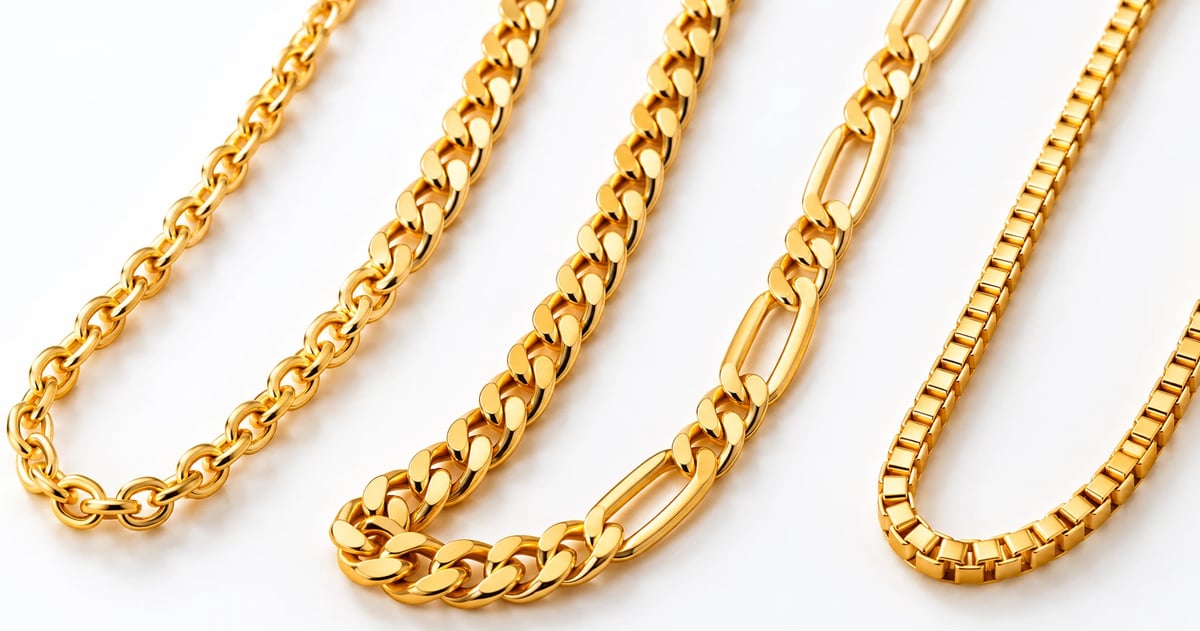
The sturdiest gold chain designs for daily wear are cable, curb, figaro and box chains in solid gold. These links hold their shape through daily movement and are simple for a jeweller to repair. Rope, Singapore, snake and paperclip chains suit daily wear too, but they kink, snag or stretch more easily. They need gentler handling.
If you're still deciding on the overall look, start with our guide to daily wear gold necklace designs. This guide goes deeper into the chain itself: links, clasps, karat, hallmark and care.
Daily Wear Chain Types Compared at a Glance
Chain | What the links look like | Strength for daily wear | Main thing to watch | Suits |
|---|---|---|---|---|
Cable | Oval links threaded one through the next | Strong | Slight stretch over years | A first chain, most pendants |
Curb | Twisted links that lie flat | Strong | Very little | Office wear, no pendant |
Figaro | Short links broken by one long link | Strong | Long link can catch on lace | Plain kurtas and blouses |
Box | Small square links | Strong at medium thickness | Fine versions can snap if yanked | Slide pendants, lockets |
Rope | Links twisted into a spiral | Moderate | Hollow rope dents | Wearing alone with a saree |
Singapore | Twisted, faceted links | Moderate | Kinks when stored loose | Light sparkle on workdays |
Snake | Curved plates forming a smooth tube | Moderate | A sharp kink is hard to fix | A short, sleek look |
Paperclip | Long, open oval links | Moderate | Snags on buttons and hair | Layering over western wear |
"Strength" here means how well each of these gold chain designs for daily wear keeps its shape. It comes from how each chain is built, not from a lab test.
Thickness changes the picture, though. A thick rope chain will outlast a hair-thin cable chain. So compare chains of similar width when you shop.
8 Gold Chain Designs for Daily Wear, Link by Link
Cable Chain: The Easiest Chain to Repair
A cable chain is the plain chain most people picture. Each oval link threads through the next. It's the most forgiving choice for a first gold purchase.
If a link opens, a jeweller can close or replace it without much fuss. Cable chains also carry almost any pendant, as long as the bail fits. The bail is the loop a pendant hangs from. The trade-off is a slight stretch over years, since oval links pull longer under constant weight.
Curb Chain: Flat Links That Resist Twisting
Curb links are twisted so they lie flat against your skin. That flat shape stops the chain from rolling and knotting itself. It also sits neatly under a shirt collar, which suits office wear.
Because the links show their full face, a curb chain looks bolder than a cable chain of similar weight.
Figaro Chain: A Patterned Chain With Real Strength
A figaro chain repeats a rhythm, usually three short links and then one long one. Think of it as a curb chain with a pattern. The flat links give it similar strength.
Its one weak spot is that long link. It can catch on lace, net dupattas or chunky knits. Over a plain cotton kurta or blouse, it's one of the most practical designs here.
Box Chain: Square Links Made for Pendants
Box chain links are small squares joined edge to edge. The chain feels firm, so a pendant hangs straight instead of flipping over. That makes it the usual pick for slide pendants and small lockets.
Watch the thickness, though. A very fine box chain can snap at a single link if it catches and gets yanked sideways.
Rope Chain: Rich Texture That Needs Gentle Handling
Rope chains twist small links into a spiral, so they catch light from every side. With a saree, a rope chain can stand alone without any pendant.
Many rope chains are hollow to keep the weight down. Hollow rope dents when pressed hard, and a dent is difficult to smooth out. Before you buy one for daily wear, ask whether it's solid or hollow.
Singapore Chain: Light Sparkle, Easy to Kink
A Singapore chain has twisted, faceted links that flash as you move.
The same twist makes it prone to kinks and knots, especially when tossed loose into a pouch. Stored flat and closed, it behaves well enough for office days.
Snake Chain: Smooth, Sleek and Hard to Fix
Snake chains are built from tight, curved plates that form a smooth tube. They feel almost liquid on the neck and look modern.
The problem shows up the day it kinks. A sharp bend creases the plates, and a jeweller often can't fully straighten them. Choose a snake chain only if you'll take it off at night and store it straight.
Paperclip Chain: Modern Look, More Snags
Paperclip chains use long, open oval links. They look current and layer well over western wear.
Those open links are the catch, quite literally. They hook onto buttons, earring backs and loose hair. Keep a paperclip chain for lighter days, and rotate it with a sturdier chain.
Matching a Chain to Your Pendant or Mangalsutra
A pendant changes how a chain wears. Its whole weight pulls on the few links around the bail and on the clasp. As a rule, the chain should look at least as sturdy as the pendant it carries.
Check the bail before you buy. It should slide over the clasp, or a jeweller will need to fit it. Box and snake chains suit slide pendants because the pendant stays centred. Cable and curb chains suit lockets that hang from a jump ring.
If you already wear a mangalsutra every day, a second chain has to live beside it. A flat chain, like a curb or figaro, sits well next to a round beaded mangalsutra. Different shapes slide past each other instead of knotting. Keep the gold chain clearly shorter or longer, too.
Choosing both together is easier with our guide to 22Kt gold mangalsutra designs.
Clasps and Joints: Where Daily Wear Chains Fail
The clasp end gets the most handling. You open it, close it and tug it into place twice a day.
Lobster clasp. A spring-loaded hook with a small lever. It's the most secure common option for daily wear.
Spring ring. A small round clasp with a tiny lever. It's common on fine chains, but fiddly, and its spring can weaken.
S-hook. An S-shaped hook often seen on traditional chains. It's easy to fasten but can work loose if it gets bent open.
Box clasp. A tab that clicks into a small box. It looks neat, though the tab can loosen over years.
Before you pay, open and close the clasp ten times. It should click shut each time without forcing.
Next, look at the jump rings. These are the small loops that join the clasp to the chain. They should be soldered shut, with no visible gap. On a chain you'll wear daily, a soldered ring is worth asking for. Our lightweight necklace guide shows the other weak points to inspect before you buy.
Karat, Weight and Hollow Links in a Daily Chain
Most gold chain designs for daily wear come in 22K or 18K, and karat decides how hard the metal is. According to BIS's hallmarking FAQ, 22K gold is marked 916 and 18K is marked 750. In plain terms, 22K is 91.6% gold and 18K is 75% gold. The rest is alloy metal, which adds hardness.
On a thin chain, that hardness matters. Each link rubs against its neighbours all day. Softer metal wears faster at those contact points. So for a fine chain, 18K usually keeps its links crisp for longer. On the other hand, 22K suits a thicker chain, where there's enough metal to absorb the wear.
Weight follows the same logic. Under 5 grams, a chain needs gentle handling. Between 5 and 10 grams, most chains are sturdy enough for everyday wear.
Hollow links deserve a separate check. They make a chain look thicker for less gold, which keeps the bill down. However, hollow links dent under pressure, and a dented link is hard to repair. For a chain you'll wear every day, solid links are the safer buy.
Price comes from the gold weight, the day's rate for that karat and the making charges. Making charges pay for the craftsmanship. Detailed links like rope or Singapore can carry higher making charges than a plain cable chain. To see how the parts add up, try our gold jewellery bill calculator.
How to Check the Hallmark on a Gold Chain
On a chain, the hallmark usually sits on the clasp or on a small tag plate beside it. The marks are tiny, so ask for a magnifier. BIS requires registered jewellers to keep one of at least 10x magnification to show you the hallmark.
Since 1 July 2021, a gold hallmark has three parts:
The BIS logo.
Purity, shown as karat and fineness, such as 22K916 or 18K750.
A six-character alphanumeric HUID, unique to that piece.
Type the HUID into the free BIS Care app, using its "Verify HUID" feature. The result shows the jeweller's BIS registration details.
Here's a chain-specific detail most buyers miss. BIS says each detachable part needs its own hallmark with its own HUID. So if your pendant comes off the chain, both pieces should carry separate marks. Check both, and make sure both codes appear on your bill.
Hallmarking has been mandatory since June 2021 in the districts BIS has notified. BIS's list of hallmarking orders shows it has kept adding districts, most recently in August 2026.
A hallmark also protects you if a chain later tests below its marked purity. BIS's consumer FAQ on mandatory hallmarking sets the remedy. The jeweller owes twice the value of the purity shortfall, plus the testing charges. You can get a piece tested at any BIS-recognised assaying and hallmarking centre, for a fee.
For a step-by-step walkthrough of the HUID check, see our explainer on hallmark gold vs BIS gold.
Why Gold Chains Turn Dark in Indian Homes
Gold of 18K and above rarely tarnishes in the usual sense. Even so, 22K jewellery in India sometimes turns dark.
The World Gold Council examined blackened 22-carat pieces returned to Indian retailers. This technical note on gold jewellery tarnishing records what it found. Analysis showed the dark layer was silver and copper sulphide, a true tarnish film. Importantly, the jewellery wasn't under-carat or faulty.
The suspected triggers are everyday ones. The note points to cooking with sulphur-rich foods like onions and spices. Sweat, perfume, deodorant sprays and some storage boxes can also cause tarnish. The good news is that a jeweller can polish the film off.
A few habits help a lot:
Take your chain off before cooking, especially dishes heavy in onion and garlic.
Put on perfume first and let it dry before the chain goes on.
Store the chain in a clean cotton pouch, away from rubber bands and old cardboard boxes.
Gold-plated chains are a different story. The thin gold layer wears through with daily friction, and the base metal starts to show. Cleaning can't bring that back. Plating does cost far less, so it can make sense for a chain you wear once in a while. For daily wear, a hallmarked solid chain, even a light one, is the better fit.
How to Clean a Daily Wear Gold Chain at Home
Fill a small bowl with lukewarm water and add a few drops of mild dish soap.
Soak the chain for 10 to 15 minutes to loosen sweat and cream.
Brush gently along the links with a soft baby toothbrush, paying attention to the clasp.
Rinse it in a second bowl of clean water, never over an open drain.
Pat it dry with a soft cotton cloth, then let it air-dry fully before storing.
Water trapped inside rope or Singapore links can leave spots, so give those extra drying time. Skip toothpaste, which is abrasive and can scratch gold. Keep bleach and chlorine away from it, too.
Ultrasonic cleaners suit many solid chains. If your chain is hollow or has stones, ask your jeweller first. Between cleans, a quick wipe with a soft cloth after each wear does most of the work.
Your Daily Wear Chain Shortlist Before You Buy
Pick a cable, curb, figaro or box chain if it will be your only everyday chain.
Choose 18K for a fine chain and 22K for a thicker one.
Ask whether the links are solid or hollow.
Test the clasp and check that the jump rings are soldered.
Match the HUID on the chain, and on any detachable pendant, to your bill.
You can compare gold chain designs for daily wear, with real weights, in our ladies' gold chain collection. For pendant and choker ideas to pair with your chain, browse these small gold necklace designs for daily wear.