


Lightweight Necklace Price Guide: Grams, Karat & Real Cost

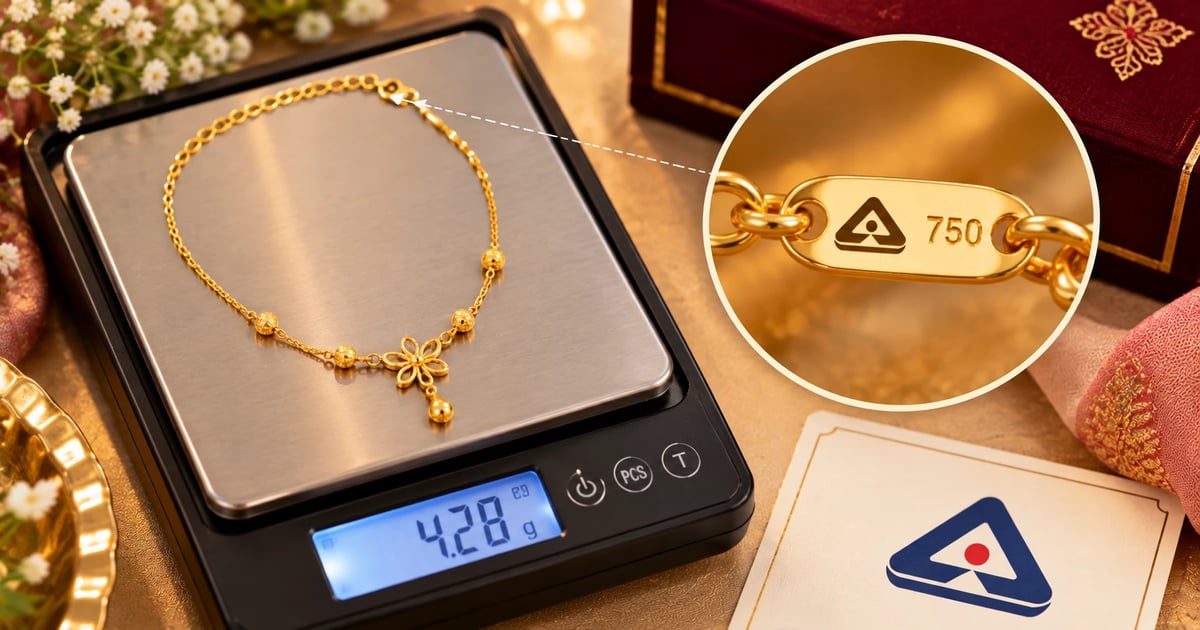
A lightweight necklace for daily wear weighs under 15 grams of gold. Within that, three bands matter: under 5 g, 5–10 g and 10–15 g. For most working days, 5–10 g gives the best balance of strength and comfort. Pick 18K for a thin chain and 22K for a plain, solid design.
Your bill is the gold weight times the day's rate, plus making charges, plus 3% GST. That's the short answer. The rest of this guide shows how each number works. That way, you can compare two pieces and spot a bad deal. If you're still choosing a style, our guide to small gold necklace designs for daily wear covers the looks. This page covers grams, purity, cost and proof.
Lightweight Necklace Weight Bands in Grams
"Lightweight" is a range, not one number. Each band behaves differently on the neck and on the bill.
Under 5 Grams: Fine Chains and Tiny Pendants
This band covers a fine chain alone or a chain with a very small pendant. It feels like nothing by lunchtime. But the links are thin, so the chain needs gentle handling.
Here's an honest warning. A 3-gram chain looks delicate in photos but almost disappears on a real neck. Go slightly heavier if you want people to see it.
5 to 10 Grams: The Everyday Sweet Spot
Here the chain gets thick enough to survive daily wear. It can also carry a pendant without strain. For office and errands, this is the band we'd point most buyers towards. A lightweight gold necklace under 10 grams still reads as real jewellery from across a room.
10 to 15 Grams: Light, but Noticeable
This band suits a slightly bolder chain or a small set. You'll notice it more on a long day. Still, it stays far from festive weight. Medium pieces usually run 15–30 g, and bridal pieces go well past that.
Weight band | What it usually looks like | Strength for daily wear | Best for |
|---|---|---|---|
Under 5 g | Fine chain, tiny pendant | Handle with care | Layering, under collars |
5–10 g | Medium chain, small pendant | Good | Office, errands, gifting |
10–15 g | Thicker chain or light set | Very good | Sarees, small functions |
18K or 22K Gold for a Necklace You Wear Daily
Pure gold is soft. The Bureau of Indian Standards (BIS) notes that jewellery gold is always mixed with other metals. On its own, pure gold can't stand up to wear. That mix is the key to your choice.
22K gold is 91.6% pure and stamped 916. 18K is 75% pure and stamped 750. 14K is 58.5% pure and stamped 585. Less gold means more alloy, and more alloy means a harder metal.
So on a thin chain, 18K usually holds its shape better. Links stretch less and kink less. On the other hand, 22K keeps a richer yellow and suits plain, solid designs. It also fits the family habit of buying 22K for gold's own sake.
There's a price gap too. On purity alone, 18K carries about 18% less gold value per gram than 22K. Our view is simple. If the chain is under 5 g, choose 18K. For a solid 8–12 g piece, 22K is a fair choice.
How Your Gold Necklace Price Is Calculated
Every jeweller's bill should break into three parts. If it doesn't, ask why.
Gold Value: Weight Times the Day's Rate
First, the net gold weight is multiplied by the rate per gram for that karat. Rates change daily, so check the gold rate in Kolkata today before you shop. Net weight means gold only, without any stones.
Making Charges on Light Pieces
Making charges pay for the craft. Jewellers quote them as a percentage of gold value or as a flat rate per gram. A fine, detailed chain takes as much skill as a heavy one. That's why light pieces can carry a higher making percentage. Always ask for it as a separate line.
GST on the Whole Bill
GST on gold jewellery is 3%. It applies to the full invoice value, making charges included. So a lower making charge also lowers your GST.
A Worked Example With Round Numbers
Say the 22K rate is ₹10,000 per gram. This is a round number for easy maths, not today's rate. Your necklace weighs 8 g, and making is 12%.
Gold value: 8 g × ₹10,000 = ₹80,000
Making charges at 12%: ₹9,600
Subtotal: ₹89,600
GST at 3%: ₹2,688
Total: ₹92,288
You can run your own numbers with our gold jewellery bill calculator. Use the real rate and the making charge you've been quoted.
Where Thin Gold Chains Break or Tangle
A lightweight gold necklace rarely snaps in the middle of the chain. It fails at small weak points. Check these before you buy.
The Three Weak Points to Inspect
The clasp comes first. A lobster clasp, with a spring-loaded hook, holds better than a small spring ring. Next, look at the jump ring, the small loop joining pendant to chain. It should be closed tight with no gap. Also press hollow beads gently. Hollow parts keep weight down, but they dent more easily than solid gold.
Watch the pendant too. If the pendant is heavier than the chain, all the pull lands on one link. In that case, pick a thicker chain. If you want a sturdier option, browse our ladies' gold chain collection and compare chain widths.
How to Keep Layered Necklaces From Tangling
Tangling is the most common complaint when layering dainty gold necklaces. Space each chain at least 2 inches apart in length. Mix chain types, such as a flat chain with a round one, since they slide past each other. For travel, thread each chain through a drinking straw and close the clasp. At home, store every chain closed and flat, never in a heap.
Which Weight Suits a Saree, Kurta or Office Look
The outfit changes how much gold you need before a necklace shows.
For office wear, a 14–16 inch chain under 5 g sits neatly inside a shirt collar. A small pendant on a V-neck works too. Keep it to one piece on workdays, because two chains can catch on an ID lanyard.
With a saree, the blouse neckline and the fabric do the talking. A fine chain gets lost against heavy silk, so choose 8–15 g. A princess length necklace, around 18 inches, lets a pendant sit clear of the blouse. For a cotton saree or a kurta, the 5–10 g band is enough.
With western wear, match the chain to the neckline. A crew neck suits a short chain sitting above it. An open collar or a strappy top suits a longer chain with a pendant.
How to Verify the BIS Hallmark and HUID Yourself
Hallmarking is mandatory, not just recommended, in the districts BIS covers. BIS was made India's sole hallmarking agency in 2000. Mandatory hallmarking began on 23 June 2021 in 256 districts. A second phase from 1 June 2022 took it to 288 districts. BIS keeps adding districts through amendments, listed on its official hallmarking overview page. Very small pieces under 2 g have been exempt from the mandatory rule.
Since 1 July 2021, each hallmarked piece carries a six-character code called HUID, short for Hallmark Unique ID. Here's how to check it.
Find three marks. Look near the clasp for the BIS logo, the purity mark (for example 22K916) and the HUID.
Open the BIS Care app. Use its "Verify HUID" feature and type in the code.
Match the result to your bill. The purity and item type should agree with what you were sold.
Act on any mismatch. You can get the piece tested at a BIS-recognised assaying and hallmarking centre.
BIS describes the three-mark system and the app check in its article on hallmarking of gold jewellery.
What Your Bill Must Show
A proper bill lists the net gold weight, purity, rate per gram, making charges, HUID and GST. For online orders, also read the return and exchange policy before you pay. If any line is missing, ask for it before the piece leaves the counter.
Your Lightweight Necklace Buying Checklist
Pick your band first: under 5 g, 5–10 g or 10–15 g.
Choose 18K for thin chains and 22K for solid, simple designs.
Check the day's rate and ask for making charges in writing.
Inspect the clasp, jump ring and pendant weight.
Verify the HUID in the BIS Care app and match it to the bill.