

Baby Gold Chain Weight and Length That Work

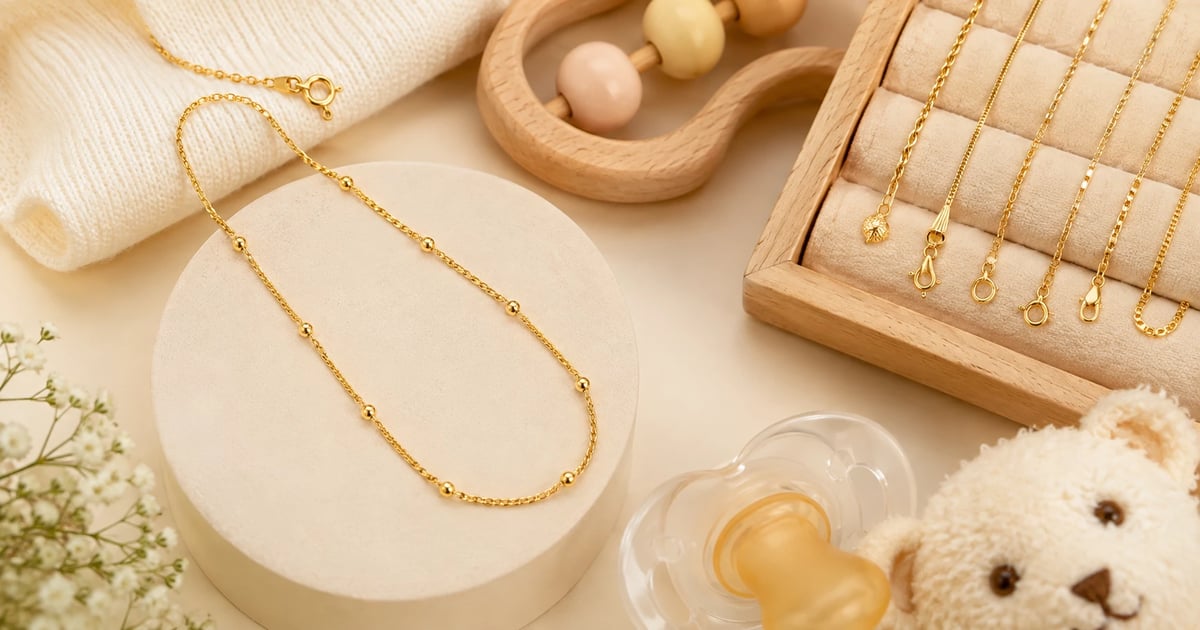
Most baby gold chain sold in India sit between 1 and 3 grams. Senco Gold, one of Bengal's older jewellery houses, puts typical baby chain lengths at 10 to 14 inches.
But size charts disagree with each other more than sellers admit. Some list 8 to 10 inches for the first year. Others start at 10 inches for the same age.
So don't buy off a chart. Instead, loop a soft thread around the baby's neck, mark it, then measure the thread flat. Add roughly an inch of room.
Weight follows length. A 1-gram chain in a fine cable or box pattern covers most newborn sizes comfortably. Push past 3 grams and you're adding metal the child can't carry yet.
One thing worth knowing early: a chain bought at three months will not fit at three years. Plan to remake it, or buy slightly long and keep it stored until the child grows into it.
The Hallmark Gap on Chains Under 2 Grams
This is the part almost nobody mentions, and it changes how you should shop.
Mandatory BIS hallmarking does not cover every gold article. The Bureau of Indian Standards exempts any article weighing less than two grams. Marking pieces that small is technically difficult.
Read that again against a 1-gram baby chain. Legally, it can be sold with no BIS mark and no HUID at all.
That isn't a scam. It's the rule. Still, it leaves you buying gold on trust. A small purity shortfall costs you most in exactly this weight bracket.
Change the question, then. Rather than asking "is it hallmarked?", ask the jeweller to state the purity on the invoice as a written declaration. A shop confident in its gold will do this without fuss.
Ask for the piece to be tested on an XRF machine in front of you too. Many established showrooms have one. It takes a minute and settles the matter.
How to Check a Hallmark You Do Get
Some jewellers hallmark light pieces voluntarily. If yours did, look for three marks on the chain or its clasp. They are the BIS logo, the purity number, and a six-character HUID code.
For 22K gold that purity number reads 22K916, since 22 karat is about 91.6% pure gold. You can verify the HUID yourself through the BIS CARE app.
Use a magnifier. On a 1-gram chain these marks are tiny. Often the clasp is the only surface big enough to carry them.
What Paediatricians Say About Baby Jewellery
We sell gold chains, so treat this section as the honest version rather than the convenient one.
The American Academy of Pediatrics does not recommend that infants wear any jewellery at all. Its reasoning is blunt: suffocation is the leading cause of death for children under one year old.
A chain around a neck is a strangulation risk, especially during sleep or when nobody is watching. A clasp or pendant that comes loose is a choking risk. Both risks are small, but both are real.
The AAP's own harm-reduction advice, published for parents, is worth following closely. Supervise the child whenever the chain is on. Remove it before every nap and every night, even for a short stretch.
None of this means gold has no place in a baby's life. It means the neck is the riskiest place to put it, and sleep is the riskiest time.
Safer Ways Families Keep the Tradition
Plenty of families want the ritual without the risk, and there are sensible middle paths.
Keep the chain for the ceremony itself, then store it. Photographs get taken, elders are happy, and the child wears it for an hour under watch.
Alternatively, gift the gold in a form nobody wears yet. A coin, a small pendant kept aside, or a chain sized for age five all carry the same meaning.
Some families move the piece to an ankle or wrist during the early months. That follows the AAP's suggestion for teething jewellery, and it removes the neck from the equation entirely.
22K or 18K: Which Suits a Baby Chain Better
Indian families default to 22K, and for a gift piece that's usually right. It holds the traditional colour, and it holds resale value better.
18K tells a different story. More alloy means more scratch resistance, which matters if the chain is actually going to be worn rather than stored.
Skip 24K entirely, whatever a listing claims. Pure gold is too soft to hold a link shape under pulling, and a baby pulls.
On skin: gold itself rarely causes reactions. The alloy occasionally does. So for comfort, a smooth finish and no sharp edges matter more than the karat number.
Choice | Best for | Trade-off |
|---|---|---|
22K (916) | Ceremony gift, long-term value | Softer, scratches and bends more easily |
18K (750) | A chain that gets worn often | Less gold value, slightly duller colour |
Silver | Budget, or a first piece before gold | No gold resale value, needs polishing |
24K | Coins and bars, not chains | Too soft to survive as a wearable link |
If the budget isn't there for gold this year, that's a perfectly reasonable call. Our silver chain range covers the same lightweight, short-length brief at a gentler price.
How the Price Is Built on a 1-Gram Chain
Three numbers make up any gold bill, and the third one surprises people on light pieces.
Gold value — the day's rate per gram, multiplied by weight and purity
Making charges — the labour of shaping the chain
GST — 3% on the gold value, plus 5% on making charges
Those GST figures have held since 2017, and the September 2025 rate rationalisation left gold untouched. So the tax side is settled and easy to check.
Making charges are where light chains get expensive. Industry ranges put chain making charges at roughly 6% to 14% of gold value. A fine, fiddly baby gold chain usually sits at the top of that band. The work per gram goes up, not down.
Senco's published guidance gives a sense of scale. Chains near 1 gram start around ₹10,000 to ₹12,000. Two-gram pieces with a pendant run higher. Rates move daily, so treat that as a shape rather than a quote.
Why Making Charges Bite Harder on Light Pieces
Picture two bills. On a 10-gram chain, ₹4,000 of labour spreads thinly across a lot of metal. On a 1-gram chain, similar labour can rival the gold itself.
That's why a baby chain rarely feels like "cheap gold" despite weighing almost nothing. You're paying for craft on a piece too small to dilute it.
Ask for wastage separately as well. Wastage typically runs 2% to 15% depending on design, and unlike gold value, you don't recover it at resale.
Check today's rate on our gold rate page before visiting. That makes the labour line far easier to judge.
Clasp, Links and the Parts That Fail First
A chain gives way at its weakest joint. That joint is almost never the middle.
Spring-ring clasps are common and cheap, but small springs jam and give way. A well-made lobster clasp holds better. Better still, ask whether a screw clasp or a flat S-hook with a safety loop is available.
Link pattern matters just as much. Box and cable links keep their shape under pulling. Fine rope and snake patterns look lovely and kink permanently once bent.
Check the finish with your fingertip, not your eyes. Run the whole chain across your skin slowly. Any burr you can feel, the baby can feel too.
Then flex the chain gently and watch the clasp. If it opens under light pressure in a showroom, it will open on a child.
Designs Worth Choosing, and Ones to Skip
Simple wins here, and not only for safety reasons.
Plain box, cable and light rope chains photograph well, resize easily, and cost less to make. They also suit any child, which is why our unisex chains work naturally as baby pieces.
Skip anything that dangles. A pendant swings into a mouth, and a loose bead is a choking hazard the moment its setting loosens. If the family insists on a pendant, choose one that lies flat and is soldered, not clipped.
Avoid engraved name plates for infants too. The engraving edges are sharp when new, and the piece becomes unwearable if you later resize the chain.
For an older child who wants a pendant, a silver locket chain is a gentler start than gold.
Buying for a Naamkaran or Annaprashan?
Ceremony purchases run on a deadline, which is where budgets slip and checks get skipped.
Order at least two weeks ahead if the chain needs sizing. Rushed work means rushed finishing, and finishing is exactly what you're inspecting on a piece this small.
Also decide upfront whether this is a wearing piece or a keepsake. That single decision settles karat, length and pendant in one go.
Your Checklist Before You Pay
Run through this at the counter, not afterwards.
Confirm the exact weight on a digital scale while you watch
Ask for purity in writing on the invoice, especially under 2 grams
Request an XRF purity test in front of you
Get gold value, making charges, wastage and GST as separate line items
Open and close the clasp several times yourself
Run the chain across your palm to feel for burrs
Measure against your thread, not against a size chart
Ask what a resize or remake will cost in two years
That last point saves real money. Most families remake a baby chain rather than replace it, and exchange terms vary a lot between jewellers.
If you're comparing options, our full chains collection shows how weight, length and design shift the price. Adults shopping for themselves may prefer our guide to a gold chain under 10 grams. Our ladies chain range covers the sizes a child grows into later.
Final Thoughts
A baby gold chain is a small purchase that people get wrong in predictable ways. They buy too long, skip the purity question because the piece is light, and never test the clasp.
Get those three right and the rest is taste. A thread beats a size chart. Written purity beats a stamp the law doesn't require. And the clasp? Test it yourself.
Then be honest with yourself about how often it should actually be worn. The ceremony photograph is the point. The chain can spend the rest of its early years safely in a box.