

Bridal Jewelry in 2026 : What to Buy and What It Costs ?
 Sujoy Dhar
13 min read
Sujoy Dhar
13 min read
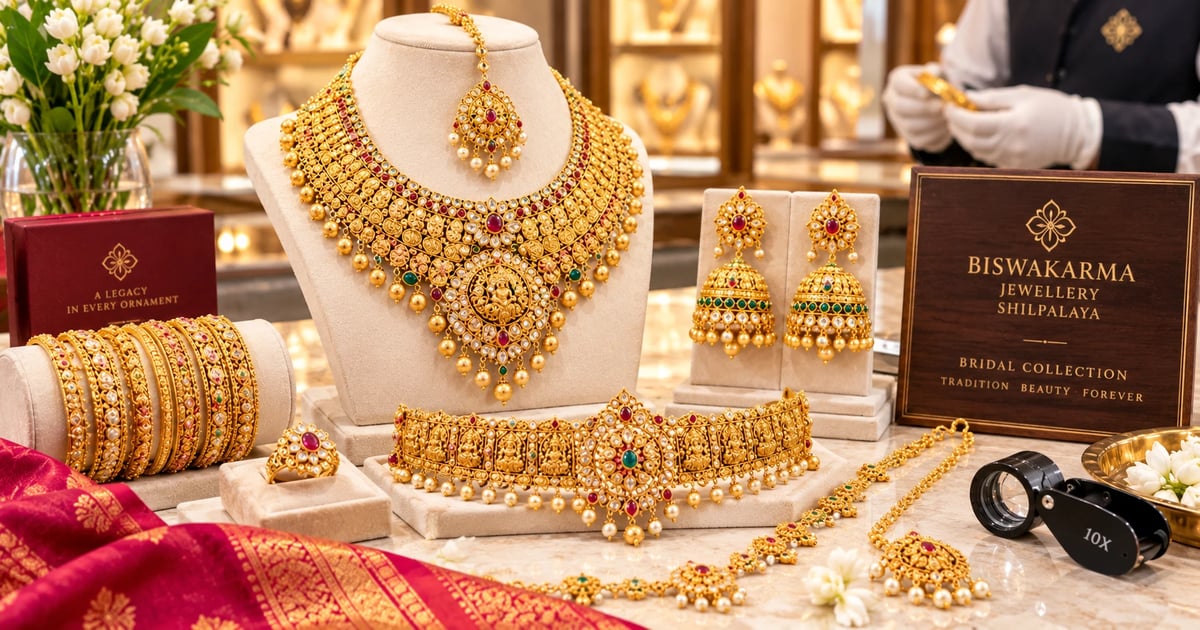
Nobody hands you a bridal jewelry price list. You get a date, a rising gold rate, and a lot of advice from relatives. So here is the commercial layer instead, in plain numbers.
This guide covers what a set contains, what each piece weighs, and how the bill is built. It covers the Bengali set in ritual order too. And it says which pieces you can skip.
Nothing here is compulsory. That is worth saying first, because almost nothing else you read will say it.
What a bridal jewellery set actually includes
A bridal jewelry set in India has no compulsory weight. Most brides buy a necklace, earrings, bangles, a maang tikka and a nose ring. Bengali brides add shakha, pola and noa. What you pay depends on four things: gram weight, purity, making charges and GST. Ask for each as a separate line on the bill.
There is no rule, no standard, no minimum. Anyone who tells you otherwise is selling something.
Across most of India, a working set is five things. A necklace. Earrings. Bangles or a pair of kadas. Something for the hair or forehead. A nose ring, if you wear one.
Everything past that is regional custom or personal choice. Both are fine reasons to buy. Neither is an obligation.
The mangalsutra sits slightly apart, because you will wear it after the wedding as well. That changes what you should buy. Daily-wear pieces need to survive daily life.
Bengali households add their own layer, which gets its own section below. South Indian sets lean on temple work. Marwari and Punjabi sets lean on kundan and polki.
One honest observation from the trade. Brides over-buy necklaces and under-buy earrings. You'll wear the earrings again.
What bridal jewelry costs, piece by piece
Your bill is built from four numbers, and only four. Gram weight. Purity. Making charges. GST.
Multiply the day's rate for your purity by the net gold weight. Add making charges. Add GST. That is the whole calculation.
So the useful question is not "what does a bridal set cost". It is "how many grams am I buying, and at what making charge". Rates move weekly. Grams don't.
Here are the gram bands these pieces commonly fall into. Check them against the live Kolkata gold rate on the day you buy.
Piece | Common 22K gram band | Making charge tends to be | Worth the money? |
|---|---|---|---|
Choker | 15–30 g | High. Hand-set, dense work | Yes, if it's your one statement piece |
Long necklace or sitahar | 20–45 g | Medium to high | Photographs best. Worn least |
Everyday chain | 8–15 g | Low. Often machine-made | Yes. Highest wear per gram |
Jhumkas or bridal earrings | 8–20 g (pair) | Medium | Yes. The piece you'll actually reuse |
Bangles or kadas | 10–25 g each | Low to medium if plain | Plain ones hold value best |
Maang tikka or tikli | 3–8 g | Medium | Worn once, usually |
Nose ring or noth | 2–6 g | Medium | Cheap in grams. High in impact |
Mangalsutra | 8–20 g | Low to medium | Yes. Buy for durability, not drama |
Treat those bands as the range you'll see on the counter, not a quote. Weight varies with design and with how hollow a piece is built.
For a worked example on one weight, our 8 gram gold necklace price guide runs the full sum. To price your own combination, use the gold calculator built for Indian jewellery bills.
A note on hollow pieces. A 20 gram hollow choker looks like a 40 gram solid one. It also dents. Ask which you're holding.
Why gold got dearer in 2026
The rate your cousin paid two years ago is not available to you. Two things changed, and both are recent.
First, prices. The World Gold Council reports that Indian jewellery demand fell 15% year on year in Q2 2026. Volumes dropped to 75.1 tonnes. Meanwhile rupee spending hit a record. People bought less metal for more money.
Second, duty. On 13 May 2026 the government raised the effective import duty on gold and silver from 6% to 15%. CNBC reported the new structure as 10% basic customs duty plus a 5% cess. The World Gold Council called it the steepest single increase on record.
That flows into what you pay. Any bridal budget written before May 2026 is out by nine percentage points.
One caveat, and it matters. As of late August 2026, press reports say the government is considering cutting the duty back to 6%. No notification has been issued.
What should you do with that? Nothing dramatic. Don't wait for a rate you can't predict, and don't panic-buy either.
Instead, spread the purchase. The Council notes buyers are moving to lighter pieces and using exchange offers and instalments. That is a sensible response, not a defeat.
The Bengali bridal set, in ritual order
A Bengali set is bought in sequence, not all at once. Each ceremony calls for different pieces. Buying in that order spreads the cost across months.
Dodhi mangal and gaye holud
The morning of the wedding brings shakha and pola. Shakha is white conch shell. Pola is red coral. They are two different materials, and half the guides online get this wrong.
Traditionally the groom's family gives these, along with the noa, an iron bangle. Many families now cap the shakha and pola in gold. That cap is where the cost sits.
Our guides on pola bangles and the Sankhari craft behind them and on gold sankha design trends cover the detail.
The wedding day
This is where the weight goes. A sitahar, the long layered necklace, usually leads. A choker often sits above it.
Then the tikli on the parting, the mantasha on the wrist, and ratanchur across the back of the hand. A noth or nose ring completes it.
We've compared pearl sitahar against gold sitahar on comfort, and on how each reads against a red Banarasi.
Pick your necklace against the saree, not against the occasion. A busy Banarasi fights a busy necklace.
Bou bhaat and reception
Weight comes down here. Lighter necklaces, comfortable earrings, less on the head.
This is the sensible place to spend on something you'll wear again. A long gold necklace made for brides earns its keep. So does a good pair of jhumkas that outlast the wedding.
For the pieces themselves, the sitahar and mantasha collections show the range.
22K, 18K or diamond: how to choose
Buy 22K for bridal gold. Buy 18K where a stone has to be held. That is the short version.
The Bureau of Indian Standards permits hallmarking at six purities: 14K, 18K, 20K, 22K, 23K and 24K. On a bill, 22K appears as 916, meaning 91.6% pure gold.
22K gold | 18K gold | Diamond-set | |
|---|---|---|---|
Purity | 91.6% (916) | 75% (750) | Varies by mount |
Colour | Deep yellow | Paler, warmer | Depends on metal |
Strength | Softer, dents | Harder, holds stones | Strong mount, fragile stones |
On exchange | Valued on gold weight | Lower gold content | Stones return little or nothing |
Best for | Necklaces, bangles, chains | Rings, stone settings | Reception, daily rings |
Gold is not better than diamond. They do different jobs. Gold is bought by weight and can be exchanged by weight. A diamond's resale is a different market entirely, and usually a disappointing one.
So if you want the piece to hold its metal value, buy gold. If you want the look, buy the diamond piece with open eyes. Just know the stones are a cost, not a store of value.
Kundan, polki, meenakari and temple work all sit somewhere between. Each adds labour and non-gold material to a piece sold by total weight. That matters later, and the exchange section explains why.
Reading the bill: making charges and GST
Ask for an itemised bill before you agree to anything. Every bridal jewelry bill should show the lines below separately.
Making charges and wastage, decoded
Making charges are the labour of turning metal into a piece. They are quoted two ways. Either as a percentage of the metal value, or as rupees per gram.
Wastage covers metal genuinely lost in working. Some shops fold it into making charges. Others list it separately. A few list both, which is where bills get confusing.
Hand-worked bridal pieces carry higher making charges than machine-made chains. That is real labour, not a trick. The problem is that the number is often quoted vaguely.
So make it concrete. Ask two questions. "What is the making charge as a percentage?" and "Is wastage included in that, or extra?"
Get both answers written on the bill. A shop that won't put it in writing has told you something useful.
Making charges also don't come back on exchange. Keep that in mind when you're deciding between a heavily worked piece and a plain one.
Which GST line belongs on your bill
This is where dozens of guides copy each other and get it half right. Two rates exist. Which one you see depends on what you're buying.
Gold is taxed at 3% under Notification 1/2017-Central Tax (Rate). Making charges, treated as job work, are taxed at 5% under Notification 11/2017-Central Tax (Rate).
But a ready-made piece from the showroom counter is normally billed as a composite supply. That means one supply, taxed at a single 3% on the whole amount.
Where making charges are itemised separately, or where you've ordered custom work, the split applies. You should see 3% on the gold and 5% on the making.
Here is the part to watch. You should not be charged 3% on the full bill and then 5% again on the making charges. That taxes the same labour twice.
If your bill shows both, ask for it to be explained before you pay. Ask again if the answer is vague.
Checking purity at the counter in one minute
You can verify any piece of bridal jewelry yourself, in the shop, before paying. It takes about a minute and needs no expertise.
HUID stands for Hallmark Unique Identification. It is unique to that single item and traceable.
Run these five checks.
Ask for the magnifier. A registered jeweller must keep a 10X magnifying glass and show you the hallmark. This is a BIS requirement, not a favour.
Count the marks. Three, not four or five. Pages listing an assay-centre mark and a jeweller's mark are describing the old system.
Read the purity. For 22K you want to see 22K916.
Verify the HUID. Type the six-digit code into the BIS Care app, using its Verify HUID feature. Do it at the counter.
Check pairs separately. Each item in a pair and every detachable part needs its own hallmark, with a different HUID. So both bangles. Both earrings.
That last one catches more problems than the other four combined. Sets get assembled from mixed stock.
Still unsure after buying? BIS says a consumer can have a piece tested by fire assay at a recognised centre for ₹200. That is your independent check.
Two of our guides go further. Try gold purity checks before buying, and what hallmark gold really means.
What your set is worth if you exchange it later
No jeweller can promise you a figure. Rates move, policies differ, and anyone quoting a guaranteed percentage is guessing. What can be explained is how bridal jewelry is actually valued on exchange.
Exchange value is based on the net gold weight you bring back. Not the amount printed on your original bill.
Three things fall away between those two numbers.
Making charges go first. You paid for labour, and labour doesn't return. That cost was spent the day the piece was made.
Stones go next. A kundan or polki piece is sold at gross weight, which includes lac filling and stones. Strip those out and the gold left is a fraction of what you carried in.
Purity is then re-assessed. A hallmarked piece with a readable HUID moves through this quickly. An unmarked one gets tested first.
So a plain 22K bangle returns closer to its metal value. A stone-set piece billed the same returns less. That is not an argument against stones. It is an argument for knowing which you're buying.
This matters more than it used to. The World Gold Council found old-gold exchange driving 40% to 60% of jewellery transactions in Q1 2026. That figure covers retailers across India.
Two practical steps. Keep the original bill and the hallmark readable. And ask any shop for its exchange terms in writing on the day you buy, not years later.
When to start buying, month by month
Start six months out if you can. Not because gold gets cheaper, but because rushing costs more than waiting.
Six months before. Set a total ceiling. Decide which single piece is your statement piece. Everything else gets sized against that.
Four to five months. Order anything custom or hand-worked now. Bridal karigar work takes weeks, and the queue lengthens near festival season.
Three months. Buy the pieces you'll wear again. Earrings, mangalsutra, everyday chain. These are the least emotional decisions, so make them while you're calm.
Two months. Buy the ceremony pieces. Confirm shakha, pola and noa with the groom's family, since those traditionally come from them.
One month. Final fittings. Bangle sizing, necklace length, earring weight. Wear each piece for twenty minutes before accepting it.
Two weeks. Collect everything. Check every hallmark, every HUID, every bill. Do it before the house fills with guests.
If your wedding falls in peak season, move each step a month earlier. Workshops get booked, and rush jobs cost more.
Watch the festival calendar too. Akshaya Tritiya and Dhanteras pull huge buying volumes into a few days. Karigars are busiest then, and counters are crowded. Order before those weeks, not during them.
What to skip when the budget is tight
Something has to give, so give it deliberately. Here is the order the trade would cut a bridal jewellery budget in.
Cut weight before you cut pieces. A lighter choker still reads as a choker in photographs. An absent choker doesn't.
Skip the second necklace. Most brides own two and wear one. The sitahar and the choker do overlapping work.
Skip the ratanchur. It's beautiful and it's worn for a few hours, once.
Buy plainer, not smaller. Dropping heavy stone work cuts the making charge sharply. You keep the gram weight, which is the exchangeable part.
Borrow the heirloom. Family pieces exist for this. Wearing your mother's sitahar is not a compromise.
For a small or court wedding, the calculation changes entirely. You need pieces that work at a registry office and afterwards. A good pair of earrings, a mangalsutra and one necklace will carry it.
Keep this in view. A lighter set is not an embarrassing set. Nationally, buyers are moving the same direction for the same reasons.
Buying with your eyes open
You now have the four numbers that build any bridal jewelry bill. Three marks prove purity. And you know why a stone-set piece returns less than a plain one.
Use them. Ask for the making charge as a percentage. Find out which GST treatment applies to your purchase. Then ask for the magnifier.
A shop that answers those three questions plainly is a shop worth buying from. That test costs you nothing, and it works anywhere.
Buy fewer pieces, better checked. You'll wear them longer.