

Long Gold Necklace Design Ideas for Brides
 Sujoy Dhar
9 min read
Sujoy Dhar
9 min read
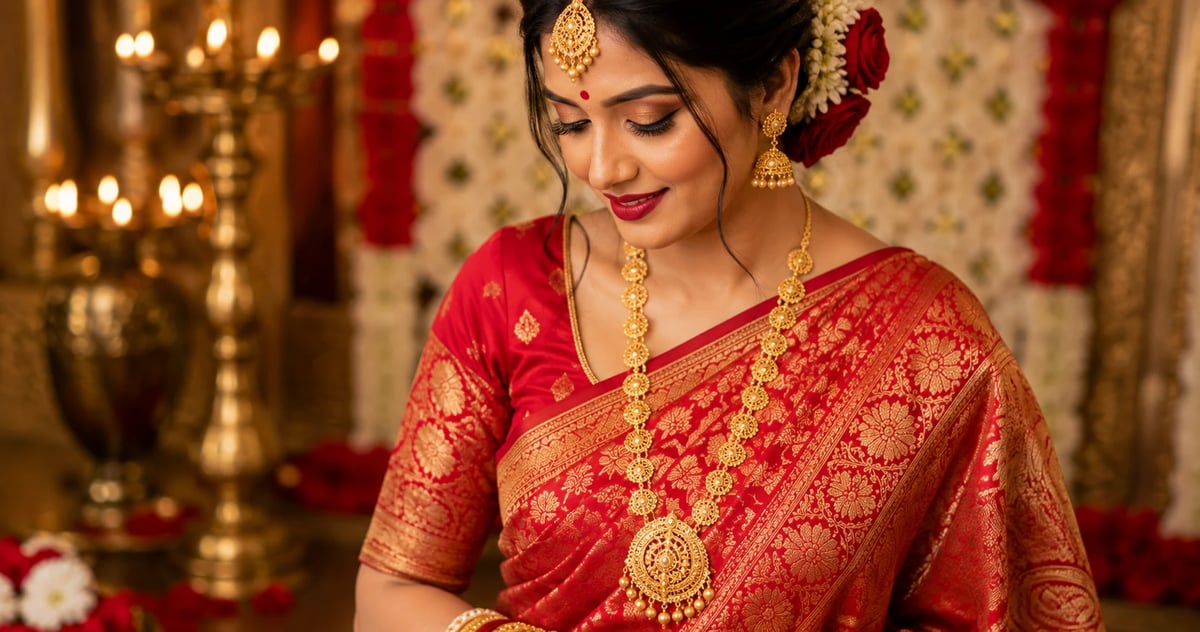
Three numbers decide a long gold necklace design for a bride. Length in inches, weight in grams, and the neckline it has to clear. Long usually starts around 20 inches. Weight matters most, so this guide groups nine designs by gram band instead of by motif. Gold prices have moved hard since 2024. So the haar your mother bought at 40 grams is a different conversation today.
What counts as a "long" gold necklace in inches
Shop assistants use these length names loosely. No Indian standards body defines them, so treat the table as trade convention only.
Length | Inches | Where it sits |
|---|---|---|
Choker | 12–14 | Tight at the base of the neck |
Princess | 16–18 | Just below the collarbone |
Matinee | 20–24 | Top of the bust |
Opera | 28–36 | Mid-torso |
Rope | 36+ | Below the waist, often doubled |
For bridal wear, anything from 20 inches up reads as long. Most sitahars and rani haars land in the matinee band. A haram or kasu mala usually runs opera length.
One caution before ordering online. Measure a necklace you already own and like. Neck sizes differ by several inches.
9 long gold necklace designs for brides
Each design carries an indicative gram band. Ranges vary by maker, so the tag on the actual piece is the number that counts.
Sitahar: the Bengali multi-strand haar
In the Bengali trousseau, sitahar names one specific construction. Multiple gold strands drop from the shoulders and meet at a lower centre. That forms a U against the chest.
Typical band: 20–45 g. It pairs naturally with a red Banarasi saree and a boat neckline. Because the strands sit apart, it photographs with more depth than a single chain. Our gold and pearl sitahar guide covers strand counts and finishes.
Rani haar: the layered north Indian classic
A rani haar runs longer and heavier than a standard necklace. It usually carries one large central pendant. Typical band: 25–50 g.
Brides across north and west India wear it below a choker. It suits a deep neckline, since the pendant needs clear skin to read. Heavier versions want a back chain.
Kasu mala: the coin haram
Rows of stamped gold coins, traditionally Lakshmi kasu, strung into a long drape. Typical band: 30–60 g. Coins add weight fast, so this is rarely a light piece.
It works best with silk and a wide neckline. Kasu mala is the design people ask to photograph, then quietly put back once they lift it.
Temple haar with Lakshmi and peacock motifs
Cast temple motifs repeat along a broad chain. Lakshmi, peacock and lotus are the usual three. Typical band: 35–70 g, which makes this the heaviest category here.
The reward is presence in photographs, because cast gold catches light where flat chain does not. Even so, reserve it for the ceremony.
Chandra haar: the crescent drape
Crescent-shaped links repeat down a long line, giving the piece a distinct rhythm. Typical band: 30–55 g. The shape drapes rather than hangs, which suits a saree pallu.
It layers well over a plain choker. Listings often swap chandra haar and rani haar around, though the crescent link defines this one.
Polki and kundan long haar
Uncut diamonds in polki, or foil-backed stones in kundan, set into long gold panels. Typical band: 25–50 g of gold, plus stone weight. Colour makes it the obvious reception piece.
One thing worth knowing before you pay. Kundan, polki and jadau are exempt from mandatory hallmarking under the Quality Control Order. So the piece may carry no BIS mark at all.
Choker and haar worn layered
Two pieces, one look. A choker sits at 12–14 inches while the haar drops to 24 or beyond. Combined band: 40–80 g.
Keep at least four inches of clear gap between them. Otherwise they tangle and read as one shapeless mass. Our gold choker designs guide covers choker shapes.
Lightweight single-line haar
One chain, one pendant, hollow or tube-built links. Typical band: 10–18 g. This is the design I would steer a first-time buyer toward, and not only on price.
You can wear it to a puja in five years without looking like you raided the wedding locker. Against 2026 rates, it is also where most families start.
Jali and filigree contemporary haar
Jali means a lattice pattern, pierced through flat gold panels. Typical band: 15–30 g. Cutting metal away is exactly what keeps the weight down while the piece stays wide.
It reads modern under a plain blouse. Filigree does need careful storage, since thin wirework bends easily.
Rani haar, sitahar and haram: what differs
Term | What it actually means | Region |
|---|---|---|
Sitahar | Multi-strand long necklace, U-shaped drop | Bengal, eastern India |
Rani haar | Long necklace with a large central pendant | North and west India |
Haram | Umbrella term for any long ceremonial necklace | South India |
Chandra haar | Long necklace built from crescent links | North India, Bengal |
Kasu mala | Coin-strung long necklace | South India |
Most ranking pages treat these five words as synonyms. They are not. Haram is the broad category, and the other four are specific constructions inside it.
So the same long gold necklace design gets four names depending on who is selling it. Ask which one you are being shown. The gap between a single-strand and a five-strand piece is entirely weight.
Choose by weight, not by picture
Weight decides comfort, cost and whether the piece survives past the wedding. Every long gold necklace design above falls into one of three bands.
Gram band | How it photographs | After eight hours | Typically worn for |
|---|---|---|---|
10–20 g | Delicate, needs a plain blouse | Barely noticeable | Reception, pujas, later wear |
20–35 g | Reads clearly in group photos | Noticeable, manageable | Full wedding day |
35 g+ | Full bridal presence | Pulls at the nape, marks skin | Ceremony only |
Nobody warns brides about that third row. A 45-gram haar worn through pheras, photographs and a reception is uncomfortable by evening. The load sits on a narrow strip at the back of the neck.
Two fixes help. Ask for a wider back chain, which spreads the weight across more skin. Or split the look: heavy haar for the ceremony, something lighter for the reception.
That shift shows up in the national numbers too. The World Gold Council's India Focus report for Q2 2026 puts domestic gold prices nearly 60% higher year on year. It records a clear move toward lighter-weight, lower-carat pieces. Jewellery demand fell to 75 tonnes, down 15%. Spending, meanwhile, rose. Families are buying lighter, not less.
Match the necklace to your blouse neckline
Neckline first, necklace second. The blouse is usually finalised earlier anyway.
Boat neck: the classic sitahar pairing. Wide fabric, wide necklace, no competition.
Deep V or sweetheart: a rani haar with a strong central pendant fills the space.
Round neck: keep the haar long enough to clear the embroidery, so 24 inches upward.
High neck or closed collar: skip the choker and let one long haar sit over the fabric.
Heavy zari or stone work: go plainer on the necklace, or the two patterns fight in photographs.
The most common mistake is a long gold necklace design that ends exactly where the blouse embroidery begins. It disappears. Hold the piece against the actual blouse before you commit.
What actually drives the price you pay
Four things set the price of any long gold necklace design. Only the first moves daily.
Gold weight × the day's rate. Check the current Kolkata gold rate before you visit.
Making charges. Cast temple work and fine filigree cost more in labour than a plain chain.
Wastage. Ask whether it is charged, and at what percentage.
GST.
That last line is where most guides get it wrong. Blog after blog tells retail buyers they pay 3% on gold plus 5% on making charges.
The CBIC's own sectoral FAQ on gems and jewellery answers this directly. GST is payable at 3% of the total transaction value of the jewellery. That holds whether the making charge is shown separately or not. The 5% rate covers job work, which is the transaction between a jeweller and a karigar. It is not a line on your retail bill.
Ask for gold weight, rate, making, wastage and tax on separate lines. Any jeweller should show that without being pushed.
Check the hallmark before you pay
Under the HUID system, three marks are mandatory on hallmarked gold jewellery. The Bureau of Indian Standards sets these out for jewellers. You need the BIS standard mark, the purity in carat and fineness, and a six-digit HUID number. HUID means Hallmark Unique Identification.
For a 22K bridal haar, expect 22K915 or 22K916 alongside the logo. Older four-mark descriptions still circulate online. Ignore them.
Three checks take two minutes at the counter:
Find all three marks, usually on the clasp or a tag near it.
Verify the six-digit number in the BIS Care app, under Verify HUID.
Confirm the bill shows the description, net precious metal weight, purity in carat and fineness, and hallmarking charges.
BIS requires all four of those bill items. Mandatory hallmarking also applies district by district. BIS replaced the district list on 3 August 2026. Kolkata, North 24 Parganas, Howrah, Hooghly and Nadia are all on it. For the full mechanics, read our guide on how to check gold purity before buying.
Will you wear it after the wedding?
Every ranking page ducks this question. It is also the strongest argument for real gold over plated. A long gold necklace design has three possible lives after the wedding.
Restyled. A haar can be shortened, or a heavy piece split into a necklace and a pendant. One limit is worth knowing. BIS allows alterations up to 2 grams or 50% of the article's weight, whichever is lower. Go beyond that and the piece needs re-hallmarking.
Exchanged. Old gold traded against new is now a major share of Indian jewellery buying. The World Gold Council reported exchange volumes rising 10–20% in Q2 2026, reaching 70% of sales in some cases. Making charges are generally not recovered. Ask your jeweller for exchange terms in writing, because these vary and no percentage is guaranteed.
Kept. Melted and remade for a daughter, which is what happens to most bridal harams. Under BIS rules the jeweller melts the old piece, makes the new one, and gets a fresh HUID.
Buy at a weight you would be willing to wear again. That single test rules out more bad purchases than any design comparison.
What to settle before your showroom visit
Decide the gram band before you look at a single photograph. Bring the blouse, or a clear picture of the neckline. Ask for the bill breakdown on separate lines. Then pick the design you like, knowing what it weighs and why it costs that.
Browse the sitahar collection and necklace range when you are ready to compare pieces in person.