

Gold Pearl Sitahar vs Gold Plated: 6 Checks Before You Pay
 Sujoy Dhar
8 min read
Sujoy Dhar
8 min read
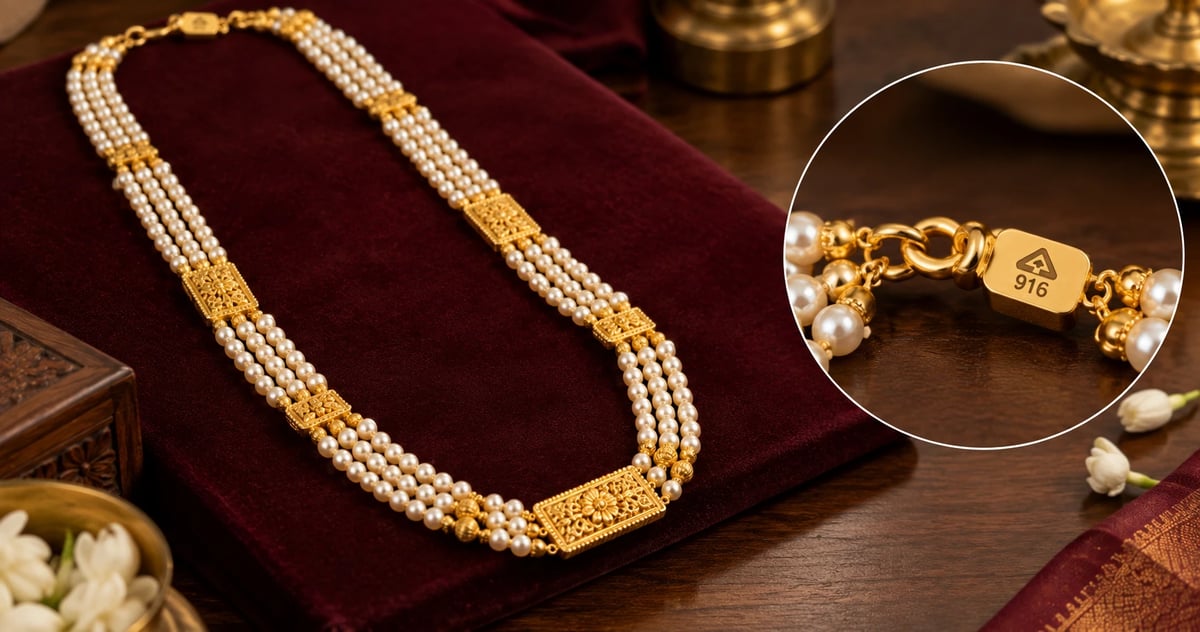
A real gold pearl sitahar carries a BIS hallmark. A plated one carries none. That single mark is the whole test, and it takes about two minutes.
Photos won't settle it. On a screen, a plated sitahar and a solid gold one look the same. The search results make it worse. One query returns pieces at a few thousand rupees and pieces at several lakh, side by side.
So here are six checks, in the order a jeweller runs them across the counter. For design types and gram bands, start with our gold pearl sitahar design guide.
What "real gold" means on a pearl sitahar
The gold is not spread evenly through the piece. Most of it sits in the spacers, the clasp, the side caps and the pendant. The strands themselves are pearl.
That's normal, and it isn't a trick. If you're still weighing materials, our pearl sitahar vs gold sitahar comparison covers that choice. A solid gold pearl sitahar counts as a gold article even though pearls dominate the look.
What matters is the metal. In a real piece, that metal is 22K or 18K gold. In a plated piece, it's brass or another base metal under a thin gold coat.
Plating has no gold content worth measuring. So it carries no exchange value later, whatever today's tag suggests.
Six checks to run before you pay
Run them in order. The first two settle most cases on their own.
Check 1: Find the BIS mark, purity grade and HUID
Ask to see the marks. On a sitahar they're usually laser-marked on the clasp, or on a small gold tag beside it.
Three things should be there. First the BIS logo, then the purity grade, then a HUID number unique to that piece.
The purity grade reads as 22K916 or 18K750. We've unpacked the marks in hallmark gold vs BIS gold. 916 means 91.6% gold, which is what 22 karat means.
Only two of the three present? Stop and ask why. A plated piece will carry none of them, though a maker's stamp can look official at a glance.
Check 2: Verify the HUID on the BIS Care app
The Bureau of Indian Standards runs a free app called BIS CARE. Its Verify HUID feature lets you check a hallmarked item's purity before you buy, according to the BIS consumer protection page.
Type in the number while you're still in the shop. The app should return the article and its purity.
A number that doesn't resolve is your answer. So is a salesperson who'd rather you checked later. There's more on this in our gold purity checks before buying.
Check 3: Read the bill before you pay it
Ask for the bill in draft form. It should show net gold weight and pearl weight on separate lines.
Net gold weight means gold only, without pearls, stones or thread. One gross weight for the whole necklace hides the number you need.
You should also see the rate applied, the purity, making charges and GST itemised. Ask which part of the GST sits on metal and which on making charges.
Sellers of plated jewellery can't produce a bill like this. There's no gold weight to declare.
Check 4: Test the price against the gold weight
Do the arithmetic yourself, on your phone, at the counter. Multiply net gold weight by the day's rate for that purity. Then add making charges.
An asking price far below that figure means the piece isn't solid gold at that weight.
Benchmark rates come from the India Bullion and Jewellers Association, which most Indian jewellers reference when pricing metal. Our gold bill calculator runs the same sum, and the Kolkata gold rate page carries the day's figure.
Check 5: Look at the clasp, the caps and the rub points
Plating wears where the piece rubs. On a sitahar that's the clasp, the back of the pendant, and the edges of the spacers.
Hold it up to the light. Look for pink or white metal showing through at worn corners.
Returned and second-hand plated pieces show this first. New plating won't, so this check confirms a suspicion. It never clears a piece on its own.
Check 6: Get the exchange policy in writing
Ask one question. What will you pay me for this piece in five years?
A gold seller answers in terms of net gold weight and the rate on the day. Making charges and pearls usually don't come back.
A plated seller has no answer, because there's nothing to weigh.
Get the policy printed on the bill or on letterhead. Verbal terms don't survive a change of counter staff.
You might be interested to Checkout our Gold Anklet for Women
Words on a tag that don't mean solid gold
Some phrases sound like gold and aren't. These are the ones that catch people out.
Gold polished, gold finish, antique gold polish. Surface treatment over base metal.
One gram gold. A thin gold coating, not one gram of solid gold jewellery.
Micron plated. Plating again, described by coating thickness.
Rolled gold, gold filled. A bonded gold layer over base metal.
BIS certified, hallmarked. Fair claims only if a HUID is on the piece. Hallmarking covers precious metal content, so a plated item can't carry a gold purity hallmark.
Ask for the word "solid" and a weight. Vague adjectives fall apart quickly under a direct question.
Real gold pearl sitahar vs plated, side by side
Point of difference | Solid gold pearl sitahar | Gold plated pearl sitahar |
|---|---|---|
BIS hallmark and HUID | Present on the gold parts | Absent |
Metal | 22K or 18K gold | Brass or base metal alloy |
Bill shows net gold weight | Yes | No |
Exchange value later | Gold weight at that day's rate | None |
Wear over years | Colour stays | Plating thins at rub points |
Worth restringing | Yes | Rarely |
Suits | Wedding, trousseau, repeat wear | One or two occasions |
What BIS owes you if the purity falls short
Almost no buying guide mentions this. If hallmarked jewellery tests below the purity marked on it, you're entitled to compensation.
BIS puts that at twice the amount of the difference. That difference is worked out on the shortage of purity for the weight sold. Your testing charges come back too.
So the hallmark isn't only a label. It's a claim you can act on. That protection exists only where the piece is hallmarked, which is the real argument for insisting on it.
How to get a pearl sitahar tested independently
You don't need the seller's permission to check a real gold pearl sitahar. Any BIS Recognised Assaying and Hallmarking Centre tests a consumer's jewellery, hallmarked or not, on a chargeable basis.
The centre has to issue an Assay Report identifying the article it tested.
Take the piece and the bill together. Ask for the gold components to be reported, since pearls and thread aren't gold.
If a seller objects to independent testing, treat that as information.
The pearls sit outside the hallmark entirely
Hallmarking covers precious metal. It says nothing at all about the pearls on the same necklace.
Judge those separately. GIA's pearl quality factors count nacre quality among the seven, and give a plain tell. If the bead nucleus shows through, or a pearl looks dull and chalky, the nacre is thin.
Thin nacre dulls lustre and shortens the pearl's life. That's the difference between a strand that survives twenty years and one that peels.
Nearly every commercial sitahar uses cultured pearls rather than natural ones. That's standard. Just don't pay a natural-pearl price, and don't expect pearls to carry weight at exchange.
When a gold plated pearl sitahar is the sensible buy
Honestly, sometimes it is. Need a long necklace for one reception, with no plan to wear it again? Plated does that job.
It travels better too. Losing a plated piece at a crowded wedding hall costs you thousands, not lakhs. The same logic applies to a second necklace for the sangeet, which is where a gold choker for weddings and parties often earns its place.
Buy it knowing exactly what it is, and price it against a real gold pearl sitahar first. Keep it away from perfume, expect the finish to go, and expect nothing back at exchange.
The mistake was never buying plated. It's paying a gold-adjacent price for it.
Don't Miss our Mangalsutra for Bridal Article
Is 22K or 18K better for a pearl sitahar?
22K holds more gold and is the Bengali default for bridal pieces. 18K is harder, so it suits designs with heavy stone setting or fine claw work. Neither is better outright. For a sitahar that mostly hangs rather than knocks about, 22K is the usual choice. Our guide to long gold necklace designs for brides walks through the gram bands.
What does panch lahiri mean?
Lahiri is the Bengali workshop word for a strand. Panch lahiri is five strands, saptha lahiri is seven. Counter staff use it constantly and national retail listings almost never explain it. The same word turns up on a pearl mantasha. More strands means more gold in the spacers and more weight on your neck.
Taking this to the counter
Two asks settle most of it. Show me the HUID, and give me a bill with net gold weight on its own line.
A shop that does both without hesitating is one you can return to in five years. You can compare hallmarked pearl sitahar designs and gold sitahar designs with weights listed against each piece. That matters, because the thread will need replacing.