

Pola Necklace Designs: The Complete 2026 Guide

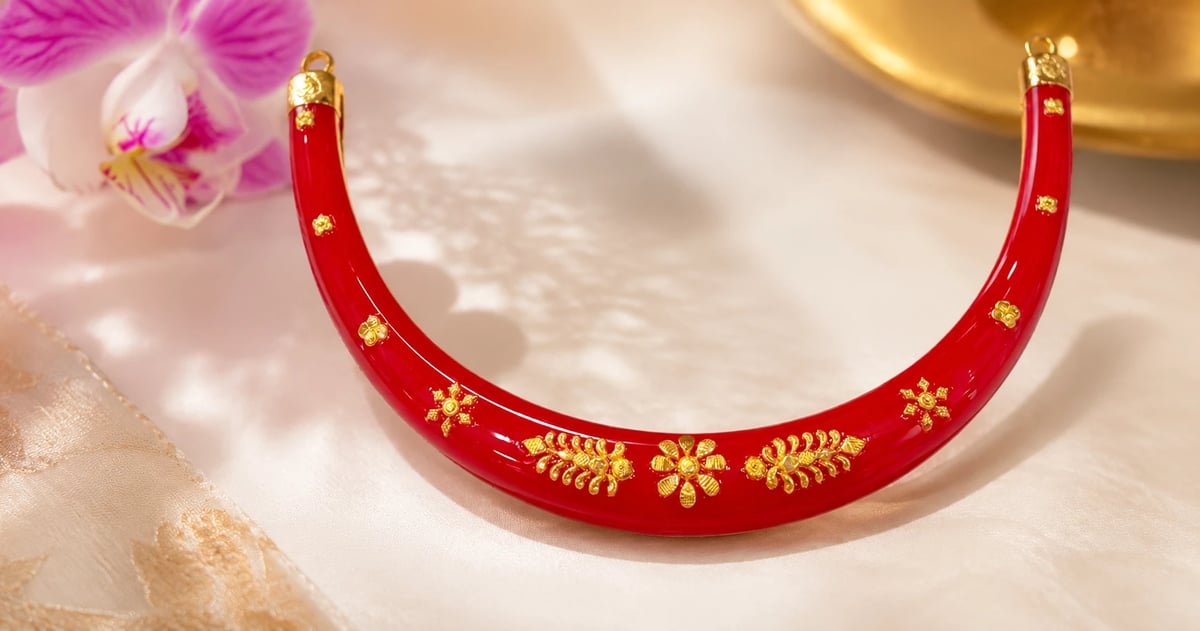
Most pola necklace searches end in a photo gallery with no weight, no price and no explanation. So here's the short version first. A pola necklace is a Bengali-style necklace built around red pola beads, usually strung or capped with gold. The red echoes the pola bangle that married Bengali women wear beside the white conch shakha. Everything after that is your choice: length, weight, how much gold, how much red.
This guide covers the designs sold now and how to match one to your neckline. It also covers what moves the price, and how to stop the red from dulling. Read it once, and you'll know what to ask a jeweller.
What a pola necklace is, in plain terms
Start with the bangle. Pola is the red bangle Bengali married women wear, paired with a white conch shakha on each wrist. So a necklace borrows that red and moves it to the neck.
Most pieces are built one of two ways. Either red beads sit strung on a gold wire or chain, or a shaped red element is bound in gold. Bengali jewellers call that binding work pola badhano. Gold caps finishing the ends are often called mukh pola.
The red itself varies more than buyers expect. Some pieces use real coral. Many use coral-look materials instead. The Gemological Institute of America's guide to coral jewellery reports that imitation red coral is increasingly common. Glass, plastics, dyed limestone, ceramics, bone and marble all stand in for it. Neither choice is dishonest. But you should know which one you're paying for.
Colour is not fixed either. Red is standard, and deep oxblood red is the most sought shade. White versions echo the shakha instead. Black pola necklaces also sell well, especially for women who want something closer to daily wear.
One number the galleries never show: gross weight and net gold weight are different. The red beads weigh something, yet they carry no gold. On real listings, a gold pola necklace can show a gross weight several times its net gold weight. So ask for both figures before you decide anything.
Why red and white matter in Bengali weddings
The pairing is old and specific. White conch shakha and red pola are worn together, usually with an iron noa. Each carries meaning in Bengali Hindu custom.
Banglapedia, the national encyclopedia of the Asiatic Society of Bangladesh, records how conch bangles enter a wedding. The bride's father or guardian gives her a pair during the wedding hymns. The groom brings a pair too. Cracked or broken bangles are read as an ill sign. That same entry lists around 25 engraving types used on shakha, including lotus bud, lily petal, paddy sheaf and jasmine.
Those motifs matter to necklace buyers. Modern designers lift them straight off the bangle and work them into gold caps and spacers. When a jeweller says a piece has padmakali work, that means lotus-bud carving. Banshrekhi means a bamboo-line pattern.
Gold and shell were never separate worlds, either. Banglapedia notes that gold wire was used on the costlier conch bangles. So a gold-bound pola sits inside a long tradition rather than breaking from it.
Two corrections are worth making. First, Bengali brides do not all wear one identical style, and families differ by district and by generation. Second, a Bengali pola necklace is jewellery inspired by that symbolism. The marital marker is the bangle set, not the necklace.
Pola necklace styles you'll see
Four broad families cover almost everything on the market. Each suits a different buyer, and the differences are practical rather than decorative.
Traditional gold-bound pola strands
These are the pieces your grandmother would recognise. Rows of round red beads sit close together, held by thick gold caps at both ends. In addition, carved gold spacers break up the strand.
The look is dense and warm. It also photographs beautifully against Benarasi silk. Still, the weight sits high on the collarbone, so a long evening in one is a real commitment.
Lightweight pola necklaces for daily wear
Lighter designs use fewer beads and much thinner metal. A single row on a slim chain is the most common shape.
This is where the market is moving. The World Gold Council reported in January 2026 that high gold prices are pushing buyers towards lightweight jewellery. 22K is still preferred, but demand for 18K and 14K is rising. For context, the same body puts everyday gold pieces in a 5g to 30g band.
A lightweight pola necklace also survives real life better. For instance, it slips under a kurta collar without fighting a seatbelt.
Bridal pola necklaces and layered sets
Bridal buying works differently, because the necklace is one part of a stack. Bengali wedding jewellery is built to layer.
The World Gold Council's India jewellery study records the classic Bengali bridal kit. Gola chik sits at the throat and sita haar hangs below. Average gross set weight lands near 210g for upper-middle-class buyers.
If your set already nears 200g, adding a heavy pola necklace shows by the third hour. Many brides now place a lighter pola between the chik and the sitahar instead.
Bridal pieces also stay firmly 22K, which the same research confirms. So expect richer yellow and softer metal in this tier.
Modern designer and Indo-Western styles
Contemporary work treats the red as a colour, not a rule. Some designers replace beads with red enamel across a carved gold panel. Others set a single pola drop on a fine chain and stop there.
Also, diamond and stone accents appear more often now, usually in 18K. Geometric caps, matte gold finishes and asymmetric single-side beadwork all show up in current collections. This modern pola necklace design language reads as jewellery first, heritage second. That's exactly why younger buyers like it.
Traditional vs modern pola necklace, compared
What you're comparing | Traditional pola necklace | Modern pola necklace |
|---|---|---|
Look | Dense rows of red beads, heavy caps, carved motifs | Single line, slim chain, cleaner metalwork |
Gold content | Higher, with more metal around each bead | Lower, with metal used sparingly |
Weight on the neck | Noticeable by the end of a long function | Easy to forget you're wearing it |
Best for | Weddings, Durga Puja, family ceremonies | Office, travel, everyday saree or kurta |
Pairs with | Benarasi, heavy silk, high-neck blouse | Cotton, chiffon, kurta, plain shirt |
Honest trade-off | Can crowd a small frame or a busy blouse | Reads quiet beside a full bridal set |
Still, neither column is the better buy. Choose by how many hours you'll wear it, not by how it looks in one photograph.
How to choose a pola necklace that suits you
Four checks settle most decisions. Work through them in order, because length rules out more options than anything else.
Match the length to your neckline
Trade lengths are simple once you know them. Roughly 14 to 16 inches sits as a collar at the base of the neck. Next, around 18 inches lands near the collarbone. Anything from 20 to 24 inches drops onto the chest.
Now match that to the blouse. A deep V or a sweetheart neck takes a short collar-length pola that fills the gap. Round and boat necks are already busy at the throat. Go longer, and let the piece fall below the fabric edge. High-neck blouses look best with a single long line, worn over the cloth rather than under it.
Balance the shape with your face
These are starting points, not laws. A round face is flattered by a V-shaped centre drop, because the vertical line lengthens. Long or oval faces can carry a wide collar or a rounded choker, which adds width where it helps.
Meanwhile, heart-shaped faces suit a softer curved outline over sharp angular caps. Square jawlines soften next to rounded beads rather than geometric panels. If you're unsure, hold the piece up in daylight and look at the outline it draws.
Gold, diamonds and the red element
Purity changes the piece more than most buyers expect. 22K gives the deep yellow that suits traditional Bengali work, but it's softer. 18K is harder. The World Gold Council notes that harder alloys suit stone-setting and thinner, more delicate designs.
So a diamond-accented pola necklace usually arrives in 18K for good reason. Plain gold-and-bead designs, on the other hand, are more often 22K. For the red, ask two questions. Is it coral, or a coral-look material? Has it been dyed, and how do the beads feel at the drill holes?
Match the piece to the occasion
A wedding piece bought for one evening can sit in a locker for years. Something under 10g of gold, on the other hand, tends to actually leave the house.
Festive jewellery occupies the middle ground. Durga Puja and Poila Boishakh call for more presence than office wear, without full bridal weight.
Styling a pola necklace with sarees and kurtas
Red does the work, so the outfit shouldn't compete. A red pola necklace looks strongest against off-white, cream, gold, deep green or black. Against a red Benarasi, the beads can disappear, unless the gold caps are broad enough to hold their own.
Layering follows a rule of gaps. Keep about two inches of skin between each piece. That means a chik at the throat, a pola at collarbone level, a sitahar below. Two necklaces at nearly the same length look like a mistake rather than a choice. If you're weighing what to layer underneath, our pearl sitahar versus gold sitahar comparison works through that trade-off.
Indo-Western pairing is easier than it sounds. A single-line pola over a plain black shirt or a linen kurta reads as a designed choice. Over a saree blouse with heavy zari, keep the necklace short and let the fabric take the attention.
Matching earrings deserve a thought too. A full pola necklace set with broad tops balances a wide collar. Light strands pair better with small jhumkas. Finally, save the heavy kaan work for days you skip the necklace.
What changes the price of a pola necklace
No honest jeweller quotes a fixed number for this category, because the gold rate moves daily. What you can understand is the shape of the bill.
Five things move it most:
Net gold weight. This is the actual gold in the piece, not the gross weight including beads.
Purity. 22K carries more gold per gram than 18K, so it costs more per gram.
The red element. Real coral costs more than a coral-look material of the same size.
Bead count and size. More beads, and larger beads, mean more binding work.
Hand finishing. Carved caps, engraved spacers and filigree take skilled hours.
Market context matters as well. Gold prices hit record highs through 2025 and into 2026, on World Gold Council data. That's precisely why lighter designs keep gaining ground. For current pola necklace designs and live weights, the gold pola necklace collection shows what's in stock now.
Caring for a handcrafted pola necklace
Coral is not a hard material, so the usual gold-cleaning habits will damage it. The GIA puts coral at 3 to 4 on the Mohs hardness scale. It recommends storing coral in its own cloth pouch, away from harder gemstones.
Four rules cover almost every mistake:
Skip the ultrasonic and steam cleaner. GIA advises against both for coral, whatever the gold content.
Keep chemicals off it. Coral is porous, so perfume, cosmetics, chlorinated water and heat attack its polish.
Store it out of sunlight. Dyed coral fades under prolonged sun, according to the same GIA guidance.
Clean it gently. A soft cloth and a brief rinse in warm soapy water is enough. Don't soak it.
Check the stringing once a year too. Thread and wire loosen at the drill holes long before the gold shows wear. A jeweller can restring a strand cheaply, and that small job prevents losing beads.
Frequently asked pola necklace questions
Can unmarried women wear a pola necklace?
Yes. In Bengali custom, the marital symbolism attaches to the shakha and pola bangles. A necklace inspired by their colour carries no such role. Unmarried women and non-Bengali buyers wear these designs freely. Family practice does vary, so if an elder holds a strong view, that conversation is worth having first.
Is a pola necklace a good wedding gift for a bride?
It works well as a gift precisely because it isn't ritual jewellery. Nothing about it clashes with what her own family gives her. A lighter design is the safer present, since her bridal set is likely heavy already. Ask about her blouse necklines before choosing a length, and keep the bill for exchange.
How can I tell if the red is real coral?
Ask the seller directly, and get the answer written on the invoice. GIA also advises asking whether the material has been treated. Dyeing, bleaching, wax filling and plastic stabilising are all used on coral. Real coral shows fine growth structure under magnification. Uniform, bubble-free, perfectly matched beads often point to an imitation instead.
What jewellery pairs best with a pola necklace set?
Shakha and pola bangles are the natural partners. A gold sankha design picks up the same white-and-red logic on the wrist. A pola ring carries the red down to the hand without adding neck weight. Keep earrings proportional to the necklace, and let one piece lead the look.
Where can I see authentic pola necklace designs?
Look at pieces in person, where you can check the drill holes, the cap joins and the clasp. Comparing across categories helps too. The full necklace range shows how pola work differs from a pearl necklace or a plainer chain. Above all, ask for net gold weight on anything you shortlist.
Choosing the pola necklace you'll actually wear
The best design here is rarely the heaviest one. Fix the length to your usual necklines first. Then decide how many hours a year you'll really wear it. Those two answers narrow the field fast.
Two honest limits are worth stating. If you want jewellery that signals marital status, the bangles do that job. A necklace does not. And if you want maximum gold per rupee spent, a bead-heavy design is inefficient. Part of what you carry home simply isn't metal.
A pola necklace gives you a piece of Bengali design language instead. You can wear it on an ordinary Tuesday. Choose the weight you'll forget you're wearing, and it earns its place.