

2 Gram Gold Earrings Daily Use: Complete Comfort Guide
 Sujoy Dhar
10 min read
Sujoy Dhar
10 min read
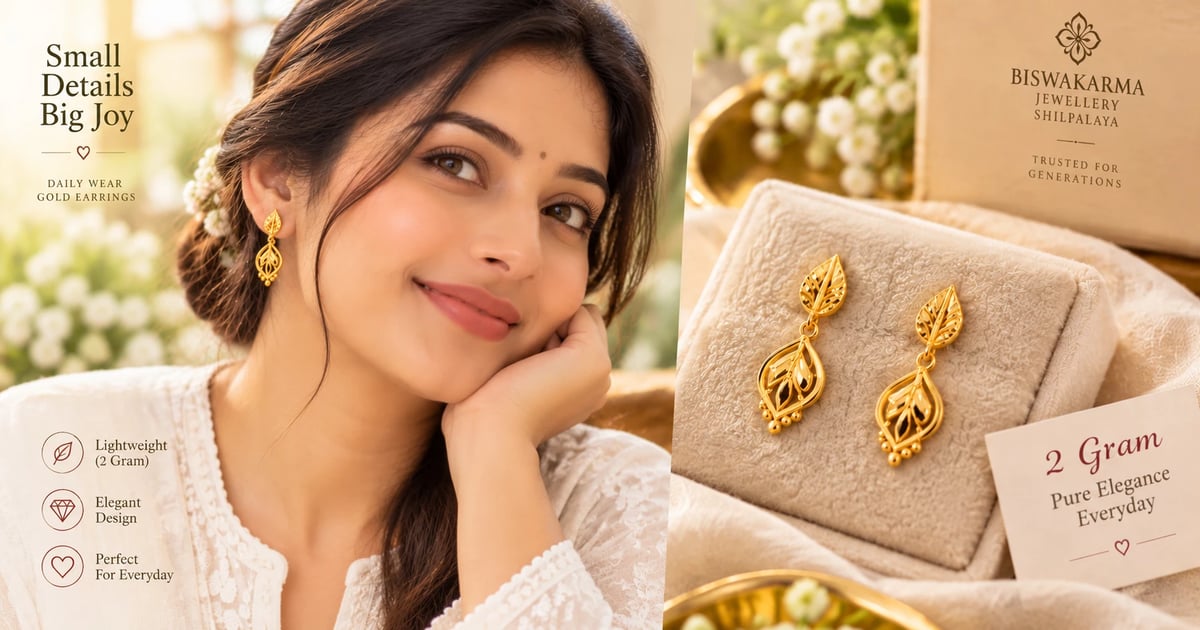
Yes, 2 gram gold earrings for daily use are a sensible buy. Three things decide whether you're still comfortable at 9 pm. The closure, the shape, and the hallmark.
A pair sold at 2 grams usually works out to about one gram per ear. That is light enough to forget, solid enough to read as real gold.
Most pages on this topic stop at a design gallery. This one ranks styles by how they behave after twelve hours. It also covers a BIS rule that surprises almost every buyer of light gold.
Why 2 grams is enough for everyday gold earrings
Weight is the whole argument for this category. So start with what two grams actually buys.
In 22K, two grams holds roughly 1.83 grams of pure gold. 22K means 91.6% gold. The rest is alloy, usually copper and silver, added for strength.
Split that across two earrings and each side carries about a gram. On the lobe, a gram stops registering within minutes.
Ask one question before you agree on anything. Is the 2 grams for the pair, or for each earring? Sellers quote it both ways, and the difference doubles your bill.
Next, ask for net weight rather than gross weight. Net weight is the gold alone. Gross weight can include stones, enamel or any non-gold part.
Here is the trade-off nobody prints. To look larger than a gram, a goldsmith works the sheet thin or builds the shape hollow. You gain visual size. You also get a piece that dents more easily than a solid stud.
Comfort ranking: which light styles survive twelve hours
Three physical things decide comfort. How far the earring sits from the lobe, whether anything protrudes, and how the back grips.
Here are the main lightweight shapes, ranked from most to least comfortable across a full day.
Flat gold studs: the most comfortable daily option
A flat stud sits against the lobe with nothing hanging. Nothing swings, so nothing catches. Pick this shape if you sleep in your earrings or wear a helmet on a two-wheeler.
Keep the face no wider than your own lobe. Anything wider presses in when you turn on a pillow.
Mini hoops that stay close to the ear
Small hinged hoops, often called huggies, sit against the lobe instead of dangling. They clear a shirt collar and a phone screen easily. Trouble starts as the diameter grows. A larger hoop catches on a dupatta, a scarf and long hair.
Floral tops and the petal problem
Floral motifs turn up in almost every lightweight range. The raised petal edge is the part to inspect. Run the earring across a cotton dupatta at the counter. If a thread lifts once, it will lift every day.
Geometric designs: light shapes, sharper corners
Squares, bars and triangles get plenty of visual size from very little gold. That is exactly why they work at this weight. Still, check the corners with a fingertip. An edge that feels fine in the shop can annoy you by evening.
Office picks that survive headsets and hair
For office wear, the test is simple. Does it fight a headset? Flat studs and small huggies pass comfortably. Drops, tassels and open filigree do not. Filigree means fine twisted wirework. A headset cushion presses a raised design into your lobe for hours.
Looking for Gifting Silver Then check our Romantic Payel Story !
Which 2 gram designs suit your face shape
Earrings add either width or length to the lower half of your face. That single idea explains most face-shape advice.
Face shape | Works well | Skip for daily wear |
|---|---|---|
Round | Angular studs, thin mini hoops, short vertical drops | Wide round hoops, large domed studs |
Oval | Most shapes; studs and huggies both sit well | Very long drops that add more length |
Square | Curved outlines, small hoops, soft-edged floral tops | Sharp-cornered square studs |
Heart | Small shapes slightly wider at the base | Bulk concentrated at the top of the lobe |
Long | Wider studs and huggies that add width | Long linear drops |
Treat that as a starting point rather than a rule. The honest test happens at the counter. Hold the pair up, then step back a metre and look again.
For heavier ceremonial shapes, the same logic applies with far more weight involved. Our face-shape and fit guide to pasa earrings covers that end of the range.
Earring closures ranked for daily safety
A lost earring is nearly always a closure problem, not a gold problem.
Closure | Holding power | Speed to wear | Best suited to |
|---|---|---|---|
Screw-back | Strongest | Slow | Daily wear, sleeping, travel |
Hinged huggie snap | Strong once clicked shut | Fast | Mini hoops |
Bullet or friction clutch | Moderate | Fast | Light studs |
Push-back butterfly | Moderate, loosens with use | Fast | Short days, frequent changes |
French hook | Weakest | Fast | Occasional wear, not daily |
Run two checks at the counter. Thread the screw-back fully on and off yourself, feeling for a smooth turn. Then hold the earring upside down and shake it gently.
Screw-backs are worth the extra seconds on a pair you wear daily. On the other hand, if you remove earrings at your desk often, push-backs will irritate you less. Both choices are defensible.
Why many 2 gram earrings carry no BIS hallmark
This part catches almost every buyer, so it is worth reading twice.
BIS lists an article weighing less than two grams among the exemptions from mandatory hallmarking in covered districts. The reason it gives is practical. Some designs at that weight are difficult to mark.
A light pair can therefore reach you with no HUID at all. HUID is the six-character code stamped on hallmarked jewellery.
That is not a dead end. BIS states such articles may still be hallmarked if the jeweller asks, after testing under IS 1418. It also lists gold hallmarking charges at ₹45 per article, with levies extra. Against the price of a gold pair, that is a small ask.
Jewellers with annual turnover up to ₹40 lakh sit outside mandatory hallmarking altogether. Plenty of neighbourhood shops fall into that group.
A hallmarked piece carries exactly three marks. The BIS logo, the purity in carat and fineness, and the six-character HUID. Verify that code in the free BIS Care app before you pay, not after.
For hallmarked articles, BIS sets what the bill must carry. Description, net weight, purity in carat and fineness, and hallmarking charges. Ask for those same lines even when your pair is exempt.
Real protection sits behind the mark. Say a hallmarked article later tests below its marked purity. BIS rules then provide compensation of twice the shortfall, plus testing charges.
Two of our guides go deeper here. Start with the five-minute gold purity check, then read what a hallmark does and does not cover. Light traditional pairs meet the same gap, as our guide to belkuri earrings and their real 22K weights explains.
Buy Something for you like Gold Diamond Finger Ring for Men !
How the price of a 2 gram pair is built
What 2 gram gold earrings for daily use cost comes down to five lines, not one. No one can quote you a fixed figure, because the metal rate moves daily. The arithmetic, though, is entirely within your control.
Five lines make up the bill:
Metal value — the day's rate for that purity, times the net weight
Making charges — the karigar's labour on that specific design
Wastage — charged by some jewellers, not by others
Hallmarking charge — where the piece is hallmarked
GST — as printed on your invoice
Making charges are what decide value on a light pair. Labour does not shrink with weight. A one-gram stud can take a karigar as long to finish as a heavier one. As a result, making charges take a bigger share of a 2 gram bill than of a heavy one.
Ask for making charges as a rupee figure per piece, never as a percentage alone. Then compare two pairs on that number.
Check today's gold rate in Kolkata before you walk in, so the metal line is no surprise.
One honest note on resale. Making charges are labour, and labour is generally not returned when you exchange a piece later. Ask your jeweller for the exchange terms in writing.
Do lightweight gold earrings actually last?
They do. Worn sensibly, 2 gram gold earrings for daily use hold up for years, with one caveat most articles skip.
Gold at 22K is soft. What fails on a light pair is almost never the gold itself. It is a joint, a post, or a thin section.
Failure points usually appear in this order:
the post bends, from a pillow or a phone pressed to the ear
a solder joint opens where a drop meets its top
a hollow section creases after a knock
screw threads wear smooth over years of daily use
Some choices last longer than others. A solid stud beats a hollow one. Fewer solder joints beat more. A rimmed setting protects a stone better than exposed prongs.
Plan on a periodic check and polish for any pair you wear every day. No jeweller can promise that a light pair will never need repair. Be wary of anyone who does.
22K or 18K for earrings you wear every day
22K is 91.6% gold and marked 916. 18K is 75% gold and marked 750.
More alloy means more hardness. So 18K resists dents better and holds stone settings more securely. Meanwhile 22K carries more gold per gram and shows the deeper yellow most Indian buyers expect.
For plain gold studs, tops and hoops at this weight, 22K is the sensible default. But if your pair holds diamonds or coloured stones, 18K is the better metal for the setting. That is the one case where our usual advice is the wrong advice.
Styling 2 gram gold tops through a normal day
At the office, a flat stud disappears under a headset and reads well on video calls. Nothing pulls, nothing swings into frame.
On a commute, avoid anything that hangs near a helmet strap or a bag strap. Huggies and studs stay put through both.
For college, mini hoops sit well with a kurti and just as well with a T-shirt. Small floral tops do the same job with a softer look.
By evening, the same pair reads differently once your hair is down. That is usually change enough for dinner or a family visit.
Lighter Bengali styles work the same way. Our comparison of sui suto and sui dagha earrings covers two of the most wearable ones.
Five mistakes buyers make with light earrings
Agreeing to "2 grams" without asking whether that is the pair or each piece
Accepting gross weight on a design that contains stones or enamel
Treating "exempt from hallmarking" as the end of the conversation
Comparing making charges as percentages instead of rupees per piece
Choosing a raised, open design for a life spent around dupattas and long hair
The seven-point check before you pay
Net weight, written on the bill
Purity stated as 916 or 750, not just "gold"
HUID verified in the BIS Care app, or a voluntary hallmark requested
Making charges quoted in rupees per piece
Closure opened and shut by your own hand
Edges tested against a piece of fabric
Exchange and repair terms, in writing
Hesitation on any of these is itself an answer. Something can still go wrong after purchase. The Department of Consumer Affairs runs the National Consumer Helpline on 1915. It takes complaints in seventeen languages.
Buying a pair you will actually wear
The best 2 gram gold earrings for daily use are the ones you stop noticing by mid-morning. That comes down to a flat profile, a closure you trust and a finish that does not snag.
Take the seven-point check with you. Ask about weight, purity and making charges in that order.
Then browse our everyday gold earrings or the full jewellery range when you are ready to compare pairs in person.