

Diamond Ring for Men: 7 Best Designs & Prices
 Sujoy Dhar
8 min read
Sujoy Dhar
8 min read
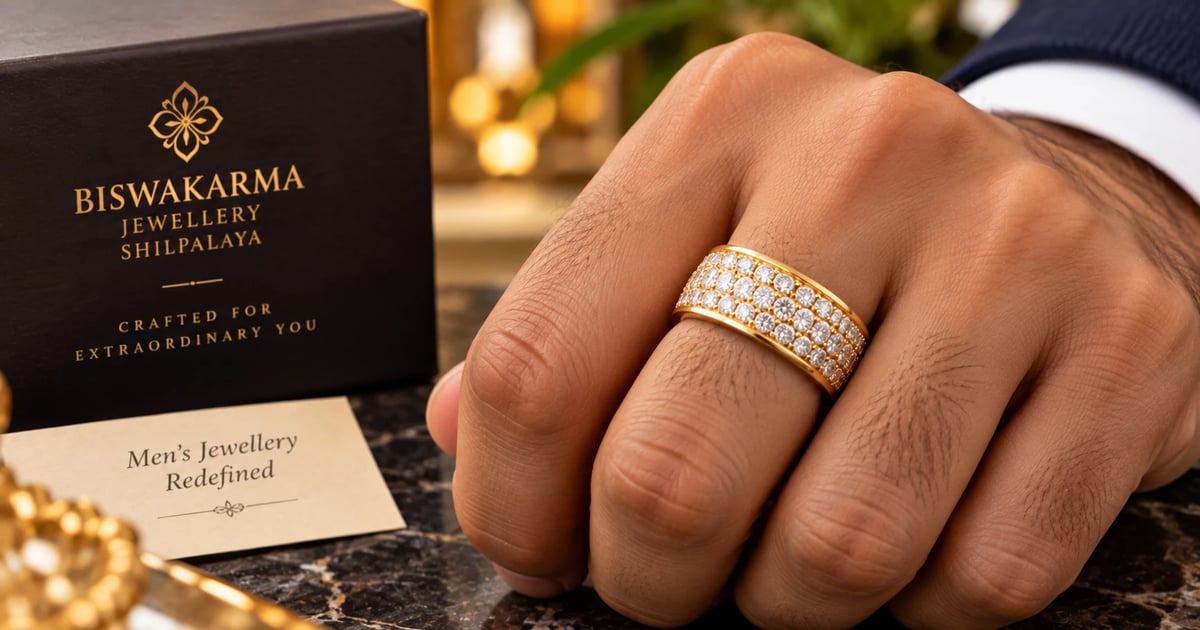
Expect to pay ₹50,000 to ₹1,50,000 for a diamond ring for men in India. Expect the gold to be most of that. At ₹12,000 per gram for 18K, a 6-gram band is ₹72,000 of metal alone. The stones often cost less than the setting holding them.
Every price here assumes 18K gold at ₹12,000 per gram. That's the rate quoted across Indian markets in late August 2026. Swap in the rate on the day you buy. Check the live gold rate in Kolkata first, then do the sum yourself.
What a diamond ring for men costs in India
Four things make up the bill. Nothing else should appear on it.
The four lines on your invoice
Metal value — net gold weight in grams, times the rate for that purity.
Diamond value — quoted separately, by carat weight and quality.
Making charges — either a percentage of metal value or a flat rate per gram.
GST — 3% on the gold and diamond value, plus 5% on making charges billed separately.
Ask for all four as separate lines. A jeweller who quotes only a final number is asking you to trust arithmetic you can't see.
What your budget actually buys
Work backwards from the metal and the picture gets clear fast.
Band weight (18K) | Metal at ₹12,000/g | + 12% making | + GST | Before any stone |
|---|---|---|---|---|
3 g | ₹36,000 | ₹4,320 | ₹1,296 | ₹41,616 |
5 g | ₹60,000 | ₹7,200 | ₹2,160 | ₹69,360 |
8 g | ₹96,000 | ₹11,520 | ₹3,456 | ₹1,10,976 |
Making charges vary by jeweller and by design, so 12% here is only a worked assumption. Ask what yours is. Then rerun the table in thirty seconds.
Gold Earring for women should not be missed !
Why the gold sets the price, not the stone
Men's rings are heavy. That's the whole reason.
A woman's solitaire puts most of its value in one large stone on a slim band. A men's ring reverses that. The band is wide and solid, so it carries three to four times the gold, while the stones stay small.
So the lever that moves your bill is grammage, not carats. Drop from 8 grams to 5 and you've saved more than most stone upgrades will ever cost you.
7 diamond ring designs for men, with price bands
Every band below is priced at the same ₹12,000 gold rate, with modest stone weight. A gents diamond ring is built from those same four lines whatever the design. So compare weights before you compare looks.
Plain solitaire band
One small round stone, flush against a plain band. Around ₹55,000 to ₹90,000 in 4 to 6 grams of 18K.
This is the one I'd point most first-time buyers towards. Nothing catches on shirt cuffs, and it reads as considered rather than loud.
Pavé band with small stones
Tiny stones sit in a row, held by small beads of metal raised from the surface. Roughly ₹70,000 to ₹1,20,000.
Pavé gives you visible sparkle for very little carat weight. Just know that the beads wear down over years of daily knocks.
Signet ring with a single stone
Think flat top face, often engraved, with one stone set into it. Usually ₹90,000 upwards, because signets carry serious metal.
Good for wide hands, and for anyone wanting a family look without a wedding-band shape.
Channel-set band
Stones sit in a groove between two metal walls, with no beads exposed. Expect ₹80,000 to ₹1,40,000.
Of every setting here, this is the one built for abuse. The walls shield the stones, so it survives keyboards, handlebars and gym bars.
Bezel-set band
A thin rim of metal wraps the whole stone. Similar money to channel setting, sometimes less.
Bezels hide a fraction of the stone, which slightly dulls the sparkle. In exchange, nothing sticks up to snag.
Two-tone band
White gold and yellow gold meet in one ring, with stones usually on the white section. Around ₹75,000 to ₹1,30,000.
The contrast does the visual work, letting you buy less carat weight. Remember that the white portion needs re-plating later.
Wide band with clustered stones
Eight millimetres or more across, carrying grouped stones. Often ₹1,50,000 and up, purely on gold weight.
Honestly, I'd steer you away from this for daily wear. It's a lot of metal on a working hand, and it dates faster than a plain band.
For a lighter first ring, our guide to gold ring designs for boys covers the sub-5-gram end.
How to choose the right men's diamond ring
Five decisions set the price and the comfort. Take them in this order.
Carat weight and what's normal
Men's rings carry small stones. A pavé band might hold twenty stones of 0.01 to 0.03 carats each. Together that's well under half a carat.
A 1-carat single stone on a men's diamond ring is unusual in India. It sits high, it snags, and it can double your bill in one line. If you want visible size, a cluster of small stones reads bigger for less money.
Band width and daily comfort
Width changes fit. A wider band touches more of your finger, so it feels tighter at the same size.
For daily wear, 4mm to 6mm suits most hands. Ask for a comfort fit — a rounded inner surface — if you type or ride for hours. Above all, get sized in the exact width you're buying, not in a thin sample band.
14K, 18K or 22K
22K is too soft for a stone-set men's ring. Prongs bend, stones loosen, and you'll be back for repairs.
18K is the sensible default. 14K is harder still and costs less per gram, because it's 58.5% gold against 18K's 75%. That puts 14K near 78% of the 18K rate — a real saving on a heavy band.
Both 14K and 18K can be hallmarked in India. So can 20K, 22K, 23K and 24K.
White, yellow, rose or platinum
Yellow gold needs no upkeep and suits most Indian skin tones. White gold is rhodium-plated, so it will need re-plating as the coating wears. Rose gold sits between them and hides scratches well.
Platinum costs more per gram and weighs more on the hand. It never needs plating, though. Ask for both prices before you decide.
Lab-grown or natural
Both are real diamonds. They differ in origin and in price behaviour.
Lab-grown prices have fallen hard. GJEPC trade data reported by Business Standard shows the scale of it. India's average export price for polished lab-grown diamonds was about $389 per carat in 2022. By early 2026 it was roughly $71. Natural stones averaged about $758 per carat in the same period.
Buy lab-grown if you want more visible stone for the money. Buy natural if resale and long-term pricing matter more to you. Neither choice is wrong, and neither one is an investment.
Certification: two documents, two different bodies
This trips up almost every buyer. Your ring carries two certifications, and they cover different things.
The metal is certified by BIS. Since 1 July 2021, a hallmark carries three marks. Those are the BIS logo, the purity in caratage and fineness, and a six-digit alphanumeric HUID. You can check that HUID yourself in the BIS Care app, using its Verify HUID feature. That's set out in the Bureau of Indian Standards hallmarking FAQ. Our gold purity checklist walks through the same check at the counter.
The stone is graded by a gem lab. Only gold and silver fall under hallmarking in India. Diamonds never do, whatever a showroom tells you. If the difference still feels blurry, hallmark gold versus BIS gold sorts it out in one read.
One rule also changed recently. From 1 October 2025, GIA stopped applying its natural-diamond 4Cs vocabulary to lab-grown stones. It now issues a Laboratory-Grown Diamond Quality Assessment instead. That describes a stone as Premium or Standard, and anything below the Standard threshold gets no assessment at all. GIA set this out in its October 2025 services announcement. IGI reports still use the familiar 4Cs, so two lab-grown stones can carry very different paperwork.
Why Boy should have fun ? Check the bridal Collections
What happens if you sell or exchange it later
Read the buyback clause before you pay, not after.
Standard gold buyback covers the metal. Stones usually get removed first, and the gold is weighed without them. Making charges and taxes are commonly deducted too.
That fine print has been challenged. In 2025, the Pune district consumer disputes redressal commission ruled on exactly this. It held a jeweller responsible for extracting extra money as government taxes during a diamond bangle buyback. The commission directed the firm to buy back at the prevailing market rate, deducting making charges and a further 10%.
So ask three questions, and get the answers in writing. What gets deducted? Are the stones valued at all? Which rate applies on the day you return? [VERIFY: link to Biswakarma's written buyback and exchange policy page — confirm the URL and quote the clause verbatim, with its exclusions]
Sizing, care and re-plating
Indian ring sizes are not US sizes. India uses a numbered scale running roughly from 1 to 30, matched to inside diameter in millimetres.
A 19.8mm inside diameter is about an Indian 22, and roughly a US 10. Trade listings often print both, which is exactly why guessing goes wrong.
Measure a ring you already wear, at the inside edge, in millimetres. Then match that number to a chart. Fingers swell in heat, so size in the afternoon rather than first thing.
Care is simple. Warm water, mild soap, a soft brush around the setting. Take it off at the gym, because a bent prong costs more than fresh plating.
Re-plating a white gold ring depends on how hard you wear it. Edges dull first. Ask what a re-plate costs before you commit, not two years later.
Before you pay
Price the gold first. Ask for four separate lines, then check the HUID in the app. Read the buyback clause before you leave the counter.
A ring that survives a decade of daily wear beats one that photographs well. Browse the diamond gents ring collection with that in mind, or the full ring range if you're still comparing shapes.