

Silver Payal for Women: Latest Designs & Prices 2026
 Sujoy Dhar
8 min read
Sujoy Dhar
8 min read
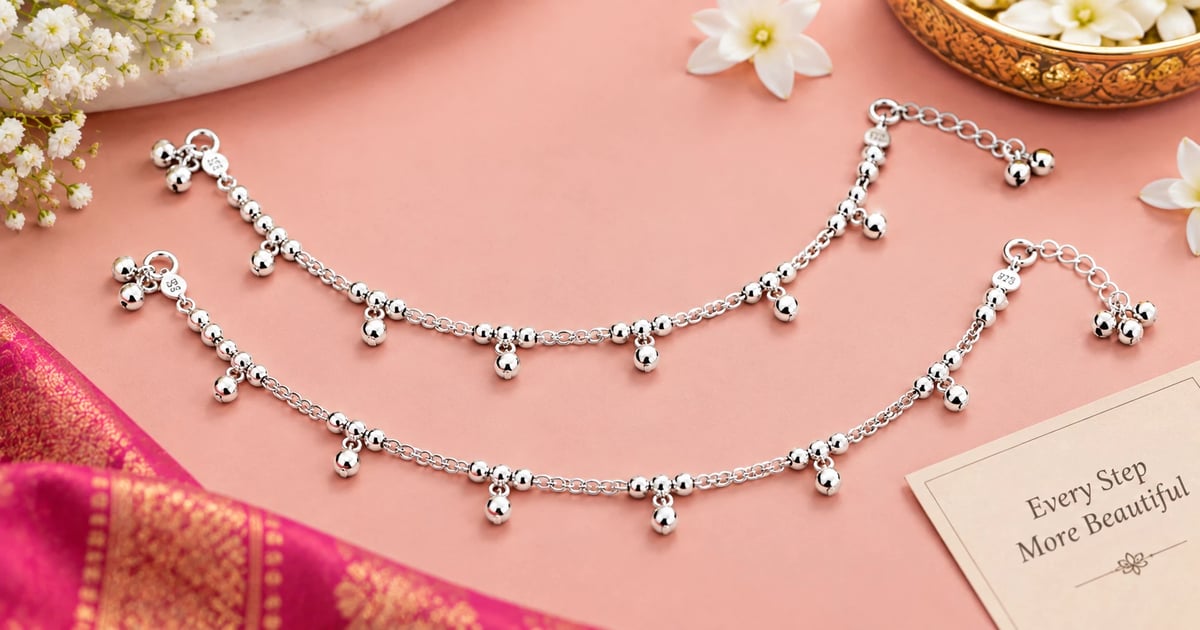
Shopping for a silver payal for women comes down to three checks. You want real silver, a design you'll actually wear, and a fair price.
Here's the twist. Genuine silver costs far more today than it did two years ago, thanks to a historic price rally. That means any price guide older than a few months is already outdated.
This one uses current rates, covers 2026's design trends, and shows you how to verify purity before you pay.
Why Silver Payal Remains Popular
Payal has been part of Indian dress for generations. Women wear it for weddings, festivals, and plain daily errands, often within the same month.
Unlike gold, silver doesn't ask you to save for months before buying a piece you like. Indian silver jewellery output grew about 3 percent in 2024. Lower import duty and rising purity levels both helped, per the Silver Institute.
Silver also suits more occasions than most jewellery. A thin chain works under jeans, while a heavier oxidised design pairs naturally with a saree or lehenga. That range is why 2026's designs look so different from what an earlier generation wore.
Latest Silver Payal Designs for Women
2026's payal designs split into six clear styles. Pick by how you'll actually wear it, not just how it looks in a photo.
Lightweight Silver Payal
This is the everyday choice: a slim chain, sometimes with a tiny charm, that sits close to the ankle. Pairs often weigh under 20 grams together, so they layer under trousers or a saree without any bulk.
Still, the trade-off is durability. A very thin chain bends faster and needs a gentler touch when you're active.
Ghungroo Payal
Ghungroo — small bells that jingle with movement — give a payal its classic sound. Dancers have worn them for centuries, but 2026's versions are lighter.
Expect smaller bells and slimmer chains instead of the heavy traditional cluster. That makes them wearable outside performance and festival settings, though the jingle still isn't ideal for a quiet office.
Layered Payal
Layering means two or three chains at different lengths on one ankle, sometimes in different textures. It's the boldest look on this list.
On the plus side, one layered piece can replace several single payals in your rotation. Even so, the downside is weight. More chains mean more grams, and more grams mean a higher bill at today's silver rates.
Bridal Silver Payal
Bridal payal is the heaviest, most detailed style, often with ghungroo, floral motifs, or stone work. It's built to be noticed under a lehenga during photos and rituals, not for daily wear.
Weight and detailing both push up the price, so this is usually the piece worth budgeting for separately. Many brides pick a lighter everyday pair too, for the days after the wedding.
Order a bridal design a few weeks ahead if it needs custom sizing or extra ghungroo work.
Oxidised Silver Payal
Oxidised — chemically blackened for an antique look — gives silver a dark, textured finish instead of a bright shine. It suits Indo-western and boho outfits especially well.
Because the black coating sits on the surface, heavy daily friction can wear patches of it away over time. So a gentle cleaning routine keeps that finish intact longer.
Charm and Evil Eye Payal
Small charms — hearts, stars, or the evil eye motif — sit on an otherwise plain chain. The evil eye, or nazar, is popular right now as a protective symbol as much as a style choice.
Plus, these charms add personality without adding much weight or cost. They're an easy first payal if you've never worn one before.
Silver Payal Price Guide
A silver payal for women in a simple 20-gram design costs roughly ₹5,500 to ₹6,500 today. Most of that is metal value alone. A heavier bridal design, 50 to 60 grams with detailing, typically runs ₹16,000 to ₹19,000.
Both figures move with the daily silver rate, so treat them as a starting point, not a quote.
That range starts with the metal itself. Silver traded near ₹250 a gram in India this week. Every business day, the India Bullion and Jewellers Association publishes a fresh rate. Check it before you buy.
That rate has moved sharply over the past two years, after one of silver's biggest rallies in decades. A year ago, the same gram cost far less.
Next, GST adds another layer. The silver itself is taxed at 3 percent. If the jeweller bills making charges separately, those attract 5 percent GST on top.
Making charges — the jeweller's labour cost — usually run 5 to 25 percent of the metal value. Simple chain designs sit at the low end. Ghungroo, layering, and stone work push it higher, since more handwork goes into each piece.
Item | Light daily-wear pair (~20g) | Bridal pair (~60g) |
|---|---|---|
Metal value (925 silver, ~₹250/g) | ₹5,000 | ₹15,000 |
GST on metal (3%) | ₹150 | ₹450 |
Making charges (approx.) | ₹500–750 | ₹3,000 |
GST on making charges (5%) | ₹25–38 | ₹150 |
Approximate total | ₹5,700–5,900 | ₹18,600 |
Figures are illustrative, based on a silver rate near ₹250/gram. Check the live rate and your jeweller's making-charge policy before you buy.
Once you know your budget, browse a silver anklets collection filtered by weight. That way, you compare pieces at a similar gram range.
How to Choose the Right Silver Payal
First, occasion decides more of this choice than looks do. But the same design that suits a wedding can feel wrong at your desk on Monday.
Occasion | Best pick | Why |
|---|---|---|
Daily wear | Lightweight chain payal | Low weight, minimal snagging, easy under trousers or a saree |
Office wear | Thin, low-noise chain, no ghungroo | Silent underfoot, reads as understated rather than festive |
Bridal wear | Bridal or layered payal with detailing | Matches the heavier jewellery worn that day, photographs well |
Festive wear | Oxidised or charm payal | Stands out against bright festival outfits without full bridal weight |
If you're buying one payal to cover everything, pick a mid-weight chain design. It reads as smart at the office and still looks intentional at a family function. Save the heavier, detailed pieces for the wedding season itself.
Buying one as a gift? Stick to a mid-weight chain in an adjustable length. Most payal use an S-hook or adjustable clasp, so you can skip asking for her exact ankle size.
Browse the full silver jewellery collection if you want to compare payal against other silver pieces before deciding.
Pure Silver vs 925 Silver Payal
Pure silver, also called fine silver, is 99.9 percent silver. It's soft, which makes it easy to dent or bend against a hard floor.
925 silver, or sterling silver, mixes in 7.5 percent copper or another metal for strength. That trade-off is exactly why most payal makers choose 925 over pure silver. Your feet take more daily impact than your wrists or ears do.
Factor | Pure / 999 silver | 925 sterling silver |
|---|---|---|
Purity | 99.9% | 92.5% |
Durability for anklets | Low — dents and scratches easily | Higher — holds shape under daily wear |
Typical use | Coins, bars, ceremonial pieces | Everyday and bridal jewellery |
Tarnish | Tarnishes; shows dents more | Tarnishes similarly; resists denting |
For a deeper look at how sterling silver is graded, the International Gem Society has a useful guide. And if gold is also on your list, our gold purity checklist walks through the same idea for karat gold.
How to Check Silver Purity
Checking purity takes minutes if you know where to look. Here's the order jewellers actually use.
Look for a hallmark stamp. A genuine 925 piece often carries a purity mark, though marking is far less consistent for silver than for gold.
Ask whether it carries a HUID, the Hallmark Unique Identification number used since September 2025. You can verify it instantly on the BIS Care app or the BIS portal.
Request an itemised bill. It should separate weight, purity, metal value, and making charges, not just show one final number.
Try a quick magnet test at home. Genuine silver isn't magnetic, so a piece that clings to a magnet is fake. That test only catches some fakes, since several non-silver metals are also non-magnetic.
When still unsure, get it tested. A BIS-recognised Assaying and Hallmarking Centre will check a piece for a small fee.
One thing trips up a lot of buyers: hallmarking for silver isn't compulsory yet in India, unlike gold. The Bureau of Indian Standards is moving toward a mandatory system for silver. For now, sellers can still legally sell unhallmarked pieces.
A hallmark on silver is still a strong trust signal, even without a legal mandate behind it. For comparison, our own hallmark gold vs BIS gold explainer covers how that same system already works for gold jewellery.
Care and Maintenance Tips
In fact, tarnish is normal, not a defect. It's a reaction between the metal and sulfur compounds in air, sweat, or your bathroom cabinet.
Take your payal off before a shower, a swim, or a workout. Moisture and soap residue speed up tarnishing more than almost anything else. Store each pair in a small airtight pouch or a lined box, away from direct sunlight.
An anti-tarnish strip or a small piece of chalk inside the pouch absorbs moisture and slows tarnishing further.
For cleaning, warm water with a drop of mild soap works for most designs. Use a soft cloth or a baby toothbrush for ghungroo and detailed corners. Dry the piece fully before you store it. Oxidised pieces need a lighter touch, since scrubbing wears down the dark finish faster than you'd expect.
Also, skip harsh chemical dips and ultrasonic cleaners at home. They can loosen stones or strip an oxidised finish completely.
A good silver payal for women comes down to three things. Real purity. A design that fits your week. A price that matches today's silver rate. Get those right, and the rest is just picking what catches your eye. Check current rates, verify what you can, and buy from someone who explains the difference when you ask.