

Silver Anklet for Baby Girl: 8 Cute Designs to Buy in 2026
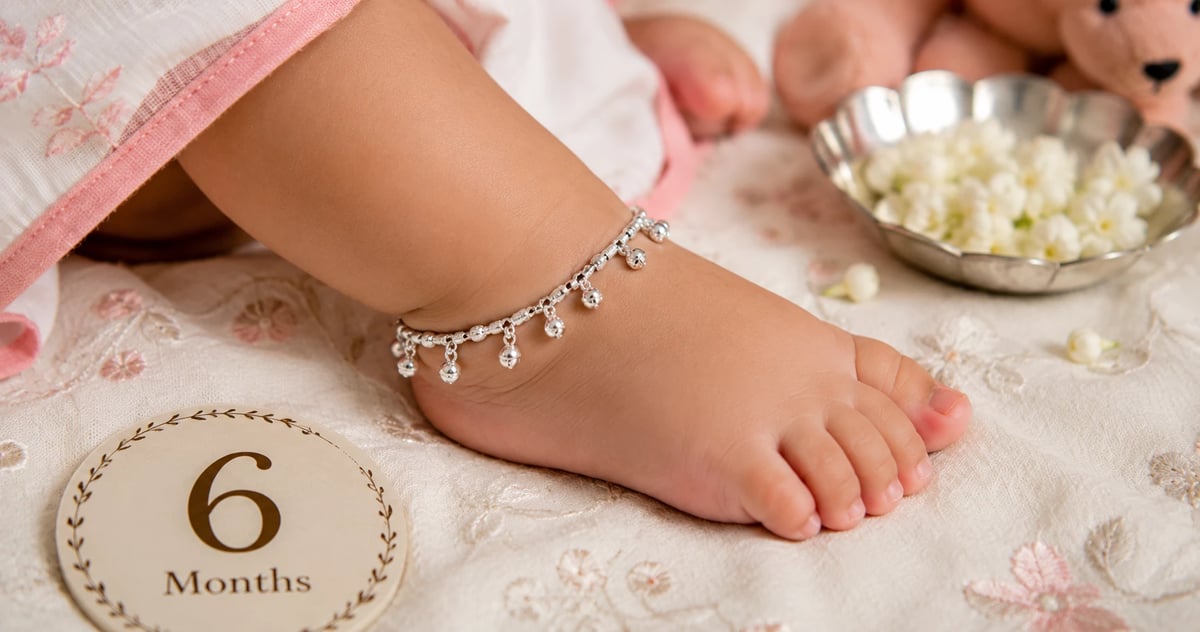
Most of what sells as a silver anklet for a baby girl is a 925 sterling payal. Sizes run 5 to 6 inches for the first year.
Below are eight designs Indian families ask for most. Under each one sits the check that decides whether it suits her.
Then the parts nobody explains properly. Sizing, purity, hallmarking, 2026 pricing, and when to take it off.
Cute silver anklet designs for a baby girl
Eight styles cover almost everything sold in India today.
Plain chain payal for daily wear
1. Flat curb chain. The links lie flat on the skin. Nothing sticks up to catch a sock.
2. Box-link chain. Rounder, and it holds its shape better than a fine rope pattern.
For a three-month-old, this is the pair I'd point you to. Nothing to work loose.
Also check the join where chain meets clasp. On thin chains, that solder point fails first.
Ghungroo payal and the bell check
3. Ghungroo chain payal. Small bells strung along the chain. This is the sound her thakuma is asking for.
4. Kada-style payal with bells. A solid ring instead of a chain, with bells fixed onto the band.
Bells are the part parents quietly worry about, and that worry is reasonable. The US Food and Drug Administration has received reports of deaths and injuries from teething jewellery worn by infants. Those include choking and strangulation.
So check the attachment, not the sound. A ghungroo should be soldered or riveted to the chain.
Hold one bell and tug it in the shop. Does it slide, twist open, or hang off a split ring? Then put the pair back.
Rigid kada styles do well here. Fewer links means fewer joins, plus the bells sit on an unbroken band.
Black bead and nazariya designs
5. Black bead payal. Silver beads alternating with small black glass beads along the chain.
Many families believe black beads turn away nazar. That's the custom, and it's a lovely one to keep. What matters is the material underneath, so ask for beads strung on silver chain or silver wire. Not on cotton or nylon thread.
Here's the reason, and almost no guide in this category mentions it. In hair-thread tourniquet syndrome, a hair or loose thread winds tightly around a baby's toe. Cleveland Clinic puts the average age at diagnosis at five months, and four months for toe cases. Left too long, blood supply suffers and tissue can be damaged.
A fraying kala dhaga on a four-month-old sits squarely in that age band. So if a thread frays, cut it off the same day.
Charm payal with hearts and stars
6. Charm payal. Tiny hearts, stars, or moons hanging from the links.
Keep charms small, roughly 4 mm or less. Above all, ask for them soldered onto the link rather than clipped on.
An open jump ring is a loose charm waiting to happen.
Adjustable and name-engraved payal
7. Adjustable payal. A sliding knot or short extension chain stretches one pair across several months.
8. Name-engraved plate. A flat silver plate carrying her name, usually eight to twelve letters.
Engraved pairs are especially popular as annaprashan gifts. Ask for the plate edges to be filed, since a freshly cut plate has sharp corners.
See how these styles sit on the foot in our silver anklet collection.
Which design suits her age, month by month
The right anklet at two months and at fourteen months are not the same object. Her hands change everything.
0 to 6 months: before she reaches her feet
She can't reach her own ankles yet, so weight and edges matter more than moving parts. Pick the lightest plain chain you can find.
6 to 12 months: crawling, grabbing, mouthing
This is the stage that decides everything. She can reach her feet now, and everything goes into her mouth.
So anything clipped, glued, or threaded comes off. Soldered bells and a rigid kada both hold up well.
Crawling also scratches the metal. That's cosmetic, not a fault.
12 months and older: walking and socks
Once she's upright, a flat profile beats a chunky one. Bulky payal catch on sock cuffs and shoe straps.
Adjustable designs earn their keep now, since her ankle thickens fast.
Getting the size right without a size chart
Charts disagree with each other, and babies don't read them. So measure her instead.
Wrap a soft thread just above her ankle bone while she's asleep. Mark the overlap, then measure the thread flat against a ruler.
Add about half an inch. That gap lets the anklet move without sliding over her heel.
For scale, Indian sellers list baby sizes from 5.5 to 8 inches. First-year pairs sit at the lower end, often under 5 grams together.
Two errors repeat:
Too loose is the bigger problem. A slack anklet slips over the heel or catches on a cot rail.
Too tight leaves a red groove. If you can't slide a fingertip under it, it's small.
Rigid kada payal need extra care, since the ring must clear her heel.
Not confident measuring a wriggling baby? Bring her in and we'll size her at the counter, using our store and contact details.
Be sure to check the Silver Rakhi Collections & Guide !
Six things to check before you pay
Run these at the counter, not at home afterwards.
Tug every bell. Soldered or riveted holds. Clipped or glued does not.
Test the clasp. A screw clasp or soldered S-hook beats a small spring ring.
Look at what the beads are strung on. Silver chain, yes. Cotton thread, no.
Run the pair across your palm. Any burr you can feel, she can feel.
Watch the weight go on a digital scale. Then ask for silver value and making charges separately.
Get the purity written on the invoice, whether or not the piece carries a hallmark.
Point six is the one people skip. It costs nothing, and it's the only thing you can hold a seller to later.
925 or 999 silver: which suits a baby better
For an anklet she'll actually wear, 925 wins.
Sterling silver is 92.5% silver, with copper making up the rest. In fact, that copper is what gives the metal enough hardness.
Fine silver at 999 is purer and softer. It bends out of round faster, and it costs more per gram.
925 sterling silver | 999 fine silver | |
|---|---|---|
Hardness | Holds shape under pulling | Bends and dents easily |
Cost per gram | Lower | Higher |
Best use | Daily-wear payal, bells, clasps | Gift and keepsake pieces |
Skin contact | Low-allergy for most babies | Very low-allergy |
One honest caveat on skin. Sterling is an alloy, so nobody can promise a reaction-free metal.
Nickel is the usual troublemaker in cheap silver-look alloys. So ask what yours is alloyed with. The answer should be copper.
Watch for listings quoting 70% or 75% silver for kids' anklets. Those aren't sterling, and they fall below the lowest grade the Indian standard recognises.
How to check a silver hallmark yourself
Silver hallmarking is voluntary, not mandatory
Plenty of pages get this wrong, so here it is plainly.
Silver hallmarking in India is voluntary. Gold sits under a mandatory scheme. Silver does not.
The Ministry of Consumer Affairs introduced HUID-based hallmarking for silver on a voluntary basis from 1 September 2025. Bureau of Indian Standards officials were still assessing readiness through mid-2026. No mandatory date has been notified.
So nobody is legally required to hallmark that anklet. Which means the checking falls to you.
The three marks on a hallmarked silver anklet
If a seller has chosen to hallmark, the revised IS 2112:2025 standard puts three things on the piece:
BIS Standard Mark, carrying the word SILVER
Purity grade, such as 925
HUID code, a unique alphanumeric identifier
Seven purity grades are recognised: 800, 835, 925, 958, 970, 990 and 999. Grades 958 and 999 joined in the 2025 revision.
For pieces hallmarked after 1 September 2025, the BIS Care app shows more. Article type, purity grade, hallmarking date, testing centre and jeweller registration number.
Then use a magnifier. On a baby payal those marks sit on the clasp or a flat link.
One limit is worth knowing. A hallmark certifies purity. It says nothing about how well a bell is soldered. Our guide on what a hallmark does and doesn't guarantee covers this for gold, and the logic holds here.
What a silver anklet for a baby girl costs in 2026
Silver isn't the cheap metal it was two years ago, so any price range written before 2025 is useless.
Work it out this way instead:
(weight in grams × today's silver rate per gram) + making charges + GST
Silver rates published for Indian cities on 27 August 2026 ran from about ₹234 to ₹260 per gram. Sources and cities differ, so check the day's rate before you shop.
GST on silver jewellery has been 3% of value since 2017, with making charges taxed separately. Ask for both lines on your bill.
A high silver rate changes two things. A light hollow payal is now sensible on price, not only on comfort. And a 999 pair costs more than a 925 pair of equal weight.
Making charges also bite hardest on fiddly work. Tiny bells take a bigger piece's handwork, spread over less metal.
When to take the anklet off
Here's the honest version, given that we sell these.
The American Academy of Pediatrics does not recommend that infants wear jewellery at all. For parents who do, its guidance is specific. Keep the piece on a wrist or an ankle rather than around the neck. Supervise her while it's on. Take it off whenever she's unattended or asleep, day or night.
Notice which form factor that guidance points to. An ankle is treated as lower risk than a neck chain. That's a stronger reason to choose a payal than any tradition-based one.
In practice, most families settle into a rhythm. The anklet goes on for the day, then comes off at nap time.
Considering a neck chain instead? Our baby gold chain guide explains why the neck carries more risk.
Above all, talk to your paediatrician about your own baby, especially if her skin is sensitive.
Tarnish, cleaning and storage at home
Silver darkens because it reacts with sulphur compounds in air and sweat. That's oxidation, not a sign of fake metal.
It can leave a faint grey mark on her ankle. But the mark washes off.
To clean a pair at home:
Soak a few minutes in warm water with a drop of mild soap.
Work gently around the links with a soft toothbrush.
Rinse, then dry fully with a soft cloth.
Still, bells are the catch. Water sits inside a ghungroo and rusts the tiny iron ball. So shake each bell out and let it air-dry.
Skip dips and toothpaste. Dips leave residue inside bells, while toothpaste is abrasive enough to dull a fine chain.
Then store the pair dry in a soft pouch with an anti-tarnish strip. Rubber bands and damp cupboards both speed up tarnishing.
Building a full set for a naming ceremony? Our baby bangle range pairs well with a plain payal.
The short version if you're buying today
Buying a silver anklet for a baby girl comes down to five checks.
First, measure her ankle with a thread, then add half an inch. Choose 925 over 999 for daily wear. Tug the bells, and refuse beads strung on cotton thread. Get the purity written on your invoice.
Then take it off at nap time. That habit matters more than any feature on the anklet.