


Benefits of Wearing Gold: Tradition, Astrology & Everyday Value

Key takeaways
Gold's proven benefits are practical. It doesn't corrode, it holds its metal value, and it can be exchanged, resold or pledged for a loan. In Indian tradition, gold marks marriage, blessing and family wealth. Jyotish links gold to the Sun and Jupiter, but that is belief, not science. Wearing gold has no proven health benefit.
The benefits of wearing gold fall into three groups: cultural meaning, practical value and astrological belief. The practical ones are measurable. Gold doesn't rust or tarnish, and hallmarked pieces can be exchanged against the day's gold rate. Lenders also accept gold jewellery as security for loans.
The cultural benefits are real for millions of Indian families, from wedding stridhan to a Bengali bride's pola. Astrological benefits are a matter of faith, not proof. Most health claims online have no evidence at all.
This guide is for anyone told by an elder or astrologer to "wear gold", or buying a first daily-wear piece. It sorts each claim into the right box.
Why Does Gold Matter So Much in Indian Families?
Gold matters in Indian families because one piece can hold blessing, security and memory. A bangle can be a wedding gift, a savings plan and an heirloom at once.
Why Do Indian Brides Wear So Much Gold?
Indian brides wear a lot of gold because wedding gold is traditionally the bride's own wealth, called stridhan. Stridhan is property a woman receives as gifts, before or at marriage. Under Indian law, it remains hers.
That's why a mother may start buying coins years before the wedding. Our bridal jewellery guide explains how families usually build the set. For budgets, see the gold set for bride price list.
Many families now keep one heavy wedding piece and buy lighter ones for later. A simple lightweight bridal necklace or a 5-gram gold maang tikka keeps the look without the weight. In many communities, a 22KT gold mangalsutra is the one piece worn daily after marriage.
Much of this gold moves down the generations. Your nani's chain becomes your mother's, and later yours. That's also why gold remains a favourite anniversary gift for a wife: it's meant to be kept.
Bengali Customs: Pola, Sakha, Noa and Annaprashan Gold
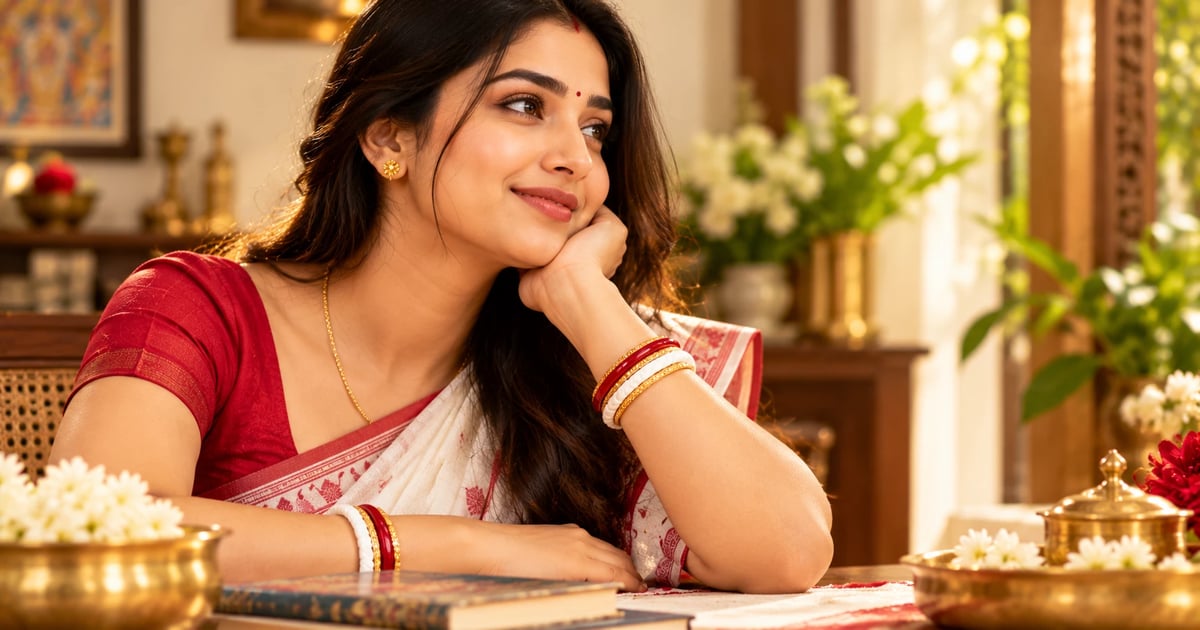
In Bengal, a married woman traditionally wears sakha, pola and noa. Sakha is a white conch-shell bangle, pola is red coral, and noa is iron.
Shell and coral crack easily, so many families have them capped in gold. Read about what pola bangles mean, the latest gold sankha designs and our gold noa price guide. You can also browse our pola, sakha and noa collections.
Our comparison of traditional and modern gold pola designs helps if you want a lighter style. Pola earrings carry the same red-and-gold look. For kanbala and other bridal classics, see our guide to West Bengal jewellery heritage.
Gold also arrives early in a Bengali child's life. At annaprashan, the baby's first rice-eating ceremony, elders often gift a small chain or bala. A baby gold chain or a pair from our baby bangle collection is a common choice. For infants, choose smooth pieces with no loose parts, and remove chains at bedtime.
Why Buy Gold on Akshaya Tritiya and Dhanteras?
Akshaya Tritiya and Dhanteras are the two days Indian families most often choose for buying gold. "Akshaya" means imperishable, so gold bought that day is believed to bring lasting blessing. Dhanteras falls two days before Diwali, when buying metal is believed to welcome Goddess Lakshmi.
Many people buy something small on these days. A Lakshmi gold coin or a gini gold coin is easy to store and exchange later. Gini gold also gives the Bengali gini ring its name.
Why Is Gold Traditionally Not Worn Below the Waist?
Gold is traditionally kept above the waist because many families treat it as sacred to Goddess Lakshmi. In that view, gold on the feet is disrespectful, so toe rings and payal are made in silver.
This is one tradition, not a universal rule. Many families today choose gold or silver anklets by preference and community custom. Our gold anklet guide for women and silver payal designs cover both choices.
If your family follows the older custom, browse our silver anklets. Our guide to 925 versus pure silver explains which holds up better.
What Does Jyotish Say About Wearing Gold?
In jyotish (Vedic astrology), gold is linked with the Sun (Surya) and Jupiter (Brihaspati). Wearing it is believed to strengthen those planets in your birth chart, or kundli. No study has shown that a metal changes what happens in your life.
Gold, the Sun and Jupiter
Gold's colour connects it to the Sun in many jyotish traditions. The Sun's gemstone, ruby (manik), is traditionally set in gold. A Surya locket is a popular way to wear the Sun symbol.
Jupiter is linked to yellow and to Thursdays. Its stone, yellow sapphire (pukhraj), is also commonly set in gold. Browse our locket collection for both styles.
One caution: a red crystal gold necklace is a style choice. Jyotish practice treats a real ruby, chosen for your chart, as something different.
Which Finger Should You Wear a Gold Ring On?
By common astrological belief, a gold ring goes on the index finger for Jupiter. The ring finger is linked to the Sun. Families differ on which hand to use, and some rings carry folk meanings instead, like the caterpillar ring.
If your ring isn't tied to a chart reading, wear it wherever it fits comfortably. See our guide to gold rings for women and our ladies' ring collection.
Who Should Not Wear Gold According to Astrology?
There is no single astrological answer, because published sources contradict each other. One links gold to the Sun, another to Jupiter, a third to Venus and the Moon. One popular astrology page even says gold doesn't suit Taurus.
These lists can't all be right. Jyotish itself says advice depends on your full chart, not your sun sign. For chart-specific advice, ask the astrologer your family trusts, and be wary of anyone selling the remedy too. If your family wears gold simply because it always has, that's reason enough.
Everyday Benefits of Wearing Gold You Can Count On
The everyday benefits of wearing gold are practical. It lasts, keeps its metal value, and can be pledged or exchanged. Honestly, the best benefit of gold is that it lasts.
Gold Doesn't Tarnish or Corrode
Pure gold doesn't react with air or water, so it won't rust or turn black. Jewellery gold is alloyed (mixed with other metals), usually copper and silver, for strength. Those metals can dull slightly with sweat or perfume. A wash in mild soapy water brings the shine back, unlike silver, which needs regular polishing.
Does Gold Jewellery Keep Its Value?
Gold jewellery keeps value because you can exchange or sell it for its gold content at the current rate. That makes it a reasonable long-term store of value, but not a guaranteed one.
Several things cut what you get back. Making charges and GST are usually not returned, and stone weight is deducted. The gold price also moves both ways. The World Gold Council recorded an 8% quarterly fall in the international price in Q2 2026.
At Biswakarma, we deduct stone weight, making charges and GST at exchange. Check today's gold rate, then estimate a piece's value with our gold calculator. Our customer FAQ page covers common buying questions. We don't predict prices, but our article on whether gold prices will rise or fall explains what drives them.
The hallmark is what makes resale smooth. BIS hallmarking rules for gold jewellery require a BIS logo, a purity mark and a six-digit HUID code. HUID means Hallmark Unique Identification. Mandatory hallmarking covers 14, 18, 20, 22, 23 and 24 carat gold. 22K is marked 22K916 (91.6% gold), and 18K is marked 18K750 (75% gold).
You can verify a HUID in the BIS CARE app. Our guides on hallmark gold versus BIS gold and checking gold purity before buying walk you through it. Our metal guide explains each purity we sell.
Gold as a Family Safety Net: Loans and Heirlooms
Gold jewellery works as a safety net because you can borrow against it without selling it. The World Gold Council's Q2 2026 India report puts bank gold loans at INR 5.1 lakh crore. That end-May 2026 figure was 105% higher than a year earlier.
The same report calls gold loans India's second-largest retail lending segment after housing. Lenders give only part of the gold's value, and missed repayments can cost you the piece. Read the terms carefully.
Heirloom value is harder to measure, but real. A gini coin bought for a child's annaprashan can join her wedding set twenty years later.
Daily Wear That Works With Indian and Western Outfits
Gold works with a saree and with jeans, which is why light daily pieces are so popular. See our small gold necklace designs for daily wear, 2-gram gold earrings and bali gold earrings. A tie chain for women suits western wear. Browse our gold ear tops and chain collection too.
Men often wear a ring, chain or kada daily. Our guides to gold for men, gents' gold ring designs and gents' kada prices cover styles and weights. See our gents' ring collection as well.
Does Wearing Gold Have Any Real Health Benefits?
No reliable evidence shows that wearing gold jewellery improves your health. The scientific facts about gold describe the metal, not your body. It resists corrosion, and it can still trigger skin allergy in some people.
Gold and Arthritis: Medicine, Not Jewellery
Gold did treat arthritis, but as a medicine, not as jewellery. The NIH LiverTox entry on gold preparations says gold salts treated rheumatoid arthritis for decades. Doctors gave them as injections or as an oral capsule called auranofin.
This treatment, called chrysotherapy, has since been replaced by modern drugs. Side effects such as rashes, nausea and kidney problems were common. Some reactions were fatal.
A ring on your finger delivers no drug. If your joints hurt, see a doctor rather than relying on jewellery.
Popular Gold Health Claims With No Evidence
Several ranking pages call these claims "scientific" without naming a single study. We found no primary source for any of them:
Gold earrings improve eyesight.
Toe rings made of gold help women conceive.
Tiny particles of gold pass through skin into the bloodstream.
A gold chain improves circulation or heart health.
Wearing gold regulates body temperature or reduces stress.
If someone shows you a real study, judge it on its merits. Until then, treat these as stories.
Can You Be Allergic to Gold Jewellery?
Yes, you can be allergic to gold jewellery, so gold is not hypoallergenic. DermNet's page on gold contact allergy notes that gold was named Contact Allergen of the Year in 2001. The American Contact Dermatitis Society gave it that title.
In a Cutis study of 355 patients with suspected contact dermatitis, 17 (4.8%) were allergic to gold. These people were already being tested for skin problems, so the general rate is likely lower.
Often the real culprit is another metal. DermNet's jewellery allergy guide says many people who blame gold actually react to nickel. White gold is usually alloyed with nickel, and its protective rhodium plating wears off over time.
Is 22K or 18K better for sensitive skin? A higher carat generally means less alloy metal touching your skin. DermNet notes that copper in low-carat gold can also cause gold release. So yellow 22K is usually the gentler choice, and yellow 18K suits most people. Avoid white gold if nickel bothers you.
Is wearing gold good for your skin, then? For most people it's neutral. New piercings need extra care, covered in our ear piercing aftercare guide. If a rash, itch or dark patch keeps returning, see a dermatologist. A patch test shows which metal you react to.
How to Wear Gold Every Day Without Problems
Yes, it's fine to wear gold every day with the right carat, a hallmarked piece and a sensible weight. The benefits of wearing gold last longest when the piece suits your routine:
Match the carat to the piece. 22K suits chains, bangles and plain earrings. For thin rings and stone settings, we usually suggest harder 18K.
Check the hallmark and HUID before paying. Verify the code in the BIS CARE app and keep your bill.
Keep daily pieces light. For chains and necklaces, under 5g is easy to forget you're wearing. Our lightweight gold jewellery guide shows what 1–5 grams buys.
Take gold off for the gym, pool and heavy cleaning. Chlorine and strong cleaners attack the alloy metals.
Clean it monthly with mild soap, lukewarm water and a soft brush. Dry it fully.
Here's the honest trade-off. A thin 22K ring can bend or scratch if you work with your hands all day. Then 18K is the better buy, even though it holds less gold.
Before a bigger purchase, read our gold necklace buying guide. More explainers sit in our gold guides section.