


5 Gram Gold Maang Tikka Price & Design Guide for Brides
 Sujoy Dhar
8 min read
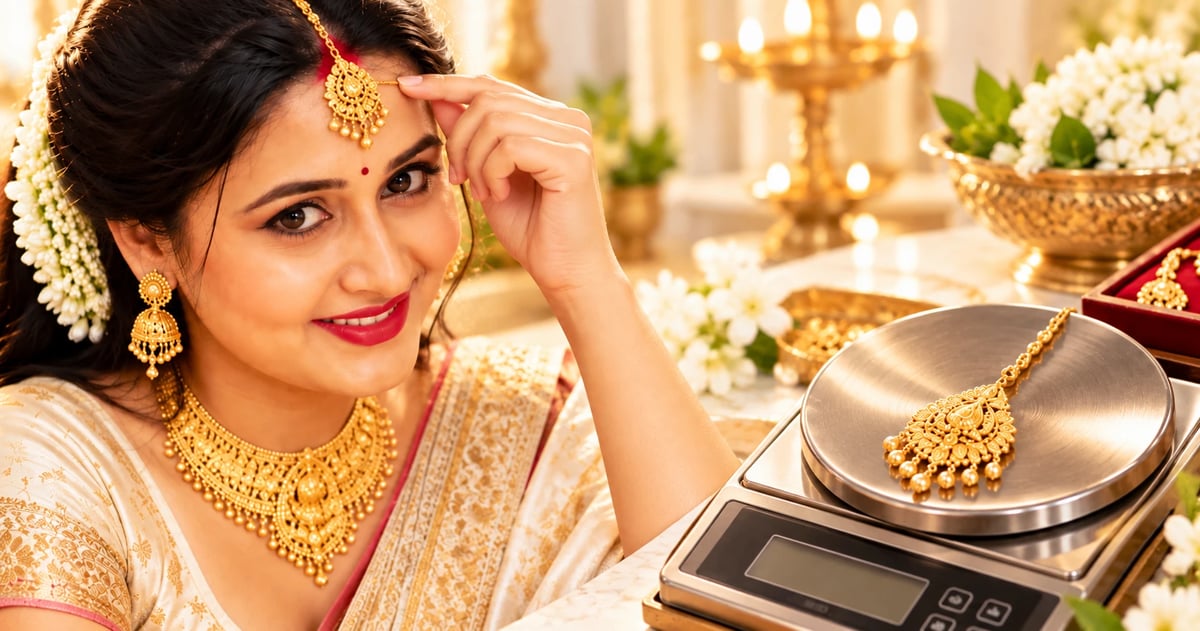
A 5 gram gold maang tikka price today comes to roughly ₹81,000 to ₹94,000 in 22K gold. That range uses Biswakarma's Kolkata rate of ₹14,560 per gram on 23 September 2026. It adds making charges of 8% to 25%, then 3% GST on the total.
Gold alone is ₹72,800 of that. The rest is craftsmanship and tax, and most listings never show you that part.
Below is the full calculation, line by line. After that, you'll see how to confirm you're paying for real, hallmarked gold.
5 Gram Gold Maang Tikka Price, Worked Out Line by Line
Every jeweller in India builds your bill from the same parts. Here's the formula:
Final price = (Weight × Rate per gram) + Making charges + 3% GST on both
The rate is the price of one gram at your chosen purity. 22K gold, stamped 916, is 91.6% pure. It's the standard purity for traditional Indian jewellery.
The 22K Calculation at Today's Kolkata Rate
Rate used: 22K (916) at ₹14,560 per gram, Kolkata, 23 September 2026.
Rates shown are illustrative. Check today's rate before buying.
You can check today's 22K and 18K rate board for Kolkata before you shop. Then swap your number into the table below.
Bill line | Simple design (8% making) | Detailed design (15% making) | Heavy handwork (25% making) |
|---|---|---|---|
Gold value (5g × ₹14,560) | ₹72,800 | ₹72,800 | ₹72,800 |
Making charges | ₹5,824 | ₹10,920 | ₹18,200 |
Subtotal | ₹78,624 | ₹83,720 | ₹91,000 |
GST at 3% | ₹2,359 | ₹2,512 | ₹2,730 |
Final price | ₹80,983 | ₹86,232 | ₹93,730 |
Figures are rounded to the nearest rupee.
Want a quick gold maang tikka price calculator of your own? Multiply the day's 22K rate by 5. Add the making charge. Then multiply the total by 1.03.
Why the Price Changes Every Working Day
The per-gram rate moves daily. The India Bullion and Jewellers Association (IBJA) publishes benchmark rates each business morning and evening. Jewellers set their shop rates using these benchmarks and local market conditions. So a ₹200 rise per gram adds at least ₹1,000 to a 5g piece, before making and GST.
That's also why gold maang tikka price today in India isn't one fixed number. City rates differ slightly, and so do making charges.
What Pushes Your Maang Tikka Bill Up or Down
Two tikkas with the same weight can end up nearly ₹13,000 apart. The gap almost always sits in the lines below.
Gold Maang Tikka Making Charges: The Line to Question
Making charges pay the karigar, or craftsman, for shaping the gold. They usually run 3% to 25% of the gold value, according to IIFL Finance's guide to making and wastage charges. Machine-made pieces tend to sit near 3% to 8%. Handcrafted work often runs 8% to 25%.
Some shops quote a flat amount per gram instead. Say a jeweller charges ₹2,000 per gram. On a 5g tikka, that's ₹10,000, or about 13.7% at today's rate.
You may also see "wastage" on a quote. It covers gold lost while cutting, soldering and polishing. Some jewellers now fold it into making charges, while others still list it separately. If your quote shows both, ask what each one covers.
Stones, Pearls and the Net Weight Trap
A kundan or pearl tikka has two weights. Gross weight includes the stones. Net weight is the gold alone.
The gold rate should apply only to net weight. Stones get their own line on the bill. If a quote shows a single weight, ask which one it is.
GST on a Gold Maang Tikka: 3% on the Full Bill
GST, the goods and services tax, is 3% on gold jewellery. It covers the gold and the making charges together. The CBIC's GST FAQ for gems and jewellery sets it at 3% of the total transaction value. That holds even when making charges appear as a separate line.
So a price quoted "plus GST" will rise by 3% at the counter. If a bill for a ready piece charges 5% on making, ask the jeweller to explain it.
Paying Part of the Price With Old Gold
You can usually exchange old gold toward a new tikka. The jeweller tests its purity, weighs it, and credits its value against your bill.
Before you agree, ask how they'll test purity and what deduction applies, if any. Get the credited value in writing. Also check whether GST is worked out before or after the exchange credit, and confirm it on the invoice.
22K vs 18K Gold Maang Tikka Price Difference
18K gold, stamped 750, is 75% pure. It costs less per gram and is harder, so it grips stones better. 22K gives the deeper yellow most people picture for a bridal tikka.
Here's the same 5g piece at 15% making, using the 23 September 2026 Kolkata rates:
Purity | Rate per gram | Gold value | Making (15%) | GST (3%) | Final price |
|---|---|---|---|---|---|
22K (916) | ₹14,560 | ₹72,800 | ₹10,920 | ₹2,512 | ₹86,232 |
18K (750) | ₹11,800 | ₹59,000 | ₹8,850 | ₹2,036 | ₹69,886 |
14K (585) | ₹10,690 | ₹53,450 | ₹8,018 | ₹1,844 | ₹63,312 |
On these numbers, 18K saves you about ₹16,300 on a 5g tikka. The trade-off comes later. An exchange credits the gold content, so 18K fetches less per gram than 22K.
For a stone-heavy or modern design, 18K often makes more sense. For a plain or antique yellow piece, 22K is the usual choice.
5 Gram vs 3, 8 and 10 Gram Maang Tikka Prices
Maang tikkas can weigh as little as 2 to 3 grams. Heavy bridal pieces often go past 10 grams. Here's how weight moves the 22K price at 15% making:
Weight | Gold value | Making (15%) | GST (3%) | Final price |
|---|---|---|---|---|
3g | ₹43,680 | ₹6,552 | ₹1,507 | ₹51,739 |
5g | ₹72,800 | ₹10,920 | ₹2,512 | ₹86,232 |
8g | ₹1,16,480 | ₹17,472 | ₹4,019 | ₹1,37,971 |
10g | ₹1,45,600 | ₹21,840 | ₹5,023 | ₹1,72,463 |
Going from 5 to 10 grams doubles the price almost exactly. Gold has no bulk discount built in.
Is 5 Grams Enough for a Bridal Maang Tikka?
For a single pendant on a chain, yes. Filigree and open-wire work make 5 grams look bigger than it weighs. A bridal gold maang tikka of 5 gram suits brides who pair it with heavier earrings or a necklace.
A wide kundan centrepiece is different. So is a full matha patti, with side chains along the hairline. Both usually need more gold.
The tikka sits where tradition places the ajna chakra, or "third eye". Treat that as symbolism, not a promised effect.
Lightweight Gold Maang Tikka for Festive and Daily Wear
For pujas and family functions, a lighter piece often works better. It stays comfortable through a long evening. Under 5 grams, the lightweight gold maang tikka price stays below about ₹86,000 at today's 22K rate.
Antique, temple, kundan and filigree styles all come in this weight band. Expect a 5 gram antique gold maang tikka price near the top of the range. That's roughly ₹86,000 to ₹94,000 today, since antique finishing is mostly handwork.
You can compare gold maang tikka designs sorted by occasion for style ideas. Or browse the gold tickli and maang tikka collection with weights listed.
Real Gold or Gold-Plated? How to Tell Online
Search for maang tikka prices, and many results cost a few hundred rupees. Those are gold-plated fashion pieces. Most are brass or alloy with a thin gold layer.
The maths settles it fast. Five grams of 22K gold alone cost ₹72,800 at today's rate. A ₹500 tikka cannot hold real gold at that weight.
Watch for these signs on a listing:
Words like "gold-plated", "gold-tone", "micro-plated" or "1 gram gold". Each one means plating, not solid gold.
No net gold weight or purity mentioned anywhere.
No BIS hallmark or HUID in the description or photos.
A price far below weight multiplied by today's rate.
Plated pieces are fine for a photo shoot or a costume. Just don't set your real-gold budget using their prices.
Checking the BIS Hallmark and HUID Before You Pay
Every genuine 5 gram gold maang tikka should carry a BIS hallmark with three marks. The Bureau of Indian Standards jewellers' FAQ lists them:
The BIS logo, a small triangle.
Purity in carat and fineness, such as 22K916.
A six-digit alphanumeric HUID.
HUID means Hallmark Unique Identification. It's a code given to that one piece.
Follow these steps at the counter:
Find the stamp. It's often on the hook or the back of the pendant. Your phone's zoom helps.
Enter the HUID in the BIS CARE app. A government release on mandatory hallmarking says it shows the jeweller's registration and hallmarking centre.
Match the details. The app also shows article type and hallmarking date. These should fit the piece in your hand.
Read the invoice. It should list net weight, purity, HUID, making charges and GST separately.
If the HUID doesn't turn up in the app, don't buy. The same app lets you file a complaint. For a fuller walkthrough, read how to read a hallmark and verify a HUID.
Hallmarking is compulsory in districts notified by BIS. That same release put the count at 361 districts from November 2024. Later phases may have added more.
Before You Visit the Jeweller: A Quick Budget Check
Take the day's 22K rate and multiply it by 5. Add 15% for a mid-range making charge, then add 3%. That's your working 5 gram gold maang tikka price.
At the shop, ask for net weight, making charge and HUID in writing. Compare that against your number before you commit.