


Gents Kada Gold Price 2026: What You Really Pay
 Sujoy Dhar
10 min read
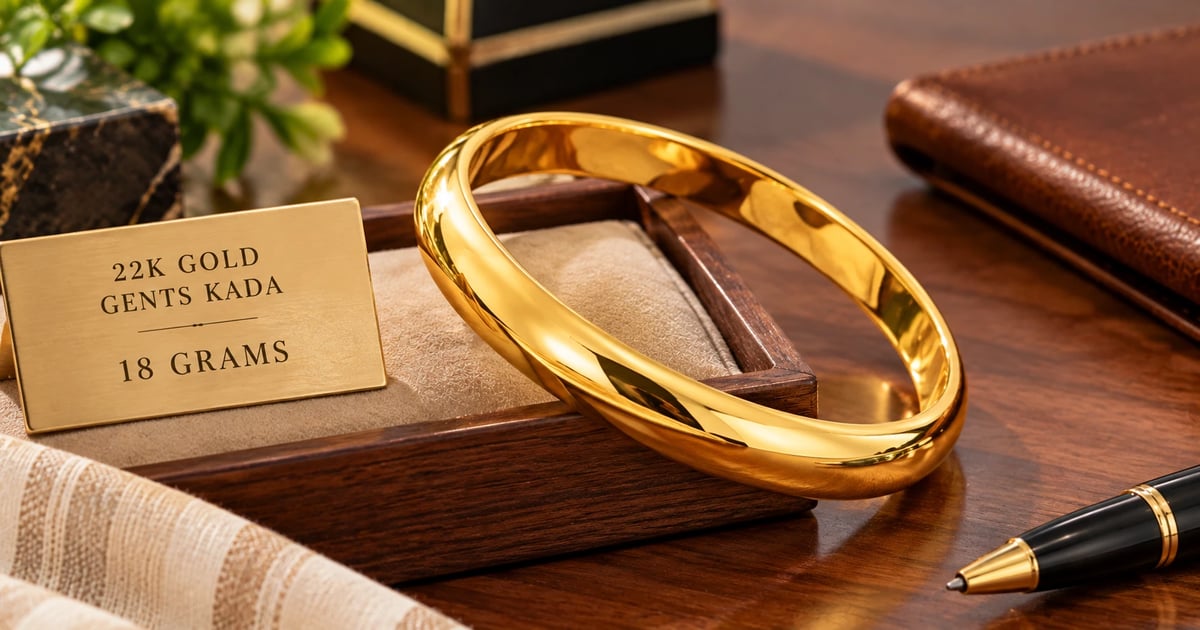
A gents kada in 22K gold costs roughly ₹86,800 at 5 grams and about ₹3,47,100 at 20 grams. That's at ₹15,045 per gram — our published Kolkata rate on 30 August 2026 — with 12% making charges and 3% GST.
Your quote will differ. But it should differ in ways you can explain, line by line.
Most men buying their first kada get one number. A total. So what follows is that total taken apart, and you can rebuild it yourself at the counter.
What a gents kada costs in 2026
The gram weight decides most of your bill. Design barely moves it.
At today's 22K rate, metal alone accounts for around 86% of what you hand over. Making charges then take roughly 11%. Tax takes the remaining 3%.
So the first question isn't which design. Instead, it's how many grams.
A word on the figures you'll see elsewhere. Several pages still say men's kadas start near ₹10,000. But at ₹15,045 per gram, ₹10,000 buys 0.66 grams. That's less than a single gram of gold. In short, those pages describe a market that closed years ago.
Gold kada price by weight: the gram bands
Below is the same kada at seven weights. Nothing else changes.
Calculated at 22K ₹15,045/gram — our Kolkata gold rate as published on 30 August 2026, 11:04 am. Making charges at 12%. GST at 3% on the composite bill. Re-run these at today's rate before you buy.
Weight | Metal value | Making (12%) | GST (3%) | Approx. total |
|---|---|---|---|---|
5 g | ₹75,225 | ₹9,027 | ₹2,528 | ~₹86,800 |
10 g | ₹1,50,450 | ₹18,054 | ₹5,055 | ~₹1,73,600 |
15 g | ₹2,25,675 | ₹27,081 | ₹7,583 | ~₹2,60,300 |
20 g | ₹3,00,900 | ₹36,108 | ₹10,110 | ~₹3,47,100 |
25 g | ₹3,76,125 | ₹45,135 | ₹12,638 | ~₹4,33,900 |
30 g | ₹4,51,350 | ₹54,162 | ₹15,165 | ~₹5,20,700 |
40 g | ₹6,01,800 | ₹72,216 | ₹20,220 | ~₹6,94,200 |
Gold rates move daily. So treat this table as a method, not a price list.
Want to run your own weight and rate? Our gold calculator does the same arithmetic on any figure you type in. Especially useful if your jeweller quotes a different making-charge percentage.
The three numbers stacked on your bill
One total hides three separate charges. That's why you should ask for all three, itemised.
Metal value
Net weight multiplied by the day's rate for that purity. Importantly, net weight excludes stones and any non-gold parts.
Watch the wording here. Gross weight includes everything on the piece. So if a kada carries stones or an inlay, gross and net will differ. Pay gold rate on the net figure only.
Making charges
The jeweller's fee for labour and finishing. It's quoted either as a percentage of gold value or as a flat rupee amount per gram.
Which method they use matters more than the headline number. In fact, on a rising market, a fixed per-gram rate quietly becomes cheaper than a percentage.
Some bills carry a second line called wastage, meant to cover metal lost in manufacture. However, that's a separate claim from making charges. So ask whether both are being levied, and why.
Tax
Gold jewellery sold to a retail buyer is a composite supply under Section 8 of the CGST Act. Because the principal supply is the gold, GST applies at 3% on the whole invoice. That means metal and making charges together. Also, it holds whether or not making charges are shown separately. CBIC has clarified this in its sectoral FAQs.
This trips up a lot of writing on the topic. You'll read that making charges attract 5%. But that 5% rate is for job work, where a jeweller sends metal to a karigar. In other words, it's a business-to-business rate. So it doesn't belong on your retail bill as a separate line.
Therefore, if a shop bills you 5% on the making-charge line, ask them to show the classification.
Making charges on a kada versus a bangle
This is where most kada buyers overpay, largely because they benchmark against the wrong item.
Published data from IIFL Finance puts typical bangle making charges at 6–10% of gold value. Kadas sit higher, around 10–16%, with carved or engraved work reaching 18%. That's because a kada needs more metal and more finishing.
Plenty of guides treat "bangle" and "kada" as the same thing on charges. Yet they aren't.
Knowing the band gives you something concrete to say. On a 20 gram kada at today's rate, here's what the percentage does:
Making charge | Making amount | Approx. total |
|---|---|---|
10% | ₹30,090 | ~₹3,40,900 |
12% | ₹36,108 | ~₹3,47,100 |
16% | ₹48,144 | ~₹3,59,500 |
20% | ₹60,180 | ~₹3,71,900 |
Move from 12% to 20% and you pay ₹24,794 more for the same gold. As a result, that's the one line on the bill genuinely worth negotiating.
One fair question: does the per-gram rate drop on heavier pieces? Many jewellers do taper it, though few volunteer that.
Why 2026 prices jumped: the duty change
If your father priced a kada three years ago, then his number isn't close any more.
Two things moved: gold itself, and the tax on importing it.
In May 2026 the government raised the gold import duty from 6% to 15%. According to the World Gold Council's analysis of India's import tightening, that's the steepest single increase on record. It took effect on 13 May 2026. On top of that, it fully reverses the July 2024 cut. The same analysis projects Indian jewellery and bar demand falling 50–60 tonnes across 2026.
Domestic prices didn't absorb all nine percentage points at once. Even so, the direction is clear enough.
What this means for you is simple. Any price quoted from memory, or from a page written before mid-2026, is likely understated.
We can't tell you whether to buy now — nobody honestly can, and a kada is jewellery, not an investment product. What we can tell you is to price it at today's rate rather than last year's.
You can check our Gold Necklace for Women !
Hollow or solid: the check most buyers skip
A hollow kada and a solid one can look identical on the tray. But the difference shows up in weight. And weight is the bill.
Do the arithmetic. A 20 gram solid kada carries ₹3,00,900 of metal at today's rate. Meanwhile, a hollow piece of the same outward size might weigh 12 grams, or ₹1,80,540. The visual difference is nearly nothing. The gap is ₹1,20,360.
Neither is wrong to buy. Hollow kadas are lighter on the wrist and on the budget, which suits plenty of men. Still, they dent more easily, and repairs on a hollow band are harder.
The problem arises only when you pay solid prices for a hollow piece.
Two questions, and one thing to do:
Is the piece hollow, solid, or filled? Get that answer before you discuss price.
Ask for net weight in writing, plus the band width in millimetres.
Then pick it up. A solid 22K kada feels dense in a way that surprises first-time buyers. So if a wide, chunky band feels light in the hand, ask again.
Hallmark and HUID: two minutes at the counter
Since 1 July 2021, a hallmark carries exactly three marks. Not four, and not five.
Per the BIS hallmarking FAQ, the three marks are:
The BIS logo.
The purity, in carat and fineness. For 22 carat that reads 22K916.
A six-digit alphanumeric HUID, unique to that one article.
Here's the part almost nobody tells buyers. BIS requires the jeweller to keep a magnifying glass of at least 10x magnification. Plus, they must show you the hallmark on request. So you're entitled to ask. Use it.
Next, verify the number yourself. Download the BIS Care app and use the "Verify HUID" feature. It should return that specific article. A HUID that doesn't resolve is a reason to walk away.
Two more things worth knowing:
Hallmarking costs the jeweller ₹45 per gold article, irrespective of weight. So if a big "hallmarking fee" appears on a 30 gram kada, that's padding, not cost.
And if you're still unsure after buying, any BIS-recognised Assaying and Hallmarking Centre will fire-assay your piece for ₹200. That's the definitive purity test. Plus, it costs less than lunch.
Buying two kadas as a pair? Then each one needs its own hallmark, with its own HUID.
For the wider difference between a hallmark and the BIS mark, we've covered that in hallmark gold vs BIS gold.
22K or 18K for a men's kada
For a kada, 22K is usually the better call. Interestingly, that's the opposite of our advice on men's rings.
22K is 916 fineness, meaning 91.6% gold. 18K is 750, or 75%. The extra 25% base metal makes 18K harder and more scratch-resistant.
That hardness matters on a ring, which takes constant knocks. A kada, on the other hand, sits on the wrist and takes far less abuse.
Cost, however, cuts the other way. At our published rates on 30 August 2026, 22K runs ₹15,045 per gram against ₹12,190 for 18K. On a 20 gram kada that's ₹3,00,900 of metal versus ₹2,43,800 — a difference of ₹57,100.
There's a resale angle too. Since 22K carries more gold per gram, it holds more of its value by weight when you exchange it.
Choose 18K if you want a heavier-looking piece for less money and you don't mind lower gold content. Choose 22K if weight-for-value is what you're after. Our gold purity guide walks through the checks either way.
Which weight suits which occasion
There's no correct weight. But there is a weight that matches how often you'll actually wear it.
Daily wear: 8–15 grams. Light enough for a keyboard, a steering wheel and a shirt cuff. At 10 grams you're around ₹1,73,600 today. In practice, most men who wear a kada daily settle in this band.
Wedding and sherwani: 25–40 grams. A heavy kada reads properly against embroidered sleeves, and it photographs well. But it also means ₹4,33,900 to ₹6,94,200 at current rates. Many buyers wear it for the functions, then keep it in the locker. Worth being honest with yourself before you commit.
In between: 15–25 grams. Substantial enough for festivals, wearable enough that it doesn't live in a safe.
One caution on the upsell. Being moved from 25 grams to 35 grams sounds like a small change. Yet at today's rate it adds roughly ₹1,73,600 to the bill.
For design, sherwani styling and the six main kada types, see our gents kada designs guide. You can also browse Punjabi kada and the wider bangles and bracelets range.
What comes back if you sell or exchange
Gold jewellery holds resale value. Your invoice total, however, does not.
When you sell or exchange, the buyer prices net weight and tested purity at the rate that day. That's it, though.
Making charges don't come back. You paid for workmanship, and that disappears the moment the piece is melted. Nor does the GST come back.
On our 20 gram example, ₹36,108 of making charges and ₹10,110 of GST — about ₹46,200 — fall away at exchange. The metal is what carries forward, at whatever the rate is then.
We can't promise you a buyback percentage, and you should be wary of anyone who does. After all, terms vary between jewellers, and rates change daily.
The practical takeaway: the lower your making-charge percentage, the less you lose on exchange. That's another reason to push on that line at purchase.
What to settle before you pay
Five things, in order:
Net weight, written on the bill. Not gross. Not "about".
The rate applied, and confirmation it's today's rate for that purity.
The making-charge percentage, and whether it's percentage or per-gram.
Whether wastage is being charged separately, on top of making.
The hallmark, under the 10x glass, and the HUID verified in the BIS Care app.
If a jeweller won't itemise those, that's your answer. Above all, a shop confident in its pricing has no reason to hide the components.
Working out your own figures beforehand changes the conversation. First, multiply your target weight by today's rate. Then add 10–16%, and add 3% on top. Walk in with that number.
The trade-off is presence. A 6 gram kada reads as a slim band, not the chunky look most men picture. Many lightweight pieces are also hollow. So confirm that, because it changes the price you should be paying.
If a slimmer profile appeals, our lightweight gold chain guide applies the same weight-versus-value thinking.