


Gold Set for Bride Price List 2026: Grams to Rupees
 Sujoy Dhar
12 min read
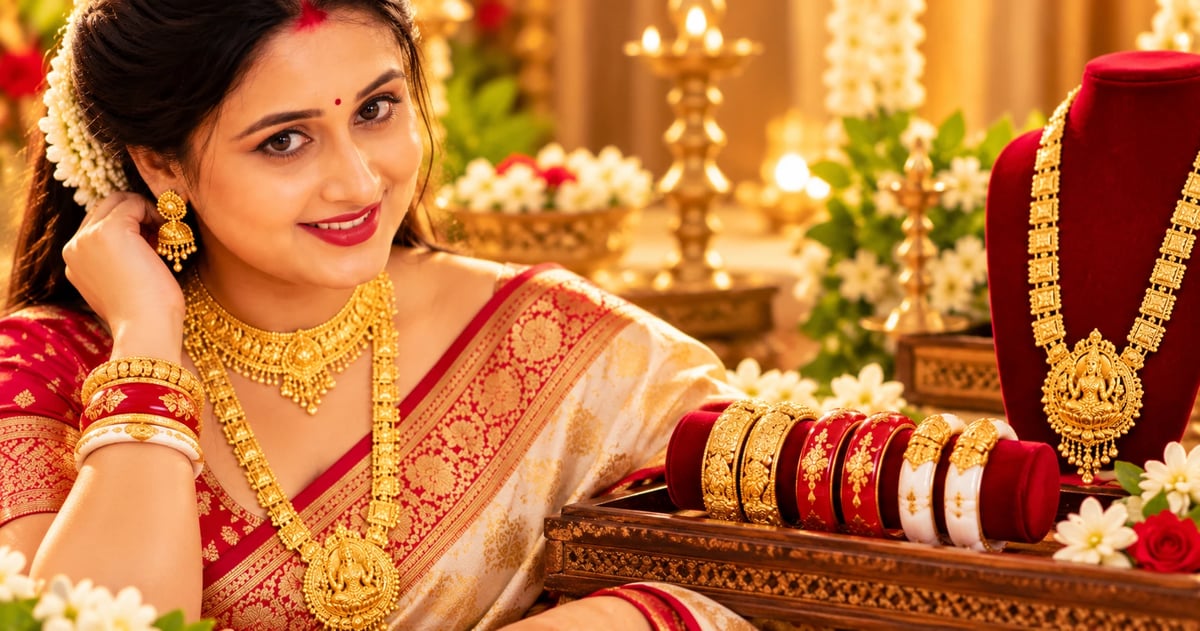
A gold set for bride costs what its grams cost, plus labour and tax. Biswakarma's Kolkata board showed ₹14,695 per gram for 22K on 22 September 2026. At that rate, 40 grams of metal costs ₹5,87,800. Making charges and 3% GST go on top.
Below you'll find rupee figures for each piece, three sample budgets and the bill lines that decide the final number. Gold rates move daily, so treat every figure here as a worked example. Check the live Kolkata gold rate before you shop.
Want the full piece checklist and the Bengali ceremony order? Our bridal jewellery guide with gram bands and ritual order covers that. This page stays on money.
What a gold set for bride costs in 2026
The price of a gold set for bride has three parts. First, net gold weight multiplied by the day's rate. Second, the making charge. Third, 3% GST on the total. At ₹14,695 per gram for 22K in Kolkata on 22 September 2026, 40 grams of metal alone costs ₹5,87,800.
Here's what the metal alone costs at different weights, using that day's board rate.
Net gold weight | 22K metal value (₹14,695/g) | 18K metal value (₹11,900/g) |
|---|---|---|
20 g | ₹2,93,900 | ₹2,38,000 |
40 g | ₹5,87,800 | ₹4,76,000 |
60 g | ₹8,81,700 | ₹7,14,000 |
80 g | ₹11,75,600 | ₹9,52,000 |
100 g | ₹14,69,500 | ₹11,90,000 |
150 g | ₹22,04,250 | ₹17,85,000 |
These are metal values only. No making charge, no GST, no stones.
A full bill for a 40 g set, worked through
Say you choose a 40 g set in 22K. The shop quotes a 12% making charge. That 12% is only an example, not a market rate.
Bill line | Amount |
|---|---|
Gold: 40 g × ₹14,695 | ₹5,87,800 |
Making charge at 12% | ₹70,536 |
Subtotal | ₹6,58,336 |
GST at 3% on the subtotal | ₹19,750 |
Total | ₹6,78,086 |
Each percentage point of making charge on this set is worth ₹5,878 before tax. So two points off saves you about ₹12,100, including GST. That's why the making charge deserves more of your attention than the gold rate.
To run your own weights, use our gold calculator for Indian jewellery bills.
Bridal gold set price list, piece by piece
The gram bands below are the 22K ranges our bridal guide uses. Rupee figures are metal only, at ₹14,695 per gram.
Piece | Common 22K weight | Metal value at ₹14,695/g |
|---|---|---|
Choker | 15–30 g | ₹2,20,425 – ₹4,40,850 |
Long necklace or sitahar | 20–45 g | ₹2,93,900 – ₹6,61,275 |
Bridal earrings (pair) | 8–20 g | ₹1,17,560 – ₹2,93,900 |
Bangle or kada (each) | 10–25 g | ₹1,46,950 – ₹3,67,375 |
Mangalsutra | 8–20 g | ₹1,17,560 – ₹2,93,900 |
Maang tikka or tikli | 3–8 g | ₹44,085 – ₹1,17,560 |
Nose ring or nath | 2–6 g | ₹29,390 – ₹88,170 |
Weight inside each band depends on design and build. A hollow choker can look as big as a solid one at half the grams. It also dents more easily, so ask which one you're holding.
The bridal gold necklace set is where most families overspend. Curious what a small budget buys? Our 8 gram gold necklace price guide runs the full sum at one weight. For more choker and long necklace styles, browse the gold necklace collection.
How many grams of gold a bride needs in 2026
No rule sets a minimum. Weight is a family and budget choice, not a ritual requirement.
Some guides still treat 150 to 350 grams as normal for a complete bridal gold set. Read that as one end of the market, not a target. The World Gold Council's India report for Q2 2026 found Indian buyers moving to lighter, lower-carat and studded jewellery. Gold prices had risen nearly 60% year on year.
Here are three sample baskets built from the bands above. None of them is a recommendation. They show how quickly grams add up.
Piece | Lightweight set | Mid-weight set | Heavy set |
|---|---|---|---|
Choker | – | 20 g | 30 g |
Long necklace or sitahar | 15 g | – | 40 g |
Earrings (pair) | 8 g | 12 g | 20 g |
Bangles | family pieces | 2 × 10 g | 2 × 20 g |
Mangalsutra | 8 g | 12 g | 15 g |
Maang tikka | 3 g | 5 g | 8 g |
Nose ring | 2 g | 3 g | 4 g |
Total gold | 36 g | 72 g | 157 g |
22K metal value | ₹5,29,020 | ₹10,58,040 | ₹23,07,115 |
Add making charges and 3% GST to each total. The gap between the lightweight and heavy set is about ₹17.8 lakh in metal alone.
Making a lightweight gold set for bride look full
On a budget, put most of your grams into one statement piece. Keep the rest light. A single strong necklace reads better in photos than two average ones.
Filigree and open designs cover more skin per gram than solid work. Ask to see the net weight on the tag before you fall for the size.
Also, borrow before you buy. Your mother's bangles or an aunt's sitahar cost nothing in making charges. For more lighter options, see our lightweight necklace price and weight guide.
Regional sets change the grams and the bill
The baskets above follow a broad pan-Indian pattern. Your community's customs change what a wedding jewellery set includes. They can move the total a long way in either direction.
Bengali gold set for bride: sitahar, bauti and pola
In a Bengali set, the grams sit in the sitahar and on the wrists. The sitahar is a long, layered necklace, usually the heaviest piece. Pearl versions use less gold than all-gold ones. Our pearl sitahar vs gold sitahar comparison shows how each reads against a red Banarasi.
Next comes the bauti, a broad gold bangle usually bought as a pair. Going by the bands above, a pair can weigh as much as a sitahar. Our bauti design and budget guide breaks down the weights.
Shakha and pola are conch and coral bangles. Many families cap them in gold, and that cap is where the cost sits. Traditionally the groom's family gives them, along with the iron noa. So check before you add them to your own list. Our pola bangles guide explains the custom.
The ceremony order also shapes spending. At Ashirbad, elders in many families bless the bride with gold. Find out what's coming before you buy duplicates. Gaye Holud often uses flower jewellery, so gold spend there can be zero. Bou Bhaat is the lighter reception. That's the right slot for earrings, a mantasha or a necklace you'll wear again.
South Indian gold set for bride: temple work
South Indian sets lean on temple jewellery. That means all-gold pieces with deity and peacock motifs, usually handmade. The long haram leads, and a waist belt (vaddanam) or armlet (vanki) may follow.
Neither the waist belt nor the armlet appears in the table above. Both can add serious grams, so ask for their net weight separately. Handwork also tends to carry a higher making charge than machine-made chains. Get that percentage in writing.
North Indian sets: kundan and polki
Kundan and polki sets carry stones, lac and foil alongside gold. That changes how the bill is built. The next section explains what to watch.
Gross weight vs net weight on stone-set pieces
Gross weight is everything on the scale: gold, stones, lac, pearls and threads. Net weight is the gold alone. You should pay the gold rate on net weight only.
Ask for three numbers on every stone-set piece. Gross weight, stone weight and net gold weight. If the shop gives only one, ask again.
Gold set for bride vs kundan set: which costs you more
Plain 22K gold set | Kundan or polki set | |
|---|---|---|
What you pay for | Net gold weight, making, GST | Gold, stones, lac and labour, plus GST |
Making charge | Varies with design | Usually labour-heavy |
On exchange later | Valued on gold weight after a purity test | Stones and lac come out, so less gold remains |
Look | Deep yellow, suits Banarasi and Kanjeevaram | Colour and sparkle, suits heavy lehengas |
If you care about what the set is worth in gold later, plain 22K is the better fit. Want colour for one day and accept the trade-off? Then kundan can still make sense. Just buy it knowing the stones are a cost, not a store of gold.
22K vs 18K: the price gap on a bridal set
On 22 September 2026, Biswakarma's board showed 18K at ₹11,900 per gram. That's ₹2,795 less than 22K, or about 19% cheaper. On a 40 g set, the metal saving is ₹1,11,800.
The saving has a catch. 22K is 91.6% gold and 18K is 75% gold. So 18K looks paler and carries less gold into any future exchange. It is harder, though, which is why it holds diamonds and small stones better.
A blunt rule: choose a 22K gold bridal set for traditional all-gold work. Choose 18K for a diamond reception piece. Using 18K just to cut the bill on a yellow gold set is usually the wrong trade.
How to check the BIS hallmark and HUID at the counter
Hallmarking, the official purity stamp, is your proof of karat. Run these checks before you pay.
Ask for the magnifier. The BIS hallmarking FAQ requires registered jewellers to keep at least a 10x glass for customers.
Find three marks. The BIS logo, the purity (22K916 or 18K750) and the HUID. HUID is a unique six-character code.
Verify the HUID. Enter it in the BIS Care app using the "Verify HUID" option.
Check pairs one by one. Each earring and each bangle must carry its own hallmark.
Read the bill. BIS says it must list net weight, purity and the hallmarking charge for each item.
Still doubtful after buying? BIS lets you test a hallmarked piece at any recognised assaying centre for ₹200. For more on marks, read what hallmark gold really means.
Making charges and GST on a bridal bill
Two lines on your bill cause most confusion. One is negotiable and the other isn't.
Making charges: the one number you can negotiate
The gold rate is set for the day. The making charge is the shop's labour and margin, so that's where you have room. Ask for it as a percentage and ask whether wastage is included.
No honest national range exists for bridal making charges. Hand-set chokers and machine chains sit far apart. So compare quotes on the same weight and design, not headline percentages.
Also, get one quote for the whole set. Flat per-piece charges hurt small items most. Our one gram gold ring price guide shows that arithmetic on a tiny ring.
GST on gold jewellery: 3% on the total, not 5% on making
Many finance blogs say making charges attract a separate 5% GST. For your bill, that's wrong.
The government's GST sectoral FAQ on gems and jewellery settles it in Question 7. For a sale to the end customer, GST is 3% of the total value. That holds whether making charges are shown separately or not.
The 5% rate applies to job-work charges between a manufacturer and an outside karigar. It isn't your tax. If your bill shows 5% on making, ask why before you pay.
Payment rules on a large bridal bill
Most bridal sets cross ₹2 lakh, so two income tax rules apply. Rule 114B requires your PAN for jewellery purchases above ₹2 lakh. Section 269ST bars a seller from taking ₹2 lakh or more in cash for one occasion. A wedding counts as one occasion, even across visits. So plan to pay by bank transfer or UPI.
Reusing and restyling your set after the wedding
Plan the second life before the first. Earrings such as jhumkas, bangles and the mangalsutra get the most wear after the wedding. Spend on those with daily comfort in mind.
Convertible pieces help too. Some necklaces have a detachable pendant you can move to a plain chain. Ask the shop to show you how the clasp separates before you buy.
Remodelling later is possible, but it costs. The old making charge doesn't come back, and the new piece carries fresh making charges. Your gold weight carries across after a purity test.
No jeweller can promise what your set will fetch later. Exchange terms vary by shop and change over time. So ask for them in writing on the day you buy.
Buying a bridal gold set online: what to check
Buying a gold set for bride online in India can be safe, with checks. It works best for pieces with standard sizes. It works less well for your heaviest necklace, which you should feel on your neck first.
Before you pay online, check these:
Registration. The seller should be BIS-registered and GST-registered.
HUID before dispatch. Ask for a photo or video of each piece's HUID and its weight on a scale.
Insured, OTP-based delivery. A heavy parcel needs both.
Return terms, read closely. Know whether refunds go to your bank or to store credit.
Here's how that last point works at Biswakarma, as an honest example. Unused gold items can be returned within 7 days. The amount goes to your BJS Wallet as a coupon, not your bank account. If you paid through an online gateway, a 2% payment charge isn't refunded. The BJS shopping FAQ lists the full terms.
Biswakarma also shows the product and its weight on a video call before you pay. If a seller won't do that, shop elsewhere.
When to buy: a timeline that protects your budget
Start four to six months out. Nobody can tell you where gold goes next, so don't try to time it.
Four to six months before. Set a rupee ceiling. Convert it to grams at today's rate, then leave headroom for rate changes.
Three to four months before. Order custom or handmade pieces. Karigar queues get longer near festival weeks.
Two to three months before. Buy the pieces you'll reuse. Spreading purchases means no single day's rate decides the whole bill.
Last two weeks. Collect everything. Check every HUID and every bill before guests arrive.
One question to ask every shop: which day's rate applies? At Biswakarma, the final price uses the rate on the booking or purchase day.