


Lightweight Gold Jewellery: What 1 to 8 Grams Buys in 2026
 Sujoy Dhar
11 min read
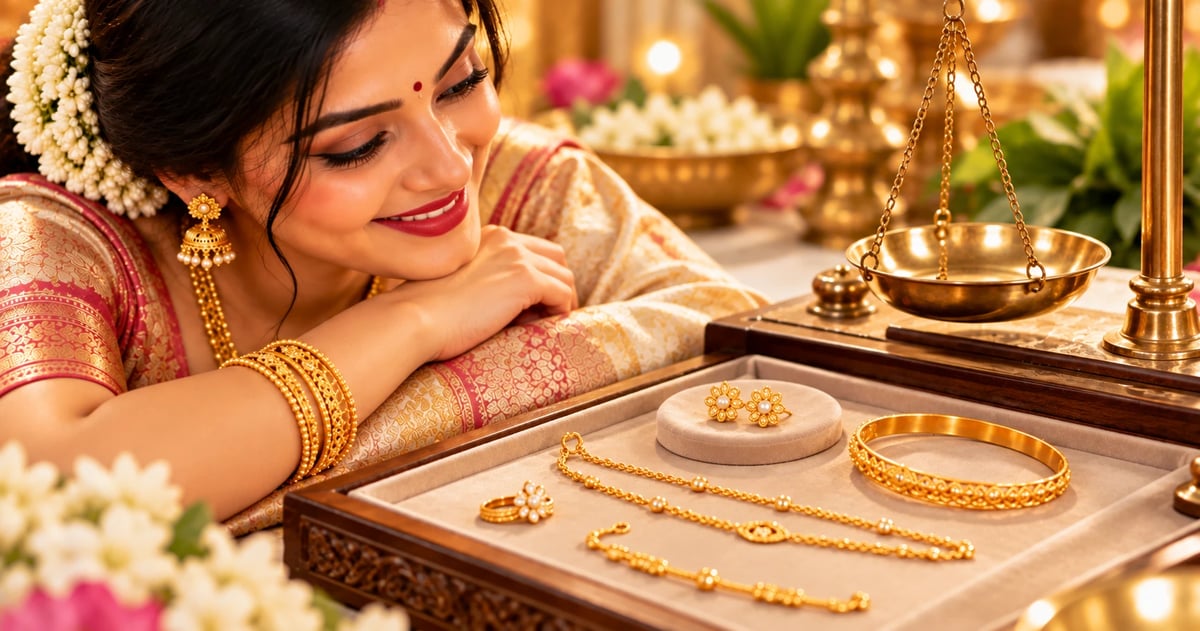
Ten grams of 22K gold costs ₹1,46,950 in metal alone at our Kolkata board rate of 22 September 2026. So lightweight gold jewellery today means roughly 1 to 5 grams, not the old 10 to 15.
Judge it by the bill, not the scale. A 3 gram 22K piece comes to about ₹53,800 once making charge, hallmark charge and 3% GST are added.
There are catches, though. Tiny pieces carry the biggest making charges in percentage terms. Some light designs are hollow. And what you pay above the gold value doesn't come back on exchange. Each point gets a straight answer below, with rupee figures you can check at the counter.
What "Lightweight" Means in 2026, in Grams and Rupees
Many jeweller pages still describe lightweight gold jewellery as anything under 10 or 15 grams. That limit made sense when gold cost far less.
But prices have moved a long way since. The World Gold Council's India report for Q2 2026 puts that quarter's average domestic price at ₹1,50,733 per 10 grams. The same report says high prices pushed buyers towards lighter, lower-carat jewellery. Its consumer survey found people buying smaller pieces, less often.
Now run the old limits through today's gold rate in Kolkata. At ₹14,695 a gram for 22K (updated 22 September 2026, 11:02 am), 10 grams is ₹1,46,950. Fifteen grams is ₹2,20,425. And neither figure includes making charge or tax.
So here's the working definition we use. Lightweight gold jewellery is real, hallmarked gold you can buy without planning the purchase for months. For most first-time buyers in Kolkata, that's 1 to 5 grams. Pieces from 5 to 8 grams still count as light, but most families treat them as a planned buy.
Best Lightweight Gold Jewellery Designs by Weight Band
The weights below come from our own shop listings, checked on 23 September 2026. Stock changes often, so read them as a guide to what each band buys.
About 1 Gram: Belkuri, Tickli and Plain Rings
First, this band suits small, personal pieces. Belkuri earrings, a traditional Bengali drop design, weigh about 0.7 to 1 gram a pair on our shop. Our belkuri earrings design guide covers the shapes and closures.
Next, a tickli (a small forehead ornament) runs from about 0.9 to 1.8 grams. A plain band sits right around 1 gram too. Our one gram gold ring guide shows which ring designs work at that weight.
Still, be ready for one thing. Making charge hits hardest here, and some sub-1 gram listings carry 30 to 35%. The bill section below shows what that does to the price.
About 2 Grams: Tops, Sui-Suto and Sui-Dagha
Two grams buys a proper everyday pair of lightweight gold earrings. This is the band most people mean by lightweight gold jewellery for daily wear. For instance, plain tops (small studs) weigh about 1.5 to 4 grams a pair. For daily-wear picks at this weight, see our guide to 2 gram gold earrings for daily use.
Sui-suto and sui-dagha are both "needle and thread" styles. A fine chain passes through the piercing and hangs behind the ear. On our shop, sui-suto pairs run about 1.7 to 3.4 grams, and sui-dagha about 1.6 to 3 grams. The sui-suto vs sui-dagha comparison explains how they differ.
Threaders also have no back to lose. Still, the fine chain is the part that snaps if it catches on a dupatta.
3 to 5 Grams: Pasha, Light Chains and Lockets
At this weight, a piece starts to hold its own next to heavier family jewellery. Pasha earrings, a Bengali festive design, weigh about 2 to 5 grams a pair on our shop. Read the pasha earrings buying guide before you choose a design.
A lightweight gold chain for women can come in under 4 grams. Add a locket of 1 to 1.6 grams and you're still under 5 grams in total. That's the practical shape of lightweight gold jewellery under 5 grams. Our guide to a gold chain under 10 grams compares chain designs at each weight.
On a thin chain, though, check the clasp first. A lobster clasp (a spring-loaded hook) holds better than a small ring clasp.
5 to 8 Grams: Noa, Slim Chains and Small Necklaces
This band, in contrast, covers pieces you'll wear for years. A gold noa, the bangle married Bengali women wear, starts around 3 grams for thin designs. Heavier mukh noa designs on our shop run past 11 grams. The gold noa design and price guide prices each weight.
Chains around 6 grams also feel sturdier than 3 gram ones. For a small necklace, see the 8 gram gold necklace designs and prices. Our lightweight gold necklace price and weight guide covers necklace weights and lengths.
Even so, two honest limits apply here. Our solid churi (plain bangles) start at about 8 grams each, so lightweight gold bangles under that weight are rare. And sitahar starts above this band, from about 11 grams in our listings.
Hollow or Solid? How to Tell Before You Pay
Some light pieces are hollow gold, meaning a thin gold shell with empty space inside. As a result, a wide bangle or a big jhumka can look generous for its weight.
Two methods come up often, and they differ. Electroforming (building gold onto a mould) usually produces hollow pieces. Filigree (fine gold wirework) saves weight with open space, but the wire itself is solid.
Hollow isn't a trick. It's a way of building jewellery, and it has real trade-offs. For example, a hollow piece dents more easily than a solid one. A dent or crack is hard to repair cleanly, and hollow rings or bangles often can't be resized.
Here's how to check in the shop:
Ask directly. Say, "Is this solid, hollow or part hollow?" Then ask for the answer on your bill.
Compare size with weight. If a wide piece weighs very little, it's probably hollow.
Look for a pinhole or seam. Many hollow pieces have one. Not all do, so treat it as a clue.
Press gently at the widest point. Thin shell walls can give slightly. Never squeeze hard.
Ask about repairs. Find out whether the shop fixes dents, and roughly what that costs.
If you plan to wear a piece every day for years, solid construction is usually the safer pick. For an occasional festive piece, however, hollow can make sense.
18K or 22K Gold for a Light Piece
Purity is stamped as fineness, meaning parts of gold per thousand. So 22K is stamped 916 (91.6% gold), 18K is 750 and 14K is 585. The BIS hallmarking FAQ lists six grades in all: 14K, 18K, 20K, 22K, 23K and 24K.
Price is the clearest difference, so start there. At our 22 September 2026 board rate, 3 grams of 22K is ₹44,085 in gold value. The same 3 grams in 18K, at ₹11,900 a gram, is ₹35,700.
For 22K lightweight gold jewellery, the draw is colour. Pick 22K if you want the deep yellow most Bengali families expect. Plus, it carries a higher gold value per gram when you exchange it later. Pick 18K or 14K for diamond or stone-set designs, which are mostly made in these purities on our shop.
On strength, however, karat isn't the whole story. The thickness of the piece and whether it's hollow matter at least as much. Ask about construction before you settle the karat question.
What the Bill Looks Like at Today's Kolkata Rate
Every lightweight gold jewellery price comes down to a few lines you can check with a calculator. Four terms matter:
Gold value: net weight times the day's rate for that purity.
Making charge: the fee for crafting the piece, usually a percentage of gold value.
Wastage: some shops bill gold lost during making as a separate line. Others fold it into making charge, so ask which.
GST: 3% on the full transaction value.
That last point often confuses buyers, because making charge usually appears as its own line. The GST Council's sectoral FAQ on gems and jewellery answers it directly. GST on jewellery sold to a customer is 3% of the total value. That holds even when making charge is a separate line.
A 3 Gram Piece, Worked Line by Line
Here's a 3 gram 22K piece at ₹14,695 a gram (BJS board rate, 22 September 2026, 11:02 am). We've used 18% making, the rate shown most often on our 22K listings.
Bill line | How it's worked | Amount |
|---|---|---|
Gold value | 3 g × ₹14,695 | ₹44,085 |
Making charge | 18% of gold value | ₹7,935 |
Hallmark charge | Flat, per piece, as on our listings | ₹200 |
GST | 3% of ₹52,220 | ₹1,567 |
Total | ₹53,787 |
And here's the same maths across the weight bands. Every total includes the ₹200 hallmark charge and GST on it.
Net weight (22K) | Gold value | Making at 18% | GST at 3% | Total |
|---|---|---|---|---|
1 g | ₹14,695 | ₹2,645 | ₹526 | ₹18,066 |
2 g | ₹29,390 | ₹5,290 | ₹1,046 | ₹35,927 |
3 g | ₹44,085 | ₹7,935 | ₹1,567 | ₹53,787 |
5 g | ₹73,475 | ₹13,226 | ₹2,607 | ₹89,508 |
8 g | ₹1,17,560 | ₹21,161 | ₹4,168 | ₹1,43,088 |
Rates change daily, so rerun these numbers on the day you buy. Our gold jewellery bill calculator does it in seconds.
Why Tiny Pieces Carry Bigger Making Charges
A karigar's time doesn't shrink with the weight, which means small pieces cost more to make per gram. A 0.7 gram earring can take as much bench work as a 3 gram one. That's why some of our sub-1 gram listings show making at 30 to 35%.
For example, take a 0.72 gram belkuri pair at 30% making. Gold value is ₹10,580, making is ₹3,174, and the hallmark charge adds ₹200. With ₹419 GST, the total is ₹14,373.
In other words, that works out to about ₹19,960 for each gram of gold you take home. The 3 gram piece above costs about ₹17,930 per gram. So if two designs look similar, the slightly heavier one can be the better deal per gram.
Checks Before You Pay: Hallmark, HUID, Weight, Invoice
Five minutes at the counter prevents most problems, so don't rush this part. Work through these in order.
Find all three hallmark marks. Since 1 July 2021, a hallmark has three parts. These are the BIS logo, the purity (for example 22K916) and a six-character HUID (a unique ID for each piece).
Ask for the magnifier. The BIS hallmarking FAQ says registered jewellers must keep a 10X magnifying glass to show you the mark. On a 1 gram piece, you'll need it.
Check the HUID in the BIS Care app. Use its "Verify HUID" feature. The purity and item type should match what you're buying.
Check both earrings. BIS says each piece in a pair, and every detachable part, should carry its own hallmark and HUID.
Ask about any unmarked small piece. If a very small item has no hallmark, ask the shop to explain why in writing before you pay.
Watch the scale. Net weight is the gold alone. Gross weight includes stones, pearls or thread, and only net weight should be billed at the gold rate.
Read the invoice. It should list net weight, purity, rate per gram, making charge, HUID and GST.
Still unsure after buying? BIS says any recognised Assaying and Hallmarking Centre will test purity for ₹200 by fire assay. Ask first whether the test suits a very small piece.
Wear It or Invest in It? What You Get Back on Exchange
Lightweight gold jewellery is for wearing. It isn't a good investment, and you should hear that before you pay.
That's because jewellers value a sold or exchanged piece by net gold weight at that day's rate. Making charge, hallmark charge and GST don't come back.
To see it in rupees, take the 3 gram piece from the bill above. You paid ₹53,787. On the same day, its gold is worth ₹44,085. That's ₹9,702 you won't recover, about 18% of the price. Purity testing and each shop's exchange terms can widen that gap further.
A rising gold price lifts the gold value, but not the making charge you've already paid. Even so, exchange itself is common now. The World Gold Council's Q2 2026 report says some retailers saw exchanges make up as much as 70% of sales.
So ask one question before buying anything. Ask how the shop would value the piece next year, and what it would deduct. Then get the answer in writing. For returns, our refund and exchange policy says most purchases aren't refunded in cash. Instead, the bill amount can go towards another piece. If you want gold mainly as savings, talk to a financial adviser first.
Three Questions to Ask at the Counter
Before you visit, check the day's rate and pick your weight band. Then ask these at the counter. What's the making charge on this piece, as a percentage? Is it solid, hollow or part hollow? And what would you pay me back for it if I exchanged it next year? A shop that answers all three plainly, on paper, has earned your purchase.