


Ear Piercing Aftercare & the Best Gold for New Piercings
 Sujoy Dhar
11 min read
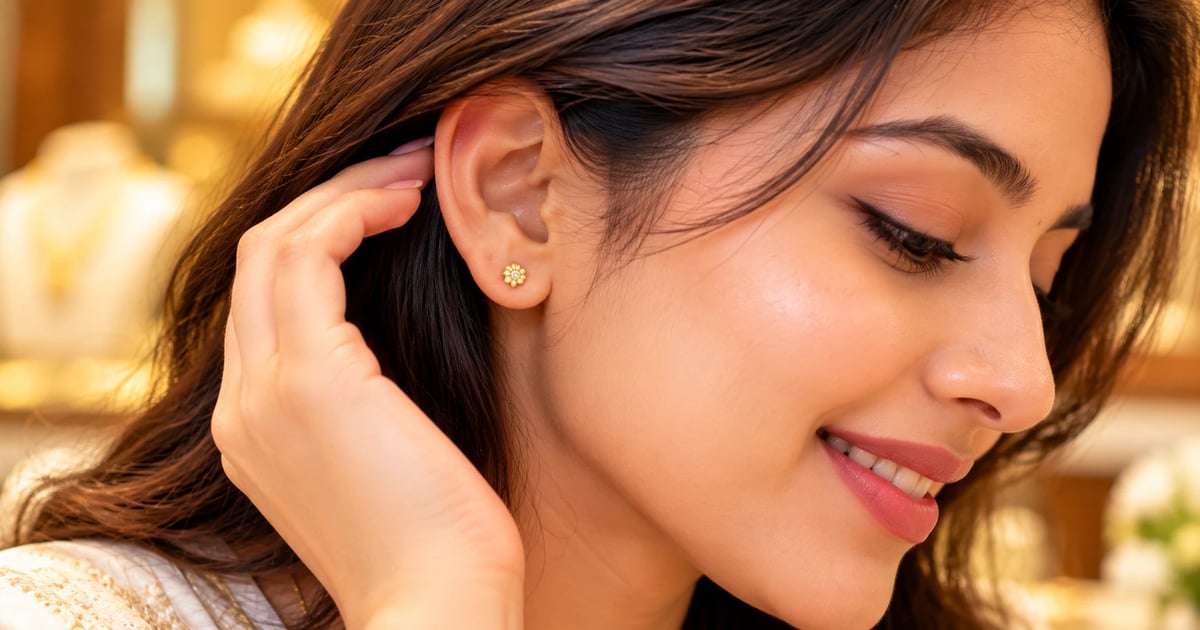
For a new ear piercing, wear a smooth, solid 18K gold stud stamped 18K750 until it heals. After that, you can move to 22K tops and jhumkas stamped 22K916.
We sell both purities, so here's the honest reason. The Association of Professional Piercers (APP) says gold above 18K is too soft for fresh piercings. Soft gold picks up tiny scratches, and healing skin catches on them.
Parents planning a Karnavedha will find the baby section below. So will anyone staring at a red, fresh piercing and wondering if it's normal.
Types of Ear Piercing, With Pain and Healing Time
Your ear has two kinds of tissue. The earlobe is soft and has a good blood supply. Almost everything above it is cartilage, the firm tissue that shapes your ear.
That difference decides most things. Cartilage gets less blood, so it heals slower. Infections there are also harder to shift.
Placement | Where it sits | Pain (relative) | Typical healing time |
|---|---|---|---|
Lobe | Soft bottom of the ear | Low | About 6 to 8 weeks |
Second or third lobe | Above the first hole, still in the lobe | Low | About 6 to 8 weeks |
Helix | Upper outer rim | Moderate | About 6 to 12 months |
Tragus | Small flap in front of the ear canal | Moderate | About 6 to 12 months |
Conch | Inner bowl of the ear | Moderate to high | About 6 to 12 months |
Daith | Inner fold just above the ear canal | Moderate to high | About 6 to 12 months |
Rook | Ridge between the inner and outer ear | Higher | About 6 to 12 months |
Industrial | One bar through two holes in the upper rim | Higher | Often 9 to 12 months or more |
Pain is personal, and these healing times are typical ranges, not promises. Your health, aftercare and jewellery can all stretch them.
Traditional gold earrings, from tops to jhumkas, are designed for the lobe. A second ear piercing in the lobe follows the same timeline as the first. A cartilage piercing like the helix needs far more patience, and it's no place for heavy gold.
Gun vs Needle: What to Ask Before You Get Pierced
A piercing gun uses spring force to push a stud through your ear. A hollow needle is a sharp, hollow tube. It cuts a clean channel, and the jewellery follows it through.
The APP explains why it prefers needles. Gun studs are fairly blunt, so the ear takes something closer to a crush injury. Plastic guns also can't go in an autoclave, the steam steriliser studios use. So "piercing guns are fully sterile" isn't a claim you should accept.
If you're getting pierced at a jewellery counter, ask whether they use a gun or a needle. For a lobe, a needle is the better choice when you can get one. For a helix or any other cartilage piercing, never let anyone use a gun.
Before you sit down, ask these:
Is the needle single-use, opened from a sealed pack in front of me?
Is the earring sterilised in an autoclave before it goes in?
If it's a gun, is the part that touches my ear disposable?
Can I bring my own 18K stud? Many studios only insert jewellery they've sterilised themselves, so check a day ahead.
Vague answers are your cue to leave. The piercing takes seconds, but a bad one can take months to settle.
Ear Piercing Aftercare, Week by Week
This is general information, not medical advice. See a dermatologist for any concern.
Good aftercare is mostly about leaving the ear alone. Here's the routine:
Wash your hands first. Do it every time you touch the ear.
Clean once or twice a day. Use a sterile saline wound wash that lists 0.9% sodium chloride as its only ingredient. A mild, fragrance-free cleanser and water also works.
Rinse well and pat dry. Use clean gauze or a fresh tissue, not the family towel.
Don't twist the earring. The APP says rotating jewellery isn't needed and can irritate the piercing.
Keep the starter earring in. Leave it for at least six weeks, even at night.
That six-week minimum and the cleanser advice both come from the American Academy of Dermatology's pierced-ear care tips. The AAD also warns against hydrogen peroxide and antibacterial soaps, because they can damage healing skin.
Some family favourites don't belong on an open wound either. That means Dettol, alcohol, coconut oil, turmeric and neem sticks. The APP notes that over-cleaning and strong products delay healing.
What's Normal in the First Few Weeks
In the first week, mild redness, swelling and tenderness are expected. You may also see a clear or pale yellow fluid that dries into a crust.
By weeks two to six, the tenderness should fade. Crusting can come and go. A lobe often looks healed outside before the inside has finished, so keep going with the routine.
For cartilage, expect this stage to run for months. Sleeping on that side is a common setback.
Signs of Ear Piercing Infection
The AAD lists the signs to watch: skin that's sore, red or puffy, or a hole oozing yellowish liquid. If any of these don't settle quickly, see a board-certified dermatologist.
Get help the same day if you have a fever or the redness keeps spreading. With a cartilage piercing, see a doctor promptly, since infections there are harder to treat.
An itchy, red, weepy rash around the hole can be something else. It may be contact dermatitis, a skin reaction to metal. Nickel is the usual cause.
This matters more than people think. In the Glostrup Allergy Study published in Contact Dermatitis, 14.8% of people with pierced ears were sensitised to nickel. Among people without pierced ears, the figure was 1.8%.
Bump or Keloid? How to Tell the Difference
A small pink bump right at the hole is often plain irritation. Snagging, sleeping on it, or a tight earring back can all cause one.
A keloid is different. It's a raised scar that keeps growing, sometimes far beyond the original wound. It can feel firm, itchy or sore.
The risk isn't equal for everyone. According to the AAD's keloid prevention guidance, people with darker skin tones face higher risk. So do people with a personal or family history of keloids.
The AAD's early step is specific. If the skin around a new piercing starts to thicken, remove the earring and wear a pressure earring instead. That's a clip that presses gently on the lobe. Then see a dermatologist, because a keloid won't go away on its own.
Best Gold Earrings for a New Piercing
This is where a jeweller's advice should be honest, even when it costs a sale.
18K Gold to Heal, 22K Gold Once Healed
Solid 18K gold, hallmarked 18K750, is the best gold for a new ear piercing. Choose a smooth post and a nickel-free alloy. The Association of Professional Piercers' standard for initial piercing jewellery says gold above 18K is too soft for fresh piercings. It scratches and nicks easily. Once the piercing fully heals, 22K earrings stamped 22K916 are fine for daily wear.
The same APP standard accepts gold at 14K or higher. It must be nickel-free, cadmium-free and alloyed to suit the body.
Can you wear 22K gold earrings right after an ear piercing? We'd say wait. 22K is 91.6% pure gold, which makes it softer. Tiny scratches on a soft post can tear healing tissue each time the earring moves.
Gold-plated, gold-filled and vermeil pieces are out too. The gold layer is thin and can wear off, exposing the base metal.
One question to ask at the counter: what is this 18K alloyed with? Some white gold alloys use nickel, so question white gold hardest. Ask for the alloy in writing.
Here's the simple plan:
Stage | Gold to wear | Stamp to look for | Style |
|---|---|---|---|
Fresh piercing | Solid 18K or 14K, nickel-free alloy | 18K750 or 14K585 | Small stud, smooth post, secure back |
Healed lobe | 22K or 18K | 22K916 or 18K750 | Tops, balis, jhumkas, sui dhaga |
Healed cartilage | 18K or 14K | 18K750 or 14K585 | Small studs or slim hoops |
For the healing stage, look for a light 18K stud with a plain, polished post.
When the lobe has healed, our 22K gold tops are the natural next step. Our metal guide explains how 18K and 22K differ in strength and colour. For shapes and styles, see our gold ear tops designs.
Why Screw-Back Tops Wait Until the Ear Is Healed
Most Indian gold tops use a pech, a screw-back with threads cut into the post. Those threads pass through your skin every time the earring goes in or comes out.
The APP's standard for new piercings is internally threaded jewellery. That means the post through your skin stays smooth, and the threads sit inside the removable end. A threaded post is rougher on fresh tissue.
That's why screw-back tops are a healed-ear choice. Once the hole has fully healed, they're a good one, because they're hard to lose.
For a new piercing, a flat-back labret works well. It has a flat disc behind the ear and a top that fits into the post.
Screw back vs butterfly back earrings for a new piercing? A butterfly back slides onto a smooth post, so no threads touch the wound. Still, it's easy to push too tight. The APP notes that tight jewellery traps discharge and limits blood flow, so leave a small gap.
Can You Wear Silver in a New Piercing?
No. Silver isn't on the APP's list for initial piercings. That list covers implant-grade steel and titanium, niobium, platinum, glass, and gold of 14K or higher.
Silver is fine once the piercing has healed. Our silver tops are meant for healed ears. Look for the 925 stamp, one of the silver grades BIS hallmarks.
How to Read the BIS Hallmark on Your Earring
A BIS hallmark is the government purity stamp. Since 1 July 2021, it has three marks. The Bureau of Indian Standards hallmarking FAQ lists them:
BIS logo: the bureau's standard mark.
Purity: you'll see 18K750 (75% gold) or 22K916 (91.6% gold). IS 1417:2016 also permits 14K585, 20K833, 23K958 and 24KS995.
HUID: a six-character alphanumeric code, unique to that piece.
Open the BIS Care app, tap "Verify HUID" and type in the code. The app shows the purity it was hallmarked at.
Tiny baby studs need one extra check. Under BIS rules, articles weighing less than two grams are exempt from mandatory hallmarking. So a very light stud may carry no HUID at all. Ask whether it's hallmarked anyway, and get the purity written on your bill.
For more ways to test before you pay, read our gold purity check before buying guide.
Baby's First Ear Piercing (Karnavedha)
Karnavedha, the traditional ear-piercing ceremony, often falls on a date the family chooses carefully. There's no single medically fixed baby ear piercing age. Ask your child's paediatrician, and pick a day when your baby is well.
Every piercing hurts for a moment, and anyone promising otherwise is selling something. A quick, clean piercing by an experienced hand keeps the moment short.
For the best earrings for a baby's first ear piercing, go small and plain. Choose a solid 18K stud with a smooth post and nothing dangling for small fingers to grab.
The back matters as much as the gold. A loose butterfly back is small enough for a baby to swallow. A flat-back stud with a secure top avoids that and keeps threads out of the wound. Whatever you choose, check the back is tight every day, as the APP advises.
Save the 22K tops for after the lobe has healed. They'll look just as good in the photos a few months later.
When Can You Switch to Jhumkas, Sui Dhaga and Heavier Earrings?
The earliest first change for a lobe is six weeks, and only if it's calm. No pain, no discharge, no crust. Even then, change to another light stud first.
Can you wear jhumkas after a new piercing? We'd hold off until the lobe is fully healed. We can't give you a safe gram limit, because no medical source sets one.
Watch for these signs of strain instead:
The hole starts to look longer or slanted.
Your lobe feels sore the next morning.
The skin around the hole turns red after a function.
If you see any of them, go back to light studs. For the first few occasions, wear jhumkas for a few hours only, and take them off before bed. Browse our latest jhumka designs when you're ready.
Sui dhaga earrings thread a fine gold wire or chain through the hole. They move through the piercing a lot, so keep them for healed lobes. We have no evidence they're safe for fresh piercings, so we won't claim it. See the sui suto earrings collection for healed ears.
For a second piercing, pick lightweight gold studs that sit neatly beside the first. Our guide to 2 gram gold earrings for daily use is a good starting point. All our styles are in the earring articles hub.