

Gold Ear Tops Design: 10 Best Picks & Weight Guide
 Sujoy Dhar
10 min read
Sujoy Dhar
10 min read
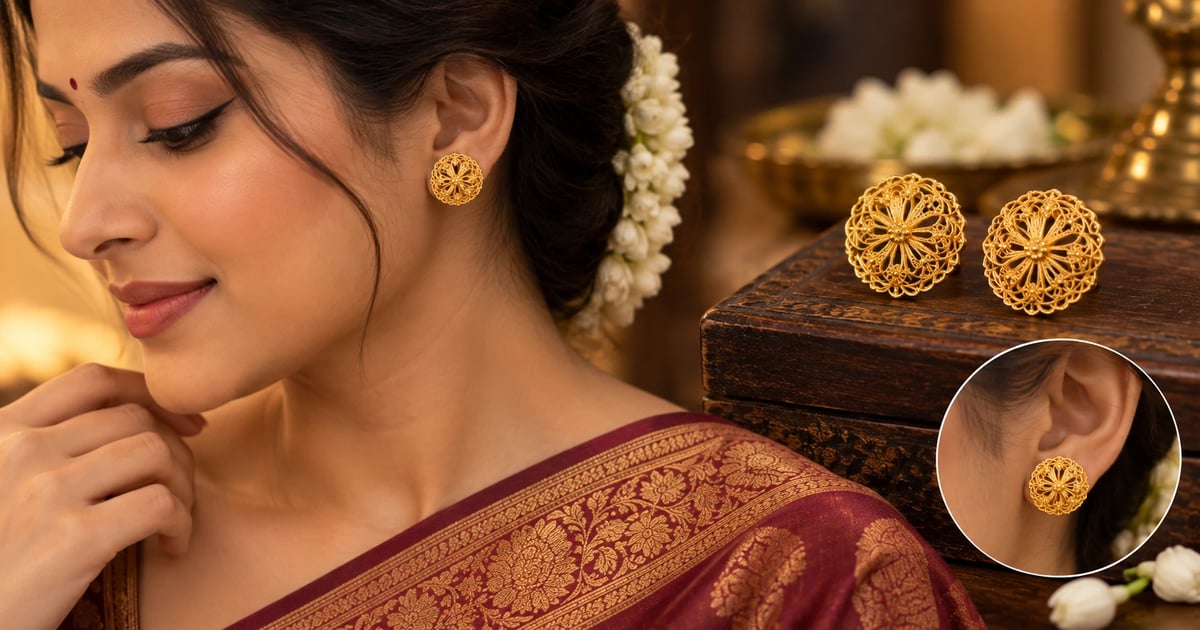
Most ear top gold weight charts neglect the one value that really matters. A pair of gold ear tops typically weighs between 1.5 and 4 grams. The ideal range will determine both comfort and cost, as well as the overall feel of the item.
Going lower than this will make the jewelry feel cheap, while going higher will make the jewelry uncomfortably heavy.
Ear tops vs jhumkas, kaan and other Bengali earrings
Ear tops sit flat against the lobe. Jhumkas, kaan and pasa hang, swing or wrap. A top is the piece that stays on when the heavy set goes back in the locker.
If you want the hanging styles instead, our jhumka design guide for every occasion and our full kaan earrings guide cover those properly.
Tops and studs mean the same thing in most Indian shops. Stud is the catalogue word. Tops is the counter word, and in Bengal it is the only word anyone uses.
Gold ear tops design ideas, with gram ranges
Plain gold ball tops
Small polished spheres, typically a first purchase for any family, with no element that dates. A ball top from 2012 looks modern in 2026, which is why they continue to sell.
Weight: approx 1.5-2.5 grams a pair. Best suited for: daily wear, schooling and first piercings.
Single stone tops
One stone in claw or bezel setting.The weight of gold is low due to the presence of a larger visual element.
Weight: approx 1.5-3 grams a pair. Best suited for: office wear and daily wear.
Floral or phool tops
Petal clusters with sometimes a raised centre. The largest single category in most Bengali showrooms.
Weight: approx 2-3.5 grams a pair. Best suited for: pujo, family functions and gifting.
Jali openwork tops
Openwork gold, cut or pierced to allow the passage of light. The word jali means lattice. You get the effect of larger surface area without the weight, which is the idea.
Weight: approx 2-3 grams a pair. Best suited for: festive wear on a smaller budget.
Matte and textured disc tops
Brushed, hammered or sandblasted surface treatments replacing high polish. These have seen a rise in popularity since approximately 2023, with a younger audience.
Weight: approx 2-3 grams a pair. Best suited for: work wear with western attires.
Half hoop huggie tops
Short curve of a hoop that sits close to the lobe, reading as a hoop earring but with minimal movement or catching.
Weight: approx 2-4 grams a pair. Best suited for: daily wear if you find flat studs boring.
Bar and geometric tops
Straight lines, squares, arcs. The lightest weight category as there is no volume.
Weight: approx 1.5-2.5 grams a pair. Best suited for: office wear and gifting to unknown tastes.
Filigree and tarakashi tops
Fine drawn wires in patterns. Tarakashi work from Cuttack is the most well-known Indian version. High labour content visible in the final price.
Weight: approx 2-3.5 grams a pair. Best suited for: occasion wear and for buyers that value handiwork.
Pearl set tops
Single pearl in gold prongs or a gold cup setting. The heft of the gold is low due to the presence of the pearl.
Weight: approx 1.5-3 grams a pair. Best suited for: weddings and evenings.
Temple motif tops
Deity figures, gopuram arches, coin motifs. South Indian in origin, now sold worldwide.
Weight: approx. 2.5 to 4 grams a pair. Perfect for weddings and for those looking to build a matching set.Want a pair set with stone? Our diamond earrings buying guide covers cut, clarity and certification.
You should not miss our Gold vs Gold Plated Sitahar Guide
What decides the price of a pair of gold tops
Four factors define what you pay. There should be nothing else on the bill that surprises you.
Above all comes the gold value, which is the net weight times the rate per gram for the purity you want. Read the date and time stamp on any rate board before comparing two shops. Our Kolkata gold rate board carries a timestamp for this reason.
Second is the making charge, which covers labour and finish, and is a per-gram or per-piece cost. Then there are the little lines. Hallmarking charges are a set amount per piece as well, at 45 rupees per gold article, says the Bureau of Indian Standards in its hallmarking FAQ. Notably, this charge does not vary according to weight.
Finally comes the 3 percent GST on a typical retail purchase of finished jewellery.
Run the numbers in our gold calculator before you meet the cashier. It asks for weight, rate, making charge and discount and shows you the pre-tax and post-tax value.
We do not list prices in rupees for any gold ear tops design on this page, and here is why. The 22K rate changes every day, and a figure printed here would be out of date in a week. Several pages that rank for this term show ranges that were not accurate for years.
Weight band | What it usually gets you | Where your money goes |
|---|---|---|
1.5 to 2 g | Small ball, bar or single stone | Mostly gold, low making |
2 to 3 g | Floral, jali, matte disc, small huggie | Balanced, making starts to matter |
3 to 4 g | Temple motif, filigree, larger huggie | Making charge is a real share |
Why making charges bite hardest on light tops ?
Every page bills tops budget friendly and leaves it at that. Making charges tend to be labour and finish based. They reflect the intricacy of a piece rather than the weight.
So a 2 gram pair of filigree tops could have the same labour cost as a much heavier plain chain. On a 20 gram necklace the labour is divided over a lot of metal, on a 2 gram pair it isn't.
Which means that making charge as a % of your bill tends to be highest on the most delicate and detailed pieces you purchase.
Finely worked metal on a small surface really does take longer per gram to produce.
But it has an impact on how you shop. Instead of asking what % making charge a design is, ask how many rupees it adds to the cost, and then compare that rupee amount between two shops for the same weight and style.
Percentages hide numbers, rupees don't.
If you're buying jali of filigree, expect to pay more making charge. It's the price you pay for the openwork.
Picking a gram weight your earlobes can carry
For a first pair, or one you're planning to wear every day but never take of, aim for between 1.5 and 2.5 grams. Ask for a 2 gram gold ear tops design if you just want a single number to go on.
Two grams a pair is the sweet spot most adult lobes in India find works, giving enough face to pass as real jewellery without being to heavy by evening.
Under 3 grams is a sensible ceiling for things you plan to wear everyday, above that treat the pair as occasion wear.
Are gold tops good for daily wear? Yes, and they're the best earring for the job since nothing hangs or swinging.
Do gold tops stretch your earlobes? Heavy earrings worn constantly can stretch a piercing out over the years, but tops in the 1.5 to 3 gram band are among the least likely to do it. A soft, thin or previously torn lobe however no earring can promise your lobe will not change, an old, thinned piercing needs a doctor's opinion not ours.
If your lobe is soft, thin or previously torn, go lighter and flatter. A wide flat back spread the load better than one that is narrow. If you're buying for a child, stay small and light. A 1 gram pair is plenty for a young ear.
Screw back or push back for gold tops
Screw back also called screw post screws into the back and holds. Push back also called butterfly back slips on with friction. Screw back for anything you're leaving in forever. It'll never come away in a saree pallu or a pillow. Push back for pairs you switch constantly.
Faster on, faster off.Screw backs have one major downside that stores don't bother telling you about. The thread strips after years of use. When the thread strips, the pair can come out, unnoticeably loose.
Push backs have the opposite problem. The butterfly works loose first (you generally notice that), long before you lose the earring. For a first good pair for a daughter, I would set screw backs and forget it.
22K vs 18K, and why your ears itch
For purity 22K is the right default for tops. It is the Indian standard and retains better resale value. The colour is the warm yellow that most buyers want.
18K is harder which is a positive for a ring that may be knocked against things. On a stud that is stationary against the lobe however the increased hardness has very little benefit. I would avoid 18K for tops unless the design requires it. A fine claw setting to hold a stone for example.
Now the part not covered on any competing page. Sore, itchy lobes are most often not the gold. Usually nickel in the alloy or in the earring back.
The American Academy of Dermatology has guidelines on nickel exposure prevention. They state that earrings and earring backs are one of the biggest contributors to nickel allergies. Nickel is a common cause of allergic contact dermatitis. It is a rash that develops when someone's skin is exposed to an allergen. They suggest wearing 18, 22 or 24 karat yellow gold, sterling silver, platinum or surgical grade stainless steel.
So higher karat gold has lower alloy content (which typically includes less nickel). This is a valid reason to buy 22K gold, aside from historical tradition.
We will not claim any of our jewelry as being hypoallergenic. If your ears become irritated on a new pair, consult a dermatologist rather than trying multiple brands in hopes that one will not bother you.
Check the hallmark and HUID in 30 seconds
A pair of tops is two articles. Under BIS rules each one needs its own hallmark and its own HUID, and so does every detachable part.
Ask the shop for the 10X magnifier. A registered jeweller is required to keep one to show you the marks.
Look for three things on each top. The BIS logo. The purity mark, 916 for 22K or 750 for 18K. And the six digit alphanumeric HUID.
Then open the BIS Care app and use Verify HUID. Enter the code and check that the purity, jeweller and centre match your bill.
Do this on both earrings, not one. Two tops with the same HUID is a red flag worth walking away from.
Hallmarking is mandatory, not optional. Coverage keeps expanding by phase. All India Radio's report on the sixth phase records 380 districts covered as of March 2026. The same report puts hallmarked items at over 60 crore since 2021.
Confused by the labels? Our explainer on hallmark gold versus BIS gold sorts them out. Our guide to checking gold purity before buying covers what to look at first.
What you get back if you exchange gold tops
Exchange value on a small pair works the same way as on a big piece. The buyer pays for the gold, not for the design you loved.
Expect deductions. Purity gets tested, not assumed. Melting loss comes off. The shop's own margin comes off after that.
Making charges do not come back. That is the honest answer. It matters more on tops than on heavy jewellery, because making was a bigger share.
We publish no fixed buyback percentage. Be wary of anyone who quotes one before weighing and testing your gold. Anyone promising a number over the phone has not seen your pair.
An old unhallmarked pair will be tested before any jeweller touches it. The tested purity decides the payout, not the stamp.
Why Bengali households wear tops every day
In a Barasat or Kolkata household, tops do a specific job. The kaan, the jhumka and the pasa come out for weddings and pujo. The tops stay on.
That is why Bengali buyers tend to prioritise differently. Comfort and back security come first, and the design comes second.
Our belkuri earrings guide covers the traditional pieces that sit alongside them. Our comparison of sui suto and sui dagha sorts out the Bengali vocabulary. You can also browse the current earrings range to see weights on real pieces.