


Red Crystal Gold Necklace: What the Red Stone Really Is

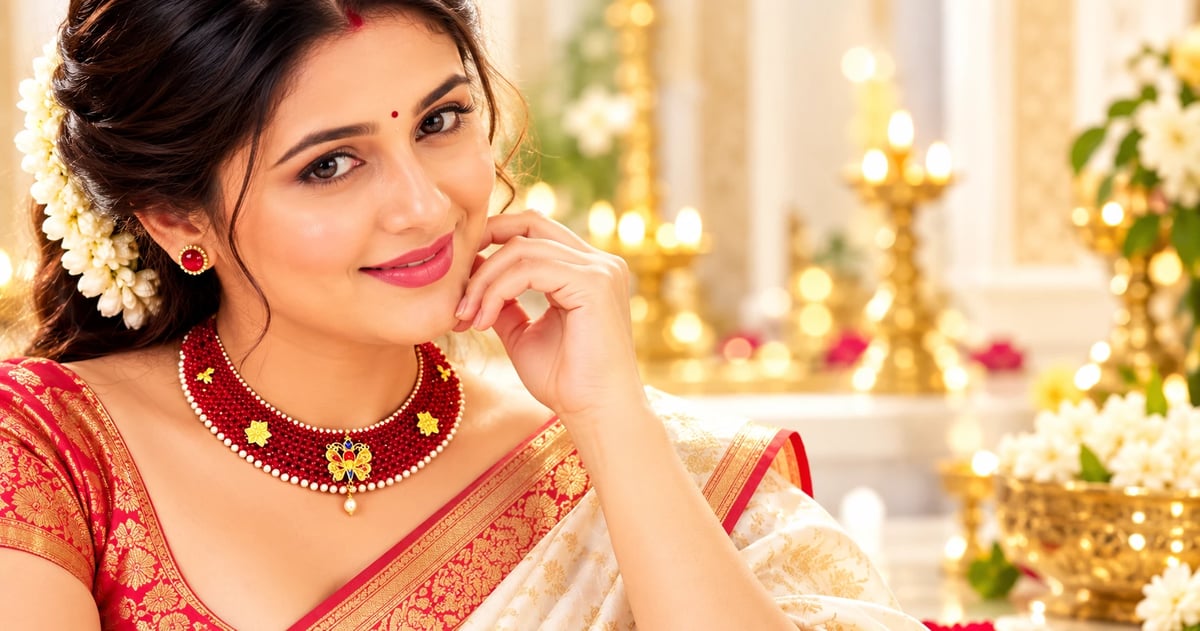
Before you buy the red crystal gold necklace you saved from Instagram, find out what the red stone actually is. The gold can be real, hallmarked 22K. The stone is a separate question, and the word "crystal" doesn't answer it.
Quick answer: A red crystal gold necklace is a gold chain or pendant set with a red stone. "Red crystal" is a shop label, not a material. The stone may be glass, cubic zirconia, lab-grown ruby, garnet, red spinel or natural ruby. So ask the jeweller to name the material and bill the stone weight separately.
That second request matters because Indian jewellers price by gold weight. A red stone weighs something, and it isn't gold. Below, you'll learn to read both, then pick a design you'll wear long after the first function.
What "Red Crystal" Means on a Gold Necklace
Search the phrase and most results are foreign shop listings. Several of the top ones are gold-plated steel or brass, set with glass. Not one of them says what the red stone is made of.
In an Indian gold shop, the same two words can cover six materials. They differ in hardness, in value and in how you should clean them. Here they are, man-made first, then natural.
The Red Stone Material Ladder at a Glance
Material | What it is | Mohs hardness | How it's usually labelled | What to ask for |
|---|---|---|---|---|
Glass crystal | Faceted man-made glass | Lowest on this list | "Crystal", "red crystal" | The word "glass" on the bill |
Cubic zirconia (CZ) | Man-made imitation stone | 8.5 | "CZ", "American diamond" | "CZ" named on the bill |
Lab-grown ruby | Man-made corundum | 9 | "Created ruby", maker's name | "Lab-grown" on the bill |
Garnet | Natural mineral group | 6.5 to 7.5 | "Garnet", sometimes just "red stone" | Stone name and weight |
Red spinel | Natural mineral | 8 | "Spinel" | Stone name and any treatment |
Natural ruby | Natural corundum | 9 | "Ruby" (assume heated) | A lab report naming the lab |
Mohs hardness means scratch resistance, rated 1 to 10. Ruby and sapphire are both corundum, rated 9 in the USGS table of mineral gemstone hardness. The same table puts spinel at 8 and garnet at 6.5 to 7.5. GIA rates cubic zirconia at 8.5. Glass sits lowest here, so it scuffs first.
What GIA Says About the Ruby Rung
The GIA ruby buyer's guide gives three facts worth knowing before you shop. First, lab-grown rubies are generally sold under the maker's name with the word "created". Second, you should assume any ruby has been heated. Heating is a known treatment, not a sign of a fake.
Third, rubies that are diffused or glass-filled are worth less than heated ones. Meanwhile, rubies with a lab report showing no heat command a premium.
So a lab-grown ruby is real corundum, just not natural. Your bill should say which one you're buying. A glass-filled ruby (ruby with glass in its cracks) also needs gentler care.
How to Tell Ruby From Red Crystal in a Necklace
You can't reliably tell by eye. And skip the scratch test that some older web pages still teach. It can chip the stone and still give a wrong answer.
Do this instead:
Ask the jeweller to write the stone's name on the bill. "Red stone" is not a name.
Ask whether it's natural, lab-grown or an imitation, and get that in writing too.
For natural ruby or spinel, ask for a gemstone lab report. It should name the lab and any treatment.
Then match the report number on the lab's own website, if the lab offers a report check.
A natural ruby at a glass-crystal price deserves more questions. That's your cue to slow down.
Red Crystal Gold Necklace Designs by Weight Band
Gold is expensive right now. The World Gold Council's India Focus report for Q2 2026 put domestic prices 59% above a year earlier. It also noted a shift to lighter, lower-carat and studded jewellery. A small red-stone piece with honest weights fits that shift.
The bands below are typical 22K ranges with the stone included. The tag on the actual piece is what counts. Looking for a gold necklace with red stone under 10 gram? Four of these six designs usually stay under that line.
Solitaire Drop Pendant, About 1 to 3 Grams
One red stone hangs from a small gold bail, the loop a chain passes through. It's the easiest red crystal pendant necklace for daily wear. Put it on a chain you already own, and the new gold stays small. Note that a pendant under 2 grams may carry no hallmark. Compare drop styles in our lockets and pendants collection.
Bezel-Set Round Stone on a Fine Chain, 3 to 6 Grams
A bezel setting (a gold rim around the stone) guards the edges from knocks. That makes it the safer pick for softer stones like glass or garnet. The look stays flat and quiet, so it sits well under a kurti collar. For more low-weight shapes, see our small gold necklace designs for daily wear. Then browse gold necklaces in store.
Halo Teardrop Pendant for Wedding Guests, 3 to 6 Grams
Here a pear-shaped red stone sits inside a ring of small white stones. It looks dressier than a solitaire, yet it doesn't read as bridal. That's why it suits a cousin's reception where you don't want to compete with the bride. Also ask what the halo stones are, because they add to the stone weight. Halo pendants sit with our pendant designs.
Three-Stone Station Chain for Daily Wear, 4 to 8 Grams
Three small red stones sit at intervals along the chain itself. With no pendant to flip or tangle, it's easy to wear every day. Prong settings (small gold claws holding the stone) show more colour. Still, they can catch on a dupatta. See the gold chains range for base chains.
Choker With a Single Red Drop, 10 to 20 Grams
A close-fitting gold choker with one red drop suits boat-neck and high-neck blouses. It's the only design here that usually crosses 10 grams. Save it for functions rather than office days. For fit and shapes, read our gold choker designs for weddings and parties. Then look through the choker collection.
Long Pendant Chain for Sarees, 8 to 15 Grams
A longer chain ends in a red pendant near the blouse line. It frames a deep-neck saree blouse without the bulk of a haar. Because it's long, choose a sturdier link so it doesn't kink. Our 8 gram gold necklace guide shows what that weight looks like on the neck. Compare lengths in the necklace section.
Gold Colour, Chain Length and Neckline Fit
Yellow, Rose or White Gold With Red Stones
Yellow 22K is the default in Bengal, and red sits warmly against it. Rose and white gold usually come in 18K. On a BIS hallmark, 22K shows as 22K916 and 18K as 18K750. White gold makes red look cooler and sharper, while rose gold softens it. Neither changes how the stone is priced.
Which Chain Length Suits a Red Pendant With a Saree Blouse
16 inches: sits near the collarbone. It pairs well with boat and high necks.
18 inches: the everyday length. It clears most round necklines.
20 to 24 inches: drops into a deep U or V blouse. That way, the pendant isn't hidden.
Measure a chain you already own before you choose. Two inches moves the stone more than you'd expect.
What to Wear With a Red Crystal Necklace
With a red crystal gold necklace, let the stone be the only red near your face. Plain gold studs usually work better than red earrings, which crowd the look. With a red saree, pick a stone a shade deeper than the fabric. Otherwise it disappears. Against cream, white or pastel, even a small drop stands out. Matching studs are in our earrings collection.
Read the Tag and the Bill Before You Pay
Do You Pay Gold Rate for Stone Weight?
You shouldn't. The gold rate should apply to net gold weight only. Here's how the three numbers relate:
Gross weight: the whole piece on the scale, gold plus stones.
Stone weight: the stones alone, often given in carats. One carat equals 0.2 grams.
Net gold weight: gross weight minus stone weight.
Take a simple example. A pendant weighs 3.40 g gross. Its stone weighs 2 carats, which is 0.40 g. So net gold is 3.00 g, and only those 3.00 g should be charged at the gold rate. The stone gets its own price line.
The BIS Jewellers FAQ (question 19) lists what the bill must show. That's each item's description, net weight of gold, purity in carat and fineness, and hallmarking charges. Gross and stone weight aren't on that list, so ask for them every time.
Next, check today's Kolkata gold rate and run the figures in our gold price calculator. Also ask whether making charges are worked on gross weight or net gold weight. GST on jewellery is 3% of the total transaction value, per the CBEC gems and jewellery GST FAQ.
What the BIS Hallmark Covers, and What It Doesn't
BIS requires three marks on hallmarked jewellery. They are the BIS logo, purity in carat and fineness, and a six-digit HUID (a unique ID per piece). All three describe the gold. None of them tells you whether the red stone is ruby, spinel or glass. That's why a stone sold as natural needs its own lab report.
You can check the HUID in the BIS Care app with its "Verify HUID" feature. Printing the HUID on the invoice is voluntary, so read it off the piece. Older marks without a HUID must be re-hallmarked before a jeweller sells them. Our hallmark gold vs BIS gold explainer covers the marks in more detail.
Is a Gold Necklace With Red Stones Hallmarked?
Usually, if a registered jeweller sells it in a district under mandatory hallmarking. Still, some pieces are exempt. BIS lists articles under 2 grams, plus kundan, polki and jadau work. It also exempts jewellers with annual turnover up to ₹40 lakh. So a tiny red-stone pendant may legally carry no hallmark.
Exchange Value: Ask Before You Buy
Exchange is a big part of gold buying right now. Retailers told the World Gold Council that exchange volumes rose 10% to 20% in Q2 2026. Before you pay, ask how this piece is valued at exchange. Ask, too, whether the stone counts for anything. Get both answers in writing.
Red Crystal or Pola: Which Fits the Occasion
Pola is red coral, a Bengali tradition with its own customs and its own care rules. A red crystal necklace isn't pola, and it carries no marital meaning. It's a faceted red stone set in gold, and anyone can wear it. Wear it to a puja, to work or to a wedding as a guest.
If you want coral beads with that traditional meaning, read our pola necklace design guide. Or see pola necklaces in store.
How to Clean and Care for Each Red Stone
For ruby and garnet, GIA says warm soapy water is always safe. That gentle method works for spinel, CZ, lab-grown ruby and glass too. Use a soft brush behind the stone, rinse, then pat dry.
Glass-filled ruby is the exception. GIA advises cleaning fracture-filled stones only with a damp cloth. So keep filled rubies away from ultrasonic and steam cleaners.
Glass crystal needs the most care because it's the softest. Store it in its own pouch so harder stones and gold don't scratch it. Put perfume and hairspray on first, then the necklace. And take it off for bathing, cooking and the gym.
Checklist Before You Buy a Red Stone Necklace
Ask what the red stone is, by name.
Get gross weight, stone weight and net gold weight on the bill.
Confirm the gold rate applies to net gold only.
Find the BIS logo, purity mark and six-digit HUID on the piece.
For natural ruby or spinel, ask for a lab report naming the lab and treatments.
Ask how the piece is valued at exchange, in writing.
Hold it against the blouse you'll wear, at the chain length you want.
When you're ready, browse red stone and gold necklaces at Biswakarma Jewellery Shilpalaya. Ask for all three weights on any red crystal gold necklace you shortlist.