


Bali Gold Earrings: 10 Best Designs by Weight & Occasion
 Sujoy Dhar
9 min read
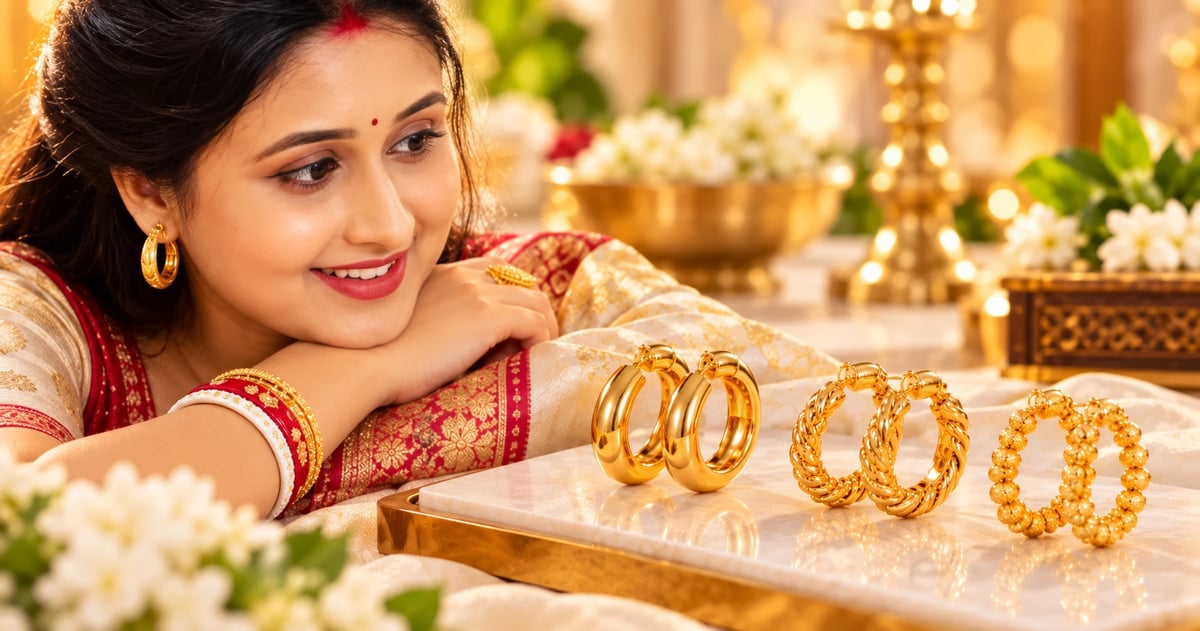
Bali gold earrings are round, hoop-style gold earrings, and most Indian homes already have a pair somewhere. Choosing a new pair comes down to four things: design, weight in grams, purity and diameter. For daily wear, a bali under 3 grams a pair sits comfortably on most lobes. Wedding pairs can go to 5 to 10 grams, but only with support.
One thing confuses younger buyers first. The word has nothing to do with Bali, the Indonesian island.
What Are Bali Earrings, and Why Are They Called That
Bali gold earrings are ring-shaped gold earrings worn across India, called hoop earrings in English. The name comes from bāli, a Hindi word for earring, not from the Indonesian island. A daily-wear pair usually weighs 1 to 3 grams, while festive and bridal balis often weigh 4 to 10 grams.
In Hindi, बाली (bāli) simply means an earring, usually a ring. Ralph Turner's Comparative Dictionary of the Indo-Aryan Languages traces it to an older word, vālaka. So when you search "what are bali earrings called in English", the answer is plain: hoop earrings. Wiktionary
Kolkata counters use the same word. You'll hear "pipe bali", "rava bali" and "chandbali" at almost any shop in the city.
In practice, a jeweller calls any gold earring shaped as a full or near-full ring a bali. Sizes run from 8 mm huggies to statement hoops 30 mm and wider.
Top 10 Trending Bali Gold Earrings Designs
These ten styles run from the lightest daily wear to the heaviest occasion wear. Each note says who the design suits and where it lets you down.
1. Plain pipe bali for everyday wear
A pipe bali is a hollow gold tube bent into a ring. It looks big for its weight, which keeps the price down. The catch is dents. A hard knock flattens hollow tube, so skip wide pipe balis if you sleep in your earrings. You can browse the pipe bali earrings in the Biswakarma collection to compare sizes.
2. Huggie bali that sits close to the lobe
A huggie earring in gold is a small hoop, usually 8 to 12 mm across. It hugs the lobe instead of hanging below it. Most use a huggie closure, meaning a hinged post that clicks shut. Huggies also suit ear stacking in a second or third piercing.
3. Twisted rope bali
Two strands of gold wire are twisted together like a rope. The texture catches light and hides everyday scratches better than a polished tube. That makes it a practical pick for office wear.
4. Rava bead bali
Rava work means tiny gold granules fused onto the surface. It's a classic in traditional Indian jewellery and suits both sarees and salwar suits. Still, dirt settles between the beads, so it needs gentler cleaning than a plain bali.
5. Filigree bali
Filigree is fine gold wire twisted into lace-like patterns. Because the design is mostly open space, a large filigree bali stays surprisingly light. On the other hand, a crushed filigree panel is hard to repair, so store it in its own box.
6. Meenakari enamel bali
Meenakari is coloured enamel fired into the gold. Red and green enamel pairs well with Durga Pujo sarees. Enamel can chip if dropped on stone floors. Also ask whether the enamel is weighed separately from the gold on your bill.
7. Bali with pearl or gold bead drops
Small pearls or gold beads hang from the lower curve and move as you turn. This style works well at weddings without the full weight of a chandbali. If the drops come off, each detachable part needs its own hallmark.
8. Diamond bali earrings in 18K
Diamond bali earrings are usually made in 18K, because the harder alloy grips stones better. Ask for the diamond certificate and the diamond weight on the bill. Our diamond earrings buying guide covers cut, clarity and certification.
9. Oval or elongated bali
An oval bali drops lower than it spreads. That vertical line makes it one of the best choices for a round face. It also sits well under short hair.
10. Bridal bali with jhalar fringe
A wide bali with a hanging fringe, called jhalar, is the heaviest style here. It belongs with bridal and wedding jewellery, not daily wear. Above 5 grams a pair, ask for a support chain that hooks over the ear.
Bali vs Chandbali vs Hoop: What's the Difference
Every bali is a hoop. Chandbali earrings are a different shape altogether. The name joins chand (moon) and bali, and describes a crescent that hangs below the lobe.
Style | Shape | Typical weight per pair | Best for |
|---|---|---|---|
Hoop | Any full ring, often plain, any metal | Varies widely | Global term for the shape |
Bali | Gold hoop, often textured, rava or filigree | 1–5 g | Daily wear to festive |
Chandbali | Crescent moon hanging below the lobe | 4–8 g | Weddings and festivals |
So "gold hoop earrings" and "bali" mean the same thing at an Indian counter. A chandbali is a statement piece, heavier and wider across the jaw. For other shapes, see our guide to gold earrings for women sorted by gram band.
Choosing the Right Gold Purity (18K vs 22K) for Daily Wear
The Bureau of Indian Standards (BIS) allows six hallmark grades for gold jewellery under IS 1417:2016. Two matter for balis. 22K is 91.6% gold, stamped 916. 18K is 75% gold, stamped 750.
Here's the trade-off many buyers miss. 22K is softer, so thin wires and click hinges can lose tension after months of daily opening. A hinged huggie in 22K can start to gape. That's why 18K often lasts longer on small, moving closures.
But 22K still wins in other ways. It has a deeper yellow colour and more gold per gram, so exchange value per gram is higher. A thick, plain 22K gold bali with a simple wire-and-loop closure handles daily wear well.
Your bali | Better purity | Why |
|---|---|---|
Thick plain or rava bali | 22K | Solid shape, no fragile hinge |
Thin hinged huggie | 18K | Keeps click tension longer |
Diamond bali | 18K | Holds stone settings firmly |
Festive filigree or meenakari | 22K | Traditional colour, worn less often |
If exchange value matters most to you, 18K is the wrong fit. It's worth less per gram when you trade it in.
How Much Should Your Bali Earrings Weigh
Most bali gold earrings for daily wear weigh under 3 grams a pair. Nearly all daily-wear designs come in well under 5 grams. The table below matches weight to occasion, so you buy only as much gold as you'll actually wear.
Occasion | Bali style | Weight per pair |
|---|---|---|
Everyday and sleeping | Huggie or small pipe bali | 1–2 g |
Office | Plain or twisted bali, 12–18 mm | 1.5–3 g |
College and ear stacking | Textured bali plus a second-hole huggie | 2–3 g total |
Pujo and festivals | Rava, filigree or meenakari bali | 3–5 g |
Wedding guest | Bali with drops, or a chandbali | 4–6 g |
Bride | Bridal bali or heavy chandbali | 6–10 g, with ear chain |
Men, single ear | Plain or matte huggie | Under 2 g per earring |
Check two things on the tag. First, is the weight gross or net? Gross includes pearls, enamel or stones. Second, is the bali hollow or solid? Two balis can look identical and differ by several grams.
Bali earrings that don't hurt ears
Pain usually comes from weight, a thick post or a closure that presses. So close the bali on your own ear at the counter. Then run a finger along the seam. A sharp edge will scratch all day.
Small, smooth huggies are generally fine to sleep in. Larger hollow balis are not, because they snag on pillows and dent. For comfort, keep daily pairs under 3 grams. If soreness lasts past a day, rest the lobe and see a doctor.
What a 2 gram bali costs in Kolkata
The price of bali gold earrings has three parts: metal, making charges and GST. Metal cost is weight times the gold rate per gram. Making charges vary most, because a machine-made pipe bali takes minutes and a filigree bali takes days.
Here's a worked example for a 2 gram, 22K pair:
Line | Basis | Amount |
|---|---|---|
Metal | 2 g × ₹14,046 (IBJA 916 rate, 22 Sep 2026) | ₹28,092 |
Making charge | 12% of metal value (example only) | ₹3,371 |
Subtotal | ₹31,463 | |
GST | 3% of total value | ₹944 |
Total | ₹32,407 |
The rate moves every working day. Check today's gold rate in Kolkata before you shop. You can also run any quote through our gold price calculator for jewellery bills. Always ask for making charges in rupees, not just a percentage.
How to Style Bali Earrings by Occasion
Lightweight bali earrings for office wear
Pick a plain or twisted bali between 12 and 18 mm. It stays quiet on video calls and won't catch a headset. If you ride a scooter, a huggie clears the helmet strap.
Gold bali earrings design for saree
With a cotton or handloom saree, a small rava or rope bali looks right. For a Banarasi or Kanjeevaram silk, move up to filigree or a pearl-drop bali. On Pujo mornings, a red-green meenakari bali matches a lal-paar saree.
How to style bali earrings with lehenga
Let the neckline decide. With a heavy choker, choose a slimmer bali so the jaw doesn't look crowded. With a maang tikka and light necklace, a chandbali or jhalar bali carries the look. Wear your hair up so the earrings show.
How to choose bali earrings for round face
On a round face, go vertical with oval balis or balis with drops. Keep perfectly round balis under 25 mm. Oval faces suit almost any size. If your face is long, wider round hoops add balance. For a square jaw, smooth curves soften the line.
Men's bali earrings: size and single-ear style
Yes, men wear balis too. Most bali earrings for women sell as pairs, but men often wear a single one in either ear. Start with an 8 to 12 mm huggie in plain or matte gold. Choose 18K if the huggie has a hinge you'll open daily.
Checking BIS Hallmark & Purity Before You Buy
Hallmarks on bali gold earrings are tiny, so check them before you pay. Here's how to check purity of gold bali earrings in six steps.
Find three marks on each earring. Since 1 July 2021, a hallmark has three marks, per the BIS hallmarking FAQ. Look for the BIS logo, purity such as 22K916, and a six-character HUID.
Check both earrings, not one. BIS requires each piece in a pair, and every detachable part, to carry its own hallmark with a different HUID.
Verify the HUID yourself. Open the BIS Care app and tap "Verify HUID". It takes about a minute at the counter.
Ask for the magnifier. Gold hallmarks can be just 0.5 mm tall. BIS requires registered jewellers to keep a magnifying glass of at least 10x.
Get an itemised bill. It should list gross weight, net gold weight, purity, HUID, making charges and GST separately.
Confirm the jeweller is registered. Search the BIS list of licensed jewellers by name and city.
Still unsure after buying? BIS says any BIS-recognised assaying and hallmarking centre will fire-assay a hallmarked article for ₹200. For how hallmark and "BIS gold" differ, read hallmark gold vs BIS gold explained.
Take the weight table and this checklist to the counter. Together they cover design, weight, purity and price.