


Daily Wear New Gold Bali Design: 7 Best Picks & Prices

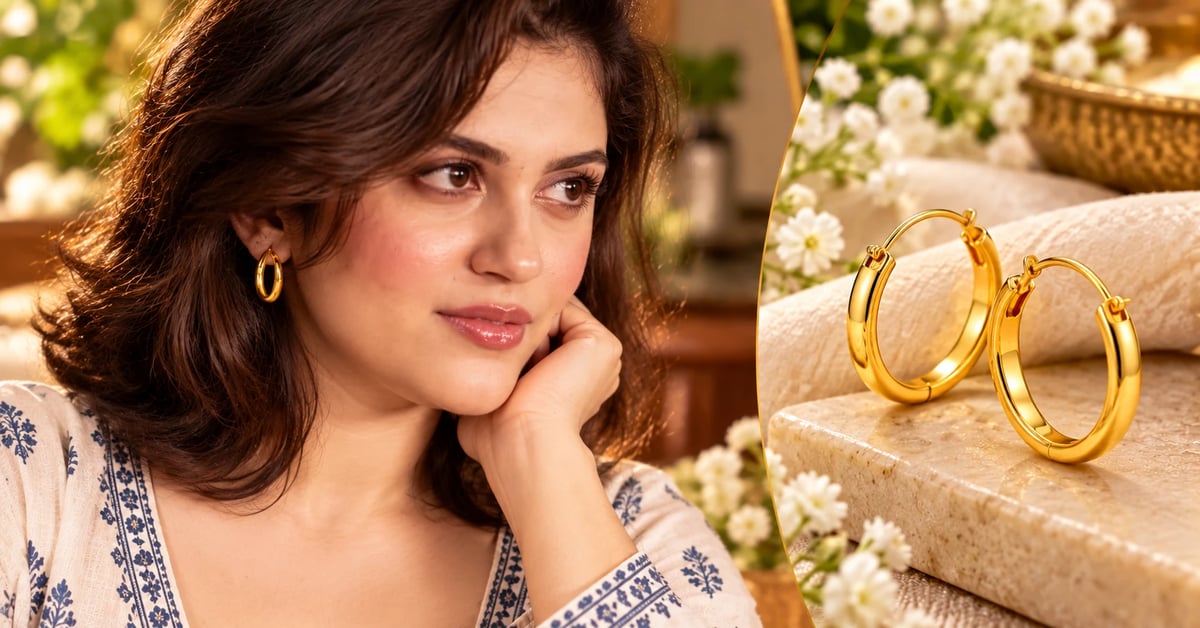
The best daily wear new gold bali design weighs 1.5 to 3 grams a pair in 22K gold. It should measure under about 20 mm across and close with a hinge or a screw. At the Biswakarma Kolkata 22K rate of ₹14,560/g (23 September 2026), a 2 gram pair costs ₹29,120 in metal.
Making charges and 3% GST sit on top of that figure. On a bali this light, they take a bigger share of the bill than on a necklace. So does one question most buyers never ask: does the piece carry a hallmark at all?
What Makes a Gold Bali Daily Wear, Not Festive
Weight decides most of it. A festive bali can carry 5 grams or more per pair and hang well below the lobe. An everyday pair has to survive a helmet strap and a phone pressed to your ear.
Size comes next. A small hoop sits close to the lobe and clears a kurti collar. Once a bali passes roughly 25 mm across, it starts catching hair and dupatta edges.
Then there's the closure. A hinged snap or a screw back holds through a 10-hour day. An open wire that threads through the ear is lighter, but it can slip out unnoticed. Stone-set and enamelled finishes, meanwhile, snag more and need more care.
Also watch for plating. Several listings for lightweight gold bali earrings sell gold-plated or imitation pieces. Plating wears through with daily friction. If a page shows no purity, net weight or hallmark, assume it's plated.
How Many Grams a Daily Wear Bali Should Weigh
For gold bali earrings for daily use, 2 grams a pair is the best weight for most people. That puts about 1 gram on each ear, which most lobes stop noticing within minutes.
The comfortable range runs from 1.5 to 3 grams for the pair. Below about 1.5 grams, the hoop usually has to be hollow or very thin. You save money, but a thin hollow tube can dent from one knock.
Above 3 grams, comfort depends on your piercing. A hole placed low in the lobe, or one already stretched, will feel the weight by evening. No medical standard sets an exact gram limit for an earlobe, so treat these as working ranges.
A simple gold bali design under 2 grams a pair is easy to find. Just ask whether the wire is solid or hollow. Also confirm the weight is for the pair, not each earring, since that doubles the bill. Then ask for net weight, meaning the gold alone.
Our comfort guide to 2 gram gold earrings for daily use ranks closures at this weight. For every style by gram band, see gold earrings for women by weight.
22K or 18K for a Bali You Wear Every Day
22K gold is 91.6% pure and marked 916. 18K is 75% pure and marked 750. The BIS hallmarking FAQ lists both among six gold grades hallmarkable under IS 1417:2016.
More alloy makes 18K harder, so it resists dents and grips small stones better. On the other hand, 22K carries more gold per gram and shows the deeper yellow most Indian buyers expect.
For a plain bali, 22K is the sensible default. But for a very thin hoop set with stones, 18K is the better metal. On the same Biswakarma rate board, 18K was ₹11,800 per gram, so a 2 gram pair costs ₹23,600 in metal.
7 Daily Wear New Gold Bali Design Ideas
These are design types, not a fixed catalogue. Each daily wear new gold bali design below has a weight target to ask for at any counter.
Plain Round Pipe Bali
Start with a smooth, polished tube hoop, the easiest bali to live with. It cleans in seconds and suits a salwar kameez or jeans. Ask for 12 to 18 mm across. You can browse the shape in our gold pipe bali earring range.
Hinged Huggie Bali for Long Office Days
Huggies are small hoops that hug the lobe, usually 8 to 12 mm across. Each one clicks shut on a hinge, so it stays put under a headset. It also suits a two-wheeler commute, since nothing hangs near the helmet strap.
Twisted Rope Bali
Twisted wire catches light from every angle and hides small scratches better than a mirror polish. Run it across your dupatta at the counter, though. If a thread lifts once, it will lift every day.
Textured or Matte Finish Bali
Hammered, matte and diamond-cut surfaces add interest without adding grams. Diamond-cut means small flat facets, not actual diamonds. Everyday scuffs also show less here than on a glossy finish.
Oval Bali for Round Faces
An oval hoop draws the eye downward. That adds length to a round face without adding width. Keep the long side under 20 mm for daily wear.
Bali with a Tiny Drop Charm
For evenings, a small bead or leaf hanging from the hoop adds movement. Keep the drop short, and check the solder joint where it meets the hoop. That joint usually fails first on a light pair.
Mini Bali for Young Girls and Second Holes
For a young girl or a second piercing, go for a mini bali of 8 to 10 mm. Choose a hinged closure, because a tiny screw is fiddly for small fingers.
Here's each gold bali design with price for the metal alone, at ₹14,560 per gram (23 September 2026).
Design | Pair weight to ask for | Metal value at ₹14,560/g |
|---|---|---|
Plain round pipe bali | 1.5 to 2.5 g | ₹21,840 to ₹36,400 |
Hinged huggie bali | Under 2 g | Up to ₹29,120 |
Twisted rope bali | 2 to 3 g | ₹29,120 to ₹43,680 |
Textured or matte bali | About 2 g | About ₹29,120 |
Oval bali | 2 to 3 g | ₹29,120 to ₹43,680 |
Bali with drop charm | Under 3 g | Up to ₹43,680 |
Mini bali | Under 1.5 g | Up to ₹21,840 |
What a 2 Gram Gold Bali Really Costs in Kolkata
A 2 gram pair of 22K gold bali earrings costs ₹29,120 in metal at Biswakarma's 23 September 2026 rate. With making charges and GST, the bill lands between about ₹33,000 and ₹36,000. Check today's gold rate in Kolkata before you shop, because the metal line changes every working day.
Here's how that 2 gram pair works out at three making levels.
Line | 10% making | 15% making | 20% making |
|---|---|---|---|
Metal (2 g × ₹14,560) | ₹29,120 | ₹29,120 | ₹29,120 |
Making charge | ₹2,912 | ₹4,368 | ₹5,824 |
Subtotal | ₹32,032 | ₹33,488 | ₹34,944 |
GST at 3% of total | ₹961 | ₹1,005 | ₹1,048 |
Total | ₹32,993 | ₹34,493 | ₹35,992 |
The price of a 1 gram gold bali pair follows the same maths. Metal is ₹14,560, and 15% making adds ₹2,184. With 3% GST, the total comes to about ₹17,246.
Why Making Charges Hit Small Balis Harder
Labour doesn't shrink with weight. A karigar, the goldsmith who makes the piece, spends similar time on a hinge and a polish at any size. That's why some shops set a flat minimum making charge per piece.
On a small bali, that minimum changes the maths fast. For example, a flat ₹3,000 on a 1 gram pair equals 20.6% of the metal value. Yet the same ₹3,000 on a 3 gram pair is only 6.9%.
How to Judge a Fair Making Charge on a 1 to 2 Gram Bali
Making charges aren't fixed by law, so no single number is "fair". What you can do is compare honestly.
First, ask for the making charge in rupees. Next, divide it by the metal value to get the real percentage. Then compare two shops on the same day, at the same weight and purity.
Handwork earns a higher charge, so a twisted or hinged bali can fairly cost more than a smooth pipe. Also ask whether wastage, the metal lost during work, is billed separately.
GST on jewellery is 3% of the total bill, making charges included. The CBIC sectoral FAQ on gems and jewellery states this for a retail sale. So if a bill shows 5% on making, ask why.
A hallmarked bali may carry a small fee too. From 14 September 2026, the BIS Hallmarking Amendment Regulations 2026 raised the hallmarking fee to ₹75 per gold article. If your jeweller passes it on, a pair counts as two articles. That's ₹150 before taxes.
One honest note on exchange. Most jewellers value old gold on weight and purity, not on the making charges you paid. Get exchange terms in writing, and run any quote through our gold calculator for jewellery bills first.
Checking the BIS Hallmark on a Small Bali
Start with a rule that surprises most buyers. BIS exempts articles under 2 grams from mandatory hallmarking, as its FAQ for jewellers explains. BIS also treats each earring in a pair as a separate article. As a result, a 2 gram pair, at about 1 gram per earring, can be sold unhallmarked.
That isn't a dead end, since a jeweller may still get such pieces hallmarked after purity testing. Jewellers with turnover up to ₹40 lakh a year also sit outside mandatory hallmarking. So always ask whether a bali is hallmarked.
When a hallmark is there, check it in this order:
Find the mark. Look on a flat inner surface of the hoop or near the hinge. BIS allows gold marks as small as 0.5 mm tall, so ask for the shop's 10x magnifier.
Read all three marks. You should see the BIS logo, the purity (22K916 or 18K750) and a 6-character HUID. HUID is the piece's unique hallmark code.
Check both earrings. BIS requires each article in a pair to carry its own hallmark with a different HUID.
Verify the HUID. Open the free BIS Care app and use Verify HUID. It takes about a minute.
Match the bill. The invoice should show purity, net weight and any hallmarking charge on separate lines.
Buying online? Ask for a clear photo of each HUID before you pay, then verify both in the app. Biswakarma Jewellery Shilpalaya states on its shopping FAQ that it is BIS registered and GST registered.
A hallmark also gives you a real remedy. If a hallmarked piece later tests below its marked purity, BIS rules provide compensation. The jeweller pays twice the value of the shortfall, plus testing charges. Our five-minute gold purity check and what a hallmark does and doesn't cover go further.
Bali vs Chandbali vs Jhumka for Everyday Use
The names overlap. A bali is simply a ring or hoop. A chandbali is a crescent-moon shape that spreads sideways across the jaw. Meanwhile, a jhumka is a bell or dome that drops straight down.
Shape | What it looks like | Typical 22K pair weight | Daily wear? |
|---|---|---|---|
Bali | Round or oval hoop | 1 to 3 g | Yes |
Jhumka | Bell or dome drop | From about 3 g | Small ones only |
Chandbali | Wide crescent moon | From about 4 g, often 5 to 9 g | Mostly occasions |
Weights follow the gram bands in our earrings guides and vary by design. Despite its name, a chandbali belongs with festive jewellery, not with plain balis. For a small jhumka you can still wear to work, see our jhumka designs for every occasion.
Styling Gold Balis for Office and College
A gold bali is good for everyday office wear, provided it stays under 20 mm and closes on a hinge. That's the easiest gold bali design for office wear, because it clears a headset and stays off camera. Pair a 12 to 15 mm pipe or huggie with a saree or a blazer.
A daily wear new gold bali design for college can be a little more playful. A twisted or textured bali looks right with a kurti and just as right with a T-shirt. Younger girls usually do best with a mini bali, which catches less on school bags.
By evening, swap in the drop-charm bali. A fine chain finishes the look. Our small gold necklace designs for daily wear sit well with a small hoop.
You can check our exclusive Pola Earring Guide !
Matching a Bali Shape to Your Face
A round face suits oval balis, which add length. Avoid big round hoops over 25 mm, since they widen the frame. A long face goes the other way, so rounder and slightly wider balis balance it.
Smooth round hoops soften a square jaw. With a heart-shaped face, a small drop adds width near the chin. Still, hold the pair up, step back a metre and trust what you see.
Counter Checklist Before You Pay for a Gold Bali
Take this list to the shop, or use it on a video call with an online seller.
Pair weight between 1.5 and 3 grams, confirmed as the pair.
Net weight printed on the bill.
Purity stated as 916 or 750, not just "gold".
Hallmark and HUID checked on both earrings, or a clear reason it's exempt.
Making charge quoted in rupees, then worked out as a percentage.
GST at 3% of the total.
Hinge or screw opened and closed by your own hand.
Exchange terms in writing.
A daily wear new gold bali design that passes all eight is one you'll forget you're wearing by lunch. When you're ready to compare pairs, browse the full gold earrings collection.