


Gold Necklace Buying Guide: Designs, Prices and Hallmarks

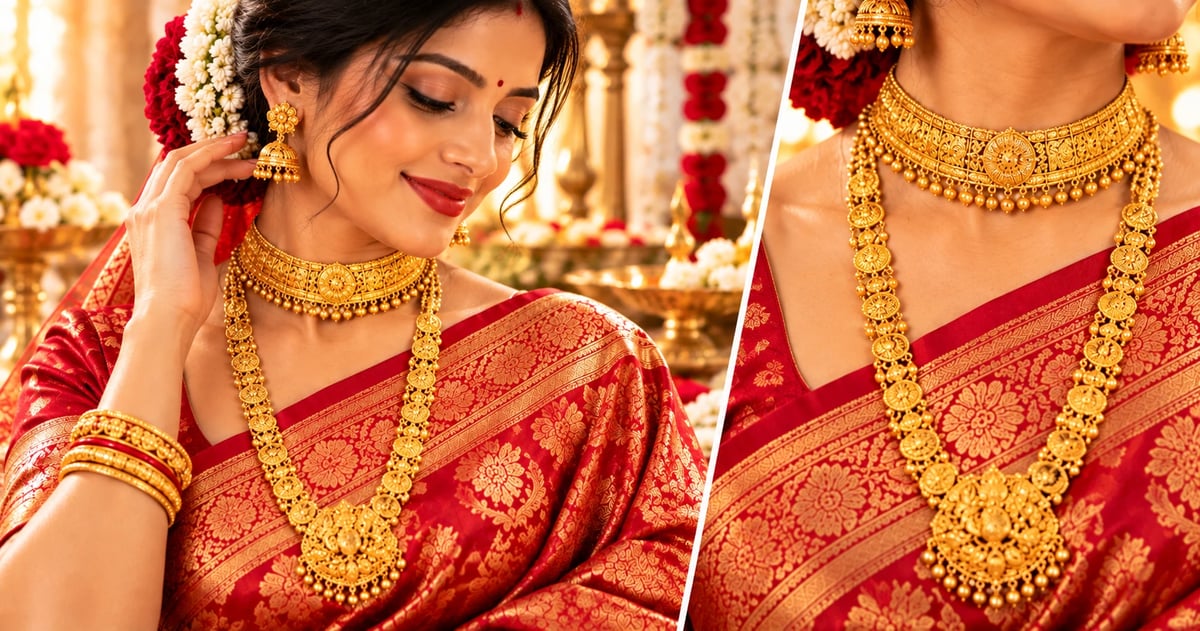
A gold necklace in India is priced by weight, purity and making charges, plus 3% GST on the full bill. Check the BIS hallmark and its six-digit HUID code before you pay. Then choose a design for how often you'll wear it, not for one photo.
Below, you'll find a real bill for a 10 gram 22K necklace, worked line by line at a Kolkata rate. You'll also learn the names you'll hear at the counter, from chik to Rani Haar.
Purity and hallmark checks come before design
A beautiful design can't fix under-purity gold. So settle the metal first, then choose a shape.
22K or 18K: which purity suits your necklace
Karat means the share of pure gold. 22K is 91.6% gold and carries the fineness number 916. 18K is 75% gold and carries 750.
Choose 22K for plain, traditional and bridal necklaces. You get the deep yellow colour most Indian families expect. Also, on exchange, you're paid on gold content, and 22K has more of it.
The trade-off is softness. A thin 22K chain can stretch, kink or snap with daily wear. Heavy 22K pieces can also dent if they're built hollow.
Choose 18K when stones are involved, or for a fine chain you'll wear daily. It's harder, so it holds polki, diamonds and small links better. It also costs less per gram. On 20 September 2026, our Kolkata board showed 22K at ₹14,820 and 18K at ₹12,005 per gram.
That gap adds up. Ten grams of 18K costs ₹28,150 less in metal than ten grams of 22K. However, the colour is paler, so hold both against your skin before deciding.
Lower purities exist too. BIS added 9K (375) to the hallmarking list in July 2025, through Amendment No. 2 to IS 1417:2016. A 9K or 14K necklace is cheaper, but it holds far less gold.
How to check a gold necklace hallmark and HUID
A BIS hallmark is the government's purity stamp. Since 1 July 2021 it has three marks, and you should find all three.
The BIS logo. A small triangle mark.
Purity in karat and fineness. For 22K, it reads 22K916.
A six-digit HUID. HUID means Hallmark Unique Identification, a code for that one item.
Ask the jeweller for a magnifier. Under the BIS hallmarking rules for consumers, a registered jeweller must keep a 10X glass to show you the mark. BIS also lets you type the HUID into the BIS Care app, using its "Verify HUID" feature.
Necklace sets need extra care. Each earring in a pair, and every detachable part, should carry its own hallmark with a different HUID. So check the necklace, both earrings and any removable pendant separately.
Keep the bill. BIS says your invoice should list the hallmarked article's details, since you'll need it for any complaint. Still unsure after buying? Any BIS-recognised hallmarking centre will fire-assay (melt-test) a piece for you for ₹200.
For the full counter routine, our guide on how to check gold purity before buying goes step by step.
Gold necklace designs you'll hear named at the counter
Knowing the names helps you ask for the right piece. It also stops you paying bridal making charges for an everyday one.
Everyday styles: chains, pendants and short necklaces
A gold chain necklace is just linked metal, with no centrepiece. Cable, curb, rope, box and Figaro links are the common patterns. Figaro alternates long and short links.
A pendant necklace hangs one motif from a chain. It's the easiest gift, because the pendant can be swapped later.
A short gold necklace sits at or just below the collarbone. Think of a small floral or leaf pattern, joined to a chain behind the neck.
Layering necklaces are two or three chains of different lengths, worn together. Keep about 5 cm between each layer so they don't tangle.
Occasion styles: chik, choker, Rani Haar and sitahar
A choker sits snug at the base of your neck, usually 14 to 16 inches long. In Bengal, the traditional choker is called a chik.
A Rani Haar is the opposite in shape. It's a long, heavy necklace, often in several layers, falling to the chest or lower. So the difference is length and weight: a choker frames the neck, while a Rani Haar covers the chest.
The sitahar is Bengal's own long layered necklace. It's often the centre of a Bengali bridal set.
A gold necklace set means the necklace comes with matching earrings, and sometimes a tikli or maang tikka. Sets make sense for weddings. For everyday use, a standalone necklace is easier to wear again.
A mangalsutra is a married woman's necklace of black beads and gold. In Bengal, the noa and sindoor traditionally mark marriage, and some families add one.
Finishes: temple, antique, polki and kundan work
A temple gold necklace carries carved figures of deities, lotuses and peacocks. It comes from South Indian temple traditions and suits silk and Banarasi sarees.
An antique gold necklace has a deliberately darkened finish that looks old. It also hides small scratches well. On the other hand, a harsh polish at home can strip it away.
Polki uses uncut diamonds, while kundan sets stones in thin gold foil. Both are usually set in 18K or 22K gold. However, their stones and lac filling (a resin core) add weight that isn't gold.
That matters on the bill. Ask for the net gold weight separately from the gross weight. For diamond-set pieces, ask for a grading report from a recognised lab like the Gemological Institute of America.
Choosing length and shape for your face and saree
Length changes how a necklace looks more than any other detail. So measure before you shop.
Necklace length chart, in inches
Name | Length | Where it sits |
|---|---|---|
Collar or chik | 12 to 14 in | Around the middle of the neck |
Choker | 14 to 16 in | Base of the neck |
Princess | 17 to 19 in | On or just below the collarbone |
Matinee | 20 to 24 in | Upper chest |
Opera, Rani Haar, sitahar | 28 in and longer | Chest or below |
Not sure of your size? Lay a thread where the necklace should sit, then measure the thread.
What suits a round, oval, square or long face
These are styling habits jewellers use, not fixed rules. Treat them as a starting point.
Round face: Longer, V-shaped or pendant-drop necklaces draw the eye downward. A tight choker tends to widen the face.
Oval face: Most shapes work. Pick by neckline instead.
Square face: Curved and rounded designs soften a strong jaw. Very angular geometric pieces can repeat the jawline.
Long or oblong face: Chokers and short, wide necklaces add width. Very long, narrow chains stretch the face further.
Heart-shaped face: A choker or short rounded piece fills the space below a narrow chin.
Short vs long necklaces, and saree necklines
Neither length is better overall. A short necklace stays in place and suits long hours. A long one photographs well and reads as more formal.
Your blouse neckline decides the rest. With a deep round or sweetheart neck, a choker or short necklace fills the open space. With a high or boat neck, choose a long necklace that sits outside the fabric.
A V-neck blouse pairs well with a pendant or a V-shaped necklace. For the best gold necklace designs for a saree, match busy with plain. A heavily worked Banarasi usually looks better with a simpler necklace.
Necklaces for Bengali weddings, Puja and gifts
The occasion changes the right weight, purity and budget.
Bengali bridal necklaces, piece by piece
A Bengali bridal set is often built across several ceremonies. So you can spread the cost instead of buying everything at once.
On the wedding day, the sitahar usually leads. A chik often sits above it, which gives you two lengths in one look. For the bou bhaat, the post-wedding feast, and the reception, lighter pieces are common.
What is the best gold necklace design for a wedding? For most brides, it's one statement bridal gold necklace plus one wearable piece. A chik or choker you'll wear again at Puja earns more than a second long necklace.
Order custom pieces early, because karigar (craftsman) workshops get busy before Durga Puja and Dhanteras. Our guide to gold choker designs for weddings and parties shows styles by weight.
Lightweight gold necklaces for daily wear
Yes, you can wear a gold necklace every day. A gold necklace for daily wear just needs a sturdier build than a festive one.
How much gold necklace weight is ideal for daily wear? No official figure exists. Instead, judge three things: comfort after a full day, clasp strength and how much you'd lose if it snapped. A lighter necklace also draws less attention on crowded trains and buses.
Look for a lobster clasp, which is a spring-hook fastener. Curb, box and rope links hold up better than very fine cable chains. If the chain is thin, 18K will usually keep its shape longer than 22K.
For lightweight gold necklace designs for daily use, see our guide to small gold necklace designs for daily wear.
Gift and engagement picks that age well
For gifting, a pendant necklace or short chain is the safest choice. It suits most necklines and most ages.
At a Bengali ashirbad, the blessing ceremony, elders often bless the couple with gold. A mid-weight 22K necklace, or a set with small earrings, fits that moment. For an engagement, pick something she can wear again at family events.
Ask for the exchange policy in writing. Also pass on the bill, since its hallmark details protect the person receiving the gift.
Gold necklace price, worked out on a real 10 g bill
A gold necklace price in India follows one formula. You pay net gold weight times the day's rate, plus making charges, plus small fixed lines. Then 3% GST applies to that total. At ₹14,820 per gram, a 10 gram 22K necklace with 12% making costs about ₹1,71,010.
Here's that bill line by line. It uses the 22K rate on our Kolkata gold rate board at 11:06 am on 20 September 2026. The 12% making charge is an example, not a quote.
Line | Amount |
|---|---|
Gold: 10 g × ₹14,820 | ₹1,48,200 |
Making charge at 12% | ₹17,784 |
Hallmark charge | ₹45 |
Subtotal before tax | ₹1,66,029 |
GST at 3% | ₹4,981 |
Total | ₹1,71,010 |
That works out to ₹17,101 per gram. So you pay about 15% more than the bare metal value. Rates change daily, so rerun the sum on the day you buy.
Making charges: what's normal and how to compare
Making charges pay for the labour of turning metal into a necklace. Jewellers quote them as a percentage of gold value, or as rupees per gram.
There's no published national standard for making charges. So any "normal range" you read online is a guess. Hand-worked bridal pieces usually carry more than machine-made chains, and that difference is real labour.
What you can control is comparison. On this 10 gram necklace, every 1% of making charge adds ₹1,482. At 8% the total is about ₹1,64,904. At 16% it's about ₹1,77,116, which is ₹12,212 more.
Some shops also add wastage charges, meaning gold lost during making. Ask whether wastage sits inside the making charge or on top. Then ask for both as rupee figures. Our gold calculator for Indian jewellery bills lets you run these sums yourself.
GST on a gold necklace is 3% of the whole bill
Most rate boards and price tags show the price before GST. So yes, ask whether any quote includes tax.
For a finished necklace bought at a counter, GST is 3% of the total value. That includes the making charge, even when it's listed as a separate line. The CBIC sectoral FAQ on gems and jewellery answers this exact question.
The 5% rate you may have heard about applies to job work between jewellers. On our example, charging 3% on gold plus 5% on making would add about ₹355. If your bill shows that split, ask why before you pay.
Tax rules can change, so check anything unusual with a tax professional.
How to care for a gold necklace at home
A plain gold necklace needs very little. Most damage comes from knots, chemicals and rough cleaning.
Put it on last. Apply perfume, hairspray and lotion first, then the necklace.
Clean it gently. Soak a plain piece in lukewarm water with a drop of mild soap. Then brush lightly with a soft toothbrush and dry it fully.
Don't soak stone pieces. Kundan, polki and lac-filled necklaces should only be wiped with a dry, soft cloth.
Leave antique finishes alone. Polishing cloths and dips can remove the dark finish you paid for.
Store pieces apart. Fasten the clasp, then keep each necklace in its own pouch so chains don't knot.
Take it off to swim. Chlorine in pools can harm some gold alloys over time.
Have the clasp and joints checked once a year. A worn clasp is an easy way to lose a daily chain.