


How to Clean Gold Jewellery at Home Safely
 Sujoy Dhar
11 min read
Key takeaways
Clean most gold jewellery at home with warm water, mild dish soap and a soft toothbrush. Then rinse it in a bowl and pat it dry. Skip toothpaste, baking soda, vinegar and bleach. Pearls, pola, sakha and lac-filled pieces need a shorter soak and careful drying. Loose stones or bent prongs need a jeweller, not more scrubbing.
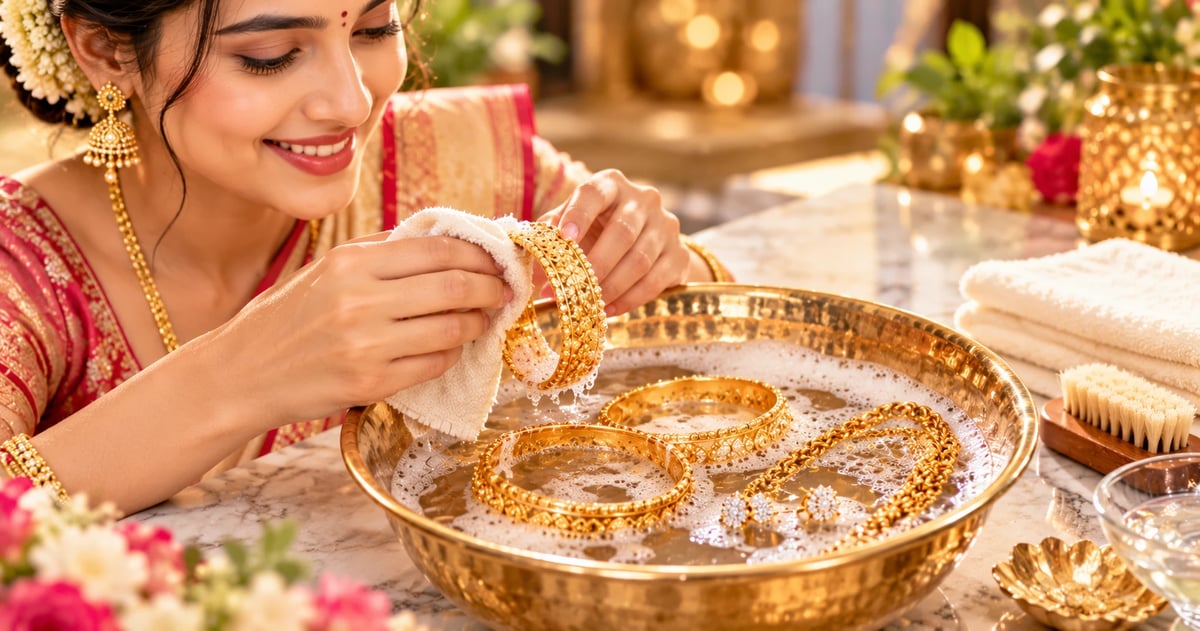
The safest way to clean gold jewellery at home is warm water, mild dish soap and a soft toothbrush. That works for plain gold chains, bangles, rings and tops, and for most diamond pieces too. Pearls, gold-covered pola and sakha, and hollow pieces need gentler handling. Here's how to clean gold jewellery at home in five steps:
Soak: Fill a bowl with warm water and add two or three drops of mild dish soap. Let the piece sit for 15 to 20 minutes.
Brush: Use a soft toothbrush on links, carvings, clasps and the back of any stone setting. Brush gently, in small circles.
Rinse in a bowl: Dip the piece in a second bowl of clean water. Don't rinse over an open drain.
Dry: Pat it dry with a lint-free cotton cloth. Leave it on the cloth until no water remains in the crevices.
Check: Look at prongs, clasps and screw backs under good light before you wear or store the piece.
What You Need to Clean Gold at Home
You need five things, and most homes already have them.
Two small bowls: one for the soapy soak, one for clean rinse water.
Mild dish soap: a plain liquid, without bleach, lemon "power" or scrub beads.
A new soft toothbrush: keep it only for jewellery.
A lint-free cotton cloth: an old cotton dupatta or a spectacle cloth works. Tissue leaves fibres behind.
A soft towel: fold it on the counter, so a dropped earring lands softly.
Add a new makeup brush if you're cleaning pearls.
How to Clean Gold Jewellery at Home: Plain Gold Pieces
Plain 22K and 18K gold without stones can go straight into warm soapy water for 15 to 20 minutes. Gold doesn't react with soap or water, so the soak only loosens oil, sweat and dust. If a piece still looks dull afterwards, repeat the soak instead of scrubbing harder.
How to Clean a Gold Chain and Its Clasp
Coil the chain loosely in the bowl so the links don't knot. Dirt hides between the links and inside the clasp.
While the chain is underwater, open and close the clasp five or six times. That pushes soapy water through the spring. Brush the clasp from both sides, then dry the chain flat with the clasp open. Lobster and spring-ring clasps on our gold chains clean the same way.
How to Clean Gold Earrings, Backs and Screws
Unscrew the back before you soak anything. Skin oil and soap build up inside the screw thread. That's usually the dirtiest part of a pair of gold tops.
Soak the earrings and backs together in a small cup. Brush along the post thread, then twist the back on and off once in the rinse water. If a screw back now feels loose, bring it to us.
Children's studs need the same care. Our guide to safe gold earrings for baby girls covers stud choices for small ears. If a piercing is still new, follow the ear piercing aftercare steps first and clean the earring later.
How to Clean Gold Bangles and Rings
Bangles and rings soak well, but carved patterns hold grime deep in the grooves. Brush along the carving, not across it.
Clean a stack of gold bangles one at a time, so they don't scuff each other. On rings, brush the inside of the band, where hand cream collects.
How to Clean a Diamond Ring or Earrings Safely
You can clean a diamond ring at home with the same soap-and-water soak, with more care around the stone. The Gemological Institute of America (GIA) says the back of a diamond collects the most oil and dirt. That oily film is what makes a diamond look cloudy.
Soak the piece for 15 to 20 minutes. Then hold it stone-side down and brush the underside of the diamond. This is the pavilion, the pointed lower half. Brush the prongs, the small metal claws holding the stone, with light strokes only. Hard scrubbing can catch and lift an old prong.
Rinse in a bowl, never under a tap over the sink, where a loose stone can vanish. Dry with a lint-free cloth and keep your fingers off the stone.
These steps suit natural diamonds set in gold. That includes diamond earrings, a diamond ladies' ring and a diamond nose pin. Setting styles vary, and our diamond earrings buying guide shows the common ones. For nose pin styles, see our diamond nose ring guide.
How Often Should You Clean Diamond Jewellery?
GIA suggests a gentle soap soak once or twice a week for diamond jewellery worn often. A ring you wear daily needs that rhythm. Diamond tops worn only for weddings can be cleaned after each use.
Which Pieces Can You Soak? A Piece-by-Piece Table
Most gold jewellery can be soaked, but soak time and drying change by piece. This table follows the guidance of the specialist karigar who cleans jewellery in our workshop.
Piece | Soak? | How to clean |
|---|---|---|
Plain gold chain, bangle, ring, tops | Yes, 15–20 minutes | Soft toothbrush, rinse in a bowl, pat dry |
Gold with natural diamonds | Yes, 15–20 minutes | Brush under the stone, light strokes on prongs |
Pearl sitahar or mantasha | Yes, a short dip only | Makeup brush, then dry flat on a towel |
Gold-covered pola | Yes, short soak | Lukewarm water, soft brush, dry the joint fully |
Gold-covered sakha | Yes, short soak | Lukewarm water, soft brush, dry the inner rim |
Lac-filled bangles | Yes, short soak | Lukewarm water only, dry for several hours |
Enamel (meenakari) pieces | Yes, short soak | Soft brush on gold areas, wipe enamel gently |
Coloured stones | Ask us first | Some stones are treated and react badly to soaking |
Hollow pieces | Yes, short soak | Shake out water and air-dry fully |
Two rules cover every row. Use lukewarm water, never hot, for lac, shell or pearls. And dry everything fully, because water trapped inside a hollow or lac-filled bangle escapes slowly.
How to Clean a Pearl and Gold Sitahar or Mantasha
Clean a pearl sitahar with a new makeup brush dipped in warm, soapy water, and keep any soak short. GIA notes that pearls scratch easily and that wet silk thread can stretch. So lay a pearl strand flat on a towel to dry, and don't wear it until the thread is dry.
Brush the gold parts of your mother's pearl sitahar with a toothbrush. Use only the makeup brush on the pearls. GIA also recommends restringing pearls once a year if you wear them often. A pearl mantasha gets the same treatment.
Still choosing? Compare pearl sitahar vs gold sitahar, or check a real gold pearl sitahar against a plated one. Brides can also read our pearl mantasha bridal guide.
How to Clean Gold-Covered Pola and Sakha
Gold-covered pola and sakha can be soaked briefly in lukewarm soapy water, then dried with care. The gold sheet sits over a core, and water can creep into the joint between them.
Brush the carving gently, rinse in a bowl and pat dry. Then stand it on its edge on a towel for a few hours, so the rim drains. If you see the gold cover lifting anywhere, stop and bring it to us.
You can see how the cover is joined on our gold-covered pola and gold-covered sakha. For background, read about pola bangles and their meaning and gold sankha design trends.
Why Has My Gold Jewellery Turned Black?
Gold jewellery turns black when sulphur or chlorine reacts with the silver and copper mixed into the gold. Pure gold doesn't tarnish, but jewellery gold always contains other metals for strength. The World Gold Council's gold alloy chart lists typical 22K yellow gold as 91.7% gold, with silver, copper and zinc.
Typical 18K yellow gold is only 75% gold, with 15% silver and 10% copper. More alloy means more metal that can react. That's why an 18K piece can darken faster than a 22K one worn the same way. Our metal guide explains the karats we use.
In Indian homes, the usual triggers are:
sweat during humid summers, especially under a chain or bangle
perfume, deodorant and hair oil
sindoor, kumkum and haldi that settle into carvings
chlorinated pool water and sulphur hot springs
Blackening is a surface reaction. It doesn't tell you whether the gold is real or fake. If you're unsure about purity, check the hallmark instead, using our gold purity checklist. Our explainer on hallmark gold vs BIS gold covers what the stamp means.
For a blackened piece, do the normal soap soak and brush. Light darkening usually lifts. If it stays dark after two rounds, bring it to our karigar.
How to Remove Sindoor, Haldi or Kumkum Stains
Soak the piece in warm soapy water for 20 minutes, then brush the powder out of the carvings. Sindoor and kumkum pack into fine engraving like dust in a keyhole. Haldi leaves a yellow film, often on bangles worn while cooking.
Rinse in a bowl and look again. Repeat once if colour still shows. Don't pick at stuck powder with a pin, which can scratch the gold.
Home Hacks to Skip: Toothpaste, Baking Soda and More
Skip toothpaste on gold, full stop. It contains abrasives, gritty particles that polish teeth, and GIA says abrasives like toothpaste scratch gold. The quick shine in a reel comes at that cost.
Reels on how to clean gold jewellery at home often push the items below. Leave them in the kitchen:
Baking soda: it's another abrasive powder. A paste rubbed on gold wears the surface down, slowly but surely.
Vinegar and lemon: both are acids. They can damage pearls and some stones in the same piece.
Bleach: GIA warns that chlorine bleach can pit or damage gold alloys. Take jewellery off before you clean the bathroom.
Ammonia: GIA calls it too harsh for delicate gems and older jewellery. Soap does the job without that risk.
Hydrogen peroxide: we don't recommend it for gold. Soap already works, and we can't vouch for peroxide on pearls, lac or treated stones.
Is an Ultrasonic Cleaner Safe for Gold and Diamonds?
An ultrasonic cleaner isn't safe for all jewellery, so leave it to a jeweller. These machines send sound waves through liquid to shake dirt loose. GIA says the vibration can loosen stones or chip diamonds set side by side. It advises avoiding these machines for fracture-filled diamonds, a treatment that fills cracks.
GIA lists stones that should never go in one, including pearls, coral, opal, turquoise, topaz, tanzanite, lapis lazuli and zircon. Gold-covered pola and lac-filled bangles shouldn't go in either.
Steam cleaners carry similar risks for treated stones, GIA notes. A jeweller checks the settings first, then decides if the machine suits that piece. When you clean gold jewellery at home, soap, water and a soft brush are all you need.
Daily Habits That Keep Gold Jewellery Clean Longer
Put your jewellery on last, after perfume, hairspray, lotion and makeup. Take it off first when you get home.
Take it off before these everyday activities:
Bathing: soap film builds up on gold and dulls it over a few weeks.
Swimming: pool chlorine can discolour gold alloys.
Cooking: haldi, oil and heat all reach rings and bangles.
Gym or heavy housework: sweat and knocks loosen settings.
Wipe pieces with a lint-free cloth before you put them away. Give daily-wear gold a full soap wash about once a month. Clean festive pieces after each use. Our article on the benefits of wearing gold covers why families wear it every day.
How to Store Gold Jewellery So It Stays Clean
Store each gold piece separately in a soft pouch or a padded box compartment. GIA advises never tossing jewellery loosely into a drawer, because pieces scratch each other and damage gems.
A few storage rules make the biggest difference:
Fasten chains before storing them, so they don't knot.
Keep diamond pieces apart from plain gold, because diamond scratches gold.
Wrap pearls in a soft cotton cloth. Avoid sealed plastic bags.
Dry every piece fully before it goes into a pouch.
Keep silver apart from gold, in an anti-tarnish pouch. That goes for silver bangles, a men's silver bracelet or a silver pendant. Your silver pooja items and silver plates and bowls need a separate cleaning routine.
When to Bring Your Jewellery to Us Instead
Bring a piece to a jeweller when a stone moves, a prong looks bent, or home cleaning hasn't worked. We clean jewellery free at our Barasat store near Subhash Maidan, and a specialist karigar does the work. Knowing how to clean gold jewellery at home covers most pieces, but not every problem.
Come in rather than cleaning at home if:
a stone rattles or moves when you tap the piece gently
a prong looks flat, bent or lifted
grime stays packed under a setting after two home cleans
a pearl strand feels loose, or the gaps between pearls have grown
a gold-covered pola or sakha has a lifting edge
it's an heirloom and you're unsure how it was made
GIA recommends a professional check every six months. A visit a week or two before a wedding or puja is also wise. If you're still buying for the day, our bridal jewellery guide helps with planning. See our store FAQ, or contact our Barasat store to plan a visit. You can also call or WhatsApp +91 9874085669. More care advice sits in our gold guides.