


Silver Pooja Items for Home Mandir: Essential Set & Price
 Sujoy Dhar
10 min read
Key takeaways
A home mandir needs four silver pooja items to start: a thali, bati, glass and spoon. Price equals net weight × silver rate, plus making charges and 3% GST. Our 92.5% silver rate was ₹222 per gram on 4 October 2026. German silver contains no silver. Hallmarked silver carries a HUID you can verify on the BIS CARE app.
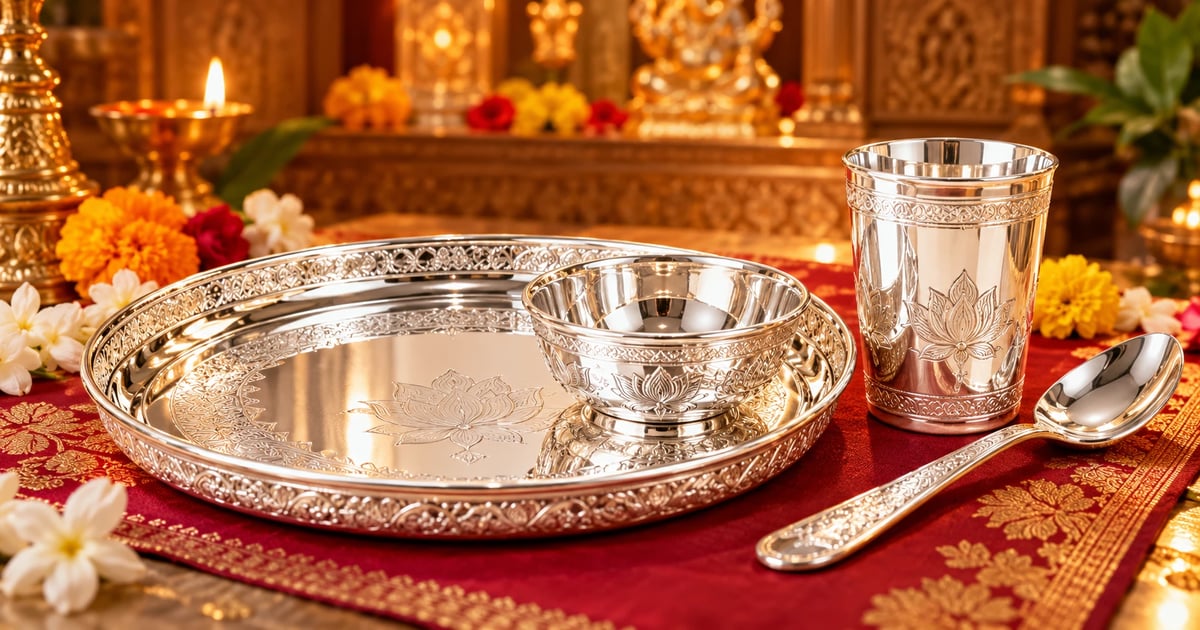
Most home mandirs need just four silver pooja items: a thali, a bati (bowl), a glass and a small spoon. With these, you can do daily puja, offer bhog and give achamani water.
Each piece is priced as net weight × silver rate, plus making charges and 3% GST. On 4 October 2026, our rate for 92.5% silver was ₹222 per gram.
This guide is for families setting up a small mandir or buying for Dhanteras. It also shows how to check purity, so you never pay silver prices for German silver.
Which silver pooja items does a home mandir really need?
A thali, a bati, a glass and a spoon cover daily worship in most homes. That's the whole silver pooja items list you need to begin. Other silver puja items for home can wait. Is your mandir a wall shelf or a corner unit? Four small pieces look neat and leave room for the idol and diya.
Measure the shelf before you shop. Then pick a thali that leaves a little space on every side.
Silver pooja thali: the base of the set
The silver pooja thali holds flowers, sandalwood paste, rice and the diya during puja. It's usually the heaviest and most expensive piece. In our range, thalis start near 19 g and go past 400 g. On 4 October 2026, they were listed from about ₹7,600 to ₹2,04,000.
Choose by shelf size first. A light thali under 30 g suits a small apartment mandir. A heavier one sits flatter and handles daily use better. For a mid-weight option, see the Lotus Frame silver thala at 134.77 g, or browse all silver thalis.
Silver bati for bhog and prasad
A small silver bati, or silver prasad bowl, holds naivedya (food offered to the deity), sweets or kheer. Many families keep two: one for bhog and one for water or milk. A 13 to 20 g bowl suits a small offering of sweets.
The Floral Rim silver bati weighs 53.58 g and suits larger offerings. Our full silver bati range runs from about 13 g to 59 g.
Silver glass for the water offering
A silver glass holds the water you offer or sprinkle during puja. In South India, the same role goes to a silver panchpatra, a small water vessel paired with a spoon. A plain glass does the job just as well on a small shelf.
Our silver glasses range from about 15 g to 90 g. The Floral Glow silver glass is one of the heavier ones, at 88.09 g.
Silver spoon for achamani
The spoon is used for achamani, sipping a little water before puja. It also serves panchamrit or holy water to family members. Spoons are the cheapest piece, so they're a good first purchase.
Try the Floral Path silver spoon at 20.79 g, or see every silver spoon we list.
Items families often add to the mandir later
Most families add a diya, a kalash, a ghanti (bell), an agarbatti stand or a kumkum box over the years. None of these is needed on day one. A brass diya and a steel kalash work perfectly well until you're ready to upgrade.
These pieces aren't part of our current silver range. Start small, and add one piece each Dhanteras if you like.
How are silver pooja items priced?
Every silver pooja item is priced with one formula. Price = (net weight × silver rate) + making charges + 3% GST.
Making charges pay for the craft: shaping, carving and finishing. On our product pages, making is shown as a percentage of the metal value. It ranged from about 14% to 150% across our pooja pieces on 4 October 2026.
Here's the real breakup for our Floral Glow silver glass, using that day's rate.
Step | Calculation | Amount |
|---|---|---|
Metal value | 88.09 g × ₹222 | ₹19,556 |
Making charges | 120% of metal value | ₹23,467 |
Subtotal | Metal + making | ₹43,023 |
GST | 3% of subtotal | ₹1,291 |
Final price | Subtotal + GST | ₹44,314 |
So making can cost more than the silver itself on a carved piece. That's why two bowls of the same weight can differ in price by almost double. If budget matters more than carving, pick a plainer design.
Silver rates move every day, so this exact total will change. The formula won't. You can check today's rate on our gold and silver rate page.
Price guide: what each piece costs by weight
Here are our silver pooja items with price ranges by weight, as listed on 4 October 2026. Treat it as a guide, not a quote.
Item | Weights in our range | Metal value at ₹222/g | Listed prices (4 Oct 2026) |
|---|---|---|---|
Silver thali | about 19 g to 408 g | ₹4,194 to ₹90,620 | ₹7,573 to ₹2,03,946 |
Silver bati | about 13 g to 59 g | ₹2,875 to ₹13,016 | ₹3,998 to ₹31,505 |
Silver glass | about 15 g to 90 g | ₹3,261 to ₹19,996 | ₹7,913 to ₹44,314 |
Silver spoon | about 9 g to 21 g | ₹2,002 to ₹4,653 | ₹2,411 to ₹7,013 |
All four items above are 92.5% silver. Listed prices include making charges and 3% GST.
Can you build a silver pooja set under ₹25,000?
Yes, a small silver pooja set for an apartment mandir fits that budget. Pick light, simply finished pieces. On 4 October 2026, a four-piece set from our range came to about ₹22,000. It combined a 23 g thali, 13 g bati, 25 g glass and 9 g spoon. That's roughly 70 g in all.
A carved 135 g thali alone costs far more. So for a set under ₹25,000, keep each piece small and the design simple.
Should pooja items be 925 or 999 silver?
For pooja items handled every day, 925 silver is usually the practical choice. It's 92.5% silver mixed with a little copper for strength. That makes it stiffer and less likely to dent.
999 silver (fine silver) is 99.9% pure. It's softer, so thin plates and bowls bend more easily. On the other hand, it tarnishes a little more slowly because it holds less copper.
There's no rule that pooja items must be 999. If your family wants pure silver pooja items in 999, ask for them, but expect thicker, heavier pieces. Our pooja range is listed at 92.5% purity. Our metal guide and our 925 vs pure silver guide explain the grades in more detail.
Is German silver real silver? How to spot fakes
No. German silver, also called nickel silver or alpaca, contains no silver at all. A US General Services Administration preservation guide describes it as a copper-nickel-zinc alloy.
It looks silvery and takes a high polish, which is why it's sold as cheap "silver" puja articles. Silver-plated items are different again. They have a base metal underneath and a thin silver coat that wears through with scrubbing.
Watch for these signs before you pay a silver price:
The price is far below net weight × the day's silver rate.
The bill says "German silver", "alpaca", "plated" or "oxidised finish" instead of a purity.
There's no purity stamp, and the seller won't write purity on the bill.
Don't rely on a magnet. The same GSA guide lists nickel silver as non-magnetic, just like real silver. A jeweller with an XRF machine (a non-destructive purity tester) can give you a far better answer.
Net weight vs gross weight: which one you pay for
You should pay the silver rate on net weight only. Net weight is the silver alone. Gross weight includes anything else attached, such as stones, lac filling or a wooden base.
On a plain silver thali or glass, the two numbers should match. For example, our Floral Glow glass lists both net and gross weight at 88.09 g. If the gap is large, ask what makes up the difference.
Are silver pooja items hallmarked? Checking the HUID
Some are, but not all, because silver hallmarking in India is still voluntary. Since 1 September 2025, any silver article that is hallmarked must carry a HUID. That's a six-character code laser-marked on the piece.
Vikaspedia's guide to silver hallmarking lists three marks on a hallmarked piece. They are the BIS mark with the word SILVER, a purity grade and the HUID. BIS recognises seven grades: 800, 835, 925, 958, 970, 990 and 999.
To check a piece, enter its HUID in the BIS CARE app. The government said at launch that the app shows the article type, purity grade and testing centre.
As of 4 October 2026, we found no official notice making it mandatory. In June 2026, the BIS Director General said BIS will move to mandatory silver hallmarking gradually, without giving a date.
Before buying, ask the jeweller, including us, whether that exact piece carries a HUID. Our FAQ page covers other buying questions.
What to buy for Dhanteras and Lakshmi Puja 2026
Dhanteras falls on Friday, 6 November 2026, and Diwali Lakshmi Puja on Sunday, 8 November. In Bengal, 8 November is also Kali Puja night. Kojagari Lakshmi Puja, the Bengali Lakshmi Puja, comes earlier on Sharad Purnima.
A single silver piece is a complete Dhanteras purchase. A spoon or a small bati is plenty if the budget is tight. If you already have the four basics, add a second bati or upgrade the thali.
Some families also buy a gold coin to place in the mandir for Lakshmi Puja. Our Lakshmi gold coin is one option. The gold gini coin is a plainer choice. You can estimate either price with our gold price calculator.
Shops get busy in Dhanteras week. Decide your budget and weight beforehand, and still check the bill for net weight and purity.
Can one silver set serve prasad, annaprashan and guests?
Yes. A solid silver thali, bati, glass and spoon work for prasad, an annaprashan (a baby's first rice) and serving guests. Many families keep the mandir set for puja and use a second set for meals.
Wash the pieces soon after food. Salt, lemon, pickle and egg speed up tarnish if left sitting.
Choosing silver pooja items for a housewarming gift
For silver pooja items as a gift, a glass and spoon pair or a single bati works well. Every new home can use them, and they don't take over a small mandir. Pair a 13 to 20 g bati with a 9 to 12 g spoon for a modest budget.
If you buy from us, the person receiving it can exchange it later without you. No bill or HUID is needed, and there's no time limit. Making charges and GST are deducted at exchange.
For a personal gift instead of a household one, a gold locket also works. Our guide to Surya locket designs covers one popular style. For couples, see our wedding gift ideas in gold and silver.
How to clean blackened silver pooja items at home
Tarnish is a thin dark layer that forms when silver reacts with sulphur in the air. It's normal and comes off.
Wash the piece in warm water with a few drops of mild dishwashing liquid.
Rub gently with a soft cotton cloth or a soft toothbrush on carved areas.
For stubborn black patches, use a silver polishing cloth.
Rinse, then dry completely before putting it back.
Skip steel wool, scouring powder and toothpaste. They scratch the surface. Also avoid dip cleaners on carved pieces, since they can strip the darker shading that makes the design stand out.
To slow tarnish, store pieces in a zip bag or anti-tarnish cloth. Keep rubber bands away, because rubber contains sulphur.
Do silver pooja items keep their resale value?
The silver keeps its value, but making charges and GST don't come back. When you sell or exchange, a jeweller pays on the silver content at that day's rate.
That's the honest trade-off with ornate pieces. The carving costs real money, and you won't recover it. If resale matters to you, choose plainer, heavier items. If you're buying for daily worship, pick the design you'll enjoy using.
For more on buying silver, see our silver buying guides, which include silver rakhi gift ideas. You can also browse our full silver items collection.